
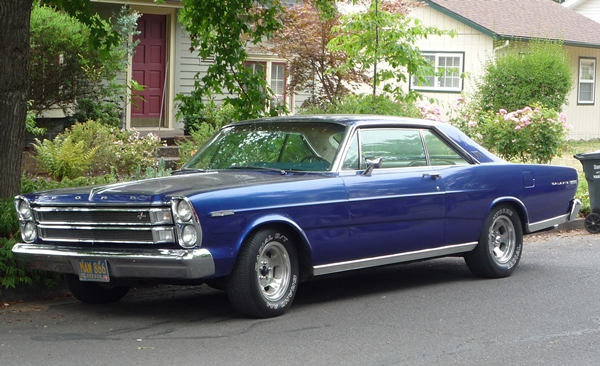
(first posted in 2011) The sixties, that golden decade of American performance cars, had two very distinct eras. The first half was dominated by the full-size bombers with their ever-larger big block V8s sporting dual quad or triple deuce carbs. Think Impala 348/409, the wild cross-ram Chrysler 413 and wedge 426, Pontiac’s 421 HO, and Ford’s specialized 406/427, which powered the Blue Oval to enduring glory, even at LeMans.

These over-sized sleds were the terror of the drag strips, NASCAR, and Main Street on Saturday night, duking it out for the glory of their respective makers, with the hope of more sales on Monday morning.
But with the arrival of the mid-size GTO and the compact Mustang in 1964, the full-sized performance cars became doomed dinosaurs almost overnight. Yes, the big hairy engines were still available in some of them (for a price), but why bother when a dirt-cheap 327 Chevy II had a better power-to-weight ratio? So the Big Three tried something else to prop up sales of the profitable mega-sized rods, like this 7 Litre Galaxie. In the case of the Ford at least, the tip-off is the 7 Litre badge.
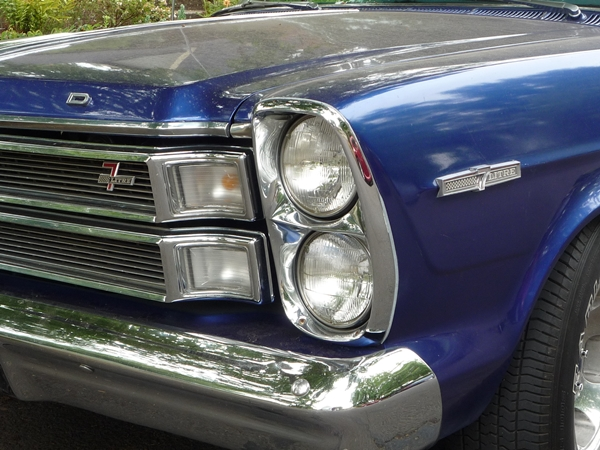
The space where Ford’s vaunted “427” badges once sat proudly on the front fenders of Galaxies is now blank sheet metal, replaced by the prominent “7 Litre” badges on the grill and the fender spear. That’s because a 428 has taken its place. So what’s a measly cubic inch among friends? (three, strictly speaking, since the 427 actually displaced 425 cubic inches). Whereas the 406 and 427 were specially developed racing motors, with unique blocks, cross-bolted mains, and other forged performance goodies, the new for ’66 428 was just a bored and stroked 390 in mild tune, shared with the T-Bird, and available across the board. It was rated at a modest 345 (gross) hp, compared to the 410 (single quad) and 425 hp (dual quads) that the 427 belted out at much higher revs thanks to a woolly cam, solid lifters and heads that hyperventilated. These heads were of course the most critical component, and they trace their origins back to the 350hp 352 FE that came out in 1960 for the benefit of NASCAR racers, and was followed up by the 375/401hp 390 Super Thunderbird V8s in 1961. Ford was quite capable of building serious performance engines, but not in having them find their way into the mass market, unlike Chevrolet and even Chrysler, to a somewhat lesser extent.

Since the NASCAR racers switched to mid-sized cars in ’66, the Fairlane was now the primary beneficiary of the 427, and although a very wicked machine indeed, it never sold in any significant numbers compared to the Chrysler and GM intermediate muscle cars. It was too expensive, and lacked low-speed torque and tractability on the street. The 428 meanwhile was cheap and expedient. And it was perfectly happy (happiest?) schlepping a fully-loaded Country Squire with an automatic, A/C and power steering. The 427, which one could still order in 1966, was not available with the automatic, power steering, A/C and even the power assist for the disc brakes. Woolly indeed!
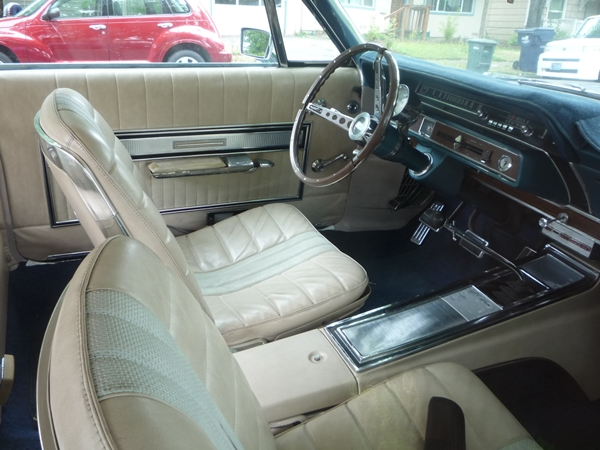
Well, those macho days were over, except for the exactly thirty-eight buyers that insisted on a genuine 427 in their 1966 7 Litre. One hopes that Ford checked their arm and leg muscles before they turned over the keys to them. That’s not to say that the 428 powered 7 Litres were a smash sales success by any means either: barely 11k sold that year. By 1967, it was just a trim/engine package available on the Galaxie XL, rather than a distinct model. And by 1969, it was history (as was the very short-lived 428, replaced by the all-new “385” 429 engine).
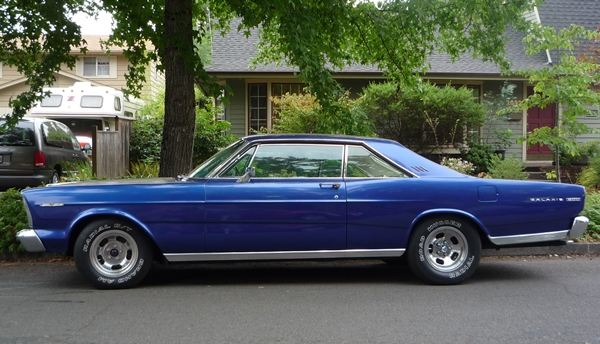
It was all a bit confusing for me as a kid, especially since in the mid-sixties Ford made distinct V8s in 427, 428, 429 and 430 cubic inch sizes. It must have been Ford’s way of trying to keep up with GM, whose divisions still proudly flaunted unique engines (mostly). Admittedly, the 427 was in the same FE engine family as the 428 and 390, and looked similar from the outside, but was a totally different animal otherwise. The 430 was the old MEL engine, and the new 429 replaced them all. But not before Ford heavily revised the 428 for its final three-year outing in ’68 as the Cobra Jet, sporting a low-balled 335 hp rating for insurance purposes.
 Shelby 427
The 7-Litre wasn’t the only car that had its 427 replaced by the 428. The legendary Shelby Cobra 427 started out with a full-on side-oiler 427, but because the whole 427 Cobra program was a financial disaster, many of them actually were built with the much cheaper 428. And, no, they weren’t rebadged “7-Litre” or “428″. Shelby wasn’t/isn’t exactly famous for a propensity towards full disclosure.
 Shelby 428
Hemmings has a write-up on the 7-Litre here, and a more detailed comparison of the two engines here, but here’s a few highlights: the mildly tuned 428 developed its maximum power at a diesel-like 4600 rpm. And its healthy 462 lb.ft. of torque was all there by 2800 rpm. Whether it even made its rated horse power is suspect: John Smith, author of Super ’60s Fords: “The carb is way too small, they are severely under-cammed, and the exhaust system is incredibly restrictive. Even though they were rated by the factory at 345hp, I’d be very surprised if the actual output was more than 275hp.”
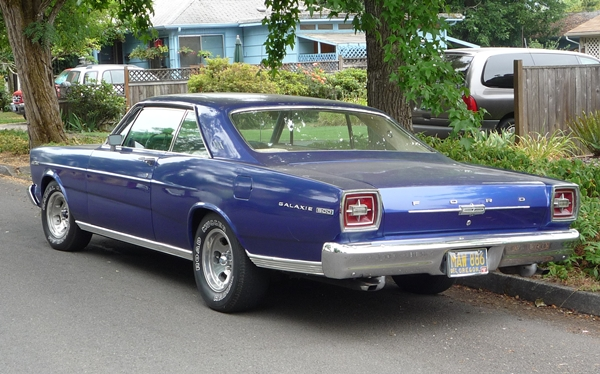
So how does a 7-Litre run? About 8.8 seconds to sixty, and 15.2 in the quarter. Modest for the times, and econo-box stats nowadays. The big Ford was a cruiser; but not a performance car. All of GM’s big blocks of the times had higher power ratings, and could back them up. You wouldn’t want to goad a big Buick, Olds or Pontiac with your 7-Litre, never mind a 427 powered Impala.
The FEs made great truck motors, having spent parts of my youth trying to kill more than one in some pretty large trucks. And great engines for hauling big cars and wagons around. It’s just that they were outclassed by the deeper-breathing Mopars and Chevy, in the streetable versions anyway. But what about the rest of this beefy Galaxie 500?
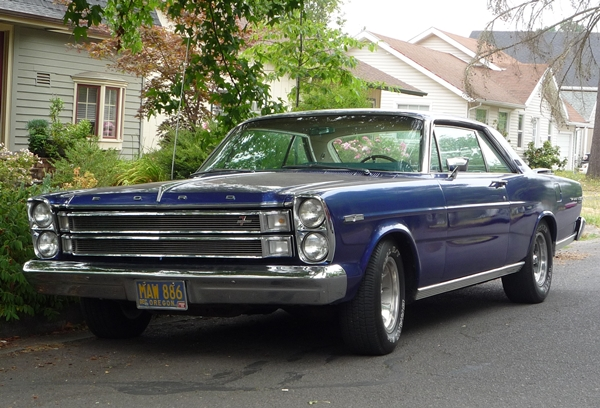
Well, I happen to have a November 1965 Popular Science from my subscription as a kid in front of me, which has a comparison test of the ’66 Galaxie, Impala and Fury III by Jan Norbye. He refused to pick an overall winner, and in fact, said that he would prefer an intermediate sized car if he was buying. The vagueness of the power steering, the soft handling and touchy power brakes was an issue with all of them. But he had a particular dislike of the Galaxie’s front end: “Ford’s front suspension will not let the car stay on its intended line on a fast turn or if the road is bumpy. The steering angles change too much on spring deflection; incessant steering corrections are needed to keep the car on its line”. But, yes, the Ford was the quietest if the bunch, reflecting the priorities of the times.
The PS tester had the 315hp 390, and it pulled a 9.2 in the 0-60 and trundled through the quarter mile in eighteen seconds. The 396 Impala handily creamed it; and in the transmission department, the Ford Cruise-O-Matic came in last too, especially against the new Turbo-Hydramatic. Contrary to all the myth about Chryslers handling better back then, the Fury’s newly-softened suspension for ’66 actually tended towards oversteer (!), and the Chevy was deemed the best handling of the bunch. Brakes? At least Ford and Plymouth offered discs on the front, which were standard on the 7-Litre.
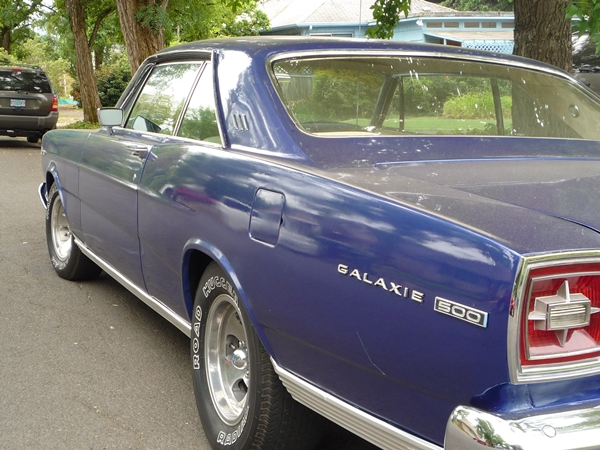
Here is Norbye’s take on the marshmallow handling and numb power steering of the times: “I like to get an indication of the forces acting on the car through the controls, and I’m not satisfied with the “dead” feel of all of these cars’ systems. The engineering problems of making power steering with proportional assist (Mercedes, etc.) were licked long ago, but the industry seems to have forgotten. When reminded, they talk lamely about some ladies’ complaints about hard steering…The automakers mistrust you, underestimate you, and give you their idea of a fool-proof car. But control systems that are more alive would put the driver in better command – and make him a safer driver” Norbye actually recommended buying these cars with manual steering and unassisted brakes “if you’re slightly fanatical about your driving”.
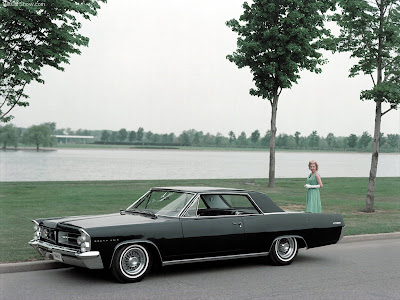
Styling? I was not a big fan of Ford’s attempt to ape the ’63 Pontiac with their re-styled 1965/1966 cars. But there’s an undeniable husky charm about this particular big coupe. Its angularity is quite a contrast to GM’s coke-bottle curvaceousness, but that actually seems to work in the 7-Litre’s favor. By 1967, Ford was (again) chasing GM’s softer lines, and any pretense of true performance, even appearance wise, just wasn’t coming through. It was the era of the LTD (CC here); big performance cars were finished. So as a visual testament to the end of that era, this big Ford carries it off quite well.
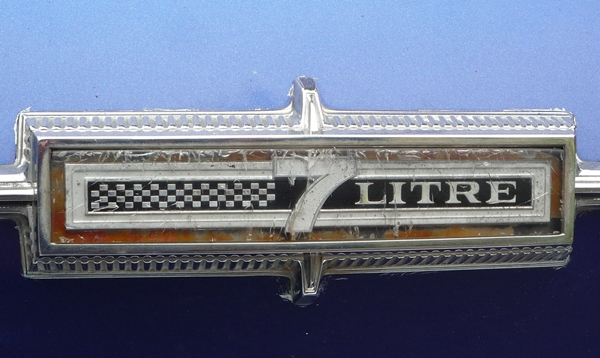
And your neighbors were quite unlikely to know the difference between a 427 and a 428 anyway. And they certainly would have been more impressed if it was an LTD.
Related reading:
Automotive History: The Ford FE Series V8 Engine J. Shafer
Vintage Review: Popular Science Compares the new 1966 Big Cars – Ford, Plymouth, Chevrolet


I have a soft spot for the ’66 Ford. My Dad had a ’66 Country Squire. I know, kind of the polar opposite of this big Ford.
I realize that this was the worst handling of the big 3 and had the slowest accelleration, but what a great car for a 4 speed – an endless fountain of torque.
Another thing that has always struck me as interesting about these is that Ford changed the roofline every year from 1965 through 1968 on the 2 door hardtops. I always liked the ’66 version with the sway in the C pillar. A great car.
Definitely agree with you about the lines of the ’66 2 dr ht, it’s just a gorgeous design from every angle.
BTW Paul, I had a Q-code ’67 T-bird with the CobraJet 428, so they must have offered the CJ starting sometime in ’67, at least in some models. Don’t know if the Galaxy was available with it that year or not though…
But that T-bird was amazingly strong; I used it to tow a 26′ Shasta camper (also a ’67 :)) from Los Angeles to PA back in ’92.
The handling was horrible, of course — even with an equalizer hitch. The Shasta was quite toungue-heavy.
But the power of that 428 was just astonishing. At one point I hit 90 MPH on a straight stretch of I-40 in NM, and it definitely would have gone faster but 90 was scary enough. That car really was all ate up with motor. 😀
Averaged 6 MPG on that trip.
My FE nerd is coming out…a Q-code Tbird had a normal 428, not a CJ. The CJ came out mid-year 1968 and was never installed in full size cars or Tbirds. The difference between the two was substantial with the heads, intake, carburator, cam, pistons, etc all being different. The big step forward were the heads, cam and exhaust manifolds on a CJ that let it breath above truck rpm levels.
I had the original factory paperwork, and it was definitely a 428 CJ according to Ford.
Thanks for the compliment on my car! This is a link to a Ford press release announcing the new 1968 1/2 428 Cobra Jet engine package. These were initially intstalled in Mustangs and Fairlanes; later in Cougars, Rancheros, Montegos, and other intermidiates. There is quite a bit of official Ford Co. documentation out there on the CJ since they are so collectable now. They were not ever installed in full size cars, tbirds or trucks.
http://www.428cobrajet.org/images/cjpr1.jpg
I inherited a ’66 7 Litre from my uncle. Beautiful white with red interior. I had it for over 20 years then sold it to a collector in New Zealand. All I ever did to that car was to put Flowmaster mufflers on it. I did have to replace the cam and lifters after I had a lifter collapse 350 miles from home an had to drive it home with the dang thing clacking all the way.
The 428CJ was never available in a Thunderbird. Just the standard 345hp unit.
Imagine this car in Candy Apple red/ red original interior and paint and that’s what I recently purchased with 49909 miles. I want to take it back to this shape and my partner my cousin wants to leave it in the original patina. What do you folks think? Thank You Robbie
Restore it. That’s my vote. To me, “patina” is what that car would have looked like decaying in the ghetto in the 1970’s.
I’m Chris from New Jersey by cranberry nj back in 1988 or 89 my dad John stiener sold his blue 1965 ford Galaxy 390 cop motor 2door if anyone know of this car please call me 7326262311 tk you
Nice piece on the 7-Litre and nice job getting the engine facts straight. I have owned a 1965 Galaxie 500 for the past decade or so and am now a well versed nerd for these cars and FE engines, but I do remember not understanding how all of these very similar engines were or were not related. Your are right about the steering and handling. I have upgraded the suspension, wheels and tires and adjusted the ride height so that my car rides solidly and tracks well, but they are not much good as a drivers car the way they arrived from Ford.
[img]http://www.supermotors.net/getfile/887761/fullsize/_dsc0178_2250.jpg[/img]
That is one awesome ride! Love the dog dish hubcaps, so glad you didn’t go with chrome wheels.
That location looks mighty familiar — is that a grass strip airport in GA or AL, perhaps?
Thanks! It’s a fun and reliable daily driver/road tripper. The location is Raccoon Mountain hydroelectric plant in Tennessee. I’m still struggling to get a pic posted…let’s see here…
Nice car, Jason. I like the dark color and the dog dish hubcaps. My first car was a ’67 Galaxie 500 convertible with the 2 bbl 390. One of my first CC pieces was on a 67 LTD, and I am still fond of this whole Ford series. You are lucky down south – the frames all rotted away up here.
Thanks, knew I’d been there just couldn’t place it. I’ve been so many places now, at my age the mind just mixes them up sometimes.
I blew up that pic to a larger size and added it to my collection. Yours is definitely my favorite Galaxy ever. 🙂
Oh my god, I love it… if I had one of these, plus the time and money, I’d do exactly the same thing.
Looking at that roofline now, I’d bet this car was designed by Elwood Engel before he left Ford for Chrysler.
I inherited a ’66 7 Litre from my uncle. Beautiful white with red interior. I had it for over 20 years then sold it to a collector in New Zealand. All I ever did to that car was to put Flowmaster mufflers on it. I did have to replace the cam and lifters after I had a lifter collapse 350 miles from home an had to drive it home with the dang thing clacking all the way.
How about some details on exactly what you did to the suspension? I’m a mite curious.
On the front I used springs about 30% stiffer, and cut a coil to lower the front of the car about 3″. All new bushings, ball joints, tie rod ends, etc. I added a 1 3/8″ sway bar from a 1978 Tbird with polyurethane bushings. On the rear I boxed the control arms used stock springs cut 1.5 coils to bring the rear down and then added air shocks to add load carrying capacity and stiffen up the rear. The next upgrade is a faster ratio power steering box that will have higher effort as well, to get rid of the overboosted feeling.
About the ONLY Fords I liked in the 1960’s were the Galaxies – 1965 & 66. 2 dr. hardtop, please. I liked them probably due to the fact that a certain blonde I chased around Yuba City when in the air force drove a white 1965! I met the beautiful blonde I married several years later back home, but I digress…!
For the life of me, I don’t recall ever seeing one of these, as Fords weren’t on my radar. Galaxie 500’s. yes, but too many Chevelle Malibu SS 396’s, Camaro Z-28’s, Impala SS’s, Nova SS’s running around with the occasional Corvette, GTO, Judge, GS and 442 to mess with Ford!
The example above looks rather special, though.
The trouble with me, though, is if I had the resources to buy any of them, I doubt I would due to fuel economy, my avatar excepted – it was a 283 2 bbl powerglide, which didn’t suck gas (too badly). I was too cheap for my own good, but what difference did it make back then? The cars were beautiful whether they had a six-cylinder or a fire-breathing V8? I’m still cheap…
I remember seeing a few of these, but they always confused me. I understood Galaxie 500, and I understood that Galaxie 500 XL was the sporty one with the bucket seats and console. This 7 Litre – what was/is it? It seems to have been an XL clone restricted to a single engine and with all the XL trim but without the XL badging. For example, this car carries the grille that was also on the LTD, the Country Squire and the XL, and not the grille from the regular Galaxie 500.
Also, as a midwestern kid, the metric reference confused me terribly. Just what the heck was a litre? And how much was 7 of them? Sales figures would suggest that I was not alone.
Yeah, JP, what was a “liter”? or was it “litre”? Some fancy European stuff that meant nothing to me at the time. Now I use both systems, so I’m getting good at it!
To sum me up, the story on the white six-cylinder Camaro on this site, I would kill to have that car – with that drivetrain! I’m a poser and doggone proud of it! I identify with the “Fernando” character on SNL – “it’s how you look”!
Thing is, now days, I’d have a recent Impala SS if my commute was close by!
Hadn’t noticed the ‘proper’ spelling on the badge!
Ford did the same here – changed to metric engine sizes in ’68, then later back to cubic inches before going to metric again when the whole industry (& country) changed.
Just bad marketing strategy I guess, but detroit has always needed to play the name game. In reality the XL was always pretty much appearance-only and could be had with a 289 and drum brakes. The 7 Litre could only be had the top-level hardware they had to offer with the 428 4V, 4 piston disc brakes, etc. It was another case of a new name for the highest trim level pushing last year’s down the list to second. Mostly it seams that it was the answer to a question that no one was asking.
Ah. I know about these Fords; only because we had two 1968s. One a company car for my old man; the other to replace our Compact-Car-From-Hell, a Rambler. And just for replacing that obscenity, my parents loved it dearly.
In the 1960s, makers were just coming off the mindset of one-car, names denoting trim. Of course by that time we’d arrived at a panoply of choices: full-size, compact, “sporty,” intermediate. But old habits die hard; makers’ as well as buyers’.
The full-size Ford line was all the same car – names denoted trim levels. There was the Custom, which was the Building Inspector Special…government motor-pool cars. Then the Custom 500, for Grandpa to save a few bucks with. Those were denuded of chrome, with painted window-frames; vinyl seats, rubber-covered floors.
Then there was the Galaxie or Galaxie 500…the two were never sold side-by-side; the “500” was name-inflation. That was, from 1962 on, the primo full-size trim level. In 1965 or ’66, the XL was added as a sub-model; and in 1966 the LTD debuted – also a subseries.
(For what it’s worth, LTD was never sold as meaning “Limited” – that name was owned by Buick in those days.)
In 1967 the LTD became the flagship; the Galaxie 500 moved down a step, and the Custom sans 500 disappeared. And in 1968 and every year thereafter, the LTD got a distinctive grille – with hidden headlights, no less. Seems ludicrous now; but on the 1968 it worked very well, complementing the narrow-height grill and avoiding obvious seams in painted surfaces.
(Correction: The 1966 offered different grilles based on trim levels. Unsure of the 1967s…strange how I never noticed that until today…)
The Custom 500 disappeared after 1972; and the Galaxie after 1978. From then on, the LTD was the big barge…until the Crown Victoria moniker was resurrected and “LTD” put out to the graveyard of forgotten names.
But anyway, there it is. Chevy did much the same with their 150/210/Biscayne/Bel Air/Impala/Caprice.
Re: The Chevy lines:
Up thru ’57 it was 150/210/BelAir
’58 it was Delray/Biscayne/BelAir/Impala (subset of BelAir)
’59 on it was Biscayne/BelAir/Impala (add Caprice on top in ’65, I believe Biscayne disappeared shortly afterwards).
The Biscayne lasted until 1972. It was dropped at the same time Ford dropped its equivalent, the base Custom. The BelAir lasted until 1975 (also dropped at the same time as its Ford counterpart, at least on an “available to the public” basis). The last year for the original Impala was 1985. At that point only the Caprice remained.
IINM, the Biscayne and BelAir actually lasted longer in Canada than in U.S. — someone from north of the border may have more details about that. I vividly remember seeing a post-1977-bodied BelAir sedan with Quebec plates while vacationing at Hampton Beach, N.H. when I was a kid.
Plymouth’s 1965 Fury I/Fury II/Fury III lineup corresponded to the three Chevy and Ford trim levels that existed prior to the introduction of the Caprice and LTD. The VIP and Gran Fury were Plymouth’s later attempts to compete with those upper-crust models. The I/II/III lineup lasted until 1974. In 1975, the Fury name was moved to the intermediate B-body, and all of the full-size C-body models became Gran Furys.
The 67 did indeed have different grilles – LTD (and probably XL) got a better grille than the Galaxie 500 and everything below it. However, the different 67 grilles were probably closer to one another than in the other years.
As for the transition from 67 to 68, it always amazed me how smoothly they went from a design with stacked headlights to the lower front end with horizontal headlights, and they both looked like they belonged, both basically bolted up to the same car.
Ford actually sold cars called “Galaxie” and “Galaxie 500” side-by-side for two years, in 1962 and 1963. From the time the Galaxie was introduced in 1959 up through 1961, there was only a “Galaxie”, no 500. When the Fairlane was downsized into the new intermediate class for 1962, the Galaxie name was moved down to the range formerly occupied by the Fairlane 500, and what had been the Galaxie became the Galaxie 500 (so the point about the Galaxie 500 name being just “name-inflation” is well taken). For 1964, the range represented by the 1962-63 base Galaxie was taken over by the new Custom 500. From that point on, the Galaxie 500 was the only car bearing the Galaxie name.
The base Custom actually lasted until 1972. The Custom 500 continued until 1975, and even lasted a few years beyond that as a fleet-only model, until 1978. The Galaxie 500 name was last used in 1974, although it was really absorbed into the LTD line, not dropped outright. Until the early ’80s, there were clear styling distinctions between the lower-line and upper-line LTDs; the lower-line models corresponded to the old Galaxie 500 (and competed directly with the Chevrolet Impala), while the upper-line models corresponded to the pre-1974 LTD (and competed directly with the Chevrolet Caprice).
The Crown Victoria name reappeared in 1980 as the subseries name for the upper-level LTD (in other words, the “real”, pre-1974 LTD). In 1983, Ford moved the LTD name onto a smaller Fox-platform sedan, intended to serve as its midsize model. At that point, the “LTD Crown Victoria” name was applied to all of the full-size models; it was also around this time that any real styling distinction between what had been the Galaxie 500 and what had been the pre-1974 LTD disappeared. The midsize LTD was dropped after 1986, replaced by the Taurus, but the larger sedan continued to be called the LTD Crown Victoria until it was restyled in the early ’90s. At that point, the LTD prefix was finally retired, and it became simply the “Crown Victoria”.
Actually, the Galaxie 500 XL debuted in mid-1962 as the sporty buckets/console job. That same year with the Fairlane moving to the new midsized car, all full-sized Fords were Galaxies with the plain Galaxie an equivalent to the Chevy Bel Air and the Galaxie 500 the top of the line and equivalent to Chevy’s Impala followed by the sportier 500 XL. For 1963, the base level Ford 300 was introduced as the fleet car to compete with Chevy’s Biscayne while the base Galaxie, 500 and 500 XL continued – at mid-year the formal hardtop coupes in the Galaxie 500 and XL series were replaced by new Sportsroof fastbacks.
For 1964, the 300 became the Custom and the base Galaxie became the Custom 500 with the Galaxie 500 and XL continuing at the top of the line.
In 1963 and 1964, the sporty XL series included a hardtop coupe, convertible and a 4-door hardtop sedan – all with bucket seats and console – probably the first U.S. built bucket-seat 4-door sedan some 10 years before the 1973 Pontiac Grand Am and Olds Cutlass Salon were promoted as “Eurostyle” luxury/sport sedans.
For 1965, 500 XL sedan was dropped leaving the coupe and ragtop. Replacing the XL sedan was the new Galaxie 500 LTD hardtop sedan (also offered as a hardtop coupe) which had luxurious bench seat interiors and other trim – it sold over 100,000 units c9mpared to “only” 14,000 1964 Galaxie 500 XL sedans.
For 1966, the LTD became its own series and the Galaxie 500 XL was joined by the Galaxie 7-Litre in the same bodystyles (hardtop and convertible) and even used the XL’s buckets and console interior – the 7-Litre was largely an “option-model” with the new 428 cid V8 and front disc brakes standard – along with the Cruise-O-Matic tranmission also standard on XLs and LTDs.
For 1967, the 7-Litre went from a separate model to a mere option package on the Ford XL (no longer badged as a Galaxie 500 sub-series) that included the 428, disc breaks and other items from the ’66 7-Litre.
For 1968, the base LTD was downgraded a bit with somewhat cheaper interior trim and a standard 3-speed manual transmission with Cruise-O-Matic moved to the option list – and to get the luxurious interior comparable to the 65-67 LTD required ordering the optional Brougham package. XLs were downgraded even more from a standard V8 and Cruise-O-Matic to a 6-cylinder and 3-speed manual transmission – also the bucket seats and console became an extra-cost option with an all-vinyl bench seat now standard – XLs and LTDs did get hidden headlights for ’68 while Galaxie 500, Custom 500 and Custom got horizontal exposed headlights replacing the verticals of previous years.,
The sporty XL lingered on through 1970 with a fastback roofline on coupes (and the only full-sized convertible for ’70) plus LTD front ends with hidden headlights. The base Ford Custom lasted through the 1972 model year and then was dropped with the Galaxie 500 bowing out after 1974 and the Custom 500 after 1977.
Beautiful, what a beast! Plus, this one seems to be in great condition. How many of these can be left?
This is the model that amazed the English by beind able to beat a Ford Cortina on a track, yep 7 litres of Galaxy could out run a 4 banger. I found several of these in a junkyard in western Sydney but they werent lost or for sale,
The handling of these cars was truly awful. I remember driving one on a highway trip, I think it was a 1968, and it was all over the road. It had just had the entire front end rebuilt, too. Constant steering corrections, smallest bump would send you in another direction, heavy dive with any braking, it is astounding that these things got out of the factory. The GM and Chrysler stuff of the era was way better.
I was never a Ford fan of anything of this era and I have spent wheel time with it all. The Ford stuff just had too many cheap details like awful brakes, fuel economy and handling.
I love old cars but as daily drivers, no thank you. The thing I really like about my Acura is you can point it at something, gun it and it won’t deviate one centimetre from where you want to go. You hear that control arm suspension going up and down and the body is like a brick it is so stiff. You don’t get that from old cars. They are better left for the Sunday cruise.
I wonder if they also replaced the bushings when they did the front end. A lot of people forget and they are the most important parts. All the new ball joints and tie rods in the world won’t help otherwise. Especially these, since they were soft to begin with and got worse from there.
The big Fords did have softer suspensions…they were tuned for ride, as opposed to handling. Interestingly, Chrysler followed Ford’s lead in this area, attempting to soften the torsion-bar suspension for a smoother ride.
I do recall, however, that magazines praised Ford’s brakes in the 1960s, particularly the disc brake option that was available from 1965 on the Mustang, and from 1966 on other Ford cars. Ford also made disc brakes standard on the 1965 Thunderbird and Lincoln Continental.
In the 1960s, I would have taken a Ford (or a Plymouth) over a Chevrolet. GM’s strength, however, was that moving up the Sloan ladder really did get you a better car, whereas a Mercury was just a Ford with a different grille (same thing for a Dodge versus a Plymouth). My parents’ 1967 Oldsmobile Delmont 88 Holiday sedan was a HUGE step up from their 1965 Chevrolet Bel Air station wagon (which, truth be told, was a piece of junk).
Interesting fact: NASCAR builders used the revised 1965 Galaxie front suspension in all Fords and most GM/Chrysler race cars up into the 1980s. This is similar to how they used the GM truck-arm suspension on the rear. They still use a fabricated/custom version of the truck-arm to this day.
The real problem with these cars was the overboosted steering, soft springs/shocks/bushings and the 0-degrees caster that were called for—all in the name of one finger steering effort and pillow like ride. The bones are OK for their era, but the tuning was for a mythical church lady that pretty much all us automakes thought were buying their normal cars (i.e. non sporting cars).
No wonder americans fell for the foreign cars after the anesthetized experience they got from these cars when new.
LOL, did they rebuild the steering too? All the ball joints and c/a bushings in the world won’t matter squat otherwise. If it bump steered, the steering is junk. Probably was junk when new. They still make them like that, even in new cars (occasionally).
Not that it was going to be great even after rebuilt, just better (if they used the right parts this time).
Never having driven one of these, I can’t comment on the handling. But the interior reminds me of my grandmom’s ’64 Galaxie 500XL that I spent some time in as a small child (age 5-9). To a kid raised on George Jetson, the 500XL was the future come to life, and don’t distract me with any annoying facts about the steering and the suspension bushings!
To start the car, did Grandmom have to reach over the steering wheel with her left hand to pull the shift lever up while she turned the key with her right hand? That was alway the drill in almost every older 64 I ever saw, including my Uncle Bob’s. It had never been an issue in earlier years when the key was on the left side of the dash. Fortunately, Ford fixed that nasty neutral-start switch issue with the 65s.
And replaced it a brand-spanking new issue-Having the trans pop into reverse on it’s own while idling.
Yep. It was easy to think you were fully in “park” when you really weren’t. Vibration would then slip the lever into reverse and off it went.
This car has some rare options. The 5-light “Safety Convenience Panel”
panel under the dash is a system of warning lamps for low fuel, door ajar, etc and also has a control for the power door locks which were included in the option.
Also the AM-FM radio was none too common.
Yeah, it’s a damn shame someone outfitted such a nicely equipped car with white letter tires and mag wheels. Looks like crap with those, in my opinion.
Don’t know about the open road with these, but for sheer frustration you should have tried pushing around one of these (1968 model) with a straight 6, no power steering, no air, around the streets of Chicago for eight hours at a stretch…the last year Chicago bought squad cars without powering steering….long hot summer days and nights..
That’s gotta have been terrible, alfromchgo. My 1974 Ford Maverick was equipped that way, and it sucked. I can’t imagine how bad a Galaxie must have been, spec’d like that.
The CHP also didn’t have power steering on their 1967 Olds Delmont 88’s, although they did have the 375 H.P. 425 V-8, power disc brakes and A/C. That must have been a bear to drive in the city.
Had friends in the CHP, they hated the ’67 Olds, they would often set waiting on on-ramps for speeders, the 425’s would load up idling, when they punched it for pursuit, they stumbled around until the engine cleared out, which often meant the speeder was gone. The following years the ’68 and ’69 Dodge Polara’s had no problem and according to the local Commander of CHP, were the fastest CHP unit’s built. I bought a ’68, changed it to B 5 blue w/white vinyl lop, added power steering, added full ’65 Imperial wheel cover’s (they have cooling vent’s for the brakes) superb handling and high speed, a great car. BTW, drove my girlfriend’s parent’s 1965 white w/black vinyl top, fully loaded LTD coupe the first day they owned it, on a date (parents thought it safer than my Austin-Healey Sprite), that LTD brand new, was all over the road, it was beautiful, but dangerous, I usually drove fast, I was afraid to get over 40 mph in the LTD. Over the years I had a lot of Ford products, from about ’61-up, all the lines suspension got worse. I had a ’66 428 Tbird Landau, and a ’68 Thunder Jet 429 Tbird coupe (noticeably faster than the ’66) both had horrible suspension, they loved going in straight lines…even on corners. In a hard right corner, my ’66 Continental convert rolled the tire under, which collapsed the suspension. I liked that car, and found there was an ‘export’ suspension AND a ‘heavy duty export’ suspension available on all Ford products being exported. I did what Jason did to his ’65 coupe, but was lucky to order most parts through the Lincoln dealer, also put large anti-sway bar’s front and rear, all Ford products should drive the way it did then. Couple of years later did the suspension mod’s on a ’65 500 XL convert, triple white, 390. loaded, put Magnum 500 wheels on it, enjoyed that car several years/ Interesting thing, when Chrysler products made their suspension ‘plushbottom soft’, they still went around corners.
Interesting to see the point about 428’s going into Cobras, I had not heard that before
I never knew that these had such glaring handling issues in stock form. Anyway, I really have always loved how these looked. Really just a quintessential late ’60s American full-size. From every angle, it just looks right. Although I tend to be a stickler for “stock”, this one has a great look and stance with its period aluminium slots and raised white letter tires. Very nice!
My dad had a ’66 Galaxie 500 coupe when I was born, in pale yellow. He brought me home from the hospital in it. So I’ll always have a soft spot in my heart for these.
I bought a 66′ Galaxie 500 to start rebuilding with my son for when he is old enough. I had a 66′ mustang and loved the 289 in it, powerful and economic. My father had a 66′ 4×4 and all these were red…..it was a good year for fords
A few corrections. The 430 MEL was long gone before the advent of the 429! It was last seen in a Ford (optional in the Thunderbird “Square-Bird”) in 1960. Even on Lincolns it was superceded by the 462 that lasted until 1968….replaced by the 460. The 429/429CJ/460 were in the 385 or Lima Engine Family.
“But not before Ford heavily revised the 428 for its final two-year outing in ’68 and ’69 as the Cobra Jet, sporting a low-balled 335 hp rating for insurance purposes.”
The 428CJ was a small/midsize car offering from April 1968 thru 1970 in the Mustang and Cougar. Torino/Montego thu 1969.
428 Thunderjets (or non Cobra Jets) existed in LTDs, Thunderbirds, Mercs thu 1968. The 428 CJs were in fact under rated, more like 400+ HP. At least that’s what NHRA classified it. And that was thanks to Tasca Ford Racing, who put bits and pieces from the mighty 427 in/on the modestly breathing 428 for a VERY street friendly torquer. In 1967 there was a grass roots effort from Hot Rod Magazine to make the CJ that Tasca put together.
http://www.428cobrajet.org/aq-0798
Actually, their solution came about by accident after a mechanic over-revved the 390 FE in a gold ’67 Mustang GT coupe while “street testing” the car one night after work. In place of the grenaded 390 went a 428 Police Interceptor short-block wearing reworked heads featuring enlarged exhaust ports and 1.66 inch exhaust valves. A 735-c.f.m. Holley four-barrel went on top and that was that. Relying only on Ford parts, Tasca had created a Mustang able to post a 13.39-second/105-m.p.h. elapsed time at the strip. On street tires. With closed exhausts.
The lead page to Dahlquist’s November 1967 HRM article featuring Tasca’s KR-8 Mustang was a ballot of sorts. At the top were two boxes marked “YES” and “NO.” Instructions below told readers to “circle your choice in the box provided and return to: Mr. Henry Ford II, Dearborn, Michigan 48121.” “It may be the only way,” concluded the directions. The deal was done once Hot Rod pages began piling up on Henry II’s desk. “It wasn’t long before a Ford public relations person was calling me asking that ‘I turn off the spigot,'” remembers Dahlquist. “”Enough already, we are going to build it.'” Bob Tasca had already seen to that.
I’m a 60s full size fan and think the early 60s “Total Performance” Fords and the 65-67 models are all very nicely styled – I think the 66 got it the best; especially these 7 Litre models.
I know most versions of the FE family got little respect on the street, some of that is deserved, but I have driven a stock S code 390 in a 66 Cyclone that was very quick and was lucky enough to drive a 69 428 Q code CJ Mustang in he early 70s – that car was brutally fast………
I love Ford FE engines, but their real problem is themselves; too heavy. Yet that heaviness does contribute to diesel-like reliability, how you over-rev one and break it in a Mustang kind of boggles the mind, as even the mildest version had enough torque to pop the windshield out when stood on… In the early ’80s, my brother had the 360FE in his 71 F250 4X4 rebuilt into a 390. We got the old crank back (About the only real difference between a 360 & 390 BTW) I weighed it. 105lbs!! More than a small block Chevy BLOCK!
Another great write up; another reason why I love coming here. Paul is spot on; when the GTO burst upon the scene and the word got out, it was game over for the big block, big cars. The age of the intermediate big block muscle (or supercar) had settled in. I always loved reading anything that pertained to Henry Ford II’s quest for world racing dominance. The 427 was a chief weapon in that war, be it on the high banks of Daytona or the Mulsanne Straight.
Such an elegant looking car with the heart of a beast, that Galaxie.
DOH! After reading Dman’s “nominal displacement increase” I thought “Wah?” SO I came back here to review this great write up again….. Learn something new everyday 🙂 …… I assumed all 7 litre Galaxies were the 427’s. My reading comprehension missed a few important bits in Paul’s write up. Sheesh!
The early 60’s was full size cars in performance ‘war’. Pontiac was making aluminum and ‘swiss cheese’ full size bodies/chassis to compete.
But, the big deal about the ’64 GTO was the same big cube, note that I didn’t say ‘big block’, motors in the smaller A body. GM brass thought that 400 CI was too powerful for A’s, but DeLorean snuck them in, and started the smaller cars with big cubes aka “Muscle Car” era.
As always this brings back great memories. I distinctly remember the “7 Litre” marketing … exotic and European, not too mention the nominal displacement increase over the 427. I also remember disliking the fatter, curvier look of the ’66 compared to its predecessor. But almost 50 years later it sure looks nice and the concave C pillar is very distinctive. I think the ’67 was an aesthetic step back. I don’t think I ever drove a ’60’s full size Ford but our ’72 Galaxie in high school driver training did not contradict Jan Norbye’s description of the ’66 in any way.
If you haven’t yet please watch Jay Leno’s restoration of a ’66 7 Litre
http://www.jaylenosgarage.com/at-the-garage/muscle-cars/restoration-blog-1966-ford-galaxie-ultimate-edition/
His father bought one brand new so he had been jonesing for one.
i think the styling has really aged well on these. At the time I dismissed them for aping Pontiac but they really hold there own especially with the one year only roofline.
I like this a lot,Ford was at the top of it’s game styling wise in the 60s(apart from the 67 T bird).We hired a full size Ford wagon for our American and Canadian holidays in the 60s,don’t think they had the 428 in them though
Memories of high school. My father had a 65 Galaxie XL with the 390 engine. A classmate’s family car was a 66 Dodge Coronet with a 318. I remember being bested on a favourite mile-long straight stretch just outside town.
Ouch! You didn’t even get beat by the LA 318 but the old wideblock, that was never really known as a performance engine.
Nice score! If I were to own a Galaxie five oh oh (that’s how Neil says it in Spacegrass, so that’s how I say it)…It would be identical to this one. The darker than cobalt blue, and polished slot mags make this car pop.
I agree that it looks good in this shade. However (and someone correct me if I’m wrong) I don’t believe that this was a Galaxie color that year. I have seen this on Mustangs, Fairlanes and maybe TBirds, but do not recall seeing this on Galaxies back then.
IT’S ON THE COLOR CHIPS.
Last week a 66 Two door sedan just showed up a couple of blocks away . It is half in a driveway.
The next time Niedermeyer starts writing about Fords, someone take his crayon away….
While many, many cars, of all makes, were floaters in those years, I CAN say a ’68 Ford Police Interceptor was neither sluggish nor floating…
Your point being? How many Americans bought and drove Police interceptors? They didn’t get tested by the magazines very often either, so I guess we’re left only with your unbiased memories. 🙂
I owned and enjoyed a ’67 Galaxie 500 hardtop coupe for a while. 390 with factory AC. (My ticket into JPC’s turquoise car club – executive member – I had the turquoise interior to match the exterior).
Informative write up that rings true in a lot of areas of my recollection.
Ford’s Tri Six models – the ’65, ’66 and ’67s are some of my favorite Fords. I like the ’64 as well, but would have gone Chevy probably any other year of the ’60s.
Which turquoise – the medium metallic one or the light robin’s egg color? Either way, I’m jealous. My 67 Galaxie 500 convertible was that light metallic green (Lime Gold Metallic) that was so popular in the late 60s, but I hated that color in the late 70s. Then I ended up with the same damned color on my 68 Mustang. While I have come around and like the color better now, Turquoise would have made my high school life much more enjoyable. 🙂
I think it’s the medium metallic. It was a re-spray, but matched the original inside of the trunk lid very well. It got a lot of compliments in the mid 1980′s.
I’d love to pick up a convertible ’67 sometime. If you can find one I think they are still somewhat reasonable in decent shape.
You can see my incoming ’72 GrandVille in the background looking like it just came off the delivery truck with its wheel covers in the trunk. My time with the Ford was too short – frame rot I couldn’t deal with.
Hopefully no demerits for the white top!
Ohhh – very nice. I owned mine from 1977-79. I guess we could start a 1967 Galaxie club as well. 🙂
Great write up! I was always of the opinion that the 428 was a torquey engine good for motivating a heavy vehicle but not a performance engine by any stretch. Even the Shelby Mustangs with the early 428’s were not really very quick. The only 428’s that ran were the underrated (in horsepower) 428CJ.
I am just curious about the performance times you quote? Most of the tests I read had a 0-60 in the 8 sec range but the quarter mile was in the 16 second range for the 428 Fords, not the 15 second range. Quarter mile times in the 15 second range for a full-size car of this era was considered fast.
From my archive I have the following numbers:
Car Life, Jan 1966, 1966 Ford Galaxie 7 Litre
0-60 MPH – 8.0 seconds
1/4 mile – 16.4 seconds @ 89 MPH
Car and Driver, January 1966, LTD 428
0-60 MPH – 8.1 seconds
1/4 mile – 16.5 seconds @ 83 MPH
Car Life, Jan 1968, 1968 XL Fastback 428
0-60 MPH – 8.2 seconds
1/4 mile – 16.68 seconds @ 87.3 MPH
On the other had, Hot Rod tested a 1965 427 Galaxie and it ran the quarter mile in 14.93 seconds @ 101.69 MPH. The high trap speed suggests how much more power the 427 had than the 428.
In 1968, my dad still had his dark red 66 7 Litre convertible. I found out a few years ago that only two convertibles were built with the 427 8V…his was the red one and the other is medium blue. I vaguely remember this car, but talked with my dad about it numerous times before he died.
He bought it in the spring of 1966. The main reason he bought this particular car was because of the 4 speed and the lack of power steering. My step mother couldn’t drive a manual, so this meant it was HIS car.
He recalled taking it to Holman-Moody’s shop in Charlotte to have it “tuned”. I never got the details of exactly what was done, but sounded like some pretty significant engine modifications were done as well as a gear change. To quote my dad: “Son; you didn’t exactly drive that car…you aimed it!”
The main thing I remember was how loud the exhaust was and that cool shifter. My uncle told me that dad was very successful at the stop light drags in both Charlotte & Winston-Salem, NC. My uncle had a 68 Charger with a 440 and sheepishly admitted that it was no match for that “big ass Ford”. Seemed the car had quite a reputation.
In 1969, dad sold that car and bought a 69 GTX convertible. Yellow with black stripes and top with a white interior. He bought both of us matching clothes for that car; but that is another story for another time.
I have a 1966 Galaxie 500 7-Liter Convertible for sale. If anyone is interested, my cell number is 573-541-1970
The ’66 Galaxie 500 was a wonderful car. I purchased an eighteen month old, 11,000 mile car in Spring of ’68 for the tidy sum of $1600, and racked up 240,000 miles over the next fifteen years. It was large but not a heavy car at 3600#, comfortable for six passengers, and had a trunk that would hold an amazing amount of luggage.
The car rode and drove beautifully but had a rather soft, comfortable ride. For $40, I purchased the springs and sway bars out of a wrecked Montana Highway Patrol car, and you would not believe the transformation in handling, without a sacrifice in ride quality. Radial tires and rear air shocks made it even better.
When purchased, the 352 V8 consumed a quart of oil in 1500 miles, causing me concern. An old mechanic at the Ford garage said, “That’s perfect . . . it will run forever that way.” He was right, and it never used any more than than during my ownership. Pennzoil 30W [20W in the Winter] and 2,000 mile oil changes.
Three repairs were made in during my entire ownership: At 98K, an exhaust valve was nicked driving across the Nevada desert, requiring a valve job. After a precision valve job, it felt like it gained 50 hp. Door weatherstrip was replaced at 150K, and seat fabric replaced with original fabric due to fading. Still had the orginal carpets. The ball joints and suspension bushings were never replaced, and the car was aligned only once, and that was when first purchased. Still ran straight as an arrow. Cruise-O-Matic was serviced every 20K, and never repaired.
Don’t let anyone tell you how much better GM and Chrysler cars were in those days. They each had their indiosyncracies but the big Fords were terrific cars, and essentially the same frame and suspension used in all the big cop cars we are so familiar with in later years. There is a reason so many Fords were used for police work . . . they are tough!
Complaints: Only one. I did not have an XL, and a bench seat is just not as comfortable on long trips, even at a young age. Mileage was a consistent 17-18 at 75mph. It may be subjective but I believe the car was much quieter on the highway than any of the new cars I have owned over the years. Body on frame!
Like so many of you folks . . . ‘Its the ‘one that got away!’
1966 is my favorite full-sized Ford, especially the coupe. No question it is because my favorite aunt got a new 1966 LTD coupe in Raven Black over Vintage Burgundy and loved it so much she kept it for ten years. A great car.
I also acquired a 1966 7 Litre promo new from Ford and still have it. Love that roofline, the square taillights, and the refined grille – such an improvement over the 1965.
For years I preferred the first 1965 stacked headlight Ford’s; such an improvement over the blobby ‘64’s. But over time I’ve grown to think the ‘66 is better looking, and even if the 428 wasn’t really a high performance engine, Ford should get props for using the metric designation, with European spelling no less, decades before Detroit finally switched over wholesale. I like the blue and I just love the arc of the C pillar.
EDIT: I just skimmed through the comments and saw that I wrote almost exactly the same thing 6 years ago. I didn’t realize that I’ve been reading CC that long. I’m glad my feelings about the ‘66 Ford’s haven’t changed, and thanks to all who have made CC such a lasting institution!
My father had a 67 4 door, always called it he Hawaii 50 car, bookem Dano! Car handling was atrocious, did discover one problem, car always had a real nose dive issue when braking. About five years in the car needed front brakes, rears looked like they were never used. Turned out the rears were not working and the light that should have warned us about the brake proportioning valve being out of position was missing! Put in new bulb, bled brakes and wow, great brakes and nose drive was gone. Still handles like a boat, cornering was accompanied with a lot of lean and tire squealing, just like on 50!
Well the anti-spam here is overkill because after 3 attempts I can’t post my message. So instead I’ll break down into 11 parts. That’s because are so many mistakes and one-sided viewpoints here it’s hard to summarize briefly. I’ll attempt to unravel all this and put some sanity in place. First point:
1) The 428 is not a bored & stroked 390. It is a 406 block with an entirely new crank. Right here that should tell you something about Mr Writer.
Second point:
2) The 7-Litre was packaged as a luxury performance car at a time when the WWII generation was maturing into family men with day jobs at the office. Not everyone wanted street machines, some buyers were more mature. As such, in addition to introducing the new bigger-cube 428, the 7-Litre was also intended to compete with the similarly packaged Pontiac 2+2 and Buick Wildcat. Yet this context isn’t provided.
Third point:
3) Characterizing the 428 as “perfectly happy (happiest?) schlepping a fully-loaded Country Squire with an automatic, A/C and power steering” truly misses the mark. Obviously Mr Writer has the 428 confused with the 390 (not to mention a bias against 428s and these cars in general) which was the real workhorse for full-size Fords. If you wanted performance, you could aptly find it with a 428, Toploader and 3.50 gears. The truth of the matter is that most buyers simply didn’t need or want the extra power. That’s why `66 428-powered full-size Fords are fairly rare.
Fourth point:
4) Yet another wrong statement: the R-code 427 cars of 1966 did in fact have power assist for disc brakes. Maybe next time Mr Writer can actually check on some of this stuff first.
Fifth point:
5) It’s true that just over 11K 7-Litres sold overall. But let’s step back and look at the entire performance luxury category overall rather than just criticize one particular model. The truth is, the much more heralded Pontiac 2+2s saw sales decline from 11,521 in 1965 to 6,383 in `66. Meanwhile, only 1,224 Buick Gran Sport Wildcats sold in `66. In other words, 7-Litre sales dwarfed its leading competitors in the luxury performance segment. Yet again, this fact is omitted.
Sixth point:
6) Again Mr Writer shows his lack of knowledge and understanding about FEs. The 427 was a bored 390/406 block while the 428 derived from the 406. The medium riser heads and intake from 427s could be bolted right on to 428s with simple piston notching for larger valves. Drop in a 427 cam, matching medium riser aluminum intake and the same cast-iron headers that were available to all full-size Fords, and suddenly you have a screamer. The only thing missing would be the bottom-end strength offered by the 427s bigger main webbing, cross-drilled crank and side-oiler capacity. But we’re talking street here, not track. Point is, while the 427 was indeed a “totally different animal”, it wasn’t hard to reach similar levels of performance with bolt-on parts from Ford. By the way, the P-code 428 had the same kind HD webbing as the 427.
Seventh point:
7) Perhaps Mr Writer was confused as kid in the mid-sixties, but that certainly seems to be the case at the time of writing this article. The 429 wasn’t introduced until 1968. By then, the MEL 430, which was never once used in a Ford, had been off the market for 4-years. Moreover, the 427 ended availability in production cars, being replaced by the 428 Cobra Jet which incidentally had its roots in the 1966 P-code 428 that was never mentioned. If there’s any confusion here, it’s by grouping the 427, 428, 429 & 430 together in one sentence without caveats, as if they all were available in Fords during the mid-sixties. Not the case. Instead, just more inaccuracies.
Eighth point:
8) Mr Writer says the “7-Litre wasn’t the only car that had its 427 replaced by the 428”, then goes on to compare this purpose-built model with cost-reduced 3200-series Shelby’s. First, it makes no sense comparing the two. Secondly, there was no such thing as a 428-car replacing a 427-car. The R-code 427 cars were always rare from the start. That’s mainly because production cost was exceedingly expensive due to the accuracy required in the thin-wall casting among things, a benefit which combined with an aluminum intake shaved as much as 25% weight off the motor compared to competitors. While almost 5,000 R-code Galaxies were produced in 1963, that number fell to an estimated 237 in 1966. At that point, it was a whopping $1,027 option in all full-size Fords but 7-Litres ($808).
Ninth point:
9) While indeed stock Q-code 428s could’ve used bigger carbs, better breathing and more dynamic ignition curving, any FE builder will tell Mr Writer that straight out of the box, there is no doubt they produced more than 275hp. The 8-second 0-60 performance times should have been all the proof needed. Comparing this motor in its factory incarnation to a 427-powered Impala is apples to oranges and yet another example of an agenda here.
Tenth point:
10) First Mr Writer is discussing 7-Litres, then a Nov 1965 Popular Science article discussing a plain jane Galaxie is introduced as an example of poor handling. The 7-Litre came with HD suspension including the R-code front sway bar, firmer springs and heavier shocks. Secondly, Mr Writer apparently forgets that this very rear-steer suspension design introduced on the new full-size Ford platform in 1965 became the benchmark for NASCAR into the 1980s. Again, the performance underpinnings were there. Holman-Moody Galaxies in `65 had unmatched racing success thanks in part. Sure, the 7-Litre was designed more as a gentleman’s performance car than road racer, and that’s the point. So is the fact that if you wanted performance, not only you could find it, but no full-size had a better platform to work from.
Eleventh point:
11) Along similar lines, now Mr Writer is comparing a the 390-4V powered Galaxie with the 396-4V Impala without providing any context. The 390 was derived from the 1959-era FE family as a torque motor made to move the kind of weight you’d find in heavy vehicles like trucks and big cars. Meanwhile, the 396 was newly designed in `65 as a high-performance 375HP/425HP motor intended for the Corvette. While a lower 325HP version used in the Impala featured in the road test may compare to the 315HP Galaxie, is that truly a fair comparison to make without at least providing some background? Besides, I thought we were talking about 7-Litres here?
Nose pic