

(first posted 10/15/2011) I know some of you are probably a bit weary with my obsession with RVs. But only once since the Model T revolutionized the car industry, has a similar revolution taken place in regard to non-passenger car wheeled vehicles. Henry Ford was able to slash the price of his car thanks to efficient mass production, making it accessible to a vast segment of the population. It was a one-time occurrence, but one with lasting impact. That a little outfit in rural Iowa desperate to create some jobs was able to revolutionize the RV industry in a comparable way is a story worth telling, especially when I found one of the earliest models to help tell it.

Obviously, the whole history of motor homes is long and a bit complex, since one-off and small-scale production “motor-homes” have been built since the Model T’s day; quite a few on its chassis, actually, like this 1915 Lamsteed Kampkar. But in terms of what it became can be reduced down to the key pioneers of the modern motorhome, of which there are just really two.

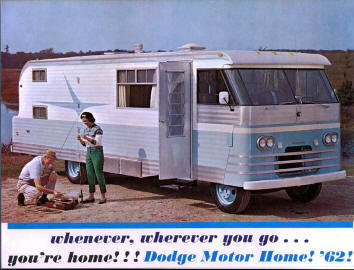
Ray Frank coined the term “motorhome”, starting with his first one of 1953, built on a Dodge truck chassis. A partnership with Chrysler resulted in the Frank-Dodge motorhome (above), which then evolved into the Dodge Travco (CC here).

In 1963, the Travco pioneered a sleek two-piece fiberglass shell, and became the iconic motorhome of its time. But it was pricey, well into the teens then (about $100k adjusted). The Travco was something the average American might dream about, but not realistically attain.
Winnebago got its start building trailers in Forest City, Iowa in the mid fifties. This was a very dispersed industry then, but somehow Winnebago survived and prospered. In part, it may be because it was willing to innovate, like its Thermo-Panel sandwich wall construction, rigid foam insulation sandwiched between the aluminum exterior skin and the inner paneling.

In 1966, Winnebago took the leap to building motor homes, and this one, serial #001, is still running. This first model was a nineteen footer, built on a Ford P-350 chassis, as typically used for step vans. Thanks to Winnebago’s modern production line and volume purchasing, it charged less than half compared to comparable sized motorhomes then available. Just like the Model T Ford, the Winnebago motorhome took off, as the first of its kind realistically available to large segment of the population.

I can’t find an exact price for that 1966, but the seventeen foot F-17 model featured here was priced at $5995 in 1970. That adjusts to $33k in 2010 dollars. And that’s also just a tad more than what a Toronado cost in 1970. Given that hourly wages were just about to hit their all-time peak in 1971 or so, the convergence of rising income and an affordable price was an explosive combination. In 1970, Winnebago went public, and in 1971 its stock was the highest flying of any on the exchange, up 462%. Winnebago was the Google of its day.

Within a year or two of motorhome production, there was a whole line of Winnebago models, and all of the larger units (above) except the smallest F-17 moved to proper Dodge motorhome chassis, with dually rear wheels, the 318 V8 and the venerable TorqueFlite. I dare say that a substantial part of the TorqueFlite’s reputation grew from the fact that it was in just about every motorhome for several decades. And it acquitted itself superbly.

But what we have here, the F-17, is the smallest of the line-up, and mighty short at that, a mere 17’4″ long (208″). It still sits on the Ford P-350 van chassis, with all of 104″ of wheelbase. Given that this rig is 111″ tall, it’s one of the few vehicles to be taller than its wheelbase. That’s not anything to be proud of, and these shorty Winnies had a rep for being a bit less than stable under certain conditions, like wind, among others.

And what powers this flying brick? The Ford 300 cubic inch (4.9 L) six. A six cylinder motorhome; hmm. Well, it did weigh a mere 4,890 lbs, dry. That’s less than some CUVs today. Winnebago’s Thermo-Panel construction was light, as well as providing decent insulation. And that Ford six was rated at 170 (gross) hp back then, the highest of any domestic OHV six. Still, this Winnie would trundle down the (flat) highway at adequate speeds, while Mom made lunch in the kitchen and the kids played in the back dinette or in the bunk over the driver’s head.

That front upper bunk and the unique angles of Thermo-Panel that defined it became a Winnebago trademark, and the basic configuration of all Winnie motorhomes,

including this much bigger later model from the late seventies. By then, the HD 440 big block was building a rep for itself along with the TorqueFlite.
The RV industry’s fortunes are tied to the economy and price of gas more directly than perhaps any other. The First energy crisis put a dent in Winnebago’s explosive growth, but by the late seventies, the party was in full swing again, and the big W built its 100,000th motorhome. The crash and oil-run up of 1981 almost did the company in, and the old look models gave way to a more contemporary style.

But these old Winnies are still plying the streets, although more often nowadays, they’re also being lived on in the streets, by owners who have no other place to call home. And they have vintage paneling to cheer them up. Actually, these very early models still had light-colored paneling, but that soon gave way to the ubiquitous dark fake-walnut that graced every motorhome for decades. Let’s just say that RV manufacturers have not been big on hiring interior decorators, at least not until quite recently for the higher end units.

Winnebago continues its dance with the economy, after mostly shutting down in 2008. The past few years have been brutal for the industry, and here in the Eugene are we have lost all of the several manufacturers that once made the region a manufacturing node for the industry. It’s a business that thrives during the go-go times, when folks are optimistic, despite knowing that RVs have atrocious depreciation. Or maybe they didn’t know.

But the RV industry always seems to reinvent itself, and more efficient smaller diesel units are here and more on the way. But the odds of an RV manufacturer being the hottest stock of the year are long gone. That was a one-time event, due to the assembly-line efficiencies Winnebago introduced coinciding with a time of peak wage growth. Neither of those scenarios are about to come back.


I never would have guessed that clue Ive not seen many Winnebagos though they are here along with all the locally and home grown RVs .
Yeah you are obsessed Paul but its an obssession that keeps us all coming back for more I guess I and my fellow curbivores suffer from the same disease.
Curbivores! Brilliant.
Curbivore!
Trademark that name right away!
I did it with “cockroach of the road”…
Do you have any idea how much beer I have coming to me?
😉
At least two from me.
Very interesting article Paul. I’m becoming more and more of an RV fan, although that F-17 is seriously one of the ugliest vehicles I’ve ever seen. Looks a tad amateurish compared with the Travco.
As Bryce noted, there are a few Winnebagos here – there’s usually a handful of top-end models on the trademe auction site. Some don’t appear to be American built though, so I’ve been wondering if they’ve licenced the Winnebago name out – eg there are late-model factory RHD Ford Transit RVs here that have Winnebago branding.
It’s ironic (or providence?) that I read this article this evening, as while driving home an hour ago, I noticed the car dealer 1km down the road from my home just got in a 1985 Winnebago Le Sharo, which I’m going to take a look at this week. It reminded me of the Renault RVs we got here new in the 80s, and a quick google reveals the Le Sharo is indeed Renault-based.
Just seeing it for sale in the yard made me think how fascinating it is that a touch of Franco-Americana has ended up here in rural New Zealand, completely on the other side of the world from its birth. Which countries had it been to? How did it get here? Which roads has it travelled? If only RVs (and cars) could talk!
If you really want to see one of the most hideous RVs ever look up the Rectrans from the early 70s. I sent Paul a few pics of the one my friend had a while back. Rectrans makes the Winnies look like supermodels.
Oddly the Rectrans was brought to us by the same guys that gave us some iconic cars like the 63 Vette and Boss 302 Mustang.
Ah…yes, just googled it…that image is emblazoned on the back of my eyes now… Although at least it has a couple of curves in its design, unlike the F-17!
I dunno, looks pretty sleek to me. A lot longer than its height, at least. Looks faster than that rolling shoebox from Winnebago.
NZ Skyliner: If it’s Ford Transit based, it’s definitely not a US-built Winnebago.
Here’s my CC on the LeSharo: http://www.thetruthaboutcars.com/2010/05/curbside-classic-1985-winnebago-23mpg-lesharo-turbo-diesel-rv/
Thanks for the LeSharo link, very interesting! I’ve done a bit more research, and the factory-RHD Winnebagos we get here are actually Australian-built, from a company named Winnebago Industries. Attached is a picture of one of their Fiat-based RVs. Their website is http://www.winnebago.com.au but doesn’t mention being connected to the American company. But they use the American Winnebago logo/font, so I presume they’re licenced to use it.
Better late than never, lol. Actually the Australian company (Knotts Investments Pty.) used Winnebago’s trademarks and designs without a license or permission for more than two decades. Finally, a couple of years ago, the US Winnebago company prevailed in litigation against Knott. See here for more details: http://www.davies.com.au/pub/detail/630/after-waiting-25-years-winnebago-is-allowed-to-enforce-its-trade-mark-rights-in-australia .
Hey NZ Skyliner. I like anything made in Australia for Australia, than anything made here in the USA. I’d buy an Aussie built Winnebago any day if it were sold here in Seattle. 🙂
Known as “Whingeabago” in the Australian RV industry.
And did the designer of the “flying brick’ have a morbid fear of curves?
That’s one blocky vehicle.
It would take me about 10 minutes of driving to somehow tip that thing on its side.
I can’t get over how short the wheelbase is on that thing. The Lincoln’s is more than a foot longer. That’s just wild!
Also funny how the lower ends of the thing are basically identical mirror images of themselves.
I am well familiar with the ups and downs of the RV industry. Elkhart, IN is a major RV center and has gone through several boom and bust cycles with the industry.
As a teen in the 70s, I remember these Winnies being everywhere, although I do not specifically recall this shortie.
My father rented a big motorhome for an east coast vacation in the summer of 1979. Yes, that was the summer of east coast fuel shortages and lines at the gas pumps going all the way down the interstate exit ramps. The big Pace Arrow got about 6 or 8 mpg (IIRC) and the whole trip was devoted to getting enough fuel to finish the trip and get home. NOT a relaxing vacation for Dad. Or, for that matter, for my sister who, as a fairly new driver, couldn’t take Dad breathing down her neck as she piloted a motorhome down the interstate. Me? I lived to have a steering wheel in my hands, no matter what it was attached to.
Too bad. He headed the wrong direction; should have gone West! 🙂
Yes, 6-8 mpg is about right, for gas rigs. That;s still about what they get. Let’s just say Winnebago didn’t have a wind tunnel in Forest City.
How well did the GMC Motorhome compare here? It looked sleeker all right, but then it also had the big-block.
I’ve heard that the GMC does a bit better, or can. But they tended to get driven a bit faster, as they handled like a Corvette compared to the Winnies.
Taller than its wheelbase? I wonder if any other vehicle can say that? Maybe a jacked-up Smart Car?
Minor nit, Paul: A 1970 318 wasn’t a poly motor – it was from the same family as the 273/340/360. I think the polys went away after ’66 or so? I’m sure someone can help with this!
The LA 318 arrived for 1967, at least in cars. I’m not 100% sure the trucks switched over right away. There was a reference to earliest Winnebagos (’66-’67, other than the F 17) having the poly 318, but it could possibly be wrong.
The A block (commonly called the wide block) 318 was last seen in 1966. The Poly is actually older than the wideblock A, and was basically a hemi without the dual valvetrains. According to Allpar, the Poly came in a whole slew of displacements and was slowly phased out by the newer A and B block engines. The Poly showed up in the ’55 Chrysler Windsor (301) and in the 55-58 Plymouths and some 55-58 Dodges.
The A block came in similar dispacements starting in 1956, including 271, 301 and 303. The 318 of 1957-66 is the most widely known.
This period of Mopar non-hemi V8 engine history is really confusing. I count 6 displacements for the A block (277, 301, 303, 313, 326, 318) and 8 for the poly (241, 259, 270, 301, 315, 325, 331, 354 – the latter two not to be confused with Hemis of the same sizes). Then there were the B and RB big blocks. It would not surprise me at all that some folks may have called the wideblock 318 a poly just because of the musical engine game being played. I am more into Mopar than most, and even I had to go look this up.
Chrysler in the 50s – the engineers’ playground.
Jim, I’m afraid you need to go back and reread that: http://www.allpar.com/mopar/a-engines.html The “wideblock” 318 really did have a poly head.
There were at least two families of “polys”, the older ones were based on the hemi block, but had a poly head. The A series engines had a more modern block, but still had a poly head, which is readily identifiably by their scalloped valve covers. Lift that cover, and one can see that the intakes rockers work in reverse, essentially. This is the reason the A polys are so wide, the poly head necessitated it.
The LA used the A block, with a few minor changes, but ditched the wide poly heads for traditional wedge heads, with all the rockers and pushrods lined up in a row. That was essential to make the A block fit into the narrower compacts.
You’re right though about how confusing it could be; when I was a kid, I had a dickens of a time keeping all those fifties MoPar V8s straight. If only allpar had existed back then!
Good catch, Paul. That will teach me to look up CC stuff when I am in the middle of trying to work too. I had started from the premise that my 2 cars with wideblock 318s were Polys, but then misread the Allpar article which I thought told me that I was wrong. So I was really right. Or was I wrong. I’m so confused.
There were THREE families of Mopar “Polyspherical” engines.
The first were based on the Chrysler Hemi. Short-blocks interchanged, heads were different. The “Chrysler” Hemi/Poly had the biggest bore spacing, 4.562″
The second-series Poly was a variation of the Dodge Hemi. The Dodge Hemi/Poly was the smallest of the “Hemi” engines, at 4.1875 bore spacing.
The Chrysler and Dodge Polys were each introduced for the ’55 model year.
At this point, Plymouth had no V-8 engine. They were using Dodge Polys or six-poppers. In ’56, Plymouth got a “clean sheet” V-8 in the “A” engine, designed as a Poly. It had wider bore centers than the Dodge, at 4.46″. The “A” “Poly” engine was redesigned, in ’64 Mopar brought out the 273 “Light A” or “Low A” “LA” inline-valve wedge engine family. A few parts interchanged with the previous Poly A engine, and it retained the same 4.46 bore spacing.
There was a DeSoto Hemi, (4.3125 bore spacing) but no DeSoto Poly.
By “two families” I meant the family of Chrysler and Dodge polys based on their respective hemi engines. More like a “generation” than a “family”.
That beats what Chrysler was in the 60s and 70s, the bean counters playground.
I like the “box on wheels” look of these things a lot. Thanks for the review.
SHAZAM!!!
PYLE!!!
I guess the reference was a little obscure…anybody remember the Shazam/Isis hour on Saturday morning tv back in the 1970s? It was a horrible show but this was the malaise era for tv as well.
Anyway, the premise was that young Billy would drive around SoCal with an old guy in a Winnebago solving 1 crime a week. And he would communicate with “the Elders” by touching a globe installed by the drivers seat. Before Billy became Shazam, he would first yell “Shazam!”.
The show was so bad, but I always liked the scenes with the Winnie.
I cant remember what Isis did. She was to Billy what Lindsey Wagner was to Lee Majors.
Ok I am done now…
I got your reference immediately. I had not remembered that awful show in years. It would come on late Saturday morning when the cartoons were over but before we kids were ready to pull ourselves away from lounging in front of the tv.
The character’s name is actually Captain Marvel — since his revival in the early ’70s, his various media incarnations have been branded “Shazam!” (his magic word) due to ongoing trademark objections from Marvel Comics. SHAZAM was actually an acronym of the elders from whom Billy derived his powers: the wisdom of Solomon, the strength of Hercules, the stamina of Atlas, the power of Zeus, the courage of Achilles, and the speed of Mercury. (How he ended up with this odd assortment of Biblical patriarch and Greek and Roman heroes and gods is another matter.)
Captain Marvel was a comic book character from the ’40s who disappeared in 1953 after a lengthy legal battle between the publisher and what is now DC Comics. Ironically, DC bought the rights in the early ’70s and now owns the character.
Isis was as far as I know created for the TV show, presumably in hopes of riding the coattails of the Wonder Woman TV show. (See also Electra-Woman and Dyna-Girl.) Her main shticks were weather manipulation and controlling animals, although she could also do a variety of other things any time the writers backed themselves into a corner.
I vaguely remember these shows. All I remember is a Winnebago and a woman saying ‘By the powers of Isis…’
And someone using fast hands to make a giant magnifying lens out of sand (or maybe that was Wonder Woman).
I think the Ford Transit be a good basic vehicle to build a new miniRV on, especially after seeing that F-17.
“I think the Ford Transit be a good basic vehicle…”
Aye matey, a right proper vehicle it be!
There’s a limit to how short an RV can be, and the Transit Connect is just a bit too skimpy in that regard (although it looks tall enough). If they had a version where the front seats folded flat, it’d be okay, though.
Otherwise a gutted minivan (i.e., the C/V work truck version of the Dodge Grand Caravan) fills the bill much better.
In the early 70’s, I used a Winnebago for my employer. I can’t quote a model but it was larger than this model. We removed part of the interior and installed electronic equipment. There was not much structure above the floor – the equipment racks were bolted to the floor.
We did not live in the unit. The big advantage was that we could drive to a location, set up our antennas, and start up the built-in generator. We recorded data for a period of hours and moved on to a new location.
As mentioned by others previously, it was a Dodge chassis/engine. The gas mileage was poor and this was the era of the first “gas embargo”. It made for some anxious moments of finding fuel.
Wonder if it’s a mobile meth-lab, now…
Where’s Jack Rebney when we need him:
http://www.youtube.com/watch?v=WDQQfBrSUs0 (NSFW)
Also, don’t forget one of the other early RV designs, the Corvair-powered Ultra Van:
http://www.corvair.org/chapters/ultravan/
“Don’t forget about the UltraVan”
I wrote the best piece that exists on it (he says modestly): http://www.thetruthaboutcars.com/2010/11/curbside-classic-ultra-van-cross-an-airplane-with-a-corvair-for-the-most-radical-rv-ever/
I didn’t reference it in this piece, because it really wasn’t significantly influential in the RV market overall. But it’s a gem.
The UltraVan looks like a spacecraft. I can see the Robinson family shuttling along on whatever planet they were Lost In Space on. The Big W looks like the box it came in.
An RV demands a different lifestyle, one that few of us can attain, but the vehicles and their variations through the years is mind-boggling.
This series reminds me of a vehicle Chevy sold circa 1977 – 78 when we, newlyweds were seriously considering a new car purchase. The RV in question at the Chevy dealer we visited that evening in December 1977 was built on the full-size Blazer, and to us, it was a lot of vehicle in a fairly small package. That would have been a delight to travel in for somebody. I haven’t seen one since.
The car we were considering? A Firethorn red 1978 Nova 4 door. We originally considered a Malibu, but declined. The reason? Fixed windows in the rear doors! Boy, were we angry when we discovered that little irregularity!
What car did we buy? Nothing. We wisely decided to save for a down payment on a house! We made the right decision, too. We made do with her 1970 Mustang and our recently acquired 1976 Gremlin.
There’s a Blazer Chalet on eBay this week, Zack. Here’s your opportunity!
To me, the whole creation story of Winnebago is as interesting as their line of products. Here a link to the Wikipedia version:http://tinyurl.com/5ts8knv
We had a neighbor when I was a kid who had one of these. I think my father would have wanted one of these, but with four kids (one of which was in college or getting married or both at all times seemingly), it wasn’t going to happen…
I now live about an hour away from Elkhart, IN, and can commiserate with Jim about how the boom and bust cycle takes it’s toll on a community…
The “Blazer based” one you are talking about is a Blazer “Chalet”, there was also a Jimmy “Casa Grande” available from GMC dealers, the modular unit was made by Chinook, I think, they were really neat, and came in 4×4 only so it was great for camping, the main problem, as far as I can tell was that it was only a small r/v, there was no way to make it a “regular” K5 Blazer again, so if it was your only vehicle you were stuck driving around will all that equipment.
What about this beast here
Not sure whether I’m repulsed or awestruck by that…ummm…Cadillac? Van? Aha: Caddyvan. Hmmm, it’s growing on me, I think awestruck wins!
Correct about the Blazer Chalets, more can be found about them at http://blazerchalet.com/ , and there is an enthusiasts’ & owners’ forum for these at http://autos.groups.yahoo.com/group/ChevyK5BlazerChalets/
i have one of these F-17s (1971). i have great fun in it. it handles real well has real good road manners. i have rebuilt this thing from the groung up. the unit has 7″ double convoluted goodyear air bags up front, and 5″ firestones in the rear. makes a huge difference in ride, seeing that Winnebago has almost all ways loaded the rvs to just under max weight, and this chassis being a Ford (known for weak suspensions, they sag after 4 to 5 years), it helps out great. i had a D-18..the floor plan is the same but the unit is 3 to 4″ wider and sits on a dodge chassis with a real thirsty engine. the F-17 gets about 15 to 17 MPG on the road at 54 MPH. they look funny but are fun to drive, easy to park, and if yours looks as good as mine ANY RV park will welcome you…and with a big smile.
Hey IttyBitty…. are you still connected with curbside classic?? so I’ve just bought my first Winnebago – a F-17. Not sure the year – as we haven’t found the VIN plate or number yet…
It’s rough but we plan to put a new roof and then start with the inside… I want to lower it… and noticed you’re running airbags on yours. Can I get more information about how you did that?? and If you’ve lowered it? Are you running the stock front straight axle or did you change the front end? I need help and suggestions concerning, well anything LOL thanks
I’m working on a 1967 Lifetime Premier 18 ft and the serial number was attached to the side panel near entry door. The Vin was on it, but not like normal vins. Mine begins with H** **** CO and was made in Mason City Iowa. Hope this helps.
Patti R – and anyone else with an F-17. I would really like for us to start an F-17 user group or something somewhere to exchange info. I have a 1968 F-17. I am desperate to get any info. What do you tink?
Do you really get 15 mpg? if an F-17 gets 6 mpg, would you guess something is wrong with it then? Thanks for any info.
Thanks for the article!! The Winnebago you mentioned as Serial Number #001 is currently owned by Jim Khroner of Lancaster,Pa. Jim is a founding member of Classic Winnebago’s and Vintage RV’s Owners Club (www.classicwinnebagos.com), and our club raised the money from donations for him to purchase the rig after another member spotted it for sale on Ebay. We also raised enough for him to rebuild the engine and transmission, and he is still working on restoring the interior and exterior,last I heard. He hosts an annual Winnebago Jamboree on his property, and has several RV sites built there just for the occasion. He always buys a couple of old Winne’s so everyone can scavange them for needed parts during the event! He calls them “Donor-Bago’s” lol
He puts Serial Number #001 on display, and several members have been thrilled to have their picture taken in it.
It is however not the first motorhome built by Winnebago Ind., They started out building a motorhome called “Life Time Premier” in 1965, but after the deal to produce them for Life Time fell apart (it was a messy break-up btw), Winnebago decided to build their own branded motorhome. This resulted in the Serial Number #001 being built, and all those who followed.
Thanks for that info about Life Time.
I have a !969 Winnebago in excellent condition but cant seem to put a price on it .Do you have any suggestiions as to where I could begin to figure a price…if I decide to sell it.
I traded an 86 Ford Ranger for a 1967 Winnebago F17 a few years ago. In November 2011 my wife and I drove it from Santa Cruz, NM to Cleveland, Ohio. It was a great trip and our little Winnie did great. The only problem was that it only had a 12 gallon tank so we had to stop every 70 or 80 miles for gas. Just this past summer I put an extra 22 gallon tank on the F17 and we drove back to NM for summer vacation. Much nicer not having to pull over as often. In September we drove it to Derby, New York, which is about 12 or so miles south of Buffalo. So I figure with those trips and a few shorter ones, we have put about 7,000 miles since we got her. She runs great and we hope to travel many more miles in the next few years.
Ive got this 1970 winnebago with 318 dodge and dodge chassis. Runs good and is ok condition. My question is this an f17? I cant find one anywhere like it online. Wade
Is this an f17?
Camper, size of a Lays potato chip truck, the front end was wedge shaped. The year was 80s. Need to find one ?
Winnebagos today are way more attractive than they were 40+ yrs ago.
lookiing to buy a 1968/69 winnebago..good condition in KY, TN, IN. any sellers? contact me!
thanks!
My parents bought a gently used 1968 F-17 Winnebago in the Early 80’s. It had plenty of power but the transmission was a dog an prone to failure. It blew out on us twice. The braking system, 4 wheel drums had a lot to be desired for as well. It was warm and comfy though and we did love the ugly old thing. 🙂
I have a 1967 Life Time Town and Country. It’s so ugly it’s cute 🙂 It’s a kick to drive as long as you aren’t in a hurry. It is a conversation piece to say the least. Mine is in pretty good shape but it had some quirks. I love it and plan on taking it to classic get togethers.
Quite the veteran! I didn’t know about these.
Wow. That takes the cake for ugly, to be sure..but in a charming way! Very cool old thing and I’m sure it does get lots of comments! The height of the door and the gray trim for some reason make it look like a little tiny building on wheels.
Every time I see the front of one of these Motorhomes, it reminds me of the Mammoth Car from Speed Racer.
As a child I remember thinking RV’s looked out of date when new. It seems only in the past fifteen years have they begin to look at least current to me.
Someplace back about 1970, I read that Winnegbagos were all piloted by Martians. I see no reason not to continue to operate under that assumption.
Although no one in my family has ever owned a Winnebago of any year, I’ve seen Winnebago motorhomes since the early 70s when I was a small boy. I thought then, as I do now, that they were the ugliest vehicles on four wheels. By comparison, I thought the Travco, with its more streamlined shape, was way better looking than the Winnebago. Another motorhome from the same generation was the Ultra Van. That looked better looking. And last, but not least, the GMC Motorhome. That vehicle couldn’t be more different if it tried. With other RVs being truck based and box like, the GMC Motorhome was basically car based, with an Oldsmobile Toronado 7.5 litre engine, more streamlined than the Winnebago, and way better looking than the Winnebago.
And considerably more expensive too 🙂
To put it mildly. As I recall, the fanciest furnished version was around $35,000, which is the equivalent of about $150,000 today. Of course, you could get cheaper iterations too, but the GMC was still a sobering amount of money.
I saw one on Monday at a gas station in Sonoma County, although I didn’t have a chance to talk to the owners or anything. (I was in the back seat of a moving car at the time.)
I reckon you’re right. I’ve never owned or driven a motorhome of any kind, so I wouldn’t know.
I wonder how much a used GMC Motorhome, one that’s been lovingly cared for, never wrecked or neglected, always garaged, etc. would cost.
If you’re talking about those three axled , FWD things , $3,500 ~ $30,000 .
My Brother is semi in love with them so I keep finding them for sale in the back lots of RV places…
They have air suspension so I imagine big $ for new bags now and again .
I even know where some homeless folks are living on them and only move it every two weeks on street sweeping day .
-Nate
Interesting that an RV mentioned in the article has the Ford 300 six in it. While the biggest with the most horsepower (and probably torque, as well) for the time, you’d think that with the popularity of the Dodges with their Torqueflites would make the slant-six more in vogue.
The Ford step-side chassis seemed to fit the bill for these very early Winnies, but they soon switched to Dodge chassis, and were Dodge’s biggest customer for them.
My favorite Tonka toy as a kid. Wish I still had it.
I had one too. The roof doubled as an awning. Lots of fun!
I remember seeing these toys when I was a little boy, I never bought one. I wish I had.
Winnebago is introducing a “retro” revival of this RV for 2015, based on a Ford chassis:
http://www.gowinnebago.com/products/2015/brave/
One has to wonder if someone from Forest City went to France in 1964 and was inspired by the SNCF’s (the government-owned French rail monopoly) new pride and joy, the Alsthom-built CC 40100 Class locomotives. They were capable of operating at up to 200 kmh/125 mph on almost any current/voltage combo used in Europe at the time, but were used almost exclusively on the Trans-Europe Express (Paris-Brussels-Amsterdam) run for over 30 years. The last one was retired in 1996….
Yes, I’ve wondered about the similarity too. Obviously, they reflected a certain design theme of that era, seen in other vehicles, etc, like the reverse-slant rear windows on Lincolns and Mercuries, but these two are definitely kindred spirits.
I loved the big French locos of the 50s and 60s; much more flamboyantly designed than the austere German and Austrian ones.
When I worked in Amsterdam in 94 -96, I had a client in Antwerp and always tried to take this train – by then known as the Etoile Nord – there. This loco, plus Budd stainless-steel coaches. If you booked first class, you got big comfortable seats with the same sink-in-to-firmness foam rubber cushions as my Citroen DS. A real time warp, done in by the speedy Thalus.
Wow. Love the styling on that locomotive! It’s like the 1960’s interpretation of the 1940’s streamliners…
An version lacking the 40100’s multi-voltage capability, the CC 6500 Class, came along in 1969…..
There was also a diesel version of the design, the CC 72000 Class…..
Finally, the Belgians had their own version of the 40100 built in the mid 1970s, the Class 18…..
Great stuff Mark ! I really know nothing about trains, the looks of these trains remind me of a classic Verheul truck. There’s even a big V too !
Can’t say I know a whole lot about trains myself, especially European ones. I saw a photo of a 40100 a while back and became fascinated with them solely because of the strong resemblance to a vintage Winnie.
We had a I believe 19ft 1972 Winnebago Brave purchased brand new. It had optional Onan generator and roof air. 318 Torqueflite dual rears. It had a small fuel tank and a second was soon added. It’s first trip was cross county, the only problems were a improperly installed fuel line on the added fuel tank (loose clamp), and the exhaust where it was bolted to the down pipe kept falling down, a quick welding job at a muffler shop took care of that problem. It was quite durable, the only additional problems over the 8 years and 70k miles we had it was a generator fuel pump and U-Joints. The nylon tires it originally had would flat spot after sitting over night and the first few miles were a vibrating nightmare until they warmed up and rounded out. Right after we got it someone threw a rock through the drivers side glass, we stuck in a piece of pexiglass and stopped at the factory in Forest City, Iowa. Winnebago replaced it at no charge. A lot of memories in that motorhome, it was a lot of fun.
I rode across America in the Summer of 1969 in one of these tiny Winnies .
It was mostly a fun trip , began and ended in Rochester , N.Y. , passing through Canada and Mexico , spent two whole weeks in California , making it the logical place for me to move in the Fall of 1970 .
I know many locations in and around L.A. where older and homeless folks live in battered Winnies & C -Class Campers, only moving them when necessary to avoid towing or parking tickets ~ @ $ 4 + / gallon , fuel is a precious resource to be hoarded .
There are entire communities of these living curbside in the San Fernando Valley , they’re mostly too ignorant to realize that dumping your trash in the gutter where you’re parked , attracts the IRE of the Citizens and then of course the L.A.P.D. who in the Spring gives them a choice : move on (over the mountains to the Desert) or get a ticket ~
In November or so they all come back as it’s freezing cold in Lancaster .
I know of one encampment in South Central L.A. that’s 99 % Black and they keep it *spotless* ~ sidewalks , gutters etc. are swept daily and no piss smell either ~ L.A.P.D. doesn’t bother them at all .
I had much fun in 1969 , first time I ever went Way Out West .
-Nate
thats my house in one of those pictures. you’ll traumatize, no rather, you’ll crunchatize my daughter boo berry by showing our cereal box home for the world to see. For shame.
Has no one else noticed that the featured Winnie has a green “W” graphic on the driver’s side and a red one on the passenger side? Is that original/intentional?
As a kid I marveled at the ugliness of these old RVs, but nowadays I actually appreciate the folded-paper styling. It’ll never be beautiful but it certainly has character.
They were white with gold W stripes, lettering, and ford hub caps.
Mine is actually the Life Time Town and Country. I call it the “Bread Truck” because it looks like an old bread truck to me. It is a quirky rig. Some one added an extra fuel tank and cut the front “hood” area replacing a section with a hinged door. I’m assuming they did this when they pulled the motor which after whatever repair they did left no oil dipstick portal :/
Looking at the Winnebago motorhomes produced during the late 60s through the 70s, I can’t help but wonder what the stylists were thinking. I find the Winnebago hideous to look at. The Travco is much better looking, and so was the Corvair Ultra-Van. I also like the FMC 2900R.
Hi, I am looking at a 67 Winnie for sale that is listed as a 35 footer. Does anyone know if there was a 35 ft made that year?? It’s looks to be a lot smaller than that but I can’t find any model history information online. Thanks
Another motorhome I’ve seen pics of, but I’ve never seen personally, that I find more attractive than the Winnebago, was the FMC 2900R. I don’t know if you’ve written anything regarding that vehicle, but I would think that’d be something worth looking into.
I see a for sale sign in the picture of the 1966 5th pic down, is it still for sale by chance?
I have an opportunity to pick up a 1968 D18 for $300 from my wife’s relative. Appears to be very original. Hasn’t ran in years, but it’s been stored as pictured under cover since the 90’s, likely.
Thoughts?
Hello,I
I love my 1970 Winnebago , Chieftain, D27, 2 door (Rare), Big block Dodge V8 413cc,
40,000 Org. Miles, bought it from a RV. Storage, $200. With a title !
Cleaned the Carb., Fuel tank, aired up the tires, New battery, then I drove it home ! !
The only problem I’m having is finding OEM parts, New or used, ?interior / exterior parts !??
I have found lots of complete 70’s Winnebago ‘s , but I just want to find good replacement parts ? ?
Anybody have a good parts , bone yard, parts house ? ?
Edwardrtafoya@gmail.com
Law Vegas, Nv.
Hello,
I’m looking for any info. On 4X4 Conversion ‘s on Winnebago ‘s ? ?
Vintage 70’s Winnebago chieftain.
They are Dodge power trains.
EdwardrTafoya@gmail.com
Law Vegas, Nv.
i have a 1969 winnebago i have restored it to amazing belive it is realy beautiful i have no idea what it is worth can some body tell me were to begin thanks teresa in yakima wa
Teresa,
It’s difficult to set a price on a RV that’s no longer listed in the ” Blue Book Co.s” listings.
I guess , it comes down to what’s it worth to you ? What price will the Market bare ?? I love ? my old Winnebago.
I got a smokin deal on mine, $200. $Cash with a title ! Under 30K org. Miles.
I did have to clean it up, tune up & fluid change.
And it runs great & it’s taken me to northern Baja a few times. Motor & Tranny work perfect.
I plan on converting it to 4wheel drive ( beach sand adventures). I’m working on gathering info. & parts for that project.
The money is well worth it to me.
But, I’ll probably never get my money back.
I’m not selling it anyway !
I have had lot’s of interest in it .
Find an old Dodge 60s to 70s w 300 power wagon it will ALL fit and work .The frames are the same !
winnies bring back fond memories of my childhood i spent the halcyon days of my youth in a brave from 1986 to 1989 i lived in one
Wanted a 1968 be Minni winni .any condition
Tough to find any ads with prices—though eBay has a few interesting German brochures for the “Minnie Winnie.”
[Interesting, BTW, to think of a vehicle taller than its wheelbase—wow!]
Here’s one Kansas ad from 1972:
I thought those early little Winnies looked like an art deco toaster.
RV’s are like boats, you are happy the day you buy it and really happy the day you sell it. Unless your an idiot like me who knew going in what a pain owning an RV can be.
I did work on a few GMC motor-homes. As with most gas powered motor-homes, broken exhaust manifold bolts, cracked exhaust manifolds and warped out contorted exhaust pipes were standard. The big longevity problem on the GMC was its rear suspension. The suspension was bolted to the side of the frame rails and eventually the rails would twist and now your tires are running a lot of negative camber. The other problem with the rear suspension was the control arm layout. The rear tire rode on a trailing arm so you have a caster affect that tends to minimizes suspension wear. The forward tires use a leading arm that tends to fight the vehicles direction. Lastly the rear suspension uses a single airbag on each side to support the vehicle, so if you damage a bag your bottomed out, and these things were low riders to begin with.
Great comments from members over the years. Regrettably (hah!), I am adding a blond joke to these comments:
A blond is at a Starbucks coffee shop. With her purchase she received a little promotion card. “Scrape off the silver coloring and see what you win,” it said. She did and jumped up off her chair excitedly, “I won a Winnebago!” The shop was in an uproar of excitement until a clerk walked over, read the card and said, “Miss, you ‘won a bagel!'”
My Dad bought a pop-top camper in early 1973 and of course we took several trips in it that first year; one of the first of those was from our home in northern Virginia at the time to Myrtle Beach, SC, which was starting to be one of those “trendy” places to go…we repeated a trip there the next year, not so much because it was trendy, but it was a nice stopover on our way down to Florida. We only went to Florida twice camping; they’d just opened Walt Disney World and my younger sisters were prime age at the time for it; 13 years before my parents took me to Disneyland (we were living in Southern California then so it wasn’t far…yes, in their younger days my parents moved quite a bit…even though my father had left the military years before I was born).
Anyhow, camped right next to us was a Winnebago, I remember hearing the generator going all night on it. Our poptop didn’t have air conditioning (our new 1973 Country Sedan was actually the first car my parents owned with A/C and our house in VA was Air Conditioned (also a first for my parents) but not part of camping…We splurged and camped at the Disney World Campground which had air-conditioned restrooms (we weren’t used to Florida but that seemed decadent to us at the time)..but also cost $20/night, which was about 4 times what I think we normally paid to camp back then.
Our prior camping was done in a Camp O’Tel (Car top camper) which was basically a fold out platform with tent on top of the car where 4 people could (just barely) fit…it reminded me of the narrow bunks on a ship, narrower than a twin bed, where you have to raise yourself constantly as you rotate around finding another sleeping position. Anyway, the Winnebago seemed very “plush” to us, but poptop was as plush as it got for us camping wise, as I and my sisters grew up, we stopped camping and went back to staying in motels when travelling…but my Dad (who was a boy scout in his younger days) I’m sure missed it….and of course as mentioned the two big gas shortages of the 70’s really stopped any idea of getting something plusher than the poptop; we had a hard enough time finding gas for the 400 CID on Country Sedan.
Greetings all..
Can anyone help identify this RV? Someone posted it on Facebook Marketplace asking for help. I found this forum and you all seem like the folks to ask. It has the “Ford Chassis” emblem on the front so it appears (to me) to be an early Winnie or Lifetime but I have been unable to locate an exact match of the body style and the headlight/turn signal arrangement. I wonder of the “CUSTOM” under the ford chassis logo might mean this is a rare or unique model?
There is nothing at all to suggest that it’s a Winnebago/Life Time. It could either be by a very small start-up builder or just a fairly well-made home-built rig. I’ve seen some home built motorhomes that were just as professional-looking as this one.
Sorry I can’t be of more help. Obviously if it were made by a manufacturer there should/would be a builder’s plate on it somewhere.
1968 Winebago how much and where are you located at
This era of early years Brave is what I’m looking for, to thoroughly renovate. Do you have any for sale?