

(originally posted 4/26/2011) The Pacer is the poster child of how questionable ideas and good intentions go awry.
In 1971, scrappy little AMC was faced with a dilemma: how to capture buyers looking to downsize, when they were incapable of actually building a truly downsized car. Yup; there was no way AMC could tool up to build a genuine compact car, like the Vega and Pinto. So the solution was to stop pretending, like the Gremlin (CC here) that preceded the Pacer.
And the pregnant answer was to build the world’s first wide-body compact, a segment nobody had ever identified before, much less pined for. To add to its zestiness, why not break all the styling molds with acres of glass and asymmetrical doors. And then just for good measure, stick a rotary engine in it. As we’ve seen repeatedly, desperation is the mother of bizarre disasters.

AMC explained the Pacer this way: it was “the first car designed from the inside out”. How about the first compact designed for the obese? The rationale and implication was that a segment of Americans just weren’t going to be happy giving up their accustomed hip, elbow and love handle room for a cramped import or a Pinto.

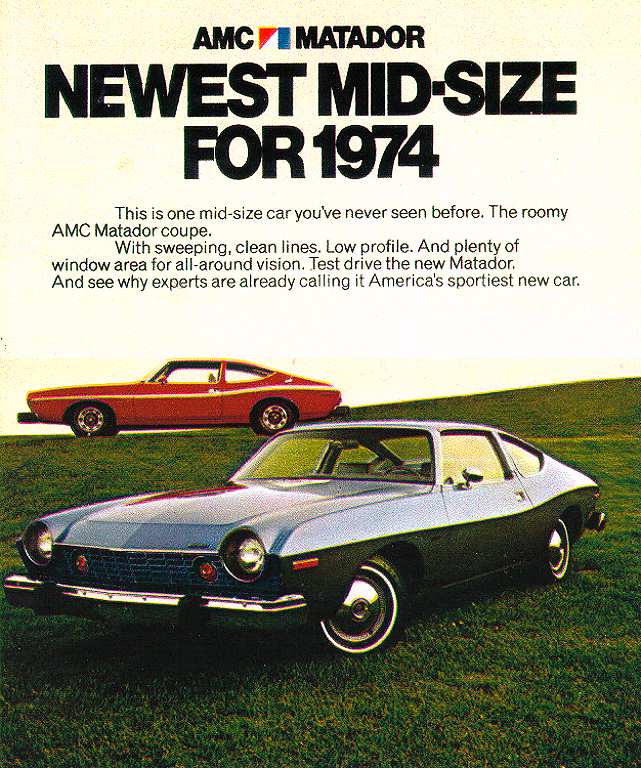
So it really started that way: cut everything away from AMC’s extravagantly-long Matador mid-size coupe except the seats and then design the shortest body possible around them. I’ve long had the desire to take a torch and cut away about six feet on both ends of a ’71 Cadillac coupe. Dick Teague, my hero, had the same impulse and actually did it (not with the Caddy, sadly). Too bad Cadillac didn’t do the same thing for the Cimarron; now that would have been something memorable.

Then AMC signed a licensing contract with Curtiss-Wright for the rights to design and build a rotary engine to stick under the resulting stubby hood. When the idea of actually developing and tooling up for a Wankel started looking onerous (you think?), a deal with GM to buy their rotaries was cut. God, I love AMC. Too bad GM chickened out on that brilliant plan at the last minute. If they had actually built it, it would have undoubtedly made the Vega engine look like a paragon of durability.

But GM’s rude cancellation of their rotary program created a nasty little-big problem for AMC; the Pacer was designed just for that compact little five-gallon bucket sized engine, and there was nothing to take its place except the big AMC family of venerable cast-iron inline sixes, since AMC sold back the production tooling of the 3.8 V6 to GM some years earlier.

Nothing else to do but roll up the sleeves and get out the acetylene torches and start cutting away; that six just had to fit somehow. Probably just as well in the end, even if the “compact” Pacer ended up weighing “an astounding 3425 lbs” (C/D) when it actually hit the road with a few options. An obese compact for obese compact-haters. Back then, that kind of weight was pushing right into mid-sized car territory.

Teamed up with a choice of two de-smogged sixes (3.8 or 4.2 liter) that mysteriously both made 100hp (couldn’t they have coaxed maybe 5 more ponies out of the optional engine?), performance was predictably flaccid. Later, a two barrel six found those extra few horses, and when the 304 V8 was finally wedged in, it gave a boost, but by then the Pacer was already dead meat anyway.
The Pacer was a wild gamble in hoping that a market niche existed for a highly truncated mid-sized coupe without a proper trunk: turns out it didn’t. Its Jetsons-styling novelty gave it decent first-year sales of 145k units, then interest quickly withered away. Lousy gas mileage hastened the Pacer’s demise. American’s love for the latest toy is usually cut short either by ADD or the toy’s all-too obvious shortcomings. Or both.

Predictably, the American car magazines gushed over the Pacer, especially Motor Trend: “Suddenly its 1980: American Motors’ new Pacer is the freshest, most creative, most people oriented auto born in the U.S. in 15 years” Well, by 1980, folks had long moved on to genuinely modern small FWD cars (think Honda) that could actually be comfortable, have real trunk space, be zippy, and didn’t get 15 mpg. The fact that the Accord arrived the same year that Pacer sales shriveled is perhaps no mere coincidence.
Small Cars had this to say on the Pacer’s styling: “admiration was an obvious reaction…the knowledgeable product writers knew without being told that they were privileged to be there to see something new in automobile design.” Privileged “knowledgeable product writers” indeed. Admittedly, the Pacer’s design was refreshingly different, and Porsche blatantly cribbed the greenhouse for its 928.

Car and Driver’s Don Sherman was distinctly more prescient in his assessment: “our first real urban transporter…There is, of course, the chance of monumental failure; it might be another Tucker ahead of its time or a pariah like the Marlin. But…with its high priority on comfortable and efficient travel and absence of Mach 2 styling, [it] at least seems right for the current state of duress. Consider this bold offering from AMC a test: Are we buying cars for transportation yet, or are they still social props?” Did you really have to ask, Don?

Road and Track offered this more objective take: “bold, clean and unique…even when it’s going 60 mph is looks as if it’s standing still..[Seems like they got that backwards, or were they saying something of significance with that?].” but noted that, even with the test car’s optional front disc brakes, “in the usual panic-stop tests…our driver had one of his most anxious moments ever as the Pacer screeched, skidded and demanded expert attention at the steering wheel to keep from going altogether out of control. The histrionics are reflected in long stopping distances from highway speeds… [The car’s] engineering—old-fashioned and unimaginative in the extreme—does not match the perky design”, which the magazine declared “most attractive to look at and pleasant to sit in.” Especially when its not moving.

The British The Motor just said: “We test the Pacer – and wish we hadn’t.”
Am I being harsh with the poor misunderstood Pacer? Oh well, it all seemed like a good idea in 1971, when AMC stylist Dick Teague started on his latest project after the almost equally adventurous and unsuccessful Matador coupe, which followed the not-so bold and daring Gremlin. Don’t get me wrong; I love Teague, and his playful and risk-taking approach. He did things no one else was doing, and he handled the dreadful 5 mph bumpers masterfully. Its just that he set himself to such difficult and improbable tasks, and then solved them with such curious solutions. But he’s certainly enriched our automotive stylistic history.

The Pacer arrived with a number of shortcomings. The pathetically tiny luggage compartment was a particular sore spot, and AMC made the remarkably heroic effort to address that with an extended Pacer, a so-called wagon. Realistically, it was more like what should have been built in the first place, but in any case, it was too late to save the Pacer’s rapid crash. As was the slip of the surgeon’s scalpel that created the first automotive upper-lip lift.

Fitting its futuristic garb, and outfit called Electric Vehicle Associates converted Pacers to EVs, using eighteen six-volt golf-cart batteries for a claimed 53 mile range. Now that would be quite a find. Well, finding this pretty solid Pacer X wasn’t a bad find either; it’s been a while since there’s been one on the streets here. And this one was looking for a new home too; only $1500. What a bargain for a genuine mid-seventies period piece, an authentic Dick Teague original. Party on, Wayne!
(This is a CC Rerun, and no, it’s not still For Sale. I talked to the seller recently, and he said it went very quickly, not surprisingly, given the $1500 asking price. I should have snapped it up)


A big problem with the Pacer was that AMC couldn’t figure out what it was supposed to be. It was initially supposed to be a more economical alternative to mid-size and compact coupes so popular at that time, but it gained weight during the development process.
When it was introduced, AMC then pitched it as the “first wide, small car,” except that its mileage was usually worse than comparable contemporary intermediates, and it was considerably more expensive than other small cars.
Those looking for small cars were put off by the mileage and the price, while people interested in an intermediate couldn’t figure out why they should pay virtually the same price for a car that was slower, thirstier and more spartan than a Cutlass Supreme or Torino or Malibu.
It’s interesting how quickly the bloom was off the rose with the Pacer. It sold well for about one year (it debuted in February 1975) and then sales quickly collapsed. The 1977 wagon version led to a brief revival of sales, but by 1979, sales had essentially dwindled away to nothing. The ugly 1978 model, with the bump on its nose to accommodate the 304 V-8 in the engine bay, didn’t help.
I have always wondered how the Pacer would have turned out if it had been developed by a company with the resources to give it a modern drivetrain with a front-wheel-drive layout and a lighter, stronger body. The styling, to be honest, isn’t that unattractive…it just promises much more than the car can deliver.
I remember Road Test magazine saying something to the effect that the Pacer had the body of Sophia Loren and the soul of a cleaning woman! (Road Test’s review of the Pacer was very negative. They were especially critical of the brakes.)
And, it’s worth noting that, one of the true, modern small car alternatives to the Pacer by 1980 was…the GM X-car. Which were a big deal in 1979 and 1980, as they offered a modern, front-wheel-drive layout in a very trim package. Of course, in retrospect, going from a Pacer to an X-car was a perfect example of jumping from the frying pan right into the fire, but we didn’t know that in April 1979!
Yup, AMC was decidedly confused as to the intent of the Pacer. This was partly the result of a fast-changing marketplace. One reason the Pacer weighed so much was because of a new front subframe that promised a softer and quieter ride. When the Pacer was first being developed that was supposed to be more important to buyers than gas mileage. But then the embargo hit, CAFE was passed and downsizing ruled the Pacer obsolete after a remarkably short production run.
In retrospect, the Pacer was best suited as a personal coupe for postmodern types. By 1978 you couldn’t sell it on anything else but distinctive styling. Yet AMC thought a utilitarian wagon was going to help. Huh?
A major champion of the Pacer was apparently Gerald Meyers, a supposed “product” guy who also pushed for the wankel engine and the AMX/3. I’ve been pretty hard on Roy Chapin, but Meyers made meaningful contributions to AMC’s demise yet was bumped upstairs to CEO in 1977 when Chapin retired.
The thing I’m most curious about is what AMC intended to do to amortize the Pacer’s considerable development costs. Were they planning to base a line of larger family cars on that platform? If so, it would be interesting to see sketches of what Teague had in mind.
I remember that AMC had a Pacer “van” concept as part of the Concept 80 show. That was the only addition to the Pacer line-up I’ve ever seen from AMC. The design simply didn’t lend itself to additional body styles, which makes one wonder what Meyers was thinking when he pushed the Pacer. What AMC needed was an updated Gremlin and Hornet, not this car.
Actually, the Pacer was re-engineered wider to accomodate the Rear Wheel drive setup. Originally it was designed to be frontwheel drive with the GM wankel engine (that failed and was dumped) and essentially the same setup GM was using in the Citation, etc. There is a link to the original models made in ’72 that are in Germany.
There was an old movie that featured an off-road Jeep-style Pacer, I had to google it and found some pics:
http://www.arcticboy.com/media/tv/DeadMan/deadmanpacer.html
During my Googling, I also found that there were real off-road racing Pacers:
http://offroadaction.ca/amc-pacern-off-road-race-car
They look much better when lifted, with large wheels and/or cut out roofs!!
They do look good with over sized tires and lifted body. I am wondering what’s were the size of those tires?
It’s an improvement,they look like a life size Tonka toy in a good way.Pacers have a French Bulldog charm about them,I’d still rather have the 4 legged one than the 4 wheeled one.If it wasn’t for the Pacer & it’s ugly sister the Gremlin AMC would have been dead even sooner,these cars bought a stay of execution for all their faults
Part of the Pacer’s weight issue is from safety standards. From what I understand the Pacer was designed for tougher crash standards that never came (GM, Ford, etc said they couldn’t meet them and they were dropped). The Fiat X1/9 is similarly heavier than you’d think as well.
The slot mag style rims are nice and the styling is very interesting.
Yes it is at least visually interesting (which is more than can be said for many cars out there today.) I did love one old car history I read that said the I6 fit in the Pacer’s engine bay like a “duck’s nose inside of a sock.” For some reason that always made me laugh.
If you take a look at my avatar picture, you’ll notice that it’s a 1976 Pacer, in glorious hospital green. This picture was taken last summer before it was sold to an entrepreneur from Green Bay, Wisconsin, who specializes in taking AMC Pacers and making mobile NFL “football helmets” out of them. I purchased this particular Pacer about three years ago. My daughter, who was 16 at the time, wanted a unique car that attracted attention. We bought the car for $2400 from a retired gentlemen from Central Point, Oregon. He had found the car sitting in a barn with about 40,000 miles on it. When we bought it it had about 46,000 miles. Although it was low mileage, it was far from perfect. The seats were completed shredded, leaving just foam rubber to sit on. The driver’s side door panel had disintegrated to the point that it was just hanging on to the door by a screw or two. What made it worse, the interior door handle had sheared off, requiring the driver to roll down the window and open the door using the outside door handle. Over the next few years, I easily spent several thousands of dollars just keeping the vehicle minimally operable. I did purchase an interior door handle on Ebay for $85, but I was afraid to remove the door panel–for fear that it would disintegrate into tiny hard plastic pieces. It did attract attention. And my retro-IMO-hipster daughter reveled in its quirky irony. When she eventually moved to S.E. Portland, and settled amongst the hipsters and techno-geeks, she was practically a movie-star. People would honk, wave, smile and even have her pull over. When my daughter indicated an interest in going back to college (at the U of Oregon), I insisted that the car go. I was not going to support a student in college and an AMC Pacer. When the Wisconsin entrepreneuer drove her car away, my daughter burst into tears. Mourning the loss of her stardom, and the fact that her first car would be be transformed into something she despised-an NFL football helmet on wheels. In a sad postscript, I received a letter from the Green Bay police department about a month later. They were threatening to sell the car in auction if I didn’t pay the accumulated storage fees. Apparently the car had been abandoned.
What a great story. I commend your daughter for driving something interesting. Hopefully she will be able to find an interesting and durable vehicle after she is done school. Sounds like your Pacer ended up with a fate worst than a football helmet in the end though – probably scrapped.
It never occurred to me that the Pacer’s oddball styling had a pedigree in previous Teague designs… but having read the Rambler American CC just a couple of days ago, there is definitely a resemblence in the grille and sunken headlights.
Paul, you are covering quite a bit of my automotive history here on CC! When I was born, in 1981, I came home from the hospital in a ’77 Pacer. Later,my Baptismal candle melted into the fabric under that fishbowl in the back..Now there’s an omen!…One of my earliest memories is of watching its bloated carcass being towed from our house. My dad had just purchased its replacement- a 1985 Toyota Tercel wagon.
“As was the slip of the surgeon’s scalpel that created the first automotive upper-lip lift.” Quote
Hadn’t seen this before – it looks grotesque.
“Admittedly, the Pacer’s design was refreshingly different, and Porsche blatantly cribbed the greenhouse for its 928.”
Which in turn inspired the rear quarter glass on the XR4TI.
Rollover standards created the XR4Ti.. And I’m willing to bet that Lutz is still pissed about it. 🙂
I only know the Porsche connection due to the (or one of the) designers of the XR4TI being a guest on Top Gear a few years ago and saying this. They even had a 928 and a Merkur side by side in the studio. Both good looking cars.
The Pacer though….
I’ve owned several XRs and 1 Scorp and never knew of the 928 connection. The only difference between the “world” Sierra and the XR is the US. rollover standard and the inability to overcome exchange rates.
Turnabout is fair play. AMC cribbed styling from the ’48 Packard for the V8 version.
My AMC experience is technically post 80.. For $1500 I can honestly say that Pacer would have been chained to my Cherokee faster than the bank could count the dough..
When AMC was “on” they were ON! Pacer dosen’t show that. The Eagle does. I’ll wait till we get there though, Pacer and Gremmie are just the tip of the AMC iceberg.
It could have been armoured and weighed less,great idea but epic fail in the execution
When I was in university in the early 80’s, a friend of a friend had a Pacer we lovingly referred to as the Spacer. It was called this because he built a small console between the front seats that hid a bong with a couple of hoses. It was a very popular car for long road trips. Or so I was told 😉
Another of my friends bought one of these for his wife to drive. He managed to find a perfectly cherry (but olive green in color) 1975 model in 1985. But it did have some elderly car issues, most of which I’ve forgotten by now, but I do remember helping to change out a radiator. It seems to me there was zero clearance between the rad and the fan, and less space to undo the auto tranny coolant lines. Anything you did under the hood of that car required you be a combination of Chinese acrobat and Indian contortionist. Big beefy midwestern types like myself just swore a lot.
The cars did ride well and were comfortable, but really didn’t compete against the smaller cars. It’s something of a shame, I like AMC’s, I don’t know that I’d buy a Pacer.
Hmmmm. How hard could it be to bolt in the drivetrain from an RX7? That’d take care of the “cramped engine compartment” problem.
Considering that when people want to make their RX7’s go fast, they swap in a LSx motor, I think I would be inclined to do that instead.
Who said anything about “going fast”?
As someone who’s done/participated in a number engine swaps, you go through all of that hassle, you WANT to go fast. Otherwise, why bother?
Well the car was originally designed for a Wankel engine that GM never built (and therefore never licensed to AMC) so in someways a Mazda rotary would be poetic justice.
Dan gets it…
Yes, I get it too. But unless you turbo those things, they just make a lot of noise. Add turbo, subtract engine room. Again, why bother?
AMC was developing their own wankel. It’s rotor had five lobes instead of three, and spun in almost a hexagon.
I’ve often wondered if – after failing to secure a Wankel from Curtiss-Wright and later, GM – did AMC ever approach Mazda as a supplier of Wankel engines? Or even NSU, although the Ro80 would wind down production a few years later.
Wankel motors didn’t get good gas mileage, and after Oil Crisis 1 [winter 73-74], GM and AMC didn’t want to touch them anymore.
Also, all the glass added to the weight of the car. BTW, AMC needed $$ and sold off Buick V6 without blinking.
They had also concluded that it was too rough for anything but truck/SUV use (where they’d replaced it with their own inline six) and didn’t want to invest the kind of money GM eventually put into smoothing it out.
I remember looking at the Electric Vehicle Associates Pacer as a kid in the local library’s copy of ‘1984 World Cars’, and thinking I was looking into the future. Judging by the Honda CR-Z, I guess that wasn’t too far off base.
IMO, no Pacer has the cool factor of a 304 V8 Gremlin X. Which raises the question–why did AMC pin its hopes on a car built around the concept of a compact cut from a big-car chassis, after the Gremlin had offered pretty much the same package and failed?
That’s one reason AMC failed , producing cars like the Pacer, Matador Coupe , and the Marlin during the 60s. Had they thought conservatively and just used the Hornet basic chassis through the 70s, the company might still be around. Instead of the Pacer, they should have introduced the AMC Spirit in 75, instead of in 79, which was the restyled Gremlin on the same chassis. I have an interesting book, ” American Motors, The Last Independent “, by Patrick Foster. Covers AMC from the start all the way to the end, when it was sold to Chrysler. The author gives his insight as to how AMC could have stayed in business. A small independent auto company needs to think conservatively, and not try and be GM and Ford coming out with many different models. Stick with the same design and style for many many years, like the VW bug and Volvo.
If I test drove a Pacer in 1975, the impracticality of the car would tell me to avoid it.
Let alone the poor space utilization and mileage.
However, those that bought them, were likely heavily drawn by the futuristic styling and to be different. I think impulse buying played a great deal in the first year sales success.
Even if the bugs in the Wankel engine were worked out. It is such an inefficient car design. The exterior looked fresh, but the underpinnings were dated when it was launched.
is that a power vent window in the station wagon?- I’d take one of the special edition ones from 1979-1980? with the V8 and leather
There was a very nice black one on I saw at a UK show around 10 years ago which was featured in Classic American magazine.It was rumoured to have been nearly the price of a Cadillac when new.
I am still ingrigued by the Pacer after all these years. I once dated a girl who owned one, a blue one with the Navajo cloth interior. I think it is the only car I was ever actually embarrassed to be seen in.
My least favorite feature of the car from inside was those ridiculous molded plastic upper door panels that were there because the windows were too tall to roll into the doors. I guess someone figured that resting your elbow too high on the sharp edge of the plastic panel was more comfy than resting your elbow too high on the sharp edge of the door glass.
It is really interesting to compare AMC’s last gasps with Studebaker’s With all of Stude’s stuff, we see great vision but limited money. With AMC, it was the opposite – there was apparently money to spend on a new car (more than one) but no vision. I guess that is what bothers me most about AMC cars (and Nash cars before that) – Everything about them makes you think they were designed by people aiming at the 35th percentile.
Agree completely. At the time, as a young boy, I found the Pacer ‘weird different’, not ‘cool different’. Even the Hornets with their quirky grilles and very round wheel arches stood out in a quirky way. I found the Matadors looked straight out of the 1960s and very stodgy compared to the Torinos, Malibus and Coronets. Did AMC (Dick Teague) ever try to design a car that would have genuine mass appeal?
Perhaps the Ambassador and Matador, when they first came out. Even the Ramblers had a quirkiness in their style. It adds to their appeal I understand… but they just seemed too different to be widely popular like a Ford Galaxie, say.
When I was a boy in 1974, if somebody used the word “Rambler”, I got visions of post WW2 cars, even though they made them until the late 60s.
I do understand the brand had a great following.
I had a ’73 Hornet hatchback in college. I loved that thing – sharp looking car, especially in arrest-me red. Always carried a spare Chrysler voltage regulator because it ate them for lunch. Every 3 months like clock work…Sears part 1487.
Sadly a drunk driver hit me and it was totaled.
@Dave
OMG, when I read about your voltage regulator, I laughed so hard, having flashbacks to my own AMC issues. In December 1978, I bought my first car, a 1970 Hornet, 304 V8, 60,000 miles, for a whopping 100 dollars. It ate starter solenoids like the teenage me eating burgers. Thankfully, it mounted on top of the right wheel well. I’d pull two screwdrivers out of the glovebox, pop the hood, one screwdriver on each side of the solenoid, cross them, and :::VROOM::: it was off to high school. Or the beach, then school. Sadly, in 1981, it was totaled when a drunk pulled out in front of me. I feel your pain Dave. I’ll always have a special place for that ol’ beater of mine.
There is, of course, the chance of monumental failure; it might be another Tucker ahead of its time or a pariah like the Marlin.
Well, either a pariah like the Marlin or just a punchline like the Gremlin.
The father of my best friend in high school was a successful financial professional of some sort, who always drove a late-model Sedan de Ville. Circa 1976 he and his wife both went on some big-time TV game show (either Let’s Make a Deal, or similar) where they did pretty well. Well enough to win themselves… a brand new AMC Pacer! They got their shiny new Mirthmobile home, but as I recall it didn’t share the driveway with the Caddy for very long. I think the missus used it for supermarket runs a few times, but she probably got tired of being stared-and-pointed at, so they sold it. The family had enough money that they didn’t need the humiliation of being seen in a silly-looking fishbowl of a car just because they got it for free.
Attached: Well-preserved Pacer with 6-cyl, 3-speed manual on the floor, seen at recent car show.
I am a big AMC fan but have never been able to stand the pacer. It and the matador are two cars I never wanted. I guess the gremlin or american with the big six would have been the two I would want the most. I’m not sure there is any requirement to be rational in your preferences. Hope not.
It would have been interesting to poll AMC buyers of these models at the time to see what influenced them…
I am sure it was impulsiveness and just wanting to be different from other car buyers. Even back then, there were many rumours about AMC’s quality.
I remember a neighbour bought a mid 70s Matador coupe in the early 80s.
And I thought to myself… “that thing makes a Duster look so clean and elegant!”
There seemed so much excess bloat on the Pacer and Matador coupe.
A Pacer parked beside a VW Rabbit just looked strange.
My father had a 1976 Pacer DL – Silver with maroon vinyl top, “mag wheels,” and reddish Navajo interior. He traded in a Gremlin for it, so we’ll just say that his taste in cars wasn’t always the greatest. Some of it had to do with him handling the insurance account for AMC, so there was a bit of a soft spot for them. His original color choice was yellow with a black top, like a bumblebee. My mother had to threaten bodily harm for him to settle on the silver.
I vividly remember us shopping for the car, and although he got it for a commuter vehicle, and it seems the mileage was actually lousy, we compared it with the Mustang II and similar small cars. In contrast to those, it really did have a tremendous amount more room, and that factored into the decision.
It seemed to always be in the shop for one thing or another, but he enjoyed the distinctiveness of it (and I must say I do still rather like the original design, before the nose bump, for all its ridiculousness). As for me, I absolutely hated riding in the thing, since I was a kid and was, of course, always stuck in the back seat. It was like riding in a fishbowl with the giant windows everywhere and low belt line. Everyone always stared at me as we drove and there was nowhere to hide! LOL
He eventually traded it in on a…..1981 Olds Omega X-car. Another disaster.
After that we wouldn’t let him pick cars ever again…
I always liked the look of these. If it actually had great space utilization and mechanicals to go with its foward-thinking looks it would have been appealing, but the way it turned out was all the disadvantages of mediocre Detroit bloatmobiles without the space — a heavy car with junky mechanicals, crap mileage AND a cramped interior.
IMO, the space utilization doesn’t seem all that impressive. For all the width, the interior doesn’t seem to offer much more seating room than a lot of other smaller cars. The rear seat is the worst offender because it sits mostly between the wheel wells. Up front, the thick doors and the bulging door panels take away the outside elbow room.
Party on, Wayne.
… party on, Garth
Excellent!
The Pacer wagon in the movie, “Oh God” showed it might make a nice aquarium.
No, no, no. Bring back the V6 that AMC lost but bring it back in Buick GNX form for the Pacer.
I’ve seen some crazy ‘sleepers,’ but that combination would be a World Champion sleeper. Almost so crazy as to incite disgust and horror. Someone should totally do this.
Uk models were converted to RHD and left with a plywood dash!. Rear passengers had to exit into oncoming traffic and the dam thing was a cheap as a Jag XJ6 and as economical.
Autocar mag called it the worst car they had tested!. That was 1975ish..
First European Pacer show in 2011, in the south of the Netherlands.
Click on the red link “Europacermeeting vindt je hier” on this website for a lot of pictures of Euro Pacers: http://www.europacer.com/Home_NL.htm
I rode in a Pacer in 1977. I was perplexed by the amount of shoulder room there was for each of the front passengers. I felt isolated from the driver. The added space really didn’t enhance the experience. My Fiat 128 was a much tidier package and never made me feel cramped.
Back in the day a friend of mine had one of these with an AMC 343 V8 and auto trans. Even with the increased power I still thought the car was awkward looking but he didn’t seem to care. One thing you can say about the Pacer is, love it or hate it, you could definitely tell what it was when you saw it. Now the only way to tell most cars apart is to look at the name badge.
The Pacer will always have a special place in my heart- it was the last car that my great grandmother (who was taking care of me at the time) bought. I still remember the excitement in her voice telling me that she was getting a new bright red car that was “as big as a Cadillac inside, but nicer” and that “the whole backend raises up” (assumingly referring to the hatchback) and other superlatives. There was weeks of talk and bragging about this new futuristic dream car of hers. Apparently her and my aunt were “known” for only driving Cadillacs, but they had grown too big for her to maneuver in her advanced years. My great aunt had just bought a (’79?) Seville and my GG degraded her, saying how foolish she was and that her car was SO much better and so futuristic. The car arrived and as I remember it was a brownish-red and nothing like I expected from all of the hype. I remember it being very nice inside, and she absolutely BEAMED with pride while driving “Scoots”. Everyone in the family made fun of her and her foible- it was called the “fish bowl” or “the bubble”, later “dieing pac-man” and it was unceremoniously sold after her death for $250 in 1985. The styling has grown on me and I half want one now.
I don’t remember what year it was and she always referred to it as “the super-deluxe model”- I believe it had leather seats (possibly vinyl) and I *swear* I remember something like a brushed stainless steel trim/ “hoop” on the B pillars, despite googling I’ve not seen anything like this- did it exist (maybe dealer add-on) or just a figment of my imagination? I seem to remember it rattling a LOT and it would drive me crazy as a hyper 5 year old, standing on the seat, backward trying to find out what was making the noise flying down the road. It was only 1 piece on the driver’s side, but 2 on the passenger side.
My pal had one in college around 1981–never was embarassed to be seen in-it was a great car and we travelled a lot of kms in it. 2 things I remember as weird–the passenger door was longer than the drivers and trying to reach the last spark plug.
I personally prefer the station wagon version over the sedan. I also prefer the front end styling of the earlier Pacer models over the later models, with the facelifted grille.
I owned a 1975 Pacer wagon for several years my wife hated it so we decided to junk it instead of getting rid of it I decided to drag race it at the local strip. as it was only a six it was not very fast but i had fun and even wo.n a couple of trophies.Recently i found the shop mqanual for the 75 anyone interestd in purchasing it drop me a email . thanks John
Hi John, I realise your post is a few months old but was wondering if you still had the manual? I live in Australia and they never sold this model here but I have just bought a 1978 model from America and am waiting for it to be shipped over.The manual will come in handy if still available. My family lost everything in the bushfires that raced through the Blue Mountains last year and this car will be my first to replace the classic car collection that I lost that day. I lost a few AMC’s so I have a soft spot for them. I had a 1966 Rambler American convertible and a 1967 Rambler American 4 door sedan, a 1975 Rambler Matador stretched limousine etc.
Can´t really explain why, but I simply love this odd car.
I heard they were quite successful in France which is why you have to look for one over there, in case you wanna buy one in Europe.
Which is the power of the engine and the maximum speed
I owned a Pacer X, six cylinder 3 speed manual. I’m 6′ 3″ and it was the only compact car at the time in which I was comfortable with enough headroom and leg room. I drove a fair amount on business and found the car very comfortable. Yes it could have been faster. I had really wanted a Honda but it didn’t have enough interior room for me. I was a fan of the Pacer to such an extent that a friend bought one on my praise. I think the car has been unjustly maligned.
Being a young Industrial Designer when these came out, I simply had to take a very close LOOK! I did, and test drove the car, too. The almost love affair (looks) was quickly crushed by the Pacers’ driving MISS-dynamics.
My lil 2.3 Pinto wagon was slow, but the PACER felt glacial. Both my Pinto and the PACER were sticks. The brakes under the Pacer made Barney Rubbles seem strong; altho I don’t recall if they were all drum or the optional. frt discs.
I did not take a long test drive because the dynamics of the PACER made my daily driver 327 equipped ’56 Chevy feel quite GOOD! SCARY!!!!!!!! DFO
What is the truth about the 1978 nose job? I’ve read two conflicting things online: (1) it was done to fit the newly-available V8 under the hood, and (2) it was done to update the appearance and/or make the hood visible from the driver’s seat, and the V8 actually fits fine underneath the lower ’75-77 hood if you swap it into your 78-80 V8 Pacer. They can’t both be right.
They sort of can be. It’s entirely possible the V8 and its’ needed additional cooling could fit under the ’75/77 hood to rodder’s standards but not factory ones.
Can anyone who’s performed the swap attest to what level of fabbing the radiator support, etc, is needed? Factory won’t do that, and if it came down to tooling a new radiator support or a new hood and grille even GM, let alone AMC with its’ limited budget for such. would go for the latter. Put the money where the customer can see it, have something new to show off.
Every time I see one of these I have to wonder-what was AMC thinking? According to “Ate Up With Motor” it was originally designed to be an “urban car” (?) except with its wide body it doesn’t appear it would be well suited to city driving.
A modern version of the Hornet would have served the purpose just as well-AMC could have designed the two door version on, say a 110-111″ wheelbase; the Javelin could have used the same platform and the four door and wagon versions could have been built on a stretched wheelbase of 114-115″ and AMC could of had compact and intermediate versions on basically the same tooling. The Pacer was an answer to a question no one ever asked.
I owned a Pacer X and I loved it !! I’m 6′ 3″ an at the time it was the only compact I found that was comfortable. Underpowered, yes, but I drove on business quite a bit and it served me well.
The extra height was a good idea, but the extra width was wasted. The rear seat was between the wheels, so it could never fit 3 across. It could be with all that glass up high, they had to make it wide for stability.
AMC would have been smarter to import a Japanese or European compact sedan as their badge engineered compact (any nominees??) while keeping the Hornet (alt-Nova), Ambassador (alt-Impala), Javelin (alt-Monte Carlo) and AMX (alt-Camaro).
Of course you knew CC-in-scale had to have a Pacer!
While I always loved the idea of these cars, and the look of the earlier models, it seems the reality was far from desirable. Fortunately I don’t have to drive this one.
I think the 1998 Fiat Multipla is an example of a short wide car that really works. Lots of room inside, modern fwd engineering and even bigger windows than the Pacer. It is also as odd looking, but I am in the minority that actually likes it.
My uncle owned a Pacer and I never got to drive it as I was just a year or so too young but I got to / had to ride in it a few times. My most vivid impression was how small and hard the back seat was. From the outside of the car you had the illusion of a lot of space but inside the wheel-wells left you squeezed together on a narrow, hard and flat platform. Front passengers did fine for space but I felt like I was sitting rather deep in a giant bucket or something- those high window sills! The car was sluggish and even at a few years old it was rather floppy and sloppy feeling, as if a 100,000 hard miles over rough roads had loosened everything up. Creaks and rattles and slam the door or it might not close right.
I did like the original stying to be honest, until I sat in the car. Then it just seemed like so much potential had been wasted. It started as a noble concept but in the end it was a VW Rabbit which had developed a thyroid problem and become obese.
Where we lived at the time air conditioning was never an issue but I always wondered if the a/c could keep up with all glass in the South or West. However no one ever seems to mention it as a problem, so perhaps it was fine.
I had become a bit of a closet AMC fan in those days; I felt like AMC was -trying- to compete. The Marlin was a disaster, but the Javelin and AMC were handsome, and the Gremlin was cheeky and fun. I thought the Pacer was a real reinvention of the company – a move to meet the future, like the Citation (hey, we didn’t know yet!). However the minute you got in the car, you knew it was just the old AMC in a funky suit.
Yeah, the Pacer squandered any advantages the wideness and large glass area could have provided. The front seating area is unusually wide for this length car, but all Pacers had bucket seats and usually a console so no three-across seating, and the door sill design ate up elbow room. The large windows should have at least lent a sense of roominess, but the strange high plastic door sills remove that advantage (are they there because the window can’t roll all the way down?) The Limited model sold in 79-80 has a different door panel design and that high sill looks removable, but not sure if it actually is. Anyway, the rear seat is much worse being between the wheels so very narrow, and the luggage area is very shallow and uncovered. Basically, the Pacer isn’t much more practical than a pony car.
OK, what’s up with the RHD version sold in the UK? Is the dash from another car? (yes, they’re all like this).
pic:
If they tried a bit more than this, AMC could have had a Pacer minivan. AMC knew how to do weird, but they couldn’t figure out trends.
This is a Wagon found in Brussels few years ago (daily driver)
I was at the 1975 Daytona 500, the only time that I did attend. As part of the pre-race show, AMC had 50 newly hatched Pacers circling the track at a little bit of speed. That publicity stunt was a sight that you just don’t quickly forget.
I’m more of a Hornet (or even Concord) fan; wish they hadn’t gone so distinct but I guess if it had worked they might have a niche (a la the 1975 Cordoba).
I like cars that have good vision, but don’t care for lots of horizontal surfaces with glass. I know cars use the shape to be aerodynamic, but I live in the sunbelt, and don’t like the car soaking in the heat with large horizontal glass. Something like an 80’s Honda is good, this (particularly the coupe, the wagon looks better) isn’t. Yes, you have air conditioning, but what about when the car is parked? Do you put those window screens in the back window? Maybe cars like this should have electric shades standard (but this car was before the time of “cheap” electric motors…heck even a few years before the windshield washers were vacuum, so power shades probably would seem too decadent.
Really, what was wrong with a Matador if you needed a wide car? They even had one with the swoopy styling (different than the Pacer, I’ll give it that). Styling wasn’t a good enough reason for these, especially being an AMC, which should emphasize practical. If they had instead come out with a luxurious Hornet (the Concord) a few years earlier and stressed development on that platform (AWD, etc) then maybe we’d be referring to the “Jeep/American” brand even now. That’s what sold Cordobas. Of course I’ve got 20/20 hindsight, bet they didn’t know AWD would be such a big thing in the 70’s (gas mileage was probably at the top of their list)