
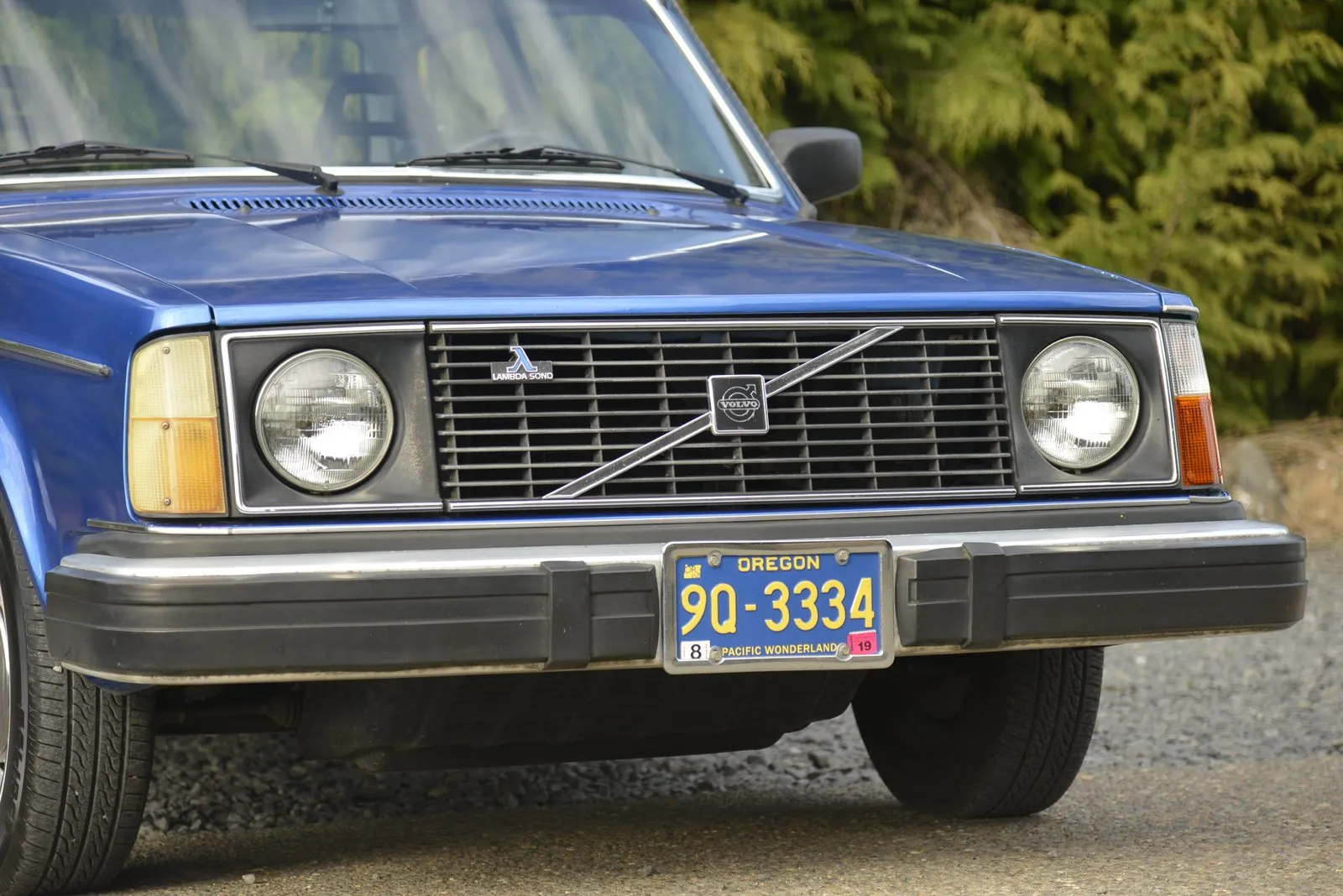
The Volvo 200 Series ran for 19 years and 2.8 million cars, and many still consider it the definitive Volvo for its brick-like styling and sensible-shoes dependability. However, its most important legacy lies under the hood: Late-’70s Volvo 240s like this blue 1979 242DL were the first production application of the single most important engine technology of the past 50 years: the three-way catalytic converter with oxygen sensor feedback control.

Since the Volvo 200 Series has gotten a lot of love on Curbside Classic over the years, I’m not going to recap its origins or try to summarize the many minor changes it received over its 19-year history. (For more, start by checking the CC archives for the articles by Volvo veteran Stephen Hansen.) Suffice to say the Volvo 240 was a moderately upscale, very conservative Swedish family sedan and wagon line with a reputation for safety and durability that kept buyers coming back, despite the blocky styling, safe but stolid chassis dynamics, and merely adequate performance and fuel economy.

When the four-cylinder 240 arrived in the U.S. for the 1975 model year, it was initially powered by the 2-liter pushrod B20 engine from earlier Volvo cars. (The six-cylinder 260 had the new 90-degree Douvrin V-6, an unhappy Peugeot-Renault-Volvo co-production.) For 1976, the B20 was replaced in U.S. 240s with the new 2,127 cc overhead cam B21F engine, with an aluminum head, Bosch K-Jetronic mechanical injection, and 102 net horsepower (99 hp in California). Road & Track tested a California-spec 242DL with the four-speed-plus-overdrive manual transmission in April 1976, recording 0 to 60 mph in 13 seconds, a 98 mph top speed, and 21 miles to the U.S. gallon. Like I said — adequate, but only just.

Since 1973, however, Volvo engineers had been hard at work on something really new. With urban air pollution growing worse, U.S. federal and California state emissions regulations were becoming progressively more stringent, and U.S. standards were starting to be imitated in other countries, including Japan and Australia. Unlike the early emissions standards of the late 1960s, the latest emissions regulations required simultaneous control of hydrocarbons (HC), carbon monoxide (CO), and oxides of nitrogen (NOx), posing many difficult technical challenges.

Volvo turned to West Germany’s Robert Bosch AG, which was then pioneering a revolutionary new emissions control strategy combining a three-way catalyst with “closed-loop” feedback control. The three-way catalytic converter was the holy grail of emissions control, a single-bed catalyst that could simultaneously convert HC, CO, and NOx to CO2, nitrogen, and water vapor. The problem was that making it work required very close control of the engine’s air-fuel ratio — much closer than was practical for a passenger car engine of the ’60s or early ’70s, even with fuel injection.

Bosch had a solution: inserting an electronic sensor into the exhaust system to measure the oxygen content of the exhaust, upstream of the catalyst, and then using that data to automatically adjust the engine’s air-fuel ratio in real time, based on actual operating conditions. This made it possible to keep the air-fuel ratio within the catalyst’s “sweet spot,” whether at idle or in stop-and-go traffic. In 1973, Volvo became the first automaker in the world to begin serious work on adopting this technology for production cars.

Early tests involved the latest Bosch L-Jetronic electronic injection system, but Volvo had only just switched from the earlier D-Jetronic to the simpler and more reliable K-Jetronic, and wasn’t keen to switch again. Bosch developed an electromagnetic frequency valve that could vary the fuel metering within the K-Jetronic system in response to signals from the oxygen sensor. Volvo called this system “Lambda-sond”: In engineering-speak, “Lambda” (written with the Greek letter λ) is the term for air-fuel ratio, expressed as a fraction of the ideal stoichiometric ratio, while “sond” is how you say “sensor probe” in Swedish.
In November 1974, Volvo delivered a 242DL with a prototype Lambda-sond engine to the EPA for preliminary emissions testing. With its three-way catalyst and feedback control system, it comfortably met federal HC, CO, and NOx standards without the air injection or exhaust gas recirculation systems required on production Volvo cars, and it returned 2.8 mpg better mileage than a standard 1975 Volvo 245 provided for comparison. With some further revisions to the catalyst and spark advance, the Lambda-sond engine could meet California’s more stringent forthcoming HC, CO, and NOx standards while still returning about 5 percent better fuel economy than a 1976 California 240 with air injection and EGR. With some fine-tuning of the sensor and regulator settings, the new system passed the EPA 50,000-mile durability tests and California assembly line testing. The three-way catalyst also didn’t increase sulfuric acid emissions, something that was becoming a problem with two-way oxidizing catalysts.

Volvo made Lambda-sond and a three-way catalyst standard on California cars for 1977 — the first production cars in the world to be so equipped. Lambda-sond was offered on most U.S. 200 Series models starting in 1978, and it became standard on all U.S. Volvo cars for 1980. The feedback-controlled B21F engine initially had 101 hp and 111 lb-ft of torque (later increased to 107 hp and 114 lb-ft). Volvo claimed it was up to 12 percent more fuel-efficient than the 1976 engine. A 1978 Volvo 242 or 244 sedan with this engine, a manual four-speed, and the optional overdrive also rated up to 24 mg on the contemporary EPA combined scale. Its driveability was good, too, which wasn’t something that could be taken for granted with new cars of this time.

Volvo was very proud of it: Lambda-sond cars started getting their own little grille badges (with the name styled as “Lambda Sond”). Volvo also somehow convinced the U.S. Patent and Trademark Office to let them register “Lambda Sond” (a very generic technical term) as a trademark.

Buff book reviewers just shrugged. They were tired of hearing about clean air, and even a racy-looking Volvo 242GT with Lambda-sond had only 101 hp to push 3,000 lb of Brick, which didn’t exactly get the juices flowing. The car magazines were more interested in later adopters of the same Bosch technology, like the Saab 99 Turbo.
If they had realized what it would all lead to, the enthusiast magazines would have thrown Volvo a parade. Before the Lambda-sond system, most solutions for meeting tougher emissions standards had come at a heavy cost in performance, driveability, and fuel consumption. Feedback control gave auto engineers an extraordinarily powerful new tool for developing engines that could comply with emissions standards (and remain compliant for 50,000+ miles) while producing more power and better fuel economy, at a time when it seemed like all anyone could expect in future cars was “less” and “worse.”

It didn’t happen overnight, or all at once. Performance began to return to U.S.-market production cars in the early ’80s, but it was a gradual process, with some false starts and half-measures. (It took more than a decade before automakers accepted that the best way to integrate feedback control was with digital engine management and electronic fuel injection, rather than carburetors or mechanical injection with Rube Goldberg electro-mechanical pressure regulators.)

However, by the late ’80s, things were definitely getting better, pretty much across the board. By that time, three-way catalysts with feedback control were so ubiquitous that they were taken for granted, but they were, and remain, an absolutely indispensable technological foundation of all the reliable, high-tech, emissions-compliant performance engines that have followed.
Volvo didn’t invent this technology (we can thank Bosch for that), but they were the first to do the hard work of applying it to regular production cars in the real world.

The rough-around-the-edges 1979 Volvo 242DL pictured here doesn’t look like anything special, and for the most part, it’s not. It wasn’t fast, exciting, or notably luxurious even in 1979. Since Volvo built a total of 2,862,573 nigh-distinguishable 200 Series cars through 1993, with quite a few still on the road, it also can’t be considered particularly rare. Only the most dedicated Volvo fanatic would probably give it a second glance.
However, it remains a landmark in the history of production automobiles. The early Lambda-sond Volvos mark the precise point where the tide began to turn — when balancing performance, low emissions, and decent fuel economy went from an impossible dream to a solvable problem. Every modern production car, truck, or crossover with a spark ignition engine owes them a significant debt.
Related Reading
The Volvo 240’s U.S. Journey – Chapter One (by Stephen Hansen)
The Volvo 240’s U.S. Journey – Chapter Two (by Stephen Hansen)
The Volvo 240’s U.S. Journey – Chapter Three (by Stephen Hansen)
Curbside Classic: 1979 Volvo 244 DL – Swedish Sense And Sensibility (by Brendan Sauer)
Curbside Classic: 1978 Volvo 245DL – The Quintessential Volvo (by Tom Klockau)
Curbside Classic: 1982 Volvo 244DL – Best Value Box (by Tom Klockau)
Volvo: A Swedish Perspective (by Ingvar Hallstrom)























The Volvo 2 series is surely among the 10 best cars made in history.
+1
Let’s say, among the 5 best cars ever.
Had one these exactly, in green. Outstanding vehicle.
Even today, I am grateful for the many engineering, and technical advances, that came from this era. That have evolved, and we continue to appreciate. Great, in-depth info here. Thank you!
What a pleasure to have access to Aaron Severson’s writing. My families ’80 244DL was light years ahead of the succession of Chrysler products that preceded it in terms of smooth drivability, ease of starting in all weather and overall quality. I’m surprised to learn its status as a innovative solution to cleaner emissions.
I remember reading aboult Lambda Sond, and seeing material at the dealer, but never experienced it on a Volvo. The family 164E used D-Jetronic and my earliest K-Jetronic VW could pass emissions without a catalytic converter. My 84 Jetta did have the same basic system with an oxygen sensor and a frequency valve on the K-Jetronic and worked fine. As I recall some late 80s VW tuners would stick a potentiometer in the oxygen sensor line to fool the system into running a richer mixture, I wonder if anyone did that with a Volvo?
Oh yes along with the Mercedes 123/124 series and Peugeot 504..the French Mercedes.
Could never understand why two door sedans were so popular in the US. ..
The only one I saw was an automatic in a car auction. It looked good until I spotted the pike of transmission fluid cans in the rear!.
Great article, nice to get comprehensive look at this issue. I recall Motor Trend had a laudatory story on Lambda Sond around 1977 or so, when the first California Volvos with the system were being sold.
I had a 1980 Volvo 242DL that was purchased used in 1982. It had the 4-speed manual without overdrive and had the badge on the grille (shown below); the car was so durable that I kept it until 2003 with about 245,000 miles accumulated by that time. Aaron, you are correct that horsepower (107 on mine) and fuel economy (averaging 22-24 mpg) were only adequate.
I test drove a new California model 242 in the summer of 1977. I ended up deciding that I wanted something more exciting and for a few other reasons, ended up with a used 1975 Alfetta. But I recall being impressed with the Volvo’s drivability and yes, refinement, compared to most of the other new cars I test drove that summer. One of which was the Saab 99 EMS. Another was the Chevy Monza Spyder. An eclectic bunch …
Great article. Volvo’s role in getting it into actual cars on the road is probably pretty-much unknown, but surely the most important part of that tech’s advancement. Every maker since does indeed owe a debt.
Volvo’s environmental care core value is on full display here. Great article that is well written and non-engineering types can understand.
This legacy is still being practiced with the clean and dependable D11 & D13 diesel engines used in US Volvo commercial trucks along with the MP7 & MP8 in the sister Mack brand.
Well-written, researched and informative article about a a revolutionary technical achievement that hasn’t received the attention it deserves. Kudos Aaron!
Great article. Epic move on Volvo’s part, pioneering technology that ulimately allowed for performance, fuel economy, and lower emissons. I remember Moter Trend did a big piece on Lanbda-Sond when it was introduced.
Volkswagen adopted a very similar system a few years later, Bosch KE-Jet. It was used until a late 80’s on some cars. Those frequency valves (sometimes called DPR’s) used to buzz, which could be quite noticable if the insulator clamps degraded.
Full marks to Volvo as the pioneers. Oxygen sensors were a game changer. As the resident Bimmerholic I have to add them in, they started 2 years later on the 528i in ‘79, a performance car that drove rings around most V8s of the era, and with lambda dramatically increased real world performance, reliability, longevity and economy. Showing it wasn’t just an economy car technology.
Which brings me to my conclusion, the catalyst is generally regarded as the game changer in the emissions/performance world, but I would argue that it was the O2 sensor, or the two combined that really changed things. Cats do good things, but they can only do so much. Air/Fuel has to be close, very close, for cats to do their thing, reliably, especially with Nox. Without the O2 sensor they can’t keep the A/F close enough.
Decades ago now at work, working with big boilers, 250 Boiler HP, which means roughly 8 foot by 25 foot, I was surprised they too had to pass smog, at least here in California. They ran natural gas, which is a pretty clean fuel, but they ran hard and long, often at max capacity. Nox was the hardest thing they had to pass, (only? I don’t recall HC or CO) and they had to be super clean. Which they did with the help of an oxygen sensor.
One of the items that made the LAMBDA- SOND possible was the microprocessor (computer chip). By the mid 70’s the microprocessor in the Electronic Control Module could read the O2 sensor, read the corresponding algorithm or look up tables, and adjust the fuel mix in milliseconds. This precision reduced the issues of hesitation, stalling, surging, etc which was common on cars in the early stages of emission controls via pneumatic and vacuum hoses.
Today, you have dozens of control modules in your car controlling you engine, transmission, doors, lights, not to mention that Info system on your dash board.
In the past, Die Hard would brag its batteries would last 4 to 5 years. If you notice, few battery companies make that claim today. On my last two cars, I’ve noticed the batteries don’t last more than ≈36 months. I have been advised by a tech that a weak battery can confuse the sensitive modules and kick out needless error codes.
The original Lambda Sond system did not use microprocessors, it was an analog system. Obviously, feedback control works better with digital controls that can compare sensor data to a lookup table rather than just a reference voltage, but the early Bosch system didn’t do that, and Volvo originally used it with K-Jetronic mechanical injection.
That’s interesting. There was a lot of sulphur in gasoline at the time, and sulphuric acid emissions were a highly noticeable (rotten-eggs exhaust odour) artefact of early catalytic converter setups with sloppy, mostly carbureted fuel systems. This was even used by the usual suspects as a lever to try to get converters banned (or at least the emissions standards relaxed and delayed) on ginned-up fears of death by sulphuric acid poisoning.
But I don’t know a mechanism by which a 3-way converter would nullify the sulphuric acid emissions; how does that work? Or is it just that the much more precise fuel metering stopped the overly-rich mixtures which had tended to aggravate the eggy grossness?
This is a very complicated question I’m not really qualified to answer: Automakers and the EPA spent a lot of time in the late ’70s trying to figure out exactly why the rotten-eggs smell was happening (mechanically, not just “Hey, that’s some kind of sulfur reaction”) and what might be done about it, and so there’s a whole stack of technical papers on this subject, of which I have read only a small portion and understood less.
Sulfuric acid emissions in catalyzed engines appear to depend on a combination of mixture richness, catalyst material, and catalyst temperature. More modern three-way catalysts can still be prone to it, which some researchers have theorized is a product of fuel sulfur being stored on the catalyst and released as it heats, albeit to a lesser extent than oxidization catalysts, and under different driving conditions (cold start versus hot cruise).
To the (limited) extent that I understand it, I would say that tighter control of AF ratios seem to be a factor in reducing sulfuric acid emissions, but probably only one factor.
A bit of an import from European culture, I guess; in the early-mid ’90s I marvelled at recent-model cars in Europe factory-festooned with badges like CATALYST or AIRBAG or TWIN AIRBAGS. And BMWs proudly declaring Dieser BMW fährt voraus. Mit Katalysator-Technik. (“This BMW leads the way. With catalyser technology.”)
I thought that Saab also used the Lambda Sond system in 1975.
In 1978.
Never been my favourite car by a long way but the significance of this development and Volvo’s commitment to it is fully deserving of note