
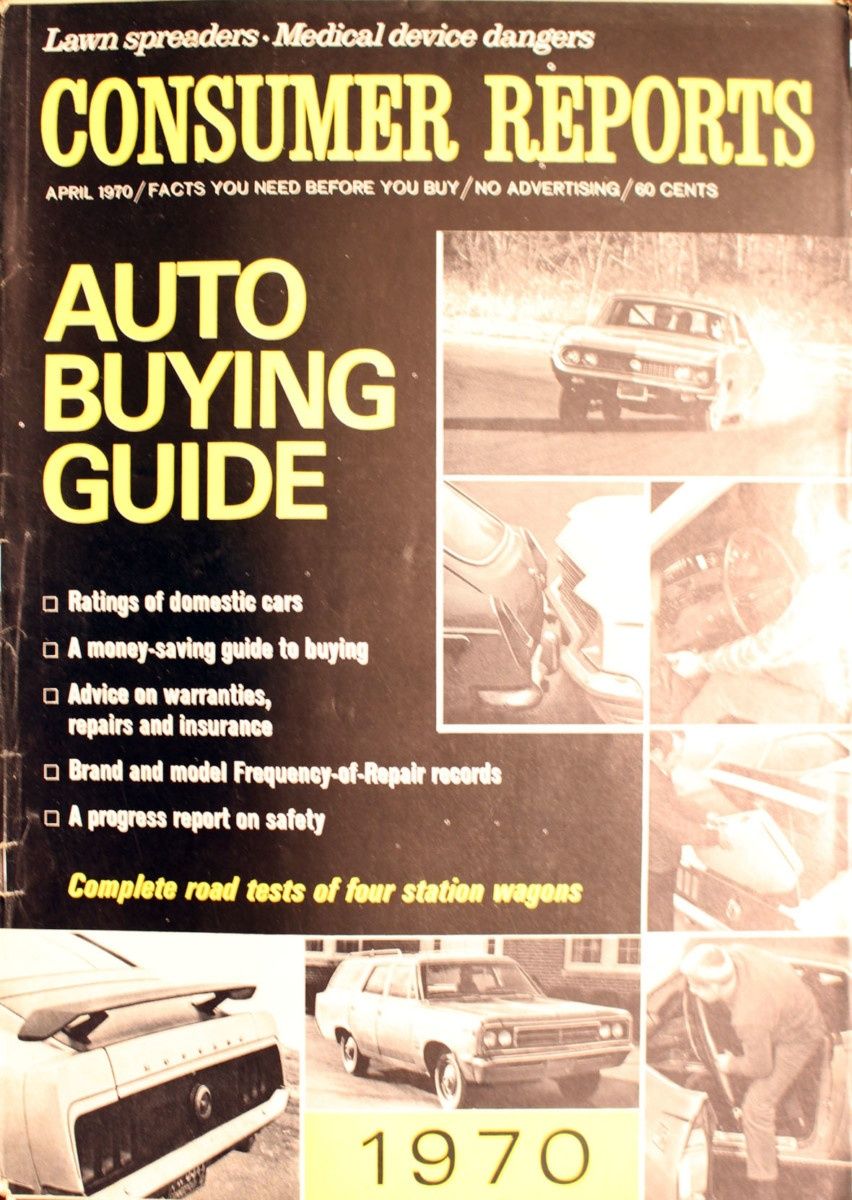
We now move solidly into the 1960s with this automotive issue of Consumer Reports. The winged, chromed monsters of the ’50s are now heading into the junkyard en masse, and a whole new crop of Detroit iron has been produced. But how do we separate the wheat from the chaff . . . ?
With this, of course:


Compared to previous years, there is more uniformity–few cars are outstandingly good or bad. Foreign cars (to my knowledge, last rated in the October 1964 issue) still are not included. However, we now have ratings for vehicles that have not been listed before: Checker, Chevy Van and Suburban, Dodge Sportsman Wagon, Ford Club Wagon, and Jeep.
Highlights:
–Most reliable used car (full-size): 1965 Plymouth Belvedere with a six. Valiants and Darts from the same era also continue their winning ways.
–Most reliable new car: 1970 Ford Maverick. Really??? (You could knock me over with a feather!)
–Least reliable used car: 1968 Corvette. Also bad: Thunderbirds (all years) and Chevrolet, once the quality King of the low-priced field, has a lot of black circles. (What’s up with Chevelles in particular? Body, exterior [paint, rust, corrosion] much worse than average.)


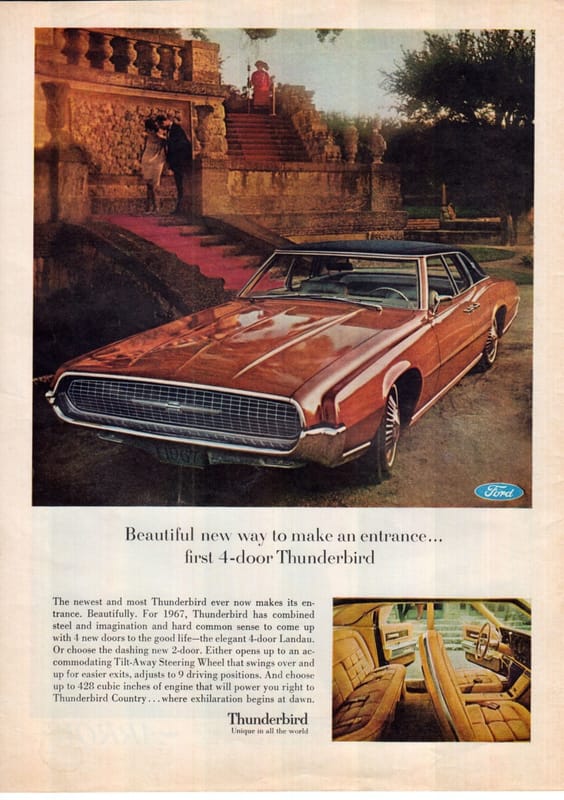


As one Ralph Caplan, writing in the April 1965 issue of CR stated: “The cars of [this era] are not ugly; they are merely boring and charmless.” “A world full of Volkswagens could be a pretty dull place, but the 1965 American models have found other ways of achieving the same sort of anonymity.” That’s a completely understandable position given what had come before: the Magic, Rocketing ’50s; the Art Deco/Airdreme 1935-40s; and the revered Classics of the 1920s-early ’30s. Typical cars from 1964-70 are boxy and plain, although there were a few sparks of inspiration seen in various specialty models. Caplan singles out the 1965 Corvair as “far and away the best looking car of this year’s lot. Sculptured to a restrained swell, it combines voluptuousness with an air of intelligence and some conviction; it looks well thought out, as if it were designed from an idea instead of from pressure.”

In other news . . .

1964-70 was really “the calm before the storm.” The next decade would see the emergence of gas shortages, hyper-inflation, plunging product quality and low morale at U.S. auto assembly plants; “Deadly Sins” (GM’s and others’), market fragmentation, the rise of imports, increasing regulation, the Great Brougham Epoch, and a general sense of alienation and defeatism broadly defined as “Malaise”. We’ll see what Consumer Reports had to say about those cars in our next installment.
Previous entries: 1954-63, 1960-66























Domestics only in 1970? Too bad I was hoping to sed how the brittish cars fared against american cars.
A safe bet might be those black or grey dots regarding the ‘Body, exterior’.
And electrics. Electrics supplied by Lucas The Prince of Darkness.
My current a previous cars are both French but both suffered the same starter motor failures which was made by Mitsubishi
my current and recent classics are both lucas equipped Hillmans and both are/were electrically reliable start when you turn the key cars
Didn’t sell many British cars by this point so I suspect the sample size would be the issue.
What were the criteria for hiring a Consumer Reports staffer? Did they get a green dot or a gray dot for sense of humor? Likelihood to make an emotional decision? Number of parties they’ve attended? The interview process probably took years and involved dozens of data points.
They were probably right about the Corvair’s looks, however, as any number of publications agreed with their assessment of its styling. Car Life commented several times about the similitude among most American cars of the mid-’60s, with only the Corvette, Corvair, Toronado, and Riviera really standing out. People have been saying that for years about cars anyway – has there ever been a time where consumer products didn’t emulate each other? Look what happens when they do stand out – the Aztec, the Pacer – they gain a cult following years later, partially thanks to movies and TV, but they’re lambasted for the limited amount of time they’re on sale.
In the mid 70s I was told by a knowledgeable adult in my life that the used cars built between 1964 and 1967 were a real sweet spot. His reasoning was that it was before the emissions tuning became a thing and you could expect almost everything to run well without much fuss. These CU ratings bear this out, by and large.
Again, these are pretty accurate based on my experience. I have long said that my 66 Fury III was one of the best daily drivers I ever had, and the solid green dot for its overall rating bears this out.
These charts always have mysterious results, like for the 66 Ford 8s (like my father’s Country Squire). Every single dot is white for average but one, a light gray for heat and a/c. Which earns the car a below average rating overall. I would love to have seen the raw data on that.
You have to wonder, if they had included all the japanese and german brands how much would that push down the american brands? Would a green dot be white? Would a white dot become gray? The japanese and germans were setting the high bar back then allready but CR left them out here.
CR was a fine reference source for vacuum cleaners, window unit air conditioners, televisions and vcr’s.
For my automotive reference sources I preferred “Car & Driver” magazine. CR’s all time favorite recommended car was a Rambler American. Need-I-say-more ?
CR’s all time favorite recommended car was a Rambler American. Need-I-say-more ?
I’ve heard you say that repeatedly. Could you provide some citations or other to back that up? It sounds a bit hyperbolic. But if it’s true, that would make a good post in itself.
The Rambler American came in third place in Consumer Reports’ June 1967 test of compact cars. The order of finish was Valiant/Falcon/American/Chevy II.
mark, I use both Consumer Reports and the enthusiast magazines, and feel that each has a legitimate use in my car buying decisions.
Especially when I was a bit younger and money was more scarce, Car and Driver helped me build a list of cars that would be comfortable and enjoyable to drive, while Consumer Reports helped me narrow that list to cars that were affordable and reliable.
It seems CR’s recent automotive staff is composed of car enthusiasts compared to the old days when cars at CR were just another consumer appliance, and written about very dryly. Conversely, Car and Driver has become more Consumer Reports-y in the last decade (at least online), frequently publishing buying guides, with a good deal of their online content aimed at routine new car buyers rather than enthusiasts. This is probably necessary for survival in the internet era; there are loads of car sites and blogs, but C/D is amongst the few that formally test cars on test loops, weigh them on scales, and the like (albeit usually with cars provided by manufacturers; CR buys cars anonymously to prevent being slipped ringers).
When I read the last sentence of the Subaru piece (“But the reported marketing practices of the SAburu distributor…”) I realized that someone at Consumer Reports was able to see 35 years into the future.
Personally I’m not surprised by the Maverick, although I’m relying on a sample of only one unit. It’s simplicity and familiar parts/assembly made it reliable enough to survive the abuse of three newly-licensed teens in my family – and as the third in line to use it, I can attest that it still shined after a wash and wax, and ran reasonably well. My brother also had a Grabber, which served him well for 7 or 8 years.
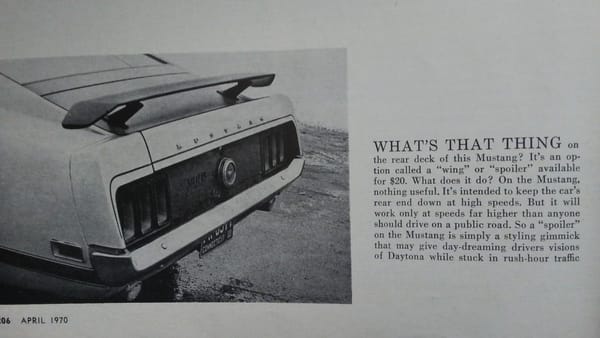
And thanks for including the Roy Doty illustrations in the last photo! Brings back fond memories of “Wordless Workshop.”
Time warp time: Stick shifts still are described as fully synchronized. I have no idea when they stopped being so in US cars, but buyers at this time will have remembered.
Actually non-synchro was around for a while.
https://www.curbsideclassic.com/automotive-histories/transmission-history-the-last-three-speed-manuals-with-non-synchronized-first-gear-grinding-gears-until-1976/
Oof. We had a fine 1976 Dodge truck with a column three. I had a bit of driver training on it. No idea we were so close to non-syncro.
I would certainly hope the Maverick had low frequency of repair: the oldest ones were less than a year old at the time. By today’s standards we’d expect perfection.
It wasn’t the only new car, sorry you were disappointed by its success.
Some takeaways:
– The delineation between “domestic” and “foreign” was so simple back then, before captive imports, foreign companies with factories in the U.S., U.S. companies moving production to Mexico, and companies like Stellantis blurred that dichotomy.
– Although not mentioned by name, Malcolm Bricklin brought the Subaru 360 to America. CR would get another chance to skewer Bricklin with the Yugo. (did CR ever test a Bricklin SV-1?)
– Mopar’s slant six living up to rep.
– Surprised to see Checker in the ratings; not something I think of as a consumer vehicle although they did sell them to private customers in small numbers.
– No pickup trucks yet, but we do get passenger vans from each of the big 3. And only one SUV, the “Jeep Station Wagon” (these were nearly all Wagoneers during the ’64-’69 time period; the model called Jeep Station Wagon was dropped in 1964 with a few unsold leftovers re-VINed as ’65s). Surely the Ford Bronco outsold the Checker Marathon, though perhaps not with CR subscribers.
Someone mucked with the proportions of the Maverick in the St. Louis dealers newspaper ad to make it look like a sports car.
It’s quite a stretch to claim that CR was conspiratorial and pro-Detroit regarding imports during this time. It’s even more to read into this that imported cars would have shamed Detroit if they were included. This doesn’t include foreign brands, and the folks doing this CR work are mostly passed on. No need to shame anyone or any car in comparison to what was not compared.
Back in the early 1960’s, Ford made a very big deal about adding a synchronized first gear on their standard three speed transmissions. They referred to them as a “3 and 1/2 speed” transmission. That synchro on first did make it a usable driving gear, not just a gear to start out in. With a non synchro first, you usually would have to almost stop the car before you engaged first, unless you were an expert and rev matching and clutch engagement. In the magazine ads, I love how Ford showed their cars driving along dirt and gravel roads in the desert to show how sporty and rugged they were.
Building on my previous scrutiny of CR’s ratings for the ’61-’65 Valiant and Dart/Lancer, here’s a cut-together of the relevant panels for the ’64-’69 Valiants and Darts. Here again, there are differences not plausibly explicable by anything about the cars themselves, which I continue to think indicates flaws in CR’s methodology.
As to the Ford Maverick being the most reliable car: I have some difficulty swallowing this claim. This was the April 1970 issue of CR, which probably hit newsstands in early March. That means it probably went to press in the first week of February or so. Working backwards from there, they needed time to write up their findings, tabulate their analysis, analyse the data, collect the data, and celebrate holidays such as Christmas or Chanukah, New Year’s Day, and New Year’s Eve, which I guess puts us sometime around mid-October for a deadline/cutoff to receive completed owner surveys.
The Maverick was launched on 17 April, 1969. Is six months really long enough to establish anything about a new car’s dependability? I guess you could get a decent first sketch on build quality; fit and finish, and dealer prep, but beyond that? Really?
It does seem premature to render that judgement. On the other hand, the “all-new Maverick” was just a rebodied Falcon six, and the 1967 and 1968 six-cylinder Falcon had compiled a decent record (although not the best among all domestic vehicles).
I’ve got to agree with Daniel here. Not on the Valiants and Darts specifically, but on car families. Now there are few if any here who dislike GM more than I do, but they had A/C down pretty good back in the 60s, better than in the 80s and 90s IMO. But vastly different ratings on similar, but differently named cars? Naw, it just doesn’t work that way.
Flash forward to the what, late 70’s, early 80’s and Chryslers Omni/Horizon twins came out. CU rated them as unacceptable handling because in their tests where they took the steering wheel, cranked it 90 degrees, let go and it did crazy things. But the land yachts of the era were ok? They were in over their head, they should have stuck to washers and lawn mowers.
The poor showing of the Chevrolets as the decade wore on may reflect the creation of General Motors Assembly Division (GMAD). GM management, over time, transferred control of the assembly plants from the divisions to GMAD. It’s my understanding that GMAD initially assumed management of several Chevrolet plants. Observers claim that one impetus for GMAD’s formation was to make it harder for the federal government to break up GM on antitrust grounds (the most common proposal involved spinning off Chevrolet cars and trucks from the rest of the company).
DeLorean, in his book, claimed that GMAD-run plants accepted subpar parts that were rejected by the plants that remained under the control of the divisions, and ran the lines harder to boost output – with little regard for quality. (This also soured labor relations.) He also claimed that vehicles from Chevrolet’s Tarrytown, New York, plant were so badly assembled that dealers were complaining to management about them. But not much, if anything, was done about this, because the plant manager was rewarded for meeting production goals, regardless of the quality of the vehicles that were pushed out the door.
Interesting that reliability drops after the 1967 model year for the Chrysler Corporation full-size cars and intermediates. Perhaps this was at least partially a reflection of Townsend’s Sales Bank, which often had vehicles sitting outdoors for weeks – exposed to the elements – until dealers could be cajoled by corporate sales staff to buy them. It does contradict the common belief that the corporation’s quality decline began with the introduction of the 1969 C-bodies.
The Maverick was, basically, a reissue of the 1960 Falcon with updated fastback sheetmetal that, as CR noted, cut into rear seat passenger room and driver visibility. Other than the minimal safety and emission control equipment of the time, every mechanical component of the Maverick had been in use and production for a decade. It would have been embarrassing if Ford hadn’t worked most of the bugs out in that time.
“The cars of [this era] are not ugly; they are merely boring and charmless.” 1965 CR
Now, car fans all over the internet say “the 60’s was the greatest time to be an enthusiast”. And millions spent on vintage 60’s cars.
Shows that rose colored glasses change how the past looks.