

Most people in the US would tell you the Excel was the first Hyundai model. They’d be wrong. Most people in Canada would say that it is in fact the rear wheel drive Pony. They’d also be wrong. The Pony that came to Canada was actually the second generation of the Pony. Before that Hyundai built European Ford licensed cars. Hyundai got its automobile start in 1967 by building the Ford Cortina and Taunus under license. These Ford licensed cars were actually built right up until 1976.

A few years later Hyundai decided to develop their own car. The first step was to recruit George Turnbull who had recently left British Leyland. Turnbull immediately hired a few good men (Kenneth Barnett, John Simpson, Edward Chapman, John Crosthwaite and Peter Slater) from Britain. Turnbull also bought with him a pair of Morris Marinas to examine. The result was not a direct copy of the Marina but the unibody structure was very similar while the suspension was very similar to the Ford Cortina: MacPherson strut front suspension and a leaf sprung live rear axle.
In fact the rear axle is identical to the MkII Cortina which I exploited when I was building a Lotus Seven clone and found a low mileage Pony axle in the scrapyard. Mitsubishi overhead cam four cylinder engines of 1.2L or 1.4L and transmissions where used to complete the drivetrain. The styling was done by Giorgetto Giugiaro of Italdesign in Italy. An interesting side bar is the Hyundai Pony Coupé concept car (below) of 1974 also by Italdesign which was meant to raise the profile of Hyundai and their upcoming Pony on which it was based.


The Pony (below) was revealed to the world at the October 1974 Turin Motor Show. Starting in 1975 the Pony was sold only in the home market but then also overseas in 1976. The year 1978 was when the Pony was introduced to various European markets and by 1981 had found its way to the UK. By this time the Pony was offered in a variety of body styles from three and five door hatchbacks, pickup and station wagon.


The MkII Pony came about for 1982 and it was a mostly a styling update that brought it into the 80s with integrated impact bumpers, square headlamps, and a plastic grill. Body styles where reduced to just a five door hatchback with a two door pickup in available in some markets.

In 1984 Hyundai brought the Pony to Canada where it was a hit in the low priced segment populated previously by East European cars. There were a few changes for the Canadian market like beefier bumpers and the use of sealed beam headlights instead of the flush lights. Sadly only the four door body style was offered. While mechanically crude in many ways with manual choke, points ignition and live axle it became Canada’s bestselling car that year.
A cut rate price Chevrolet Chevette is probably an accurate comparison. Canada never did get the 1.2L engine but started off with the 70hp 1.4L engine paired with four speed manual or a five speed manual in higher trim levels and optional three speed automatic. All Ponys had front disc and rear drum brakes.
In 1985 a 74hp 1.6L engine from the larger Stellar became available and with the bigger capacity engine A/C was offered for the first time. This 1.6L engine had seen duty in Mitsubishi Colts and its Mopar branded siblings of the 70s. I had a Hyundai Stellar with the 1.6L and five speed combination and while no performance dynamo it was quite an agreeable combination.
Trim lines included L, GL and GLS. The L being base with GL offering five speed transmission, uprated trim, tinted windows, clock, rear wiper/washer. GLS added even better trim including cloth seats and a AM/FM/tape stereo. Power steering available as an extra as well as A/C (with the 1.6L). Dealer add-ons included rear window louvers, air dams, spoilers, and fog lamps. Canadian sales went right through 1987 with it even being sold side by side with the front wheel drive Excel for a time. The early cars can be identified by the “HD” logo on the grill with later ones (after mid 1985) with the Hyundai lettering on the driver’s side of the grill.


The Pony was never sold in the US due to its inability of meeting emission standards. The US market Excel was initially going to be called the Hyundai Pony Excel but the Pony name was dropped before the first US sales. In Europe the Excel replaced the Pony and even continued with the Pony name. South Korea was the last market to offer the classic Pony and sales finally ended in 1990.
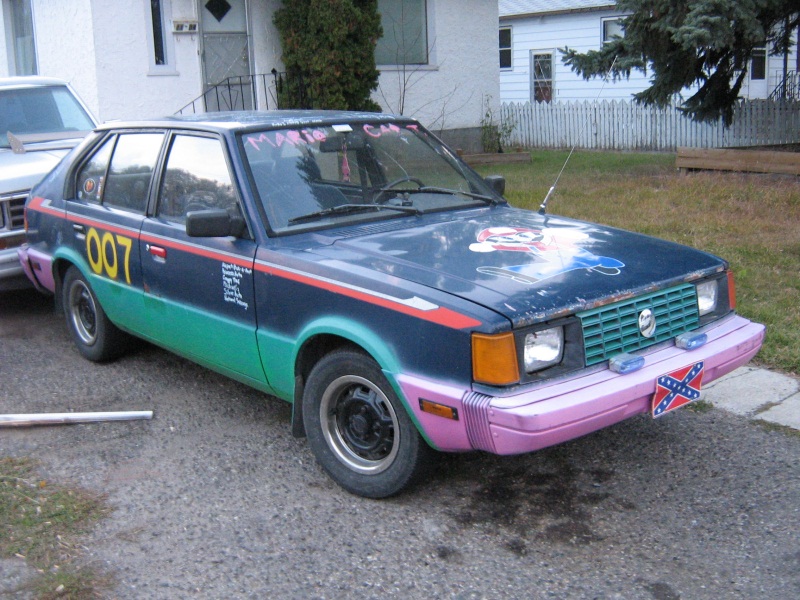
Sadly it is rare to see a Pony on the street these days. This local one has a very whimsical Mario Kart theme.


Out East rust killed them off very quickly. Simple neglect and lack of value killed them off in the West. Mechanically they seemed to be more robust than the Excel that followed. I’m more likely to see one in the scrapyard than on the road and even those spottings are slowing down.


Nice history. I know many of the current Chinese manufacturers are going to have histories like this in my lifetime. (Currently making old versions of VW ect then invade North America with their own cars.)
I was always confused by the Hyundai Pony as a kid cause the most stripped down Escort was known as the “pony” also.
excellent history. i’ve been to korea and there are virtually no survivors there. i was very excited to see a 1980s hyundai grandeur on the street and the koreans with me thought i was nuts.
http://en.wikipedia.org/wiki/File:20101003_hyundai_grandeur_001.jpg
I visited Toronto on business in ’91, and saw scads of these things on the road. Since they had never been sold in the States, at first I didn’t know what in the world they were, but I could tell they were popular.
A closer look revealed that they were Hyundai Ponies, which actually befuddled me even further. I was familiar with the U.S. Excel, but these obviously didn’t share that platform. I vaguely knew that Hyundai had Mitsubishi DNA, and concluded (from the angular front end and square eggcrate grille) that it was some kind of sedan conversion of the concurrent MItsubishi pickup–like a reverse Ranchero.
Think about it before you laugh at me–there is some resemblance….
I saw a Pony on the road in southern California with Canadian plates in the mid-90s. Given the horrendous reputation of the Excel I couldn’t imagine how clunky its predecessor must have been.
I don’t know what the rules are on allowing cars-that-don’t-meet-US-regulations to enter from Canada or Mexico, are they prohibited or is it OK for visiting vehicles that aren’t registered in the US?
I recall in the late 70s when Russian Ladas were sold in Canada there was a policy, or at least a rumor, that US customs prohibited driving them across the border, but don’t know if that was based on its regulatory noncompliance or just an unofficial exercise of Cold War spite.
It’s quite an incredible succes story , given both the Taunus/Cortina and the Marina’s reputation in Europe. Allthough the Taunus/Cortina range sold in millions, I don’t think even us enthusiasts will ever claim they were neither refined or reliable, allthough easy to work on. (they had to be, if they were ever going to last more than a year 🙂 )
Most japanese manufacturers started out the same way btw, but I guess most people are aware of that now.
I believe the Cortina had a fine reputation. The Marina on the other hand …
I am not sure that the Cortina had such a great reputation. They seemed to be sort of brittle, as many british cars were back then. My boyscout master had a 69 or so Cortina wagon. I thought it was one of the most attractive small wagons ever, but it gave him no end of trouble. By the time the car was 2 years old, one wiper had broken off, the shift lever had snapped off so that he had to shift it with vice grips, and the hydraulic clutch leaked enough fluid that if you did not drive the car for a few days, it needed a complete fill and a hundred pumps of the pedal to get the clutch back. I loved the car, but I am glad I did not have to pay for the upkeep. On the other hand, I can’t imagine the Hyundai version being worse.
Those old MK2 Cortinas were good cars the Lotus version was discontinued as Lotus discovered OHC Vauxhall engines instead of the Ford Kent but these things were very popular and fairly durable NZ even had its own model the GTE worth huge bucks if you can find one now sounds like your scout guy severly neglected his one as the problems are only minor and easy repairs I didnt even realise thesemade it to the states
The first car I owned was 1964 Ford Cortina “Estate car” (station wagon). I went on to own a 68 sedan which I later sold to my future wife to buy a 1967 wagon. I also owned a 1969 wagon. Sometime after the 1967 wagon, I worked in an auto repair shop near Washington, D.C. that specialized in British Fords (Anglia and Cortina, principally), Capris and Japanese imports. If a wiper comes off of your car, you get it fixed. If the shift lever snaps off it may be due to an early implementation of a Gov’t mandated snap-off safety feature. You get it fixed. If the clutch hydraulics leak, it’s because the seals are worn out. You get it fixed. These cars had their characteristic failures as most cars do, and every car is different, but they were very rugged, well-designed and reliable if the modest maintenance needs were addressed with reasonable care. These cars were raced with a great deal of success in Europe and America and were among the largest selling cars of their type in their time.
I rolled side over side 4-5 x according to the police officer in about a 1974 or older Cortina. There were 5 of us with no seatbelts crammed into that thing. Last thing I recall is my cousin saying “….and he switches into 5th” as we flew around a corner on a back country gravel road. Brilliant. We all survived, the Cortina did not.
The Pony and Stellar were fairly common sights in the Netherlands in 1984. The only time I can recall seeing a Pony in the US was when Jack Black did a belly flop on one, squashing it like a bug in ‘Saving Silverman.’
I was in korea a lot in early ’70s, and remember well many ex-ford types employed in Ulsan designing the factory. Do not remember them being very optimistic for this endevor. At this epoch the koreans were mostly building Japanese cars under license.
But then in the mid-50s remember Toyota or maybe datsun making Renault 4cv.
Think of china and remember he who laughs last, laughs best.
The factory was built in an incredibly short period of time – a record for Ford at the time.
Interesting stuff. I didn’t know most of this.
I saw a Hyundai Stella yesterday but no camera that was the last Korean Cortina the Mk4 pretty rare now the engine was the weak link Ford Cortinas abound in Aoteroa plety of 2l pintos about The Marina was complete crap so they dodged a bullet there but the Marina ended up in China, poor bastards thats a shocking way to start a caR industry just ask Bmw and Nissan
Like many newly-wealthy societies, Koreans have little nostalgia for the time when they were poor. Hence, there amost no fond recollection of older consumer products, cars included. Only the latest and greatest counts here. Couple that with suspect early quality, lack of maintenance knowledge in the early years, and a taxation system that can impose a negative value on old vehicles. It’s little wonder that virtually nothing old survives here. I’ve seen perfectly good cars scrapped here just because they were out of style. This applies to furniture and electronics, too. Also, Korean culture dictates a complete change of furniture every time they move into a new residence.
Given time, an expat here can almost oufit thier apartment with what’s found in the street. Just make sure you do it at night!
Having said that, someone near me has undertaken the restoration of one of the above pictured Pony Pickups. It’s a painted a jaunty non-stock Lime Yellow-Green and i’ll try to shoot it and send it in.
WRT to the licence-built Fords. The folklore has it that the son of the Hyundai Chairman Chung Ju-Yung was killed behind the wheel of a Mark 2 (square lined) Granada-This led to him banishing the Ford-licensed cars in favor of thier own designs, although, as pointed out above, the Stellar was essentially a reskinned Cortina with a Mitsubishi engine.
And Stellar it werent Korean suspension tuning was pretty ordinary then too and crap tyres very basic cars
Korean suspension tuning still is, for the most part. I haven’t driven the Genesis, but generally, their cars are set on “Mush”.
I had a Daewoo Prince (Opel Senator-Holden Commodore genes)that ostensibly had Lotus tuning. Didn’t seem to help much.
The only decent handling car I had here was the Daewoo Lemans, a Kadett E built in the dark. Probably because it was early model , and the Koreans hadn’t a chance to monkey with the specs yet.
I attribute this tendency to local conditions of high congestion levels and low average speeds. High speed prowess just seems less important than a soft ride here.
The face lifted MkII Stellar is quite different from the Cortina – at least the front suspension as it changed over to use struts.
Ive spent some time turning wrenches under a Hyundai van lately very well made with a gruntyCRD engine these guys do seem to know what theyre doing now The have got away from the Misubishi crap they built for years and are doing their own thing and better than their Japanese tutors4, The worst by product would be Daewoo but the new Cruz seems ok so maybe they have their act tight too those old Lemans were awful quality wise assembled in the dark is correct.
OMG saw a mint Pony on Sunday no camera in car rare sight but they were here new
I am afraid that David Saunders’ premise that the Pony contained anything from the Cortina or the Marina is completely wrong.
As I was the Engineer responsible for developing the car, and making the original prototypes, I can tell him that the floorpan was developed from the Mitsubishi Lancer of that time, under licence from MMC.
The Lancer was at that time, a very successful Rally Car, yet we actually wore though the floor when using one as a comparator on Korean Roads, which at that time were very rough.
Guigiaro made one concept car, and my Korean Team and I made the next six cars by hand. We designed and developed the Pick-up too.
I am the only one of the original British Team still alive!
Further to another comment elsewhere about the Factory.
Ford had no part at all in building the Factory, it was built entirely by Hyundai Construction, and was to make 400k cars a year. This construction included Press Shop, Forging and machine shops, as well as the Production Lines
It was built on reclaimed land in the river estuary, and the Koreans virtually took down a local mountain for the hardcore necessary.
The first cars were coming down the line in 10 months, and at Production rate in 11, and we made every part of the car, except the glass and the tyres.
We also made 25km of Proving Ground.
Congrads for still being alive, but the “experts” imported to Ulsan for setting up the factory where Ford US men. Saw at least 30 or more of them. Never saw a brit, but was not looking for them either.
Most of the cars I saw on the road where Korean versions of Japanese models. Do not remember English like Fords being much around. Driving in that country was a real adventure. And getting an Olds around town mighty interesting. We had the only white car in a sea of black.
Lambda, Anyone know if Hyundai kept one of these prototypes.
It was supposed to be built on the floor pan of the Pony.
Guigiaro Desgin. Apparently, the Dolorean concept was based on this Pony concept car as well. You can see the lines.
If only the Pony looked like the prototype!!!
There are still a few Pony’s running around Canada. Rust usually got to them.
Most first time car owners never really took care of these cars.
More on the Guigiaro design.
When I was working in Korea last year, I toured a car museum and could only find a few old Korean cars. The Koreans I knew thought I was crazy for looking for old Korean cars. I’m crazy in plenty of ways, but didn’t see that one coming.
First place I ever saw a Pony was in, of all places, Costa Rica, where they were quite common as red-painted taxis (and the pick-up versions were plentiful, too) for some years in the late 90’s/early 2000’s. Fewer and fewer on each subsequent visit, as parts for any car are hard to come by there (so your car better be either plentiful or dependable). As of my last visit, almost no sightings (2004).
I have a Stellar 1.6GSL and it still works. Very basic by today’s standards but it always starts and now so rare
There are still quite a few good conditions Pony’s around the world.
At a Local Car Show.
Look at the condition!
https://www.facebook.com/pages/Hyundai-Pony-and-Classic-Hyundais/342351645864653
In a Hyundai Dealership currently.
Low Mileage Car.
https://www.facebook.com/pages/Hyundai-Pony-and-Classic-Hyundais/342351645864653
Once owned by the president of Hyundai Canada.
Before that, it was owned by a little old lady. Dealer serviced.
https://www.facebook.com/pages/Hyundai-Pony-and-Classic-Hyundais/342351645864653
More Pony’s
https://www.facebook.com/pages/Hyundai-Pony-and-Classic-Hyundais/342351645864653
Still on the Road.
Fairly original 1.4L Base Model Pony. Sat for 8 Years and fired up and running again with little work.
https://www.facebook.com/pages/Hyundai-Pony-and-Classic-Hyundais/342351645864653
I had a 1990 Stellar 1.6 GLS until I sold it last year. Rear floorpan from Cortina, diff said “Pony” on it, Mitsubishi engine, electric windows, central locking, remote trunk and fuel opening, 5 speed box and lots more. A great package 20+ years ago
Even if Hyundai sold this Pony here in the U.S., it, being rear wheel drive, would’ve seemed out of place against the likes of similar-looking hatchbacks as the Dodge Omni/Plymouth Horizon, the Mitsubishi Mirage and Dodge/Plymouth Colt, and the VW Golf, all of which were front-drive.
And even if the larger Stellar sold here (which we first got as the Sonata for 1989), because that was also rear-drive, its only real competition here would’ve been the BMW 500 series and the Mercedes 190 (W201) series, as the Nissan Maxima was front-drive since 1985.
Power steering was never an option on these cars. Only Stellar 2.0s had that option (and it worked well, I had one for 10 years).
I remember the stellar had a lot of parts commonality with the mk3/4 Cortina. Suspension components would swop over between the two. That’s not much help these days, as Stellars are probably extinct by now.
I have a 1985 HUNDAI Pony pickup on the road today. 37 years in my hands. Excellent in durability, handling on the road, engine and gearbox. But there is a problem with plastic parts and there are no spare parts……it’s a shame it was discontinued.