
Paul’s post on the GM “Twin Six” was fascinating to me. While I’m sure I’ve seen mention of these, I really wasn’t aware of them in any detail and his brief overview expanded my awareness to yet another GM innovation that for one reason or another never really caught on.
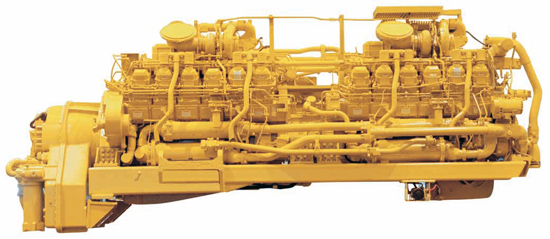
That got me thinking about another engine manufacturer that created a powerplant by marrying a pair of its existing engines in order to fit a specific application. In 1998, Caterpillar introduced the largest “off highway” mining truck the world had seen to that point–the 797–which was powered by mating two V12 Cat 3512 HD engines together to create the 7,147 cubic inch V24 3524B HD quad-turbo intercooled diesel engine, capable of around 3,550 HP and 12,000 lb.-ft. of torque at an easy-going 1,750 rpm. Fuel economy is a bit less than a Prius (or even the Peterbilt 218 Paul recently posted) at 0.3 mpg.

The 797 was unique in that Caterpillar decided to stay with a fully mechanical drivetrain as opposed to the diesel-electric drivetrains more common on trucks of that size. It has a seven-speed planetary gear transmission, all controlled by numerous on-board computers. The truck itself was also the first to be completely designed on computer.
The current 797F model, introduced in 2008, is powered by a Cat 175-20 twenty cylinder engine (single block) of 175 Liter displacement, which is rated at 4,000 HP. This enables the truck to carry a load of about 400 short tons (equivalent to about 120 Ford Excursions) at a top speed of around 42 mph (loaded). With a 44/56 weight distribution, a gross weight of well over a million pounds and a live rear axle, you won’t be running it through the slaloms. 0-30 times of about 27 seconds won’t win any points at the drag strip, either.

It’s hard to comprehend the scale of these trucks. For example, you’ll need a really big “four-way” wrench to change a tire on the 797. Each 12′-10″ tall wheel is attached by 47 lug nuts, each torqued to 2,300 lb.-ft. Six Michelin tires are required per truck and they’re the largest tires made on the planet–59/80R63 is the size if you need to order a set at Sam’s, and they’ll run you about $42,500 each (as of 2009).

The 3524B (and current C-175-20) engines are manufactured at Caterpillar’s Lafayette, Indiana engine plant and then shipped via flatbed semi to Decatur, Illinois for installation in the frame. The final assembly of the 797 is done at or near the customer’s site, and requires numerous semi loads to deliver. A team of seven mechanics will spend about twenty days working 24-7 to weld the dump body together and assemble the truck.

A new 797F will run you about $5,000,000, and can be completely rebuilt several times over its typical twenty year life. I was in Canada a few years ago at an Oil Sands mining site, which had about 100 trucks in operation at that time. Except for maintenance, these trucks are kept running 24/7 (time = money), and if you shut one down outside the shop in the winter, you’re not going to get it started again until spring!

To my knowledge, no-one has ever wrapped a beautifully streamlined aluminum body around the 3524B engine (Jay Leno, call your office!). But if you’re one of those “Men Who Has Everything And Just Needs Something to Carry It In,” I suspect the 797 will fit the bill perfectly.


Id like a job driving these things once my daughter gets old enough to look after herself Ill renew my passport and head to where these beasties roam.
Not sure about NZ, but You should be able to find plenty of these trucks at work in Australia Bryce. If you want to venture further there are all kinds of them in service up here in Canada.
I am pretty sure many of these are robot driven. See: https://medium.com/war-is-boring/bed4b2b5a70a
These are awesome machines. I recently had occasion to travel to a quarry where a Cat 990 loader was loading a truck of comparable size – but it sure wasn’t this big!
About 45 years ago we were on vacation in Minnesota. My father was always fascinated by manufacturing (I got that bug, too) and would stop for plant trips or anything similar. One stop was above the strip mine in Hibbing, where the then state-of-the-art big trucks were at work. They had a couple of old tires at the overlook–the small one used about a 36″ diameter rim, while the bigger one was about 72″. I saw a service truck carrying one of the tires. 1 ton (at least) truck, and the tire was a full load. (You still see such sights in ranch country, at least where the bigger tractors are used.)
Had a film about earth moving trucks when I was still teaching. A modern marvels IIRC. It started by showing something like this going down the road and (I think) a ford escort passing it by driving underneath back to front. It was pretty impressive. The whole thing was actually.
I have a Nissan hard body with a frozen engine. How much trouble to swap that in I wonder.
You might get the engine in, but don’t blip the throttle – you’ll flip the whole thing right over with all that torque!
So where do they go after their 20 year lifespan comes to an end?
Truck heaven?
I imagine another team comes to cut them up for the scrap yard.
Right. It’s actually the frame that determines EOL for the truck – everything else can be rebuilt virtually indefinitely.
If there were really lucky, they get put on permanent display like the Terex Titan in Canada.
Thanks; I didn’t know these had mechanical transmissions. I know the original giant truck (Electra-Haul, I think) was diesel electric, but the mechanical gears are undoubtedly more efficient .
I think Cat is the only ultra class haul truck with a mechanical transmission. The Komatsu 930E is one of the main competitors to the Cat 797 featured here, and has diesel electric drive. On the Komatsu, the engine runs a big alternator that drives motors in the hubs of the rear wheels. One advantage of electric drive is the wheel motors can be used as a retarder brake. Unfortunately all this energy is dumped as waste heat – it would be great if the battery technology was sufficiently developed to make a hybrid haul truck. Despite their outrageous fuel consumption, these trucks are actually quite fuel efficient when you consider how much they haul.
Probably a close-run thing between the few % lost in the electricity conversion, versus slightly better efficiency due to no change in engine rpms due to the electric drivetrain being effectively a CVT
Great article, and a superb complement to Paul’s “Curbside Classic Defined” post. The reason I love this site is the variety, and even if I’ve probably seen enough brougham posts to last me a while, I appreciate that someone loves them. Just as I love articles like this.
Still, wish I didn’t have to deal with the challenge of imperial measurements. I really struggle with cid as a measure of engine size, and I’d love it if these were routinely stated as both cid and cc. Mind you, anyone who can discuss weight in “short tons”, and give the alternative unit as Ford Excursions probably isn’t going to listen to me 😉 (btw, I can only guess what a Ford Excursion is – perhaps a day trip to Blackpool in a Ford Prefect???)
You make a good point, Chaz, and even though I work for a global company and have to keep that in mind when I have that hat on, I keep forgetting that CC has a global audience as well…
While it can get tedious listing metric/imperial units every single time, I’ll try to remember to do that when it will add clarity (as opposed to “color” using things like the Ford Excursion as a unit of measure – next time I’ll put that in VW Beetle units instead!).
FWIW, the weight of 120 Ford Excursions = 517 VW Beetles… (c:
An intersting question might be how many cylinders are used in the really big diesels in ships and railroad engines. I am not under the impression that they get much beyond 24, but I would appreciate some real information.
One of our product groups manufactures “medium speed” marine engines, and it looks like they range from 8 and 9 cylinder configurations up to V16 and V18 configs, the largest being around 43 Liters (19,700 cubic inches if I did my maths right) displacement.
Thanks for this article, brings back many memories of Northern Minnesota.
43 liters is 2,623 cu in’s. The only reason I know that is that a 4.3L Chevy has 262 cu in’s. Trying to convert liters to cubic inches or vice a-versa with out a calculator gives me a head ache. Growing up on the Iron Range and working in the Mountain iron pit by Chisholm I was always fascinated by these giants. When I had a break from shoveling the mud back on the belt on my beginners job; I liked to go up to the top of the plant and watch the giant crusher munch on rocks the size of full size pick-ups that the trucks would dump in it. They had two huge interlocking metal bars that would slam into the rocks, I always expected them to break instead of the rocks, but they would just munch them right down. The noise was deafening.
The most common submarine engines from WW2 were the 16 cyl GM 248 and 278. The Germans I understand also powered a battleship with diesel. They wanted the range it provided over steam. I am pretty sure that this thing puts out all the power one would have needed for those subs which, after all, was used to turn a generator.
BTW Ed. I am under the impression (until you probably correct me) that most of the earth movers use hydraulics for the power and the ancillary function of the machine. Immediate torque from zero rpm’s up. Just like a series wound electric motor.
If I forgot to say so earlier, this was a great article that centerpunched my interest.
The drivetrain in earthmoving machines will vary by the machine type, size, application and manufacturer. For example, the Cat D11T bulldozer has a mechanical drivetrain, the D7E is diesel-electric, and the smallest D3K is hydrostatic, for example. Hydraulic motors do have some losses – it’s the electric drive machines that have 100% torque from zero rpm.
Subs are of course diesel-electric. My Dad’s Fleet boat (Burrfish, during Korea) had four Fairbanks-Morse opposed piston engines, which, interestingly, is the same backup engine used in the USS Wyoming today…
By diesel-powered battleships, you must mean the Deutschland-class “Panzerschiffe” (“armored ship”), large cruisers with battleship-sized 11 inch guns, better known as pocket battleships. You are right that they used diesels for fuel efficiency and long range; they were designed with long range commerce raiding in mind. Each had four 54,000 shaft horsepower 9 cylinder two stroke MAN diesels powering two screws.
In my Political Science 101 class our prof posed a question-“Why do political scientists study any particular political system?” Collectively the class posited a number of deep and serious answers. But I was blown away by the pure simplicity of the prof’s answer-“Because we find them interesting.” I don’t remember anything else from that class (45 years ago), but I find the prof’s statement can be applied to so many things in life, as well as to Curbside Classic. We write and photograph this stuff because we find it interesting. I find 16-cylinder Diesel tugboat engines in 1943 International dump trucks that go 273 mph (439 kph) interesting. Some guys find gray 2000 Acuras interesting. The car doesn’t particularly interest me, but I am interested in the observations and driving experiences of the owner of the thing.
Nice job Ed. Anything Caterpillar gets me hot and sweaty.
I remember in my first year Philosophy class, we were all looking for me meaning of life. The professor was a man named Bob Lane, and he is the best teacher and finest man I have ever known in my life. He often took us out for beers after class, and when we asked him, “Bob, why do we study Philosophy?” he replied, “Because it’s fun!” When we asked him, “Bob, what is the meaning of life, he said, “Hell, we got beer and tobacco, that’s the meaning of life!”
There is really nothing here at CC I don’t find interesting in some way. Keep in coming! This is a really fun site, full of like minded guys having fun.
We are also nice to each other, which makes coming back a pleasure.
+1
If this beast has a mechanical drive train, and the engine is always running, it must have a clutch or a fluid coupling like an automatic. How is that practical at this scale?
It’s a lockup torque converter, that locks up at 4 mph. (Wikipedia) In other words it’s a 7-speed automatic.
I’d like to see the oil cooler on that transmission! Wheel it into Aamco for a quick fluid change, it’s only 166 gallons (629 L). How do I know that? Click through reference 12 of the Wikipedia article and it’ll download you the brochure, chock filled with ultra class truck porn.
Several years ago I visited Hibbing, Minnesota and also visited the Mesabi open pits mines just outside of the city. They had one of these beasts on display, although I’m not sure if it was one as in your article. This one had a diesel-electric drive, I do remember it had twin turbochargers for each bank on cylinders-a most impressive machine.
It’s the same size or bigger than my rental house. I’ll bet it weighs a lot more, too. 2 tires are the same price as the house! Great article, missed it the first time.