
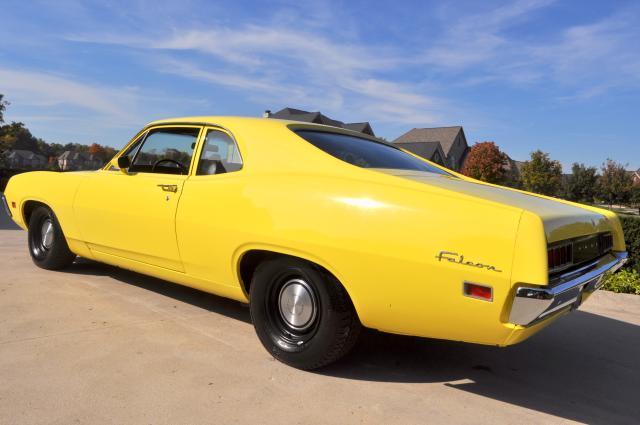
(first posted 1/1/2012) For most of us, the turn of the calendar represents a new (hopeful) beginning. A fresh start, if you will, to take stock, begin anew, or re-commit to what’s important. New Year’s Day is life’s reset button. So it was on this day 42 years ago when Ford re-launched a trusted marque that had, in its former life, defined what it meant to be sensible and thrifty. The new “Falcon” that buyers saw in showrooms that day was not in itself a bad car. But with an unclear purpose and a half hearted commitment by a management very much in turmoil, the last Falcon was an endangered species from the moment it appeared on the scene.

The original Falcon’s ashes weren’t even cold when FoMoCo pirated the name for a new sub model to be carved out of the Fairlane/Torino series in time for the new decade. The original Falcon had been made superfluous by the new for ’69 Maverick and imminent federal crash protection standards that the car couldn’t meet, and Ford pensioned it off in December 1969 after a short run of 1970 models.

Even before Ford released the Falcon as a “half year” model, there were many sub-plots taking place out of sight of the public at the company’s Dearborn, Michigan headquarters. The executive suite at FoMoCo had become, by 1969, a seething palace of intrigue and political infighting that threatened to split the company into warring camps. The corporation went through an entire year with no president after “Bunkie” Knudsen (above) was dismissed on September 2nd and remained rudderless during almost all of 1970. Characteristically, company chairman Henry Ford II had grown bored, resentful or just jealous of Knudsen and thus the way was paved for his favorite marketing Svengali, Lee Iacocca, to ascend the greasy pole to the company presidency in December 1970.

Thus the real history of who exactly greenlighted the Falcon of 1970 ½ is hard to pinpoint with any accuracy. More than likely, it was a collective effort of anonymous committee men with no real power to lose or perks to share. On the other hand, what would become the ’70 Torino was one of Iacocca’s favorite designs of this era. He approved it as a project after just a single viewing. This would explain the bizarre coming and going of one of the most obscure models ever intended for a mass market. The car would be gone in a season (literally) and leave no lasting legacy except confusion. To this day, even knowledgeable Ford watchers call it a Torino. This is the car that in a sense, never was.

One thing that is known is that the last Falcon would share the body developed in 1967 by Bill Shenk for the 1970 Torino/Montego twins. There would be some differences for the Falcon line (see below) , but the same basic car was offered as everything from straight six stripper Falcon at $2599 to a Mercury Cyclone for $3938.The Torino line won the Motor Trend “Car Of The Year” award for ’70, (which more or less affirmed Iacocca’s gut instinct) and sales marched smartly upward.
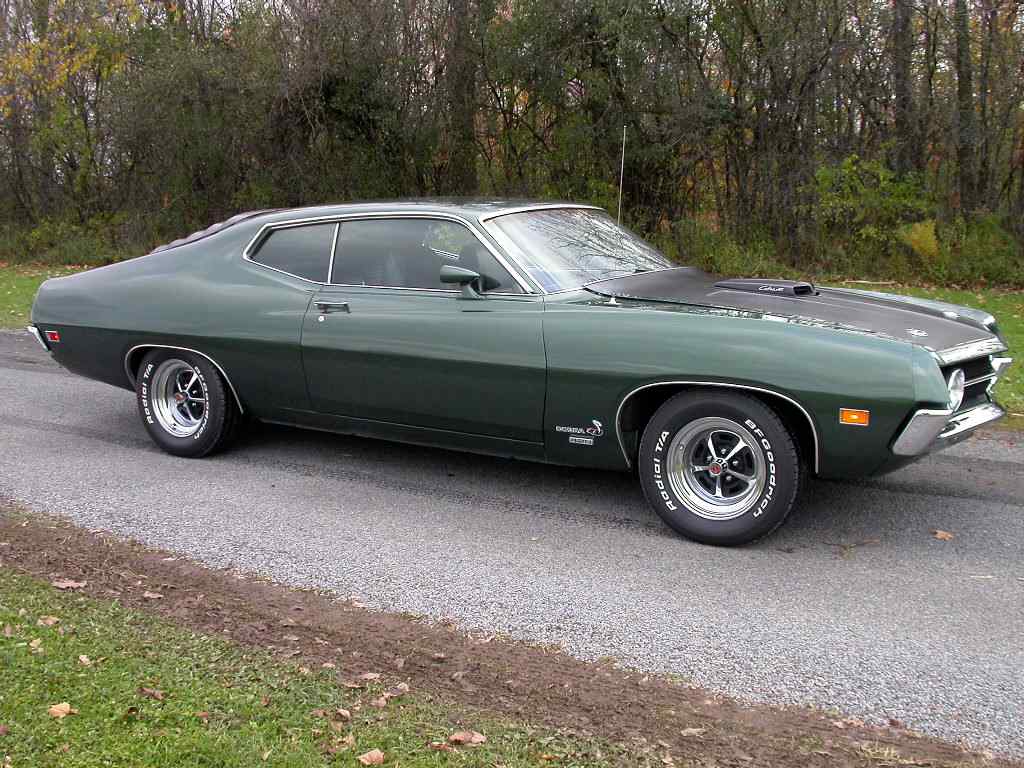
The new Torino was a fetching design that got Ford’s mid size line away from the boxy, dated Fairlane genre of 1967-69 that was rapidly losing ground to the curvaceous new GM midsize models. Straight lines were out, the “coke bottle” look was in, and Ford interpreted the trend with a full line of mid size/mid price cars that were arguably among the best looking cars on the road in their day.

The Falcon was the dowdy “grandma car” in the Torino/ Fairlane lineup. (The Fairlane had been downgraded to a sub series of the Torino line in preparation for its phase out for 1971). Even though the Torino offered a strikingly handsome hardtop and a sporty convertible, the Falcon lineup included only a two and four door sedan and station wagon. Ford also kept the Ranchero in the Torino family, even though the model had been a “Falcon” staple in years past.

Interiors were taxicab plain, with all of the usual stripper characteristics that kept the price low (rubber floormats, radio delete, tinted glass optional) and delivered the kind of value that the marque was known for.

Under the hood, the base engine was Ford’s 250 Straight Six that was itself a stroked 200 that had been around since 1963 and had found its way into lots of bottom feeder Blue Oval cars since that time. With 155 HP, the six made the Falcon respectable, but not particularly exciting. The effect was that of a librarian’s dream wheels.
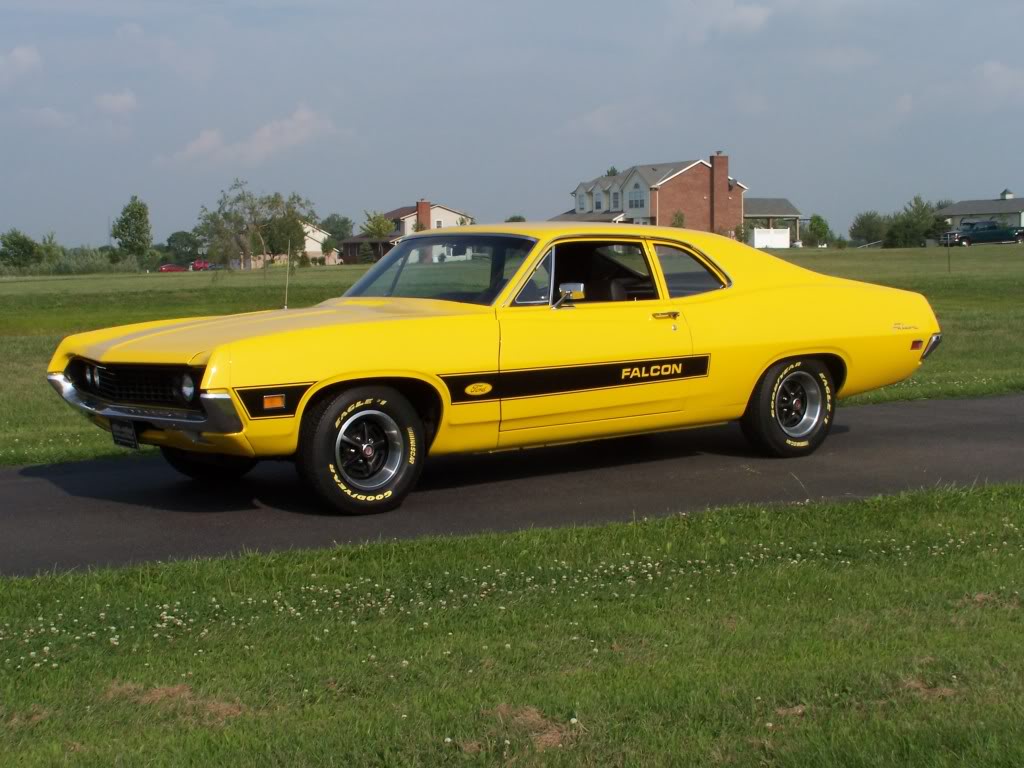
That is, unless you checked off just the right boxes on the order sheet at your friendly Ford dealer. One anomaly of the Falcon adventure was the availability of every engine combination offered in the performance Torino. That meant that if so inclined, a potential buyer could choose from no less than seven powertrains on offer in the Torino catalog. This meant that you could get some picante relish with your dog dish hubcaps. Engines ranged from the low-po straight six to the mighty 429 Cobra Jet Ram Air mill that belted out 370 (gross) horsepower. A Hurst shifter was another option for the go fast buyer on a budget. This could make the car a real sleeper in the stoplight derby of 1970 if the protagonist didn’t understand what he was up against. But only 90 429-4V –CJ engines left the factory in the car’s brief run. And since front disc brakes were offered, but not standard, stopping a 429 at full tilt must have been terrifying. Falcon’s rode 14 inch bias ply Firestones.

One option not in the mix was the hidden headlights that gave the Torino its unique “face”. The Falcon made do with a cast plastic mini eggcrate grille that was shared with the base Fairlane 500. Windshield wipers were the hidden variety that was becoming popular in these years. Lack of adornment made the car look exactly like what it was meant to be –a bargain priced stripper that belonged in an air force base motor pool. While by no means unattractive, its plain jane looks helped hold sales below expectations.

By Memorial Day, it was obvious that the reconstituted Falcon was a turkey, and plans to phase it out were set in train. The jazzy Torino was selling like hotcakes and it didn’t make sense to tie up production lines with a car that made little money and had no future. The last Falcons were assembled the week after July 4, and dealers slowly sold their remaining stock. Just over 67,000 Falcons were hatched in the short model year, so the car is obscure, but not really rare. When the ’71 Fords debuted that fall, the Fairlane and Falcon were nowhere to be seen. Mid sized Ford would mean Torino forthwith.

Finding a Torino Falcon these days is tough, but not impossible. Lots of them have the straight six with three on the tree and as such, don’t bring any big money. Lots of those models were driven into the ground and ended up as beer cans not too long afterward. The big engine, go fast examples command big bucks in top nick, but condition is paramount. Rust, a thirst for premium gasoline and indifferent build quality meant that survivors of the second gas crisis in 1979 were few. Some owners may not even know that they are even driving a Falcon. It was not unheard of for teenage gearheads to swap the Falcon emblems on their straight six hand-me-down for Torino livery (Like my friend Donny Crabtree did in our high school days). And rumours persist that Ford offered dealers a rebadge kit for leftover Falcons late in 1970.
Have you seen or remember these rare birds? I welcome your comments below.























More mystery to add on the table, I spotted on this forum devoted to the Maverick http://mmb.maverick.to/showthread.php?t=62699 then the Maverick development originally started as a 3rd-gen Falcon. Too bad then the pictures are deleted, It showed some proposal sketches of these earlier “Falcon Maverick”.
Too bad then Ford didn’t shipped the tooling of the 1966-70 Falcon in Brazil, it could had been a more bigger cotenter against the Chevrolet Opala and the local version of the Dodge Dart.
Back to the main topic of the mid-size Falcon, let’s imagine some “what if?” scenarios. Just imagine what if Ford had let the Falcon name continued in North America on the Torino platform? Does Starsky & Hutch still look cool if they had rided in a 1970½ Falcon 2-door sedan (as long as they had the 429 under the hood)? 😉 And if Clint Eastwood’s movie was “Gran Falcon” instead of “Gran Torino” would still be a big smash hit at the box-office?
“Does Starsky & Hutch still look cool if they had rided in a 1970½ Falcon 2-door sedan (as long as they had the 429 under the hood)?”
Zing! Good one.
Or, what if Ford stuck with Fairlane for all their middies for ’68, would we have had “Gran Fairlanes” in 1972? S&H ‘Striped Fairlane’?
Nah, new name Torino was needed. But then was trashed for 1977, :=(
“Gran Fairlane” would had sounded nice.
Interesting trivia, Ford continued to use the Fairlane name in Venezuela for the 1972-76 Torino, here some interesting pictures from brochures at
http://www.flickr.com/photos/ifhp97/4751342492/in/photostream/
http://www.autospecs.info/Photos/6369428469/1974-ford-fairlane
it almost like if we landed in some “alternate universe” or “parralel universe”. 😉
In Argentina, Ford made the 1968-69 4-door sedan body until 1981 with the old 292 V8 Y-block. http://www.flickr.com/photos/ifhp97/4750702999/in/photostream/
Australia got a different Fairlane…. (there some pics of those 1970s Aussie Fairlanes at http://www.autospecs.info/CarSpecs/1974-ford-fairlane )
I am not certain who wrote this crap? Evidently no one familiar with the ’70 Falcon badged mid-size Torino based car? I rode back and forth to La.Tech from New Orleans 120 miles in a four-door Falcon 150 c.i. six auto trans Falcon. It was an excellent car. It had the Torino styling that made the mid-sized Ford a really sharp car, the 250 c.i. six which was a really great engine, now I owned three 200″ sixes and there’s not a lot of difference. My friend’s car served him well for four years of college and a bit beyond.
My Dad bought a brand new Pastel Blue 4 door 70 1/2 Falcon with a V8 302 under the hood. I bought it from him in 75 for my senior year car! I had it repainted to midnight metalflake blue. Also had some engine work that actually had our mechanic baffled. Come to find out it was a Boss 302 motor. Once he found that out the car ran like a champ. I loved that car, finally after 200000 miles I finally had to trade it in. I miss that car still today in 2020!!
Another curiosity (to me at least): the Australian Ford closest to the Torino in style and intended market, most famously seen as the ‘V8 Interceptor’ in the Mad Max movies, kept the Falcon name thoughout the ’70s. ‘Torino’ didn’t mean anything to Australians? Too small a market to bother promoting a new name? Who knows?
The Falcon was the mainstay of Ford Australia throughout the seventies and eighties. It had quite a different market position in Australia than it did in the States — it was not a compact, but a largish family car. (There was also a stretched Fairlane/LTD, based on the Falcon, but it was a smaller-volume product.)
Ironically, the Falcon had gotten off to a rocky start in Australia, and some histories claim that Ford seriously considered dropping the Falcon nameplate — the likely replacement would have been Fairmont, which was introduced as the better-trimmed upper-series Falcon– but by the early seventies, it was doing very well, and was one of the best-selling cars in OZ.
Ford OZ never wanted the Falcon it tried for its own redesign of the MK2 Zephyr and was knocked back probably because the MK3 Zephyr was already done The Zephyr was tough durable race and rally proven it lapped up the tough aussie conditions and had already been converted into a ute Ford OZ got the Falcon off the drawing board as a booby prize it turned out the customers expecting a replacement for the Zephyr or their aging Customline were horrified, Falcon fell apart not in the bush but on city roads it certainly wasnt competition for Holden or the new Valiant and had to be reengineered properly.
Charlie Smith, Ford Australia MD, lobbied hard for the Falcon instead of the Zephyr Mk. IIA — he saw models for the latter in Dearborn in ’57 and thought it would be DOA in OZ. He retired about a year before the XK actually went into production, though.
Charlie Smith won through but the Falcon lacked development it wasnowhere near as good as the Zephyr it replaced The MK2a was only a minor facelift the MK3 was a full redesign that debut in 62 Ive seen drawings of what Ford OZ wanted their Zephyr to look like its awful no wonder dearborne said no
They never used the Torino name on Aussie Fords, so I doubt it was ever a serious possibility
I remember seeing a few of these on the road in the early ’70s. They really were fairly decent looking in its low-budget class.
Yeah, I know…. BUT…….. going on appearances only I detect a few semblances (resemblances a better term?) of the Chevy Nova in a few of the body lines of the pictured cars with some viewing angles more Nova-like than others.
Copying going on? By Ford, by Chevy or neither?
Old Coot not drunk or impaired by any intoxicating or impairment-inducing substances.
Other than normal aging processes.
Remember…. as my Mennonite pal avers; do not drink nor drive.
“only I detect a few semblances (resemblances a better term?) of the Chevy Nova in a few of the body lines of the pictured cars with some viewing angles more Nova-like than others.”
Your gut instinct is right. Knudsen had come from GM and even though his tenure at Ford was short, he did influence the design of several FoMoCo models.
Despite being a 2 door sedan, these cars were quite sharp looking I’ll say, even sans extraneous chrome bits to brighten it up, outside the little “Falcon” script in the rear quarter flanks.
It’s rare to have a car looks this good in such a “plain Jane” package but then you step up into a Torino and it only got better since you then had the hardtop version of the same car.
That dog-dish yellow example you show would look a tad better with a set of chrome trim rings on those black steelies with the dog-dish caps for a little extra touch and yes, it DOES look great in yellow.
However, for the post ’71 Torino’s, I’ve always like the ’72’s best of that body style.
Nice write up of a car that I never knew came as a Falcon, let alone that the Falcon name existed beyond 1969 as a dowdy sedan/coupe, who’d da thunk?
Along with the 1969 Chevelle 300 Deluxe coupe with the SS396 package, the 70 ½ Falcon with the 429CJ engine ranks as one of the most rare, ‘strippo-special’ musclecars.
The rarity is also rather hard to understand. Did the market that was so hot only a scant two years before with the wild success of the ultra-cheap Plymouth Roadrunner suddenly die out that quickly, or was it due to neither GM nor Ford doing very much to advertise either of their cheapest (and, thus, low-profit), fastest musclecars? I suspect the latter because, although Roadrunner sales were also sliding, lightning had struck twice over at Plymouth with the new, hot-selling, de facto replacement for the Roadrunner, the Duster 340.
Or maybe it was as simple as the pillared 2-door versions of the Chevelle and Falcon just weren’t as good-looking as the pillared coupe Roadrunner.
Here a pic of a ’69 Chevelle 300 Deluxe pillared coupe with the SS-396 package then I saw at http://www.showyourauto.com/vehicledetail.php?Chevelle-SS-270
I regret then Chevrolet didn’t do a 1970 300 Deluxe pillared coupe with the SS-454 package. Pontiac did the same with the GTO reverted as an option for 1972, here a picture of a pillared ’72 GTO at http://www.junkyardlife.com/2011/07/cars-in-yards-1972-pontiac-gto-post.html
I guess Don Yenko was on something with the Yenko Novas with the 427 big-block for 1968 and 1969 and the 1970 Yenko Deuce with a beefed 350 small-block. Imagine what if Pontiac had stepped earlier in the game with the small Ventura GTO coming in 1971 instead of 1974?
rudiger: Because even though the Roadrunner was pretty much a stripper, by virtue of its exclusive name and marketing, it didn’t really come off like one. It’s an image thing, as usual.
Those guys that bought the true strippers with the big engines were more “in the know”, and/or more serious about their racing, etc., and less image-conscious.
The market did pretty much die out that quickly. By the time this car came out, insurance on anything with a large engine — or, in some cases, anything with a four-speed — had become prohibitively expensive for the people who were most interested in such models.
Some months back I bought a glossy enthusiast mag called Ford Milestones. One of the featured cars was one these. It was a nasty shade of mint green and had the 429CJ, four-speed, and GT wheels.
One thing to keep in mind about the 1966-70 Falcon is that it was no longer a “real” Falcon. For 1966 Ford switched it from the compact platform shared with the Mustang to that of the mid-sized Fairlane/Comet platform, which at the time was roughly four inches wider.
The 1966 Falcon was literally a shortened Fairlane. The door sheetmetal for the sedan and coupe were identical to that on the Fairlane, and the wagon’s main differentiation was its front sheetmetal.
As such, I’d be skeptical of claims that the Ford would have had trouble upgrading the 1970 Falcon to meet federal crash standards.
When the Maverick four-door sedan appeared in 1971, I remember reading in a buff mag that some Ford execs had regrets about discontinuing the pre-Torino Falcon because of growing sales of aging compacts such as the Valiant and Nova.
I wonder whether the Torino-based Falcon was discontinued primarily due to low sales; 67,000 is pretty good for a mid-year introduction. The base 1971 Torino didn’t sell all that much better with a full year of production.
For 1971 Ford also discontinued the Fairlane 500 nameplate in favor of Torino. Using only one nameplate for all of its mid-sized Fords was certainly less confusing, but Ford also threw away a whole lot of brand equity when it simultaneously retired the Falcon and Fairlane.
Dejavu when Alan Mulally demanded they bring back the Taurus…
I always understood that the old Falcon that survived into early 1970 models (built up to 12/31/69) were discontinued on the eve of new design regs that took effect 1/1/70 (the locking steering column comes to mind). It would not have taken much to make the car compliant, but the Maverick sedan was on the way, so there was no need to spend the money.
Frankly, I always saw this car as something, anything, to hold the fort until the 71 Maverick sedan arrived. Doing a strippo Torino had to have been way cheaper than making the 69 Falcon legal for only a year.
I happen to own one of these rare cars, I ask how many have u seen, I’m 62 years old and have worked at ford dealerships since 1971. i’ve only seen 5 in my life and other than mine the other four have been in ths last 15 years since i’ve started attending car shows and cruise in. 67,000 is a very wrong production number. I have printed documentation from Ford stating that only 26,000 total uints were built with 2600 being 2 door post and the rest being four doors and
wagons. Have never seen a wagon nor have i ever talked to anyone who has.
I have a 1970 1/2 ford falcon 429 cobra 4speed .just wonder what its worth car has only 5600 miles .
The Internet is your friend…try KBB or NADA
heres mine,i made a few changes but its a true j code 429scj 4 speed drag-pac car 4:30 n-case ,ashtabula,ohio
I’m in Canada and I also own a 70 1/2 Falcon 2-door post sedan. My father-in-law was a Ford mechanic for nearly 40 years here and he had never seen one in the dealership’s garage or on the sales lot. Thanks for the data on how rare these cars really were.
I owned a 71 Torino GT 429, right this moment there is a 70 1/2 Falcon on a lot been there at least 7 years. Last time I checked asking price $ 9000. It’s 429 auto.
Ralph, Does the car lot that has the 429 automatic 19 70 1/2 falcon for $9000 still have it?
Really you have printed documentation from ford? is there any way i can see it? or get a copy from you?
gday mr T Blades….im just wondering if i can call upon your expertise and ask if you know of any 67 xr ford falcon special 6 cylinder cars built in brisbane at all..this bloke recons their was and i have bought it at a good price regardless..but jus curious to see if he’s correct or sadly misguided..thanks heaps
bretto
My grandfather worked for the newspaper in our town and they bought several Falcon wagons. His was bright red with a black interior. I clearly recall the Falcon badge on the rear near the side marker light. I bet he drove it until 1976. Also emember the rubber bands on the column shifter. 😉
hey I have a ford falcon torino with 55,00 miles on it an im look for more information about them me an my son want to restore it but we cant find anything or anyone to give us a push in the rite duration so anything would help an it has a v6 in the motor as far as anyone has told us ….-
I have seen one wagon when I was in auto body class and maybe one 4 door. I have seen 5 2 door sedan Falcons and have owned 2 of them. I bought one in 1985 and sold it when NJ was coming down hard on older cars and I just bought another one I don’t even have yet. Maybe we have seen more 4 door cars and wagons but they would not stand out like a 2 door post model sedan.
I’ve seen several ’70 1/2 falcons over the years – not that rare. I had a ’70 dowdy falcon 4 door compact version – no front sway bar!! lol
What is the rarest of all chevys MADE? I seen only 1 (ONE!!!!) of these my entire life & that was in 1968 & i thought it was 1 futuristic lookin car with the ultrarare hidden headlite option & exclusive ONLY to this model & ONLY on the 2 door that year, ventless front windows! There’s even a commerical for this car WITH those hidden headlites & it’s not dowdy or a muscle car.
Oddly, i seen a TON of ’69s & torinos & camaros & eldorados & chargers, etc with the hidden headlite option , but not this ’68 chevy below!!!
Give up?
I wondered about this also, as the 4 door Maverick didn’t appear for a couple of model years after the initial ’69 2 door Maverick. In the 60’s it seemed more likely to get a “full line” of a particular model car, including 2 and 4 door (and sometimes wagons as well) which seemed to persist only for certain platforms maybe into the 80’s when 4 door sedans only seemed to be the only configuration offered. Having a 2 door only (and not a very roomy 2 door at that) would seem to greatly limit the market by excluding those who were looking for a cheap but roomy car.
Maybe that’s part of the reason these mid-sized Falcons were offered briefly, though they didn’t last till the 4 door Maverick debut? Maybe Ford was forced to discontinue the Falcon before the plan for the Maverick solidified?
Anyhow, I never got the chance to drive a Maverick…a co-worker and friend owned a 4 door during his undergraduate days, but he traded it for an early 80’s Pontiac Sunbird so he didn’t own it long while I knew him. Despite working as a transporter for Hertz in ’77 and ’78 for some reason there were no Mavericks in our fleet (nor Pintos)….in ’78 I drove many Fairmonts (which I supposed were the replacement for the Maverick) but even in ’77 never drove a Maverick for them. Nor did I get to drive a Torino, but the LTD II successor was the most common rental (since back then Hertz seemed to specialize in Fords) in our fleet back then.
More than a few of these made their way into Canuckistan and I remember I had a friend in elementary school whose dad had a yellow stripper Falcon, just like the one in the picture, complete with three on the tree and boat anchor six. The car was a total rust-bucket three years after it was bought. The owner spent a fortune fixing the holes, only to have more rust pop up almost immediately.
In the early 1970s, strippers were popular in Canuckistan for a couple of reasons. First, we have always paid more for cars for some strange reason. After the Auto Pact of 1967 there has never been any reason for this, but we still pay more. (Even with the appreciation of the Canuckistani Peso from one million to the the Real Dollar to six hundred thousand, we still pay more). Second was cars of those days were throw-away items in places like Quebec and Ontario, where millions of tons of road salt are applied to roads every year. It didn’t make a lot sense to spend the extra pesos when your fancy ride was going to have holes in the rocker panels after a few years.
My dad did exactly this for these reasons. I remember he had a 1970 Pontiac Srato-Chief two door hard top with 350 2bbl and Powerglide. It was a leftover, bought in December of 1970, after the 1971 models were available (and the UAW strike didn’t hit Canuckistan, so we had cars). It was the cheapest car on the lot at $3300, or $20,000 in today’s money; it didn’t even have power steering to go with the small diameter steering wheel. Parallel parking was a real chore in that car. Neither did it have power brakes, nor even a radio. It was in the family until May of 1976, by which point the paint had become chalky, the front springs had broken and been replaced and the entire exhaust had been done. The rockers were holy and there was surface rust all over it. Five years and five months and it was sold for $100. A complete throw-away. That same $20,000 can put a Civic LX on the road in Canada now, taxes in, loaded. That car could last 20 years with any care. Who said cars were better in the old days?
Cars were so bad the government in Canada forced through seven years rust through warranties. Amazing how quickly the cars improved, isn’t it?
I never understood Ford’s thinking on this. The Falcon name was known as a good value compact car and why they felt the need to rename it Maverick when they re-bodied it made no sense. Then they obviously realized the name still had some equity so they stick it on a stripper Intermediate?
As I read it, the Falcon was McNamara’s car. It was his baby, from conception to delivery at dealerships. It was his vision of the Perfect Car – stark, utilitarian, thrifty.
Lido hated the car – displaced hostility at a rival, I’d wager. He, by all accounts, recognized McNamara’s value to the company, but he was about selling; and about tapping into customers’ lusts and emotions.
McNamara was about remaking society in his own spartan image. McNamara wanted less to sell it, than to sell the values of the original Falcon – a car bought logically, for logical reasons.
Lido thought the original Falcon, according to one writer, an “anticar.” The Maverick was his answer of how to REALLY sell a compact car. And with that change in mission, came a change in name.
Someone in the Marketing department must have realized, that while the Maverick might get the kids, librarians buy cars, too. Making one Torino a stripper and pasting a “Falcon” badge on it, must have been an attempt to see how deep was that loyalty.
Probably Iacocca didn’t much like preserving a McNamara icon, as it was axed even with reasonable sales and no real cost.
Didn’t “Bunkie” Knudsen played a part in it as well? Most of the development and the launching of the Maverick came under his short tenure as Ford president?
I think not. Bunkie’s tenure at Ford was very, very short; and the product-cycle coming up were the full-size and personal-luxury models.
Product lead time in those years was about five years, so the Maverick project would have been hatched about 1965…just when the Mustang success was verified; and about the time McNamara’s funk had dissipated from the front office.
Meantime, while Lido was passed over, for a time, as company president, he was still head of the Ford Division and wielding considerable influence. In Bunkie’s tenure, too, as it turned out.
As a license plate collector, I’ve observed many anomalies in license plate design and manufacture that are best explained by the observation that license plates are designed by bureaucrats and generally manufactured by convicts.
Perhaps a committee made the decision to build the car, and some marketing vice-president made the naming decision the day before the brochures and trim pieces needed to be ordered.
1970 was a recession year, and I think this car was a reaction to that. Chevy offered a similarly stripped Chevelle series at mid-year as well (the 1970 model year had started with the Malibu as the base series). What they didn’t do was bother re-tooling for a 2-door post coupe, as Ford did with the 70 1/2 Falcon. This is what always struck me as the strangest thing about these cars.
I think the 1969 Chevelle 300 Deluxe was really the only reason for the 1970½ Falcon. When the 1970 Chevelle came out without a pillared 2-door series, Ford’s primary rationale for their similiar, intermediate 2-door sedan disappeared.
When sales of a Ford version of the intermediate 2-door sedan turned out to be negligable (the reason Chevy dropped it from the Chevelle), the Falcon was quietly dropped.
The tooling for a 2 door sedan was there for the 70-72 Chevelle. They didn’t build it so they could offer the lowest priced 2 door hardtop in it’s class. Buick, Olds(non Holiday) and Pontiac A bodies all offered 2 door sedans.
Whadaya mean what if,? The Falcon continued on uninterupted just because the US couldnt get one doesnt mean it was gone the US body was used for 71 with a new Torino style body being released in 72 as the XA restyled into the XB with better rust resistance later restyled again in 76 as XC then rebodied with a UK Granada body in 79 underneath it was still the late 60s US Falcon The suspension was upgraded in 83 with the new V8less XE model and a minor restyle done for the XF in 86. The engine was fitted with a Honda designed alloy head to pass emissions and cope with unleaded fuel and the 200 dropped at last the 250 soldiered on untill redesigned for the new EA released in 88. The Falcon continues in production today V8 I6 RWD sedan wagon ute.
The market in Australia and New Zealand is peanuts compared to that of the USA, Bryce. Just how long Ford will keep specific models for that market is a very good question.
True Falcons are not selling well at present and there is pressure from the mother to stop building it but its as much an icon down here as the Holden however GMH is a more secure operation since it exports its cars as Chevrolets all over the world and builds all GM 6 cylinder engines. Ford will not export the Falcon to other markets even though there may be a case for RWD cars elsewhere.
Bryce Holden hardly exports any Commodores any more, the middle east market has died, and there are very few of the new cop cars on the go. I have seen numbers but can’t remember them, it is only a few thousand a year. Falcon has never been allowed to export by head office, for example the middle east market was held by the Crown Vic – what they are going to do now is a good question (nothing?)
The next gen is a good question, if they tie it to the Mustang it should be ok, likewise if there is to be a rwd car for North America (doubtful). On the other hand if they kill the Falcon they could only expect to retain a very small % of those sales, most will go straight to Commodore – if that returns for the next generation also, I think if Falcon goes (and presumably local production) the Commodore will be under a lot of pressure as there are many common parts suppliers.
Holden does not make all of GM’s 6 cylinder engines.
builds all of GM’s 6 cyl engines? Maybe fore your area, certainly not here.
In 1970 I was serving in the Air Force, and a lady who was a civilian employee purchased one. It was the only 701/2 Falcon I ever saw.
Yes, as Bryce says for us the Falcon never went away (although it’s at death’s door though with only appx. 20,000 sales last year). Here’s an ’73-ish XB in hiway patrol livery. Although it looks like a Torino, and the XD was UK Granada-ish (way more adventurous styling though) all the sheetmetal is unique to Aussie.
Yup, and the XA was the first Falcon designed specifically by the Australian styling group (headed by Jack Telnack in those days). The work was done in Dearborn — Telnack’s team flew to the U.S. to take advantage of their greater development resources — but their design won out over a proposal from the U.S. studios, which would have been a sort of cut-down version of the restyled Torino. (Even so, I think the XA/XB/XC hardtops look awfully Torino-like.)
without the pointy front guards they are lookalikes definitely done in the same studio
They were styled by different teams, but they were all working in the same studios in Dearborn, so there’s a definite resemblance. It’s the hardtop’s roofline that really does it — an unsuspecting America looking at pictures might think it was a SportRoof Torino.
I tried to get photos of the styling proposals for my Falcon article early last year, but wasn’t able to. I’m curious what the rejected U.S. proposal looked like.
It would be interesting to see those if you were able to get them Aaron (who knows they might send them one day…). There is a lot of similarity to the Maverick sedan too. I have a small drawing of a Torino-based Falcon in a book, the central body styling lines are clear, it says they worked on versions using the Torino cabin with shortened overhangs, but neglect to mention the 6″ longer wheelbase that would be a significant change.
Alistair, they certainly did not help themselves in 2011 dropping the wagon & having no LPG version until recently (which had been making up 25% of sales previously. Hopefully 2012 will be better with the new LPG injection and Ecoboost 4cyl
Speaking of the devil:
http://cgi.ebay.com/ebaymotors/70-1-2-Falcon-Rare-Drag-Pack-429-SCJ-1-80-/190622099121?pt=US_Cars_Trucks&hash=item2c61f666b1
“Ford also kept the Ranchero in the Torino family, even though the model had been a “Falcon” staple in years past.”
Nit to pick here. The last Falcon Ranchero was 1966 (although it didn’t say “Falcon”). In 1967 in was a Fairlane-Ranchero only, 68 through 1969 it was Fairlane (Ranchero 500) or Torino (Ranchero GT) depending on trim level.
As for the Italian naming…….
Back in the late 60s early 70s Ford and HFII had a love/hate affair with all thing Italian. De Tomaso Managusta and Pantera, all things Ghia…..and of course the GT40 vs Ferrari feud that Ford won. It was somewhat ironic that the 70-71 “Sportsroof” Torino wasn’t as slippery as the old 69 Torino/Cyclone OR the 70-71 “Formal roof” Falcon/Fairlane/Torino. The NASCAR Cyclones had some success using the Formal Roof, as there was no Sportsroof for Mercury. A moot point by then, as Ford pulled out of racing.
Wasn’t HF2’s second wife (Cristina) also from Turin?
@Aaron: That was the story I’d always heard about the Torino.
Yep, I’ve seen a few. New, in a dealer’s lot, as I walked by on the way to school.
As a twelve-year-old motorhead wannabee, I studied the products parked there. At the time, Ford was busting out of the “granny” mode they’d been in ten years earlier; their pickings were, to my young eyes, more daring than that of good grey GM.
It did give pause for thought. Fairlane? Torino? Falcon? All the same car!
When the model year changed over, those disappeared. I seem to remember seeing one around town for a few years, and not any since.
I really dig these early model Torinos. Like the majority of us, they seem to gain gloat as they aged until they because the Starsky and Hutch flailing manatee.
Thanks for locating this one, Jeff — it’s one off my bucket list for 2012 .
I always liked the ’70 and ’71 Torinos when I was a kid, and even the corresponding Montegos with the anteater nose. I thought Ford had taken a step backward with the ’72 models, which were subsequently marred by 5 mph bumpers. Oh well, they wouldn’t have looked so hot on these cars either.
It does make me wonder how much lead time manufacturers had on that 5 mph regulation. Everybody put them on as an afterthought, whether foreign or domestic, and it took years before anybody integrated them that well.
Camaros and Firebirds were good, as were Corvettes. Maybe Chevelle Lagunas, and only in front. Just about everything else looked like crap.
The quarter vent windows & lack of dash vents indicate these things don’t have flow-through ventilation which was in the 1963 Ford Cortina. The gain in size over the previous model is a sign of the pre-gas crisis times I suppose and a clear sign why Australia didn’t want the Torino – the 1972 XA Falcon was 20″ shorter on a 6″ shorter wheelbase but was actually an inch wider.
It’s been many years since I’ve seen a 1970.5 Falcon. For some reason, I liked them better than the hardtop version of the same car (no offense Zackman). Actually, I have a similar fondness for pillar versions of the GM midsizers from this period, too.
I saw very few of these growing up, I guess because they weren’t popular to begin with, and then the congnoscenti would be the only ones who really cared. The few I did see were usually poverty specials, nothing like the “Roadrunner-killers” featured in the OP.
Many electrons are spent complaining about GM’s (and others) muddled marketing, it looks to me Ford had no better luck in that arena. Falcon still has a lot of brand equity, even with folks who were never around for the first version.
My 21 year old daughter is a fan of the older ones; she saw one at a car show somewhere when she was rather young and it really appealed to her. When she was old enough to drive, she asked me if we could find one for her to drive, but there weren’t any decent ones locally at that time. I think one of those is still on her ‘hit’ list.
Ford inexplicably made a lot of “stealth” moves with its muscle cars back in those days, the Falcon being one of the most obscure; the Torino Cobra got all the press, and even it wasn’t nearly as visible from a marketing standpoint as the Road Runner or Chevelle or GTO.
Even more obscure, unless you were really a Blue Oval geek “in the know,” were Ford’s high performance engine options, especially the 3 different 429 engines available in the Falcon/Torino line. The top dog motor in these cars was the 429 SCJ (Super Cobra Jet), which is what you got when you specified the 3.91:1 or 4.30:1 rear axle ratio, aka the “Drag Pack” option. Either the close-ratio (2.32 first gear) “big” input top loader 4-speed or C6 automatic tranny could be ordered. Oddly, 429 SCJ cars had the same “C” or “J” engine VIN code as the 429 CJ (at the “low” end was the “N” code 429 Thunderjet, essentially the same 429 4-barrel motor available in the T-Bird, Galaxie, LTD, etc), the difference being non-ram air vs. ram air (i.e., “shaker” hood scoop). Only the rear axle ratio number in the VIN is what tips you off that it’s a SCJ car; the VIN plate will have a “V” denoting a 3.91 axle ratio, or a “W” for the 4.30 ratio.
No minor upgrade, the 429 SCJ gave you essentially a Boss 429 “820 T” block, with 4-both mains, forged rods w/ 7/16″ cap screw rod bolts, forged crank (the mere CJ made do with 2-bolt mains and a cast iron crank), the excellent breathing big-valve SCJ heads and a solid lifter cam (the CJ used a hydraulic cam), and an aluminum high-rise intake manifold with a Holley 780 CFM 4-bbl carb (the CJ used a cast iron intake with an Autolite 4-bbl carb), and an external oil cooler.
Thusly configured ’70 429 SCJ Falcons are among the rarest of the rare in muscle-dom, with something like 16 cars built (not sure of the breakdown between 4-speed and auto tranny cars).
Correction: The 429 CJ used a Rochester Q-jet 4-barrel, not an Autolite.
Cool factoid. I was not aware that any Ford every used a Quadrajet.
My 429 Cobra Jet came with the Quadrajet, IIRC, it was the only Ford to ever use one. Back in the day everyone with a 429 Torino would say they had a SCJ. A quick look at the carb would confirm they were wrong. These cars came with a funky ribbon tach on the left side of the dash and also a rev limiter.
The easy way to confirm CJ heads was take out the top center valve cover bolt. On a CJ head you would have a huge vacuum leak as the bolts were threaded into the intake port.
Some of the hi-po 351Cs used a Q-jet as well. I’m not sure why Ford did that. It’s actually a pretty good performance carb if you know what you’re doing with it. I lost a case of beer on a bet long ago over the originality of a Q-jet on a Ford….
I remember seeing one or two of these around years ago. I will echo Canucklehead – in salty environs, these things were horrible, horrible rustbuckets. When I was in Jr. High, around 1974 or so, I had a teacher with the Fairlane version of this car. He was so proud of how he had fixed all of the holes with old-school body lead and painted them. A really nice job, but the car was only 3 or 4 years old.
I must add that this was one of the best looking cars of the early 1970s. There is a grace and a fleetness to these that was missing in most of the competition. It is too bad that they were not more robust.
Most of my experience was with the early 1970 (true) Falcon (also a strippo) owned by a friend’s family. The upholstery fabric in the interior shot here looks like the same stuff.
Fabric? These were the el-cheapo era Ford vinyl found in Custom/Custom 500’s and Econolne vans. Like Harry Callaghan’s blue ’72 Custom 500 wrecked in “Magnum Force”.
A man’s just got to know his limitations!
I have seen two in my lifetime. One was a two door sedan with whitewalls, automatic, and I’m sure power steering and brakes. It was metallic green and was a selection at Hertz as my Dad was grabbing a rental for abusiness trip. He passed on the Falcon and got a red Barricuda (!) for that trip instead. I was about ten at that time.
1970 Falcon #2 was a buddy’s car I was stationed with in Virgina, 1983-84. Full wheel covers, blue, matching vinyl interior with black rubber floor mats, but his was a 2-bbl 302 and had p/s, C-5 auto, but manual disc brakes.
Mondo bondo.
Not a bad car. Drove nice, but he was from Elmyra (Elmira?) NY; car had an equal amount of body weight on it as the car itself weighed.
In ’84, he got married, sold the Falcon and got a Renault shit-box Encire. He was kicking himself over that one. His wife wanted a cheap (!) new car with air.
Bondo – equal amount of filler as to the actual body weight of the Falcon. iPhones make it hard to go back and edit. Curses and expletives!
I have only seen one of these, it was a green 2 door that must have lived somewhere near my grandmothers house, it was driven by an old man of course, I never found out where it actually lived though.
This was one of those cars that puzzled me in the pre-internet era, I knew what a 1970 Torino looked like, and I saw one of these on the street as a kid, it was already a 17 year old car, but I was confused by a body that clearly said “Torino” but an emblem that read “Falcon”. I had to look it up in a Ford book to satisfy my curiosity.
I was in high school & my Dad worked for Heintzelman Ford in Orlando back in the day when all the car dealers were downtown. A bright red 70.5 Falcon with the 429 ram air and 4 speed was on their lot at the corner of Livingston & Orange for several months.
I fantasized about owning that car a lot ! Later in life, I owned a 1970 Torino Cobra with that 429 and 4 speed, but I always liked the look of that post Falcon better than the fastback roofline of the Torinos.
Thanks for the memories.
I have only seen one of these and it was on the island of Maui. Owned by a Maine lobsterman who shipped it out in a container along with his furniture when he retired. He lives in the same condo complex as my MiL. It has a 351 in it and he claims he surprises a lot of kids in Hondas at stoplights.
I remember these brand new, since they were introduced at the 1970 Chicago Auto Show. [Was 9 y/o] ‘The new 70 1/2 Falcon!’ on turntable with model and separate Falcon brochures handed out. Lots of fanfare for a base model.
Someone earlier said 1970 was recession year, and there were a few ‘bargain cars’ brought out, such as Pontiac T-37. But, in early 70’s makers started rationalizing car names, and base stippers with old 60’s names like F-85, Biscayne, BelAir, and Belvedere were dropped.
Regarding last Falcon, who knows? I’m thinking it was a way to ease Falcon customers into new cars, and may have been planned for 1971, but killed at last minute?
Shortly after i graduated in 2011 I spotted one of these beauties with a 302 that was “suped up” with hi performance parts and it had a loving roar when started the man told me i could buy it and so i saved up. Only $500 left then i’ll have mine. I love these cars i am not a big ford guy but this one car is my kryptonite. It’s painted primer grey, the hood has 2 black stripes. it even has the original grille.
I recently picked up a 70 1/2 Falcon Torino that had been fitted with a periscope by Ford for NASA. Anybody know anything about this car, I live 60 miles from Kennedy Space center and apparently they were sold off at auction in the late 70’s.
Did you get this car from an old guy in winter haven named Bob Wiegert?
Paul made a mini CC of my 1970 Mercury Montego a few years ago… there she sits, still, though I’ve finally found a barn a few miles out of Eugene to begin the stripping and repairing of the 302 (with an all Edelbrock top-end from heads up) and intend on having it road ready by next summer. I’ve spotted a four door Montego here, as well as a woodie ute! That is it for the Mercurys here in The Euge. Plenty of Torinos of this vintage 2 year run lived here until a few years ago. If they aren’t restored, they rust away.
I have a 1970 1/2 Falcon wagon. It was on Craigslist for sale and I thought the guy just didn’t know what car he actually had. I was suprised when I saw it in real life. It has the 250 6 cyl, FMX trans, 8″ rear, power assisted disc brakes, power steering, air conditioning, trailer tow package including Ford hitch, roof rack, AM radio, bench seats and rubber floor mats. The color is a shade of purple/maroon with a Ginger interior. This is the only wagon I have ever seen. I have seen three 2 dr, two 4 dr, but only this wagon.
I bought one in May of last year. It is defiantly a project that is worth my while, even though I am having trouble finding a C4 transmission for it. Thank you for the input it helped me figure out what kind of motor I had.
I had one of these, which I bought from my brother when he went off to college. It was a true 1970 1/2, four door sedan, Falcon badges, icebox white, straight six, auto on the column, black vinyl seats like NYC cabs, black rubber flooring. No A/C. A real rolling sensory deprivation chamber. I remember it having an AM radio, and I hooked up an FM convertor to drive the single center dashboard speaker. Bought a hunk of shag carpeting to cover the rubber flooring. Huge engine compartment with that tiny 6-you could almost stand inside it to work on it. Buy why bother? I used to gap the points with a matchbook cover. I finally drove it to the junkyard the day one of the rear leaf springs cracked and the mechanic quoted $80 to replace it (and not to mention burning a quart of oil every 500 miles if that). After reading all these posts I have to ask: why would anyone bother reminiscing about this rolling tin can?
No matter, thanks for the memories!
The parents of a grade school classmate owned a plain, white 4-door 70-1/2 Falcon. (0nly one I ever saw in real life). They had it until they traded it for a Chevy Citation.I remember thinking it being odd that they would call a Torino a Falcon. ( i was also 7 at the time…). The 70-1/2 Falcon must’ve been Ford’s version of the 1958 Studebaker Scotsman….
I have a 70 1/2 falcon that i drive around every day. It needs some work though, i would love to have it in mint condition but I am finding it really difficult to find some parts for it especially a grill and a rear driver side window. does any one know where i can find these parts at? if you please email me at [email protected]. i want this car restored and i am never going to sell it. its all original but does need parts. its got the v8 302 just in case your wondering.
Post on the forum:
http://www.torinocobra.com/forum/
A guy name Dave in IL parted a Falcon recently and has parts for sale.
I owned a 71 Torino GT back in 1985-1986. I was about 17 when I bought it from a shady-ish used car lot. It was originally a 351c car, but at some point that engine had been removed and replaced with a 302. It was bright red with auto trans. I paid $450 for it in 1985 and verified that it was a real GT car, and although the body was 95% straight, the left front fender had obviously been hit and there was slight evidence of straightening. The interior was solid with no rips or fading. The real problem was a missing few teeth on the ring gear on the flywheel, and a few more damaged teeth, which caused the starter’s gear to wear out and some times at first the starter would contact the area of the ring gear where there were no teeth, leaving me stranded because it wouldn’t start if that happened. Fortunately I was only left stranded once. The big problem was that I was still in school while working 25 hours a week at a high performance auto parts machine shop for $5 an hour, and I had to pay for all gas, insurance, repairs myself, and I just didn’t have the cash to pay to have the transmission dropped so the flywheel could be replaced, along with the starter on a car that seemed like there may have been more problems in the future, so I sold it to a guy at the shop where I had the estimate done, and he gave me $450 dollars for it!! So I lost nothing when I sold it, so it seemed, however, I’d love to still own it, with a nice 351(w or c).
Not a Falcon, But at the other end of the scale, My 1970 Torino Brougham 2dr hardtop. Hideaway headlights, GT wall to wall taillight panel, 351 Cleveland, dual exhaust and FMX tranny with a shift kit .. Original turbine wheel covers and for the period, White walls. Go fast luxury for 1970.
Nice article on an obscure vehicle…I happen to own the yellow SCJ 4spd 4:30 diff Falcon featured in the article…came from the factory without 429 emblems…ultimate sleeper.
I spotted some non factory items on your car that is racing mirrors should be 1 chrome blacked out grill should be silver blacked out rear panel should be body colour wheels should be 14 in with chrome rings and F 70 Good Year Polyglass .Why do I know this is because I bought one new in Edmonton Alberta.
This is my 1970 1/2 Ford falcon factory drag pack it is the 429 SCJ with a Toploader and 4:30 N rear end. I Purchased The car July 3, 1975 when I was 19 I won the car 45 years they made 135 drag packs in 1970 1/2 model year if you were lucky enough to order a Ford Fairlane 500 in the same time. They only made 20 drag packs here is my email if anybody wants to talk. Thanks Joey Brogna([email protected])
Sorry here is the photo
Here is my 1970 1/2 Ford falcon factory drag pack for 429 SCJ Toploader 4:30 nodular Rear. I Purchased the car July 3, 1975 when I was 19 I’ve owned the car 45 years they made 135 drag packs in that model year and if you were lucky enough to purchase a Ford Fairlane 500 in the drag pack they only made 20 here is my email if anybody wants to talk thanks Joey ([email protected])
I was the second owner of a 1970 1/2 Falcon 2-door. 351C 4bbl, 4-spd wide ratio, Hurst shifter, 9-inch rear end, PS, PB with discs in front, deep maroon color. The car had a split personality, because although it said “Falcon” on the rear fenders and dash, it said “Torino” on the hood and deck lid. 10mpg on premium whether I babied it or bashed it, so I generally bashed it. It was lots of fun but rust finally made me put it away. Sold it to a guy in Rockford IL several years back but I don’t know what he did with it. It was ready to rumble, as I had new headers and a used limited-slip diff in the trunk, and the hood with the scoop (not the shaker) from a Torino. I ditched the bench seat for some Chevelle buckets but they never sat right.
If you’re out there Rockford, drop a line here.
I bought my 70 1/2 Falcon in January 1970 and picked it up on May 6, 1970. I STILL HAVE IT…it has 86,000 miles, is Light Ivy Yellow, 2 door sedan with 302, auto trans, disc brakes and AM radio. My husband and I are beginning a sympathtic restoration adding carpeting and magnum 500’s. We also have a matching 1970 Ranchero with a 351 Cleveland with factory AC. They look sooo cool sitting next to each other.
Thats is awesome…you said “adding” carpet; did it have rubber flooring and not carpet from the factory? I would like to see it if so…you can email to [email protected]. Thanks.
P.S…dont ditch the full wheelcovers for magnums…everybody has magnums…JMHO…
No it has rubber flooring…I just want to add some carpet and I definitely won’t throw the wheel covers out. As I recall I was told that you could only get disc brakes on the Falcon. Do you know if that is true or not? I had a good friend that also bought a new Falcon at the same time in dark green. She also had disc brakes. We did not know that we each bought one until we showed each other when they came in. I bought mine in Arcadia, California. I thought you would like to see a picture of the Ranchero also. It is also from Calif. My husband found it here in our home town… 81,000 mi, factory air, nice solid car. He bought it from a body shop owner for $500. The body shop guy was a chevy dude who took it in for tow expenses. It had a stuck valve from sitting. I couldn’t believe it when he brought it home.
Strange car, a real oddity, but nice in its own way, The only one I ever saw was a red 1970 4 door sedan. It was the fire chief`s car at my local firehouse. It had NY Fire Dept markings, a chrome siren on the roof, flashing red emergency lights behind the rear window and dog dish hubcaps.. Inside, it had rubber floormats, an automatic, roll up windows and under the dash air conditioning. It lasted to appx 1982 when it was replaced by a 1980 Impala.Unusual, to say the least.
Air conditioning!!!!! I knew my Falcon was missing something, but I suppose I was terminally distracted by the industrial rubber seats and flooring.
I bought a 1970 1/2 Ford Falcon 429 non-RAM 4-speed in Grabber Green from a small used car dealer in Smiths Falls, Ontario, Canada, in 1974, and it is the only one that I have ever seen. I had it for about 4 years, but it rusted out so bad that I finally quit driving it. My then-brother-in-law pulled the 429 and dropped it into a ’73 Mustang, and the rest of the Falcon ended up in a scrap yard somewhere. It wasn’t until a few years ago when another brother-in-law bought a ’68 Buick Skylark and started going to cruise nights and car shows that I started thinking about that 1970 1/2 Falcon. When I discovered how rare that car was, I was kicking my ass for not taking better care of it and hanging on to it! But, when you are 20 something and only thinking about how quickly the car can get you where you are going, and leaving more than a few would-be dragsters sitting at stop lights, you don’t really think of saving it for your future. Crap!!!
Seen at a swap meet last week a 71 Falcon, this is the up market Fairmont same body but better trim and V8 powered
And from the back the reuse of the US body is obvious but this model had uprated suspension over the previous model with bigger ball joints etc
I was 20yrs old and bought a brand new 1970 1/2 Ford Torino Falcon. It said Torino on the front and Falcon on the rear panels behind the back tire.
It was a 2dr post, 351C, Ram air with Shaker hood, Hurst 4speed, positraction, bench seats.
I got married and had started a family and this car was just too expensive to operate so I traded it in on a 73 Vega wagon!
I had no idea this was a rare car or I would have found a way to keep it.
Does anyone have the stats on this car & what the value might have been today? I guess I just want to make myself feel bad.. lol
I’m restoring a 1970 1/2 falcon. I need quarter panels do they make such a thing? I’ve looked everywhere I can think under 1970 maverick ,Torino ,fairlane ,fairlane 500. The Vin for this car doesn’t even come up in the system but its registered in Missouri. Its a 4 door with the v6 automatic.
I also owned a 1970 1/2 Ford Falcon, 429CJ 4 speed Hurst, in the early 70’s and it had the appearance of a “sleeper” car as stated above. Few standard gauges, heat controls and a glove box, no radio, no frills, just the “Cobra”. I am unsure of the gearing/rear end, but it was kind of a slug off the line, but at 80mph…. down to second and well the rest is history. I to, should have never sold it, it still haunts me, as I continue to watch for it and others at car shows. I know of one ’70 1/2 Falcon that was located in Lethbridge, Alberta, Canada, and possibly another in Saskatoon, Saskatchewan, Canada, both restored nicely. The 1/2 yr model seamed to be a problem each year while renewing insurance/ plates & registration, it just didn’t show up in anyone’s system. Great to here they remain a collectable. Just wish I still had mine!
Found out the other day one in great shape went to the crusher do to the lack of interest in the 4door. Very sad day. Any idea where to find parts?
I can tell you of another one, it,s on Gabriola Island, British Columbia Canada. It has the 351c & a C-6
I ordered one when I was a senior, from the local Ford dlr, Sullivan Motor Co. In Crockett, Texas. Paid $2644 drive out. Ordered with AM radio, 351 Cleveland, 9 inch rear end, std trans, 14×7 black wheels and Goodyear F70-14 Wide Ovals. This car surprised a lot of people in those days, as it was lighter than a Torino. Later swapped in a 4-speed and 3.91 gears, was really a sleeper then. Sure wish I had it now.
Aloha all, a 1970.5 falcon torino still lives in Maui it’s the 4 door version and its in pretty good shape. Hopefully, it’s the same one the Maine lobsterman brought over to Maui back in 2012. I hope to be cruising in it soon! Thank you all for the great posts! Mahalo!
I have one for sell. 302 engine
I have one of these 701/2 Falcons 429 scj with ram air and a wide ratio 4 speed with the hurst shifter and the n case rear end 3:90 ratio 31 spline axles always wondered how many of these where made back then.
I had a 70 1/2 Falcon in high school. It was 3 on the tree. What a great time. It was orange with a white vinyl roof. You could always start that thing somehow.
I owned a 1970 1/2 Ford falcon my very first car had a 305 on column dad put it in floor so I could handle it it’s in Dallas Texas been trying like heck to buy it back still.need one that’s the year I was born really looking for one have cash if anyone can help
My grandfather left me one in the mid-80’s. It was all original condition, 40,000 miles, straight-6, garaged and well-maintained. I had to sell it in the late 80s.
I just found one on the Falcon Owners face book group. They are out there.
I think the question was asked, “have you ever seen one”? I bought one in 1985 and when you own a certain car you see them everywhere. I’m talking about the 2 door sedan mostly. I used to see one In Willingboro NJ that someone drove to work every day. I used to see on on the way to the Columbus Flea Market. A guy I knew in high school bought one and wanted mine just to get a door for his. I went to East Brunswick HS body shop class and a guy there was fixing up a wagon. I saw one in a junk yard in East Brunswick, I went back a week later for parts and it was gone. I sold mine in 2000. It had a 200 six that was shot but would not die. The car had over 250K miles on it. It had very little rust for a Jersey car but didn’t have a straight body panel anywhere. I paid $100 for it 85 and got $250 for it 2000. I just bought another one from Wyoming that is on a transport carrier as we speak. I wonder if I’ll get 15 years out of this one.
I just picked up a 4 door 1970.5 Falcon Torino from this sweet little 98 year old lady. She’s the original owner; bought right here in Lancaster Pa. at the Ford dealer. She told me she had a stack of towels in the garage for “Bessie” and said she was garage kept. The undercarriage of Bessie is a beautiful sight! She has 128,000 miles and is all original besides a shining coat of the original paint color. (She drove it until just a few years ago when she was forced to retire her drivers license at the age of 95!) The straight 6- 250
Still does the job smoothly
Like everyone else whose commented; it’s hard to find information or comparable vehicles.
I just bought it this month March 2018 and already put the rear seat belts in and hauled my wife and 4 children around town in her. The kids loved it and I felt like I was in a time machine.
I gotta say the best part of the find was definitely the experience I got to have while making the transaction and feeling the passion as the nearly Century old woman gave me a biography on her Bessie. Truly an honor!
Does anyone know how many of these 4 door sedans were made?
What the approximate value might be?
Do I call it a Falcon, a Torino or both!? Lol
A very nice car. You must be in an area that does not use road salt as these were bad, bad rusters. There was the Falcon and there was the Torino. It is one or the other. The production info should be online. You could order a Marti Report on your car that would give you a lot of info on it.
I am confused about your having to install rear seatbelts. Those would have been mandatory equipment then. Had someone just taken them out? I once bought a 68 Chrysler from an elderly owner and all of the belts had been removed and neatly folded up under the back seat. Certain folks had grown up without seat belts and saw no reason to put up with them.
As others have said, they had both labels on them, at least mine did. Falcon some places Torino in others.
Down here in the greater New Orleans area, there were never any salted roads and only extremely rarely any snow. We do get our share of rust problems, but not from salted roads. My persona;/family experience with Ford economy cars was:1″ in late ’59 as the first ’60 Falcons rolled out my older brother came home from work(aircraft mechanic in the air National Guard) a new completely base model Falcon 2 door it did have two options: AMradio and heater, nothing else. He drove this little Falcon until he bought a ’70 Nova (stripper, base model again only AM radio and heater. In later years I bought a ’70 Maverick with a 200c.i. six a C4( it was originally a three on the tree but the first owner needed an automatic( she also did not like the factory green and painted it greay with a brush and porch enamel. I was selling Fords and we took it on trade. It had new brakes the recent trans and on;y 32k miles, the used car mgr. allowed $160 on trade (this was early ’76I bought it the next day for $175. and proceeded to spend more than that sanding priming and repairing the inner fender where a battery leaked and rusted the inner fender. I sprsayed new metallic brown acrylic enamel. I drove this little car until ’90 62 miles omne way to work every day, it was such a great little car, no a/c but lots of airflow with the under dash vents and pop-out rear windows.
The first car I specifically remember my dad buying was a brand new, light yellow 1970.5 4 door Falcon, bought in Fairhope or Mobile, Alabama (I don’t remember exactly which place, but we lived in Fairhope). It had the 250 and the automatic transmission.
That was the first car we had that had seatbelts, as I recall. I remember my parents making me put my seatbelt on. And, I remember being made to sit in between my older brother and sister, probably as a result of my curiosity about mechanical things, and my somewhat unpredictable nature. I’m sure I would have played with the door handle and opened the door while driving, so my parents were smart to make me sit in the middle.
Soon after, around the time that I turned 5, we moved to just east of Sharon, PA. Within 4 years, the car had rust holes the size of quarters. My dad ended up trading it on a new orange and white 1974 VW van, which we had for 8 years, well after we moved to Florida (where we were originally from) in 1976.
Did Ford make a 1970 Fairlane 2 door post? If not, I don’t understand why they would go to all the trouble to tool up a B pillar and those sedan-style doors for a car that was in production for half a year. They could have made the Falcon a 2 door hardtop and nobody would have thought any differently. I am glad that they did build the 2 door sedan version because I love oddball cars.
These came and went so quickly in 1970 that, even though I was in my prime year of car-crazy teenage years (turning 14 in ’70, knew every make/model/options/specs, piles of sales brochures from the Detroit Auto Show, etc.), I quickly forgot about this model… though I always had a warm place in my heart for the Torino GT (sportroof?), in red… with the reflective laser light show stripes down each side…
Fast-forward twenty years… Around about 1990, we were still in our starter home in the Old Redford neighborhood of NW Detroit, and down the street from us was one of these. A 2-door, in medium green color… It belonged to a guy in his twenties as far as I could tell. It may have had a black vinyl roof… I just thought to myself “Old Torino, eh…”, and then one day I drove by it and saw the Falcon script on the rear quarter. “Oh, yeah!”, I said… “I forgot all about that stripper model!” I did not recall ever knowing that any big V8s even being available in these, until just now, reading this. In 1990 I assumed the one in Old Redford was a six-cylinder… But who knows?
I had a 70 1/2 in the late 70’s for my Winter ride to work so I could keep my ’65 Falcon convertible in the garage and out of nasty Pennsylvania weather. I think I paid $200 at a used car lot. It was definitely used. I quickly found out that there was air leaking in around the firewall and the heater barely worked. It did, however, get me through the Winter. That, my friends, was a long, cold Winter. My friends and I had quite a few Falcons of various years back in the 60’s and 70’s and we had a saying. “A Falcon will always get you home”. Mine always did. I miss those days. LOL Here’s a picture of my ’65 taken around 1980.
This is the car I learned to drive on, three on the tree, white a real plain Jane ride, we did have a radio, it was my dads first new car, I can still smell that new car smell, it had a rust problem only after four years of use, I remember taking girlfriends out in it and I liked the fact they could set right next to me.
Those were the days, Steely Dan on the radio, on a date with your best girl !!!
These cars were produced in my hometown of Lorain, Ohio. My memory of it stems from my late grandfather, who worked for the local newspaper (Ford pride in the community) and drove one, being one of the newspaper’s managers.
Happiest memory is the year that my dad and grandfather went out together in that car and I saw grandpa drive up in our garage, with the two of them opening the tailgate to reveal a 6 foot 4 inch tall freshly cut Christmas tree.
I had a maroon Falcon 2-door with 351C 4-bbl, 4-speed with Hurst T-handle shifter, PS, PDB, 9-inch rear end and carpeting, all factory original. I was the 2nd owner @ about 55K miles. The Falcon replaced my ’62 Impala with a 327 300HP motor (best small-block mouse motor ever) and a 3-speed manual with a Hurst shifter.
I replaced the Falcon’s bench seat with Chevelle buckets, and added ‘racing’ mirrors, the Torino hood with the slot scoop (not the shaker), and Keystone mags. It looked pretty good for a few years, but eventually it deteriorated badly. I sold the car when I bought a new SHO, which I still have.
The 1970 ‘Torino’ body was available in amazing 8 separate body styles: 2-door sedan, 4-door sedan, station wagon, 2-door hardtop, 4-door hardtop, 2-door ‘sportsroof’, 2-door convertible, and Ranchero pickup. Nowadays you can rarely get a car at all (too many sport utilities) and you can’t choose number of doors, you get only what the manufacturer decides to make. I’m still looking for a good used Fiesta ST to play with, but either the owners really like them, or they are all broken or totaled.
Here is I 1970 1/2 Ford Falcon 429 SCJ FACTORY drag Pack. 4:30 N rear. Have owned the car since July 3, 1975. Was 19 when I purchased it. They made 135 of them. And if you were lucky enough to purchase a Ford Fairlane 500 in the 1970 1/2 model year they only made 20 of them. My email if anyone wants to talk. Thanks Joey ( 427sohc@ Comcast.net)
It’s not an anomaly, all the 70/70.5 Torino/Fairlane/Falcon models were available with atleast five V8 options including the 429CJ Ram Air unless it was a station wagon. Everything from the base Falcons and Fairlane 500 hardtops up to the Torino Cobra and Brougham.
Hi everyone, yes Ford did make a 1970 1/2 Falcon as the 1970 Falcon was not going to pass safety standards for 1971. A Torino based model was produced. Here is mine i purchased in 1975 I was 19 years old and still own it, you do the math. A 500 cid. Now with 700 HP and 665 FT LBS torque. Original block and heads. Numbers matching. Wife will not get in it as she is afraid of it. That’s ok it’s My little world!!! My email is 427sohc @comcast.net if anyone would like to talk. Thanks for looking Joey
1970 1/2 Falcon. 429 SCJ Factory drag pack. Thought you would like to hear engine. 500 cid. 700 hp 665 ft lbs torque. ENJOY!!! Joey
Safety standards were no different in 1970 and 1971.
I read that Falcon sales had dropped and the Maverick was not quite ready to be introduced. I just learned the Maverick is on the original Falcon chassis but Ford felt that the Falcon name had run its course so they renamed it. They had a down period while they retooled the factory for the new Maverick and had no car to self in that segment. So they created a decontented Torino to fill the gap until the Maverick was ready.
I smiled when I read where Paul wrote that it, “looked like it belonged on an Air Force base.” I was stationed in Germany, late 1969-early 1971, as a Military Policeman and we used a couple of 70.5 Falcons as patrol cars and to ferry soldiers and families to Frankfurt when the arrived or departed Germany. I remember driving on the Autobahn, trying to go fast enough to keep out of the way of the fast cars in the left lane. The Falcon with the 6 cylinder and automatic transmission would barely manage 90 mph, with your right foot firmly planted on the rubber mat. That being said, they were a much better alternative than an M151A1 when on patrol in the winter
We had one of these 1970 1/2 Falcons. It was the family car but when a teenager was let loose alone in it, she could really pick up and go! Never tried to see just how fast she could fly, though.
Here’s my 1970 1/2 Falcon… turns more heads than most and she gets down the road pretty fast! look me up on Facebook! Search page – FordFalcon1970
My uncle had one when I was a teen . Cleveland 4bbl 4 spd 3 90 posi . I loved that car. It was number one after my other uncles 67 firebird . Had thrush mufflers on it, no tailpipes loved the sound and the shape of the car . I am undecided .( Lottery permitting) whether Id like one of those or a torino gt .
I always thought that the Falcon name didn’t belong on that car. The Falcon was the Everyman’s reliable compact. They upgraded when they merged with the Fairlane platform, but it was still clearly a Falcon. Chevy had progressed from Chevy II to Nova. Similarly they had the Chevelle renamed Malibu. But it was rare to see a model name jump platforms. Dart did it in the early 60’s going down to the compact. Chevy had the Biscayne, BelAir, Impala, Caprice but they stayed in the full size platform. Ford had Galaxie and LTD. Fairlane did move down a platform. But doing so with Falcon just never worked. You recognized for a Falcon for what a Falcon was. Perhaps they should have had the Maverick be the new Falcon. Or just let the Falcon name ride off into the sunset after the 70 square cars. Maverick is now a pickup truck. That’s taking some getting used to. And the Fairlane name was almost applied to the boxy Ford Flex. I wonder if Falcon would ever come back.
Similarly they had the Chevelle renamed Malibu.”
Well, the Malibu was a trim line of Chevelle from 1964-77. Then, the downsized 1978-83 A/G body was simply called Malibu. [Classic trim optional].
Ford moved the Taurus name from mid to full size in 2008, but never took off. Ended up fleet cars most of the run until 2019.
1975 I was 17 with a good paying job in Manitoba Canada. That summer I sold my 1966 Galaxy 500 2 door and bought a green 1970.5 Fairlane Falcon 2 door bench seat 351 Cleveland 4bbl Hurst shifter 4 speed with factory dog dish hub caps.
Soon after I got the local Ford dealer to completely rebuild the engine with all FoMoCo factory parts. Then I made the mistake trading it in on a low mile 1974 Nova SS at that dealership which turned out to be a lemon.
Lots of regrets not keeping the Falcon but I did end up buying in that same year another 1970.5 car this time a Firebird formula 400 with a Vern Moats built 448ci dragster setup. Helped me forget about the loss of the Falcon until I got married in 1979.
Good morning Willard, I own a 19 70 1/2 Ford falcon factory drag pack I’ve owned it this year for 48 years. It would be too much to write about you’re welcome to call me if you want my name is Joe I’m from Massachusetts my phone number is 978-696-6247 would love to talk about the Falcons mine is a factory 429 SCJ drag back with way too much read about over 700 horses 680 foot pounds of torque anyway you’re welcome to call me great to see somebody responded
Hello Joey I have same car in blue w shaker
looking for the speedometer reducer and the correct dual vac distributor
from Berlin ct.
Phil
Phillip, that would be the speedometer reduction gear. Located on the transmission. My cell number is listed. Reach out as it would be great to talk to you. Thanks JoeyB.
And now the nameplate has been resigned to memories, 3 were good cars for me, YMMV.
This belongs in the Worst Rebadge QOTD a few days ago! Amazingly nobody mentioned it.
I’ve got one for sale!!!!!
My grandma purchased the white two door 70-1/2 new, that my parents still have. Think it’s just a straight 6 unfortunately, my grandma was 70ish when she got it and not racing it haha. It’s been outside half covered in FL for its entire life, so it’s got some rust lol. Don’t think it’s run since I drove it in HS in the mid 90’s. I so wanted to paint it metallic green and put hydros on it… thanks Snoop and Dre!
Anyways, it would be a project or for used for parts perhaps. Low original miles I believe, but my parents are downsizing and interested in selling it. Anyone in here have any advice for where to sell it, or interest in buying it? I don’t have pics as of this post, but could get some tomorrow, and may add them. Any help is much appreciated!