
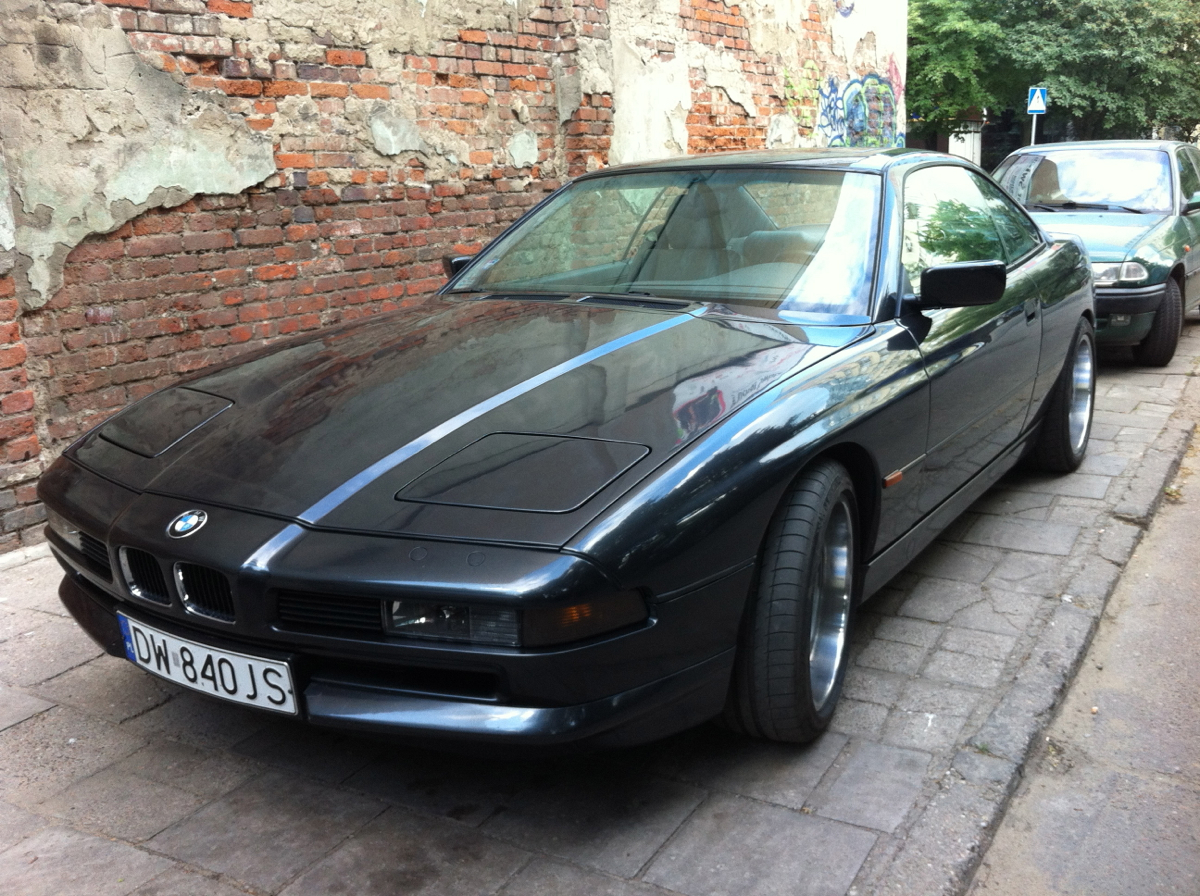
(first posted 10/7/2012. This post includes images by the author as well as by P. Niedermeyer)
Recently I found this BMW 8-Series parked next to my house. As a departure from typical BMW design standards (and somewhat the opposite of essential BMW philosophy), the 8-Series was one of BMW’s riskier moves of recent years. Since the late 1960s, BMW had become synonymous with sporty handling, great dynamics and advanced technology, and renowned for cars designed to engage drivers in the pursuit of ultimate driving pleasure. So did the 8-Series fit that bill?
Well, not at all.

The 8-Series was not intended as a direct replacement for the 6-Series, which was a sporty, compact, agile coupe with sleek looks, good weight distribution and, in the case of the 635 CSi, brisk performance. Instead, it was purpose-built for another kind of customer: the 80’s/90’s yuppie crowd. The car was very good looking, well equipped and exceedingly stylish–a stockbroker’s wet dream. A car to be seen in. An “über-machine”. Per the typical Gran Turismo, it was designed more for fast cruising than cornering orgies on mountain roads, and better equipped to spoil you en route from the downtown office, than thrill you on a weekend drive over the nearest mountain pass.
A sort of a luxury-barge. A posh-mobile. A status symbol of massive and shiny technological overkill.

Just one look at the sloping bonnet with pop-up headlights told you it was fast. The wide tires and long and wide stance signified it as a seriously quick machine. Add in the luxurious and roomy interior, with its great seats and hundreds of center-console and instrument-panel buttons and switches, and you had a modern automotive interpretation of the medieval cathedrals that were built to make a crowd feel minor and pray to the lord of power.

Oh, and it was powerful. Debuting as the 850i, it was powered by a 300-hp V12 engine–something offered by no other manufacturer at the time. The engine, at once very powerful and torquey and very elegant and refined, propelled the big coupe with ease.

If you ask BMW designers and engineers of that era about their targets for this car, they will definitely point to the Porsche 928, another big, strong and heavy luxury cruiser, which had been introduced in 1977 and was built nearly 20 more years. It was a clear benchmark for the 8-Series.
Probe a little further and they’ll also name other cars of the same period that could also have been alternatives to “the Bimmer”, including the Mercedes SL and SEC models and the Lexus SC400. While they couldn’t beat BMW and Porsche in all disciplines, they were nonetheless really good in some. The SL was a luxury convertible and a very advanced car; the SEC, more comfortable and far less sports-oriented, was more suited to “serious men” who didn’t wish to be seen in an “unreasonably sporty car”.

The Lexus was a bargain compared with the others, delivering sleek styling, good looks and great equipment and refinement levels, and a V8 about as smooth as the BMW’s V12. It was a serious contender with only one major downside: no prestige, at least at the beginning. That would change quickly, especially in the U.S. At roughly half the lofty price of the BMW ($78,000 in 1991), the SC 400 undoubtedly impacted the 850i severely. After selling only 7,232 cars in the U.S. over seven years, BMW pulled the plug in 1997. A rather embarrassing disaster.

Today we know a lot about market niches, those specific customer groups willing to pay more to appear individual and stand out from the crowd. We have also become much more focused on the image a car gives us than we were in the early 90s. Clearly, the BMW managers saw those needs much sooner. They chose their customers well, but in the end, the whole idea of an über-coupe didn’t pay off.
You need to drive this car to discover its greatest weakness. I had a chance to drive two of them–an early 850i and a very late ’98 840Ci–and boy, are they different…

The 850i had a rather heavy engine and rather modest-sized wheels and tires (235/55 ZR 16). It drove like a boat on stormy waters, floating on tip-toes and feeling nose-heavy and very massive. The model I drove had one of the first steering wheels with an airbag, and it was surprisingly big for a sports car; certainly, it didn’t add any sportiness to the ride. And inside there was total silence, with minimal wind noise and nearly none at all from the engine and exhaust.
What was good about it? It was very well made, quite comfortable on harsh roads, and very fast. Not really sporty, for sure, but very, very quick.
I also spent some time behind the wheel of a 1992 Ford Thunderbird LX, and those memories popped up as I was driving the 850i. For me, the 850 was more of an evolution of the American personal luxury car than a real sporty coupe. It was like a guidebook for the designers of future Thunderbirds/Cougars and even Eldorados/Mark VIIIs. It showed those big, comfy coupes the way they would go as they grew out of their price brackets. Driving a V8 T-bird was in many ways very similar to driving the 850i. Both were big and comfy; quick, but not sporty; luxurious, but somehow not very charismatic. And that’s the biggest sin the BMW 8-Series carries upon its shoulders. It has neither the sex-appeal of a nimble sports coupe nor the refinement of such more mature personal luxury cars as the Bentley Continental GT.

Two years later I had a chance to do nearly 200 kilometers in an 840Ci. It was a much younger car equipped with the best engine available for that model, a light and very compact 4.4-liter V8, which was mated to a five-speed automatic gearbox. This car handled much better than 850i, as its lighter engine was located well back into the engine bay, behind the front axle and very low. It had slightly less power than the V12 (286 hp vs. 300 hp), but nearly the same torque–and a much better gearbox. That made a lot of difference to the driving experience.
With updated suspension and a lovely small, 3-spoke steering wheel, this car felt much more sporty than the earlier model. It rode on 17-inch alloys fitted with properly low-profile tires that greatly improved cornering and grip. In fact, it felt like a totally different car and I loved it very much. It did share one major flaw with the old 850i in that it was far too quiet. I’d love to hear more “V8 songs” than wind noise…
But you know what? This car makes me think: What would I buy TODAY, assuming I were a bloke capable of buying an 850i or 840Ci? For one thing, I’d be 20 years older, probably with grown-up kids who drove their own cars and mostly visited my house during spring break at university. My wife would have become a serious lady. Or perhaps I, like some other men, would have to present my manhood to a subsequent trophy wife 20 years hence…what to choose from today’s showroom offerings?

One natural move would be a new 6-Series – bigger, less radical and far more luxurious than the recent “Bangle-styled” 6-Series. But will I? I don’t think so…
I think that the customers capable of buying such cars at the time have gone off in three distinct directions: Some went upmarket to a Bentley Continental GT or Porsche Panamera; some older buyers switched to higher-sitting SUVs like the BMW X6 and Porsche Cayenne, simply to avoid having to bend while getting inside; and others went into a niche occupied by the Mercedes CLS, BMW 6 Series Gran Sport or Audi A7.
And what does that leave on the personal-luxury coupe battlefield? In my opinion, only the Mercedes CL series and Bentley Continental GT.

Meanwhile, today you can go out and buy a good 8-Series for anywhere from $10,000 to $20,000. Sounds like the bargain of the century, doesn’t it?























The orginal 8 series seemed like it would have been a fun car with a complete engine/transmission/electrical system transplant from a late 90s Corvette. At least then it would be as reliable as it was good looking.
Or you could save yourself a pile of time and money and just buy a new Ferrari.
+1. Stay away from `classic’ BMWs.
+2
I had a Dealer Principal buy one of these cars in the early 90’s. The thing rapidly went from “what a cool car” to the car from hell. It was replaced with a Supercharged XJ Jag. All I can say is some folks are slow learners.
Beautiful cars for sure. But their techno-overkill made them maintenance and repair nightmares even when new. At their advanced age nowdays ( 20+ years old ) they’re much, much worse.
Plus the early BMW V8 engines with their Nikasil cylinder blocks were another huge headache…
“Meanwhile, today you can go out and buy a good 8-Series for anywhere from $10,000 to $20,000. Sounds like the bargain of the century, doesn’t it?”
Not if one considers what most BMWs are sold for, today – STATUS. Snob-status, to be specific. Today’s BMW customers are becoming what yesterday’s M-B customers became: Wealthy, uncritical older buyers who are uninterested in the engineering, passively accepting of the styling, and blindly loyal to the marque.
It seriously hurt Daimler-Benz, as bad habits and arrogance were cultivated and reinforced and then put on display in the Chrysler debacle. And it cannot but hurt BMW as their customers go the way of all flesh, and develop geriatric shopping habits…and finally exit the market, so to speak.
When new those cars were without peer…I have no doubt. But even when new, operational costs reflected purchase price and expected owner resources. To have one of those things as an OLD car? Thanks, no.
I’ll second that. At one of my previous jobs one of the guys in my work group owned a mid 90s M3 BMW. The sociology of people who buy older luxury cars is always interesting.
The thing was nightmarish on parts. Stuff broke constantly and most things were dealer only parts. IIRC it was eating $6-8k year in parts & labor.
I can only imagine how bad parts would be on something older, made with 80s cutting edge tech and a much smaller production run.
Look at the archaeological evidence (this article). We have finally earmarked the beginning of the transition of BMW from “the ultimate driving machine” to “the status seeking snob’s shiny, pretty, toy”.
And every BMW that follows tried to be a smaller 8-series.
No way this car can be considered a bargain. They had huge issues even when new and as a twenty year old, it is going to be el mondo money pit.
Hell, all BMWs are money pits. The new ones are over priced to beat the band and a used one is a sure-fire way to max out your Visa on a regular basis.
“Hell, all BMWs are money pits. The new ones are over priced to beat the band and a used one is a sure-fire way to max out your Visa on a regular basis.”
I have to disagree. BMWs from the M20, M30 era are very reliable and not expensive to maintain. They are well built cars with incredibly durable low fuss engines. I have had an e30 for the last few years and I have yet to take it to a shop. I have done all needed work myself and I am no expert mechanic by a longshot. It just hasn’t needed much. I would say that my experience is an exception but the other folks I know with old 3 and 5 series have had similar experiences.
I didn’t get my car for the snob appeal. I got it because it was an inexpensive way to have a fun car to drive as a counterpoint to my other car: a Volvo 240 wagon. Beyond driving dynamics, which are very different, the cars have been similar in terms of cost per mile, that is cheap.
I stand corrected. Thirty year old BMWs are reliable. The new ones, however, are disasters. I stand by that assertion.
This is still a way too general statement. The two daily drivers in my family are a 17 year old 328i and a 10 year old 330d. Except for the intake manifold on the latter (swapped out preventively) and a couple of minor electrical gremlins, they have given us no trouble and never left us stranded. Both have superb handling and great engines. If you know what models to choose and service your car regularly, you can still get a lot of driving pleasure out of a BMW at bargain prices.
I really doubt if any of you are bmw owners. You all sound like untrained techs that find working on bimmers difficult at best. I think some goof said one of his co workers drove a mid 90 s m3 and was spending 3-6 k a year in parts and labor? Dude stop the lies nobody pays that much for a car
Been driving a ’91 for twenty years and I don’t plan to part with it. It still better than 90% of the currently available vehicles available; reasonably rare; no more expensive to maintain than a 7-series; a dream to drive and oh-so cool.
I owned a 1991 850i and currently own a 1994 840ci. I consider the 8 Series among the most beautiful cars ever produced, by anyone. 20 years after introduction it still looks magnificent and continues to be copied poorly (Audi A5).
The 12 cylinder can be very expensive mechanically, but not so for the V8 which is a shared engine among the 5 and 7 of the era. Cosmetic and trim parts are expensive due to low production. But the real challenge is finding a mechanic or BMW dealer who knows the car; My local dealer in Nj had NEVER seen one, whereas they are common to BMW in California – where most seem to have been sold.
Both the 12 and 8 drive pretty much the same, although I distinctly remember feeling the power curve of the 12 was infinite….they are quick, handle beautifully, and for a few hour drive – there is nothing better – as long as you’re in the front seats 🙂
None of the car rags at the time had anything good to say about the driving dynamics of this car. But the interior was probably the cars downfall. I won’t say it was cheap, but it certainly wasn’t commensurate with a car this expensive. Designworks in California was called upon to redesign the interior, but by the time the upgraded interiors made it to market, it was too late. $10,000 might seem to be a steal, but a blown head gasket (the V12s were known to have this problem) would make the purchase price look like a down payment.
Just follow the path well worn by Jag owners and swap in a 350 SBC.
That made me sputter on my coffee!
I don’t know whether to nominate you for an award, for making the thing affordable, reliable, and serviceable in one move…or damn you for the blasphemy! THINK…the pride of a century of German engineering, defaced with a MASS MARKET V-8!
And in Munich? “Vee…are not amused….”
> the pride of a century of German engineering
You still have that as long as you don’t tell anyone what’s under the bonnet. 🙂
Been done (L98 in pic), but 350 conversions are old-hat; it’s all about LSx swaps now. Stand-alone retrofit harnesses are a few hundred bucks. An 8-series LS1 six-speed manual would be an awesome ride.
I also remember some serious complaints about headroom, even in front. I’ve never ridden in an E31 and am not tall enough that it would probably make much difference, but I recall that taller reviewers found that a dealbreaker even if they could have afforded the tab.
Can’t understand where you got that from.
Headroom is plentiful for all heights.
Being a rare car I often get admirers wanting to sit in it and they are from approx. 5′ 8″ to 6′ 2″ and not one of them have complained or looked
as though they were cramped in.
Very good read. MOAR!
These things were so much junk that that at least one has been entered into LeMons racing.
Half way down the page:
http://blog.caranddriver.com/24-hours-of-lemons-thunderhill-bs-inspections-180-cars-foolish-engine-swaps-galore/
I believe they designed the V12 as basically 2 6es with seperate fuel pumps and ECUs for each bank.
I am amused by the BMW (cellphone?) held on the console with what appears to be a rubber band.
I knew the 928. You sir are no 928..
Ha! Such a shame that the only BMW that’s not butt-ugly to me ends up being a POS.
The first 850i on the left coast made its appearance at my summer job at dealership on the Eastside, just outside of Seattle. I was 18, and was for some reason, allowed to drive a $90,200 car. With supervision of course. It was quiet on highway 520, and traffic started moving very slowly around me. Nope, I’m doing 120 mph. The only other cars keeping up were a 928 and a 300zx twin turbo. Three red cars, thundering (or whispering?) down the road. Time to slow down and turn around. Put that car back in the lot and don’t go near it for fear of my license self-shredding. But I still want an E30…
Nineties icon, and it’s a pilarless hardtop.
Being pilarless makes it so cool to me. Just as the SEC / CL or even a CLK from a class below. The new E-Class coupe however does not look so good because of those little triangular windows at the end of the roofline… Pity they left it this way.
Great article on a rather forgotten car! I’ve maintained and interest in these for a while…admittedly part of the appeal is their low value here in the UK…..and anyone that knows me knows I don’t like paying much for cars.
I now know why the values are low, didn’t realise the engines were problematic or the electronics were poor. Not sure that BMW have ever built their reputation on forward thinking technology though! Think Citroen for that; and look what’s happened to them!
Interesting that several amongst us feel that BMW is going downhill- that fits in with what I’ve thought for some time- there owners ate getting too old, BMWs are becoming commonplace and are loosing their identity and appeal as ‘the ultimate driving machine’.
To me the ‘1’ series is a woeful mistake, too small, too cheap too commonplace. Simliarly the Audi A1 does nothing for the Audi brand.
Interestingly the Mercedes ‘A’ class did MB no favours 15 yrs ago and they went through a bad patch.
Thank you! I like those cars and I’m very lucky someone liked my look at them…
In Rhode Island there is an older gentleman that lives near me that has had one of these from new. (I think it is a ’92 if I’m not mistaken.) It is pearl white with beige leather and it still looks awesome. In fact my wife always comments on it when she sees it. I spoke to him about it once and he says he still loves driving it after all these years. It has been very reliable although when he needs a part it can be expensive.
My mother has a ’98 528 and it too has been extremely reliable. The only problem she ever had with it was a hose blew and it nearly overheated, but luckily she was smart enough to turn the car off before causing any serious damage. Other than that it has been a fantastic car. I often tell her to trade it in and upgrade to a newer one and she flat out refuses. In fact, the mechanic she goes to says her model is one of the best. The newer ones are a lot more troublesome.
Here is a picture of the 1994 840ci interior, which is identical with the 12 cylinder cars. In 1995 they added a bit of wood trim to the center console….All business in the cockpit. First car to incorporate drive by wire, meaning no mechanical linkage between accelerator pedal and engine; first car to incorporate the seatbelts INTO the seat structure – which is why there is no rear legroom. Just a blast to drive though when you want to cover a large amount of territory quickly….
I just bought a 1993 850CI. It has the EDC which greatly improves handling when you want it, but making the ride on some roads where I live a bit harsh, totally worth the back pain! Best 18K I’ve spent
I’ve owned my ’92 850i for 11 years. The longest I’ve ever owned a vehicle. It has started every time I’ve turned the key and I still get a kick out of driving it … and even just looking at it! OK, some digital readouts are no longer 100% and it’s not without its faults, but it’s 20 years old. Every time I get the urge to replace it, I just can’t come up with an alternative that looks and GOES like the 850 for the money. I wouldn’t be surprised if they buried me in mine.
I’ve owned a BMW 840Ci for nearly a year. I suppose one buys an unusual “old girl” for all sorts of reasons. I’ve always been impressed by BMW’s but since a young man with my first car, I have pretty much ALWAYS serviced and repaired my car myself. I am not a mechanic but starting on simple 4 pot ford engines and slowly progressing to the complex and interesting BMW engines has become something of a hobby.
The 840ci WILL drink fuel. Regular servicing and maintenance is crucial. I get about 18-21mpg out of mine driving her gently. Since I don’t drink or smoke(!) fuel for my big old 90’s GT is I suppose “my little luxury”.
So far the only time a BMW has let us down was a water pump failure on a 525 with 120,000 miles on the clock.
Modern garages are hard pressed for time and will miss the odd little thing that left unattended can leave you stranded.
One buys an old girl like this if one is prepared to spend half an hour every Saturday morning just giving her the once over: Oil, Water, Tyres, check the exhaust, plug in the computer for error codes and so on.
If I had to take her to a garage the cost would be prohibitive, but with Ebay, a friendly BMW parts dept, a friendly car accessory shop, lots of “google time”, patience and some determination, I have a motor car that is a head turner like a Porsche or a Ferrari, but actually doesn’t cost me more than service items and petrol and is an absolute pleasure to drive.
I could have bought a brand new Fiat Panda for what I paid for the 840….but there was no contest!
I hope this helps. be bold, BMW’s are “driving machines” 🙂
M
Always interested that those that have never driven or owned an 8 series know everything about them and bag them out. It seems that the ones who own them love them. These were not ever designed to be a race car they were a true Gran Turismo, a cross continent cruiser and a very fast cruiser at that. Comfortable and quiet.
They can easily be modded to handle like they are on rails and go really hard.
Remember that these cars were put up and compared to ferraris and other super cars. These were not about that at all. As for comparing to Corvette or the like please don’t embarrass yourself as these cars will smash a vette around corners and stop way quicker.
Let’s be real about the level of car these were compared to in the day. Now all back in your poverty packs.
I used to own a 2000 BMW 323ci that I purchased new and few friends of mine warned me that BMW’s don’t age too well and are wallet emptiers when their warranty expires. I just kind of brushed off their comments as nonsense. After a few years my 323ci was aging beyond its years. The paint still looked good, but interior pieces were degrading and literally falling off! I had to have the front end bushings replaced at only 12K miles!? The entire steering rack was replaced because I’d hear a loud click and then a snap when making a right turn! Then I began having a plethora of electrical maladies mainly with the HVAC system that never worked right after several attempts to right the wrongs with my dealer’s repair facility. Now I know why my friends warned me. Despite my BMW having so many issues I still kind of liked the car. Even though it had a buckboard ride and the cabin would fill with tire roar on moderately coarse pavement and the brake pedal felt like you were stepping in wet oatmeal when applying the brakes and the sport seats killed my back, I still kind of miss my BMW in a strange sort of way. I traded my 323ci with just 40K on clock for a 2006 Infiniti G35 coupe and will never own another BMW again. My Infiniti has never had any major problems with 118,000 miles, and is night and day compared to my 323ci.
There’s your problem. I’ve never had and good luck with newer cars. I’ve now owned my 850CI for just under 2 years and my E34 525I for about 4. I have yet to have any major issues with my 8 and honestly my e34 I jus cannot kill despite about 2 years of trying. They don’t make BMWs like they used to
just bought a 95, 840ci , for £2000 , black and beautiful , sold my jaguar in order to pay to bring the bm up to date , jag prices are rock bottom and the series eight prices are on the up , this will be my last car so i had to have one , so far the problems found have been few , brakes and shocks all round and a broken side light unit , not even up to a grands worth , plus it has two lpg tanks , dont play golf anyway……. or i could have bought an astra .
In May 2014, I purchased a 1993 850CI. I always thought a V12 would be great to own and drive, what a dream come true. I have owned Mercedes S class, several BMW 7 series (2002 to 2007) and this car is like heaven when you drive it, smooth, powerful and comfortable. It fits in with my other old cars, 1952 MGTD, 1973 911 targa, each has it’s own persona, but the 850CI stands alone. It is just great to look at in the garage, starts instantly and runs so smooth.
I just did some reading up on engine weights and if it’s to be believed, the v12 motor is only 20 pounds heavier than the v8. This would lead me to believe that the heavy engine you felt is based on perception, not actual weight of the motor.
RyanB – you’re absolutely right. I know the weight difference is minimal, but the V8 is shorter and sits much closer to the cabin, positively changing the balance of the car. I love 840Ci much more than the 850 because of that…
I always though it looked much like a big Honda Prelude.
Now, the second generation 8-Series is out. Any thoughts?
I saw several carefully camouflaged prototypes on loose in Munich (where i live) and one production model at BMW Welt. I do like the new one very much.
https://www.bmw.de/de/neufahrzeuge/8er/coupe/2018/bmw-8er-auf-einen-Blick.html
Seen them around tarped up a lot since I used to work near the BMW development centre (Hi fellow Zuagroasta!). Since the proportions looked cool with the details invisible I was disappointed when it was unveiled; in my eyes, it just looks fat. A far cry from the athleticism of the preceding 6 and E90 3-series, BMW has seriously lost its way with its latest designs. If their design language reached a dead end in the late 90s, history appears to repeat itself once more. Reiterating the tropes rather without taking a holistic view.
That being said, the profit margin is undoubtedly higher on the new car, and with the new 6-series suddenly becoming a flashy crossover, it makes sense from a financial perspective; these cars are a niche thing anyway, I doubt the old, slow-selling 6 attracted a much younger audience.
That’s true.
People criticize the hell out of Bangle-era cars, but the 2003 6-series and the E90 3-series were stunning, and I definitely loved the look of them. Especially if you add the restyling to the E90.
Current era BMW is losing its mind at an accelerated pace. Have you seen the X2? The interior is fine (been inside one) but God that thing is A W F U L looking outside. I would take an E65 over that.
The original 850 looked like nothing else on the road.
That one looks like an Accord coupe.
Tyler Hoover bought one that lived up to expectations. Never was able to fix it.
Beautiful cars, but absolute junk.
Leave it to Tavarish to get it fixed. It would maybe take him months, but it would get fixed (haha)
When I see a BMW 850, I can’t help but think of this (NSFW for language)…
I’d say the original 8 Series wasn’t an aberration; it was the beginning of a line of beautiful-but-mostly-pointless halos for the BMW brand whose nomenclatures included that auspicious number 8. It was followed by the Z8, and most recently the i8 and newly-resurrected 8 Series.
You can bet that just about any “8” model for BMW is going to be something massively priced and drop-dead gorgeous, but not particularly groundbreaking or focused on driving. A status symbol, like you said.
Not to mention the number eight is considered auspicious and fortunate in Asian culture, especially Chinese.
Funny how 8-Series and Z8 aren’t any auspicious and fortunate for BMW…
So many, many cars fall into this category:
Jaguar XJ 12 cylinders
Audi A8 W12
Volkswagen Phaeton
Mercedes-Benz 600SEL
Pretty much any 10, 12, 16, or 18 cylinder cars…
All are overly technically advanced for their time but now are technologically obsolete, fitted with large engine, and looked good at purchase. These cars have depreciated horribly, and now are available at a reasonable price, but maintenance and upkeep make them a money pit that should be avoided by all but the most dedicated owner. It reminds me of someone wanting to own an old MAC computer. Yes, it was great in its day, and held a lot of social cache, but now is just an old relic that can be outperformed by a smart phone. Or, speaking of phones, this is like using a Motorola brick phone. Retro-cool, but utterly ridiculous and frustrating for everyday use.
Enjoy these as occasional drivers, take care of them, and it makes sense. But even then, it no longer possesses the qualities that made it desirable when new, as it was really just a status symbol.
someone wanting to own an old MAC computer. Yes, it was great in its day, and held a lot of social cache, but now is just an old relic that can be outperformed by a smart phone.
I respectfully disagree with your statement. My mum has ten-year-old iMac 20″, and I have nine-year-old MacBook Pro 17″ and eight-year-old iMac 27″. They run absolutely marvellous and give me no reason to replace them with newer one.
They work marvellous with my iPad and iPhone, syncing data between them. I love the fact that I could work with Safari or Pages on iMac then grab my iPad to sit outside and continue what I left off. I can’t imagine living without any of them.
Replacing HDD with SSD and maxing out the memory do the massive wonders for the older Mac. Best investment ever…
By the way, no such a car with 18-cylinder motor in production exists.
The 18 cylinder was sarcasm, but I believe Bugatti had a prototype with a W-18 in it. And 10 year old Macs will work with more modern devices, but I mean an original Mac. From the 1980s. I would challenge you to do much with one 20 years old or older, as I don’t think they interface with the newer iPhones or iPads. I must be much older than you, as I don’t consider 10 year old computers so old….
I have long contended that the reason so many BMW’s are leased is simply because you can get the next one before the current car runs out of warranty. The same comment could be made of Audi or Mercedes. To my knowledge, the only German car company that knows how to build a reliable high end car is Porsche.
No, I’m not biased. (grins)
I suspect the reason many are leased, if there is a disproportionate amount leased, is a mixture of cost and vanity. Nobody wants to be seen in yesterday’s BMW. My family started buying BMW’s about 12 years ago. We’ve had quite a few now and they are really quite reliable. The only one we ever had any trouble with was an E32 we purchased a couple of times. Frankly they’re the best built cars I’ve ever had the pleasure of dealing with. I’d trust a BMW with 200,000 miles on it more than I’d trust a Chevy with 20,000 miles.
In the UK, BMWs are seen on every street in every town, I believe that they are even more common than the Ford Mondeo, I can see 2 looking out of my residential home window right now
There are so many that they can be picked up for banger money (1990s -2008) parts are plentiful, especially from breakers and we do not consider them particularly difficult to repair.
This availability does not diminish their value as good second hand buys, you can get a lovely motor car for £2000, or recognition that they are good cars.
I prefer the 6 series as my favourite BMW, the BMW straight 6 is a wonderful engine and defines the character of the marque to me but I wouldn’t say no to an 8 series
I owned a ’92 850i for two years back in the 90s, drove it all throughout the south. It was “perfect’, probably the last gasp of the standard German “all or nothing” philosophy. I previously owned a 750L (both bought two years old). The problem with the 850 was that it was supposed to be sportier, but was actually 50 pounds heavier than the 750 with the same engine! It was de-contented, only a 4 way passenger seat, no center arm rests, no wood and of course unusable, perfectly tailored rear seats. It was a great tourer, but I think the main issue was the absolute seriousness of the car. If you went over 90 mph, all the windows and sunroof would automatically close. So German!
This type of car is expected to have a bit of “sport” built in, the 850 had nary a smile.
When I sold my company, I became responsible for the maintenance and promptly sold it, replaced it with a ’95 Camaro Z28 convertible. For that type of car, the Camaro actually was closer to the mark than the BMW!
I would agree that most “mega cylinder ” engines were produced in limited numbers and enjoyed limited success in the market. The Jaguar V12 was something of an exception. Initially used in the series three XK E. it went on to power several generations of XJ 12. It also famously powered the the XJS over most of it’s twenty two years of production. Total production of this motor was around 130-140 thousand examples. It was used a as the standard propulsion unit for many vehicles. It was a real engine to be used in real cars.
Improvements were steadily made over it’s lifespan. Initially offered with four carburetors, it was upgraded with fuel injection. The ” High Efficency” version with the Mays head brought about a welcome improvement in fuel economy. The final versions were enlarged slightly to six liters of displacement.
Performance was pretty good when it debuted. Emission controls had sapped much of the snap of the E Type, Further development of the six did not seem promising from a performance standpoint, although the original XJ series engine continued to power the XJ6 sedan into the mid 1980’s. The XJS was for a time the fastest four seat car available, with a top speed of 150 mph.
Of course, improvements in technology also caused this motor to become obsolete. XJS models powered by the newly developed, four valve six had performance that very nearly matched the 6.0 V12. Jaguar added a supercharger to the six and it was used in the original Aston Martin DB7 (in a higher tune) and was used in the late 90’s XJR sedan. These were superceded by Jaguar’s first V8 design in the new XK8.
Now we have turbo charged fours and V6s that can outperform any of the esteemed American muscle cars of the past. These old mega cars like the BMW, Mercedes, and Jaguar twelves can make interesting hobby cars but their low market values makes preserving and maintaining them a labor of love. Though the Jaguar is far from problem free, the basic engine is pretty trouble free, as long as the cooling system is kept in top shape. Electrical and accessory systems will be enough to keep you busy! Due to the large and extended production runs, replacement and used parts are easily available. There is a lot of enthusiasm and knowledge for these cars on several forums on the Web.
The ideal status symbol for an ageing bloke with a 20+ years younger girl friend who still leaves him enough money to waste. Fast cornering? VW GTI is better. Long Trips? I’d prefer the Lincoln Town Car. Family vacation tour? My Vanagon has plenty of room. I can’t imagine why I’d ever need a BMW.
The Prelude comment made me smile – I drove an 840Ci when my wife had a Civic VTi.
I was quite amused by how similar they handled, both having trick rear suspensions and small steering wheels – that seemed odd in a German car!
The BMW was wider, heavier and vastly more refined, of course. But it handled its bulk very well indeed. And yes, the pillarless design was very pleasant. Both had remarkably similar driving positions and good ergonomics.
Replacing steel liners with Nikasil coating to permit an over-bore did not agree with our sulphurous petrol – many manufacturers found that out. But I understand they’ve now fixed the petrol.
German engineering – it occurs to me that the modern ones are perfectly engineered to be reliable until the last day of the warranty. But all cars now have too much bought-in electronic crap on them, so one is merely stacking the odds of a failure.
Anything M10/20/30 hardly has anything on it to go wrong! Except that they are now very old and so one can expect things to break/wear out.
These BMWs are beautiful and impressive machines. I admired them greatly when they were new. I’ve bought a lot of old luxury cars in my lifetime, but modern cars are luxury combined with complex electronics, and crushingly complicated technology. They are not for the faint of heart.
As some of the commenters have mentioned, with a high level of commitment, dedication,and a high level of owner education, it’s possible to have a successful relationship with a car of this type. If you instead choose an older low tech car, like a ’40 Ford, ’55 Chevy or ’60’s Mustang you can maintain, them more easily at their optimum level.
I found my earlier six year old comment interesting, as my current Hobby Car series will soon segue into my period of Jaguar ownership. This post and discussion is also timely as I just posted a related topic in my weekly blog. Sorry to blow my own horn, but I think that CC readers will find it entertaining.
I’d forgotten I’d driven one of these fifteen years ago. I’d just started my first tour as a pilot in the Navy, was starting to build up a little cash, and wanted a stylish coupe with some performance in the mix. The cars I’d had in mind were the Lincoln Mark VIII and Mercedes SEC. Anyway, I came across an 840i at a used car dealer and took it for a spin. It really didn’t speak to me: it wasn’t inspiring to drive, the ride wasn’t great, the front seats weren’t great – to say nothing of the back seats! I think there was a warning light or two that came on (none that said “grab your wallet!” – I guess that’s assumed) and the price didn’t seem that reasonable. I’m pretty sure this was a lot that sold quite a few slightly older sports and luxury cars and made a big profit by feeding on junior enlisted types, FWIW. Some months later I came across a great deal on a 560SEC that needed some work, but was simple enough that I was able to get it sorted without breaking the bank.
The 840/850i fails to stand out as anything other than an expansive BMW. It’s not bad-looking, but it has a very “1990!” look – I think very comparable to the T-bird of the same era mentioned, or maybe better yet, the original Ford Probe. Actually, both are centered around that slightly softened angular look, but I think the Probe actually pulled it off a little better. In both cases, it’s a little too dated to be classic. The mechanical issues (moreso with the 850) are the strongest reason not to own one – to my mind it’s not a compelling enough car to be worth the risk of frequent failures and unfixable gripes. I think, too, that BMW (while obviously looking to the 90s) created more of a last gasp of the 80s – something overly tech-heavy and businesslike.
I have to make a few comments on the comparable cars, with the caveat that I’ve only driven an 840i, and the SEC (obviously). I think Lexus did everything you’d need in such a car for a much lower price. I’m not big on Japanese cars, but if I were looking at one of each at the same price, I’d have a hard time choosing the BMW – even if it worked perfectly, I’d have to wonder for how long. The 928 and XJS are both a little more compelling to me, although both require careful shopping to get a really good one, and the XJS especially is firmly a ye olde world car. I’ve kind of wanted a 928 for a while, and despite being a decade older, I think that would be the way to go if you leaned toward the sportier side. I hear they’re pretty solid mechanically too, if taken care of. For someone looking more for luxury, I think the Mercedes W140 coupes would be a strong candidate. The looks are a wash to me, and the mechanicals aren’t great on them either (way too much to go wrong, unlike the W126), but they’re a real isolation chamber on wheels. I’ll also take the W140’s interior over the BMW’s any day. That leaves the W126 SEC. It’s too bad US models suffered from a suffocating exhaust, park bench bumpers, and uglier headlights. Even as such, it’s a classic look that the 840/850i missed on. It’s equal or better in comfort, a little worse off in handling, and miles ahead for reliability. Even with the US-spec drawbacks, I say it’s the one to have. If we bring in the ultimate version, a euro 560SEC with the high compression motor, I can’t see any argument for the BMW. It’s a nice car, and the rarity makes it a collectible, but it falls short of being a classic.