

(first posted 9/5/2011) Being a true multi-national, the Jensen Interceptor has many facets to its complex personality. If you were a pessimist you’d say it has the electrical system of a British car, a rust-prone body inspired by the Italians, and all the mechanical sophistication of a big American brute. I’m often an optimist to a fault, so I view it as a car with British charm, a finely tailored Italian suit and a strong, reliable American V8 heart. Exactly why the Interceptor speaks to me so strongly is hard to pin down; maybe I’m tri-lingual. But the story of Jensen and the Interceptor is a highly fascinating one, even in just English.

Our CC car is far from being the first Jensen, and is in fact not even the first Jensen to have the Interceptor name. The Jensen story starts with two brothers in Great Britain, the inevitable Austin Seven, and lots of aspiration. It’s amazing how many companies either started with an Austin Seven, or had it play a major role in their early history: Lotus, Jaguar, Nissan/Datsun, even BMW via the Dixi, among others.
The Jensen brothers, Alan and Richard, started by building a sporty body for their Austin Seven special, and from there landed a job re-bodying cars from Standard. They continued to re-body cars for the next few years until 1935, when they created the first real Jensen. Nicknamed the “White Lady”, the brothers’ love of big engines became apparent by their choice of powering it with a flat head Ford V8. The S-Type of 1938 (above) is a direct descendant of the White Lady.

They also built various other big touring cars as well some trucks, with the war interrupting. I know you are eager to hear about the Interceptor and I’m getting there… just not to the one you think. In 1950 a Jensen was produced called the Interceptor (above), which was powered by a 4.0L Austin straight six. Austin loved the styling so much that they commissioned Jensen to build what turned out to be almost a 2/3 replica of it based on the Austin A40, called the A40 Sports.

Next came the 541 in 1955, with a fiberglass body and was also powered by same Austin straight six as the old Interceptor.

By 1962 the C-V8 was introduced, also using a fiberglass body, but this time powered with a big block Chrysler V8. The C-V8 also featured some very odd styling at the front, but was incredibly fast for a four seater. For its replacement, all the in house styling proposals were rejected and Jensen looked for outside proposals. At this point, both the Jensen brothers and their head stylist left the company.

Touring of Italy came up with the winning design for the Interceptor, which Jensen bought all rights to. Then in a very odd move, considering Jensen itself was a coach builder (they built the bodies for early Volvo P1800s, Austin-Healeys, etc), they hired out the initial production of body shells to Vignale of Italy.

Paul Niedermeyer did this analysis of the design origins of the Interceptor: The top car is the 1963 Studebaker Avanti. The middle one is a bit obscurer: the 1964 Brasinca Uirapuru, a Brazilian GT, of which only 73 examples were made, and powered by a triple carb version of the old Chevy six (just like the original Corvette). Wiki makes reference to the Uirapuru’s being the stylistic antecedent to the Interceptor, and even has a link to a Brazilian video comparing the two, but no mention is given to the rightful originator of them both. Undoubtedly, the Uirapuru was the missing link, as its front and rear ends are much closer to the 1966 Interceptor.

The similarly styled but very advanced FF model was brought out at the same time, with Ferguson Formula four wheel drive, traction control and anti-lock brakes. While the Interceptor used the same chassis and underpinnings of the C-V8, the FF (above) had a five inch longer and much modified chassis. That extra five inches was between front door and front wheels, resulting in two side louvers, and a longer front hood and fenders. The Interceptor FF was a true milestone car, and its full-time AWD drivetrain that was eventually taken up by Jeep, and others.
Because the FF was (foolishly) designed to be strictly a right-hand drive car, and the mechanical packaging of the AWD system made it impossible to convert to left hand drive, no FF’s were ever (officially) imported to the US. Its 30% price premium also dampened its sales substantially.
Unlike the C-V8, the Interceptor and FF now had steel bodies. The Chrysler 383cid V8 remained the engine of choice, most often with a three speed Chrysler Torque-Flite automatic, but there were a handful of manual transmission cars made too. With the end of the MkI Interceptor, Jensen brought body shell production back home to West Bromwich in England.

The MkII (1969) was brought up to date a bit. King pins and lever arm shocks were out and radial tires were in. Power steering was now standard. The interior lost some of its Italian flavor, and the styling was tweaked. The 325hp 338cid V8 carried over. There were a few SP models built with a 440cid V8 and three carburetor setup more commonly known as the “Six Pack”.
Back when I was in University, I used to drive two and half hours back home every few weekends along some of the most straight and dulls roads. I think there was literally four turns between my place and my mother’s, three hundred kilometers away. But there was an interesting little town in between the two which was probably home to less than fifty people but it did have a sad and neglected looking Interceptor MkII.

This town was not the most direct way but most often I’d invent excuses to go that way and usually stop and gaze at the Jensen. From what I remember it had a few different colours of body panels, extremely dusty but complete. I often dreamed of selling my Z28 and making an offer on it. As much of a wide eyed automotive dreamer as I am, I did know that being a student with no garage and no real tools or mechanical knowledge, the car would break me.
I even joined an Interceptor mailing list but never inquired after it. After a few years it disappeared, but hopefully found a good home. Unfortunately this was pre-digital camera era so I have no photos to share. I can share a photo of a Vanden Plas Princess 4 Litre R that sits in a field behind were the Jensen was.

The Mk III brings us up to our subject CC. The 440cid V8 with a four barrel carburetor became standard to maintain performance with dropping output from emissions equipment. I talked to the owner of this one briefly, and he said it was the first year of the 440cid, so that would make it a 1973 model.

Naturally enough, he drives it only on nice summer days, as Interceptors are known for guzzling impressive quantities of fuel, thanks in part to tipping the scales at some 4000lbs. The thing is, it doesn’t look as big you’d think from photos. It is actually over 10cms shorter than say, a Dodge Challenger.

Most of the motoring world was assuming the convertible was to be banned in the United States so they were all very busy creating sporty coupes to replace their drop tops. Jensen went the opposite way and developed a drop top version of its Interceptor. Lopping the roof off meant that the distinctive and large rear glass was lost, but in its place was a very bulky-when-folded top. As I recall the Rolls-Royce convertibles of the period have the same look, so perhaps it is meant to have class rather than that it wasn’t designed as a convertible. Convertible values are much higher, so a lot of folks must like the look, but I prefer the sedan with its trademark rear glass.

There was also a little remembered coupe version that used the convertible’s truck lid and a Jaguar XJ6 rear window to create a slightly odd look. Only 54 were built as Jensen was slipping into bankruptcy as warranty claims on its Jensen-Healey convertible, and low sales of the Jensen GT, combined with a sharp increase in fuel prices had overwhelmed the company. By 1976 production had ceased.


That is not the end of the story however as a subsidiary was created to service and provide spares for the cars. Before long they realized they had everything they needed to resume production. Production was restarted on a very limited scale. Some were apparently powered by a 360cid small block Chrysler V8. The horror! Another bankruptcy and the S-V8 project was launched to replace the Interceptor with a modern, Ford V8 powered roadster (below).
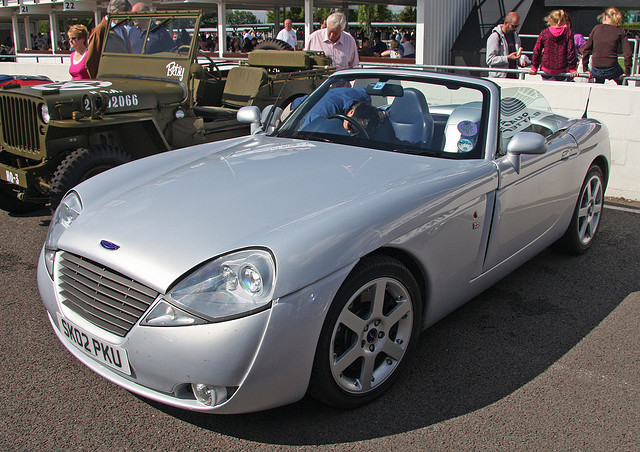
Yet another bankruptcy followed. You’d think that would be it then, wouldn’t you? No, Interceptor story still continues with the Jensen Interceptor R offered from a restoration company as opposed to Jensen, which was broken up in the last (and final?) bankruptcy. The Interceptor R is created from a classic Interceptor but with some modernizing such as a GM LS3 V8, independent rear suspension, updated brakes and 21st century luxury interior. Still sounds like the classic Italian styling, British charm and American power recipe to me.

Related reading:
CC 1972 Bristol 411 and Bristol History: The Last British Eccentric
CC Jensen Healey: Care To Take It For A Really Long Test Drive?


Although I know virtually nothing about them, I have long harbored a fascination with these cars. I remember the magazine ads of the early 70s. An english sports car with a Chrysler big block – what’s not to like?
The profile of this car is a little reminiscent of the Studebaker Avanti, particularly the C pillar and rear window areas.
Great piece on a very unusual car.
I’ve wanted one of these (like a few others I’ll probably never own) since I was a kid, despite having seen exactly one in the wild in all that time. I have a soft spot for all the oddball “executive grand tourer” cars, particularly those from the early ’70s (the Citroen SM is another). Like the author here, I know that despite the possibility of finding a decent example at a decent price (you can find a decent example of almost anything in Southern California), my lack of space and tools to work on such a car would mean paying a mechanic to work on it, which would mean busting the budget wide open, which means I’ll just have to be satisfied with a Subaru (although, there is always the SVX…another “oddball” car with an unusual glass treatment).
Found on of these myself not too long ago, though the CC car is in far finer shape. I had put it as being newer, but it makes sense that it is older than I thought because of the skinny bumpers.
As I understand it, these cars are immensly strong and rigid, due to the fact of its structural redundancy. The Interceptor contained the old twin tubular frame rail chassis from th C-V8, with a (more or less stand alone) steel body on top of it. Another thing that strikes me is how clean and modern it looks like. It was designed in 1966, and the Italians were all into curvature galore at that time, with cars like the Fiat Dino Spyder. Touring was 2-4 years ahead of the competition with that one.
This is another one of those simultaneously tempting / terrifying cars. Kind of like the E-type Jag, the Interceptor’s reputation for hard to fix rust is enough to keep me away, at least the American drivetrain is easy to manage.
What I find the most interesting point on these cars is that for many years these have been the most affordable big block Chrysler powered two door cars you can buy. In North America they are almost worthless, an original big block Challenger or Satellite goes for way more. Interesting reversal of roles considering how much they cost new.
+1 That’s sort of the way I’ve always felt about Jensen.
It had the largest rear glass ever created.
I thought the original Plymouth barracuda held the record for largest rear glass…
I dunno. I thought the `77 Toronado XS with the ginormous wraparound rear window held that record.
My understanding is that the gen1 Barracuda’s rear glass is the largest.
I’d much rather have a Sunbeam Tiger….Great article however….
These are quite the unusual machine. For some reason I’ve ran across a number of them over the years. Never running driving versions though. They all seem to have a dead engine. The emissions 440’s liked to eat up exhaust valves so I assume that is the reason. The people who live across the street from my mother in law has one in their garage. It’s been in there since before I got married so over 20 years. It has boxes stacked on it’s dust covered body. I am not sure why it still sits, it’s not like the owner doesn’t do his own work. The son’s Acura was layed up in the driveway for a month or 2 when they changed out it’s dead engine. I’m surprised that the hoist that was left out there with the engine hanging in the bay from it for at least a month didn’t find a new home.
Great find! I’ve always liked these, the idea of a British GT with a big block Mopar powertrain appeals to me. There can’t be too many of these in Southern Alberta.
I wonder if the ABS system on the FF somehow inspired Chrysler (and Bendix) to work on ABS themselves? I understand the system on the FF was fully mechanical, while the Chrysler system introduced in 1971 was more or less a modern ABS system with wheel sensors and electronic controls – but I wonder if they got the idea of ABS for passenger cars from working with Jenson on powertrains?
The AWD system in the FF was developed by Ferguson, the tractor manufacturer. To my knowledge they developed it themselves, not in conjunction with Chrysler nor Bendix.
Also, if I recall correctly, the ABS used in the Jensen basically modulated the vacuum in the brake booster, ie: to reduce brake pressure, it vented the booster to the atmosphere to momentarily reduce the power assist. I’m not sure how it detected wheel slip to activate the system though. I’d be curious to know how well the system worked.
The FF used an adaptation of the Dunlop Maxaret anti-skid system, originally developed for use on carrier-based aircraft. If I’m remembering correctly, the system worked by comparing the rotational speeds of the front and rear driveshafts — it would engage if either shaft overran the other by more than a certain amount. (I think that’s why it wasn’t offered on non-FF vehicles.) I believe you’re correct that it was a “single channel” system that didn’t have the ability to modulate individual wheel pressure.
I’ve never driven a Maxaret-equipped car and probably never will, but the consensus of contemporary reviewers was that it was crude and not all that effective.
I doubt it had any direct influence on the Bendix system. Different engineers had been toying with antilock systems for a long time (again, originally for heavy aircraft) and there were several (admittedly rear-only) systems on the market before the Bendix-Chrysler system debuted.
As for the FF system, the guys who developed it, Freddie Dixon and Tony Rolt, actually started working on full-time automotive 4WD before they went to Ferguson. Since they didn’t have a lot of resources, they convinced Ferguson to set up a research division to underwrite development in hopes that they’d come up with something to sell the auto industry. The corporate history after that is complicated, but Rolt and Ferguson’s Derek Gardner did develop the viscous coupling common to later AWD systems.
I first became aware of these cars as a kid after seeing a 70’s B-grade car chase movie titled “Speedtrap” starring Joe Don Baker. A mysterious lone car thief dubbed “The Road Runner” was stealing cars and making the local cops look like idiots, and JDB was called in to help catch him.
The first or second car stolen was a Jensen Interceptor, which aboslutely got the crap beaten out of it as the thief fled the cops.
I’ve had a ride in one of these, on a skidpan where once it got moving it acquitted itself well, good grip.
Haven’t checked on prices lately but they were always available cheap here, I expect on the basis that the purchase price was just a deposit on what it would cost to fix up & get running properly. Also 15mpg (imperial, so 12.5 mpUSg) highway cruising does not help keep the cars running well via regular use.
Theres a couple of these for sale on trademe auction site 50k start price we pay $10 per 4.5 litres of dino juice, way outa my league.
Just had a look for curiosity’s sake, 2 at $32k, one at $48k and a convertible asking $130k! They don’t look like the restorer condition where they are cheap though – I was going to say deceptively cheap but I don’t think anyone would be fooled!
Nothin cheap about repairing one of these only the motor and trans are simple and common body work could bankrupt a wealthy collector Ive seen one of these Interceptors in pieces in Sydney at a restoration place and that guy was a genius he had replaced the bottom 1 foot of the car not really a task for the amateur at least not this one.
The good ones have always commanded good money but in the last few years prices in the UK on these have been gaining which drives up the prices here too.
Great write-up, thank you! I’ve always loved these, very distinctive styling. Oddly, considering the number built, there are five of them in my rural New Zealand town (population 10,000). Only two are actually on the road though – one has been owned by a local school teacher for about 20yrs, and the other resides in a local private car collection which I visited recently – the owner has a spare glass hatch on display on a (large!) pedastal. Looks strangely beautiful.
As Bryce notes, there are always a couple of Interceptors for sale here on trademe, sooo tempting! One that was on recently was one of the Six Pack models, which had been fully restored. It was awesome!
Top Gear UK did a great piece on the updated Interceptor R recently too.
Ahhh, back to my dreaming…
There is a Jensen Interceptor convertible that shows up at local carshows. Only one I’ve seen in years. It must’ve been later production after tougher rollover standards came into place or something. Unlike the red convertible pictured above, it has a “hoop” rollbar over the back seat.
Thanks to eBay, I picked-up a set of cast aluminum Interceptor valvecovers (I guess they would be “tappet covers” since they’re off a British car. 🙂 ). I think they’re one of the best looking valvecovers for Mopar big blocks, and they’re certainly uncommon, so I wanted to put them on one of my Chryslers just to be different.
My plan was to clean them up and polish them til shiny. They were covered with some old, nasty wrinkle-black powdercoat. I used a powerful solvent to strip the powdercoat, and discovered it was hiding a lot of sins. The casting was pretty bad, and the finishing was done by a trained monkey with a grinder. Fortunately they were pretty thick, so I was able to clean them up to look decent. Unfortunately, I couldn’t install them because they hit the brake booster on my car.
If you’re curious about another rather rare British sports tourer sporting big Chrysler drivetrains, look up the Bristol from the same time period.
Then there were the French Facel Vegas. The earlier models used 331 and 354cid Hemis, and the later ones used 383 and 413cid big blocks.
+1 on the Bristol nice to see another fan.
you know this is a fabbulas car becouse …dusty springfield and cliff richard owned them
A British/American/Italian mash up that’s gorgeous.A car on my wish list since I saw one as a 10 year old at the car show in Earls Court London.For safari suit,cravat wearing play boys to drive at tyre smoking speed on their way to solving crimes and espionage.Of course the playboy will need a glamourous blonde assistant,I volunteer right now.They turned up in a few TV shows at the time,The Baron, The Magician and Department S/Jason King were a few I can remember
I’m in, Gem, dahling. Though I don’t do cravats. 🙂
Glamorous blonde assistant reporting for crime solving duty
I live right across the street (the wrong side of the tracks, so to speak) from one of the richest neighbourhoods in Canada. Somebody around here had a 1974 convertible (a deeper burgundy red than the one pictured and with deep tan roof and upholstery) for sale a few years ago. It was parked on the lot of the local gas station (I think they rented space to people who were doing private sales as the location right on the corner was prime. That was a really beautiful car. I even saw it driving around the area one fine sunny day. I’m not sure if it was a test drive or the owner enjoying it a bit more before he sold it. I know it was a ’74 because I found its listing online. He wanted $40K, saying he needed it to help pay for his son’s university. He must really love that kid. Or really resent him now. 🙂
Interceptor looks pretty good as a 4 door too:
There’s a 1973 Interceptor III in my local craigslist for $34K. It’s supposed to be in showroom condition, but even then the price seems high. For quite a while, these were the cheapest way to get a Chrysler V8 in a 2-door body in the US. They really weren’t built that much worse than Duster 340s and Super Bees, were they?
Genuine Chrysler products weren’t beset with an electrical system manufactured by Lucas, the Prince of Darkness.
Well put!
Looks like the kind of car a private detective would drive on a `70s TV show.Polyester suit, open collar with gold chains, and styled semi long hair. I thank the British “Top Gear” for this comment when they did a mock TV show called “Jensen” a few years ago with characters like I described.
There was Department S and Jason King.Sometimes shown on TV today
You missed nothing with the FF it was badly underdeveloped,the pedal kick was never cured and the fwd understeer was at best disconcerting.The electrics were largely Mopar and Marelli if I recall with Marschal providing the head lights.
Worked at the Jensen dealer in ’76, getting into one of these when it was new, was like climbing into a huge baseball glove; you could OD on the smell of all that leather. I had one on the lift to replace the starter and had to work around a 3″ diameter piece of pipe that the frame was made of. Pretty crude, but the owner didn’t see it.
Didn’t need the Prince of Darkness components to have problems; the mopar alternator had a diode short to ground, pulled battery voltage thru the harness to the ammeter and back to the diode. No fusible links, so it melted most of the insulation off the rest of the wires in the engine and dash harness. $1200 for the harness back then, another $320 to install it. Tech had the new harness laid out on the floor, was a little longer than the car. They were around $25-30K, so easy $100K in today’s money.
As a small child back in the 70s I developed an interests in the Jensen Interceptor. I remembered thinking it’s level of coachwork was no the usual for sports cars. I wrote to our cousins across the pond and they (the company) responded with a kind letter and new sales brochure. I still like them.
Beautiful styling, great luxury and storming performance, but the quality, alas, is not of the best.
In 1973 or 1974 the manager of the Leyland,Rover,Jaguar etc dealer I worked for returned from England with a 1968 Bentley,1971 Rover P5B Coupe and a 1973 Jensen Interceptor,to resell.I did get to drive the beautiful white with black interior Rover but only got to sit in the Jensen.That Jensen was a striking looking car,light metallic blue with cream interior and supremely comfortable seats.It sold quickly to a local millionaire who lived in a coastal area,so rust would have been a problem.A car fanatic friend told me that the engine was set well back against the firewall and with that vast rear window,the air conditioning struggled to keep the interior cool in our hot Australian summers.I still think the Interceptor is one of the most beautiful cars ever made.
I always loved the late ’60s coupe version of this car. It was a true exotic, sort of like the DeTomaso Pantera. I didn’t like the convertible, because that distinctive roof line is what gave the car it’s looks. And of course I don’t like 4 doors.
Rebuilt the engine in one of these years ago. I think it was a ’72, the car had a ‘good’ 440 in it, ‘HP’ stamped block, 906 heads, big Thermoquad, and dual-snorkel air cleaner. It was quite some job, the car was literally built right around the engine. Since the Jensen had a front mounted rack-and-pinion steering gear (out of a Jaguar as I remember) it would have interfered with the 440’s oil filter location, so these cars had a remote mounted oil filter. A blown line to the oil filter took this 440 out, and that was why the engine needed attention. The engine to (727 Torque-flite) transmission bolts were inaccessible, which required pulling the engine out with the transmission attached. This required considerable finessing, a tall hoist, and raising the front of the car quite a ways off the ground to get the right angle. As bad as the job was, a drive in the finished car with a fresh engine made it all worthwhile. It was a very nice automobile.
hey- that’s a Porsche 928, rear wise….
I love this era of American power shoehorned into beautiful European GTs. But make mine a Facel Vega
If you continue the line of red cars beyond the Avanti, Uirapuru, and Interceptor, you get the Mazda RX-8…
Speaking of Mazda, I can see a bit of Miata in that S-V8 if I squint hard. . .
Late to the party, but does anyone see some Triumph Stag here, especially on the Coupe
There is an earlier, technical assessment by Ate Up With Motor. Does anyone know where he is? I am certain that I am not the only one that misses him.
He’s in LA, where’s he’s been for a long time.
He mostly stopped posting at his site for some reasons that he wrote about there. He seems to be somewhat unreasonably paranoid about legalities that in his mind might apply to him and his site. There may be other issues too.
Great article on a fascinating car, a major object of automotive lust for me as a young man, there were quite a few getting around Melbourne in the 1980’s. Holden’s special vehicle division HSV, built a 4wd version of the Monaro called the Coupe4 in the early 2000’s. Very similar concept, American V8 in a 2+2 coupe with 4wd, I can’t think of many others that tick those boxes. The Coupe4 however did not have a long life among a number of factors Australia being in the middle of the longest drought on record didn’t help its sales figures, why spend extra on a 4wd system you can’t use to blow people off at the lights on a wet rainy afternoon. Very rare and quite collectable now.
A very nice, succinct piece on these interesting cars. I’m glad it was rerun.
My very first exposure to the Interceptor was a rerun of a ’70s movie called “Speed Trap” starring Tyne Daly and Joe Don Baker. I was a kid at the time, but I couldn’t take my eyes off this alt-world-Avanti, as it sped through California roads being pursued by police. The car was thoroughly thrashed by the time the thief got away, but it took me years before learning that it had been a Jensen Interceptor. It had such a great, throaty exhaust note during its brief appearance in that movie.
Side note. The Brasinca Uirapuru was launched in late 1964. It was designed by Rigoberto Soler, a Spanish engineer who immigrated to Brazil in 1950. Early on he worked at the car industry and designed several types of bodies for the companies Vemag (DKW) and Willys-Overland (Kaiser branch). Eventually he moved to Brasinca, a large industrial outfit that made bodies for trucks and buses. The Uirapuru was essentially a kind of halo product for Brasinca. Only 70 cars were completed, including 3 convertibles and a single station wagon for the highway patrol. The car was fitted with hand made steel body and frame, used the GMC 260 ci six with two SU carbs (160-180 HP), front suspension from the Brazilian Chevrolet truck but a special rear supension with coil springs, 4 track bars and a Panhard rod. Good for 120+ mph, however somewhat slippery in the back. Millionaire stuff at the times.