

One of the most powerful words in marketing is: “NEW!” People are always seeking something new, endlessly. Manufacturers and advertising copywriters know this, and are forever coming up with the “next new thing” to wow the public. This is actually good–it drives innovation. But for one reason or another, not all boldly heralded new ideas catch on. Or they have an initial spurt, then slowly fade away, as people focus their attention on other things. Yesterday’s exciting new idea is then either scorned or, most often, quietly forgotten. So ephemeral, just like life itself.

Among automotive flops, the famous ones are the Chrysler Airflow and the Edsel. (And later the Cadillac V8-6-4 engine). But I have personally selected a few of the the lesser known, smaller examples of ideas that went nowhere and have largely gone out of the public consciousness.

The late ’50s were especially known for boldly styled, extreme designs with advertising hype to match. These cars were before my time, so I did not witness their introduction. But as a youngster it was always an exciting thing to actually see one in person. To me, these ’50s dreadnoughts were old, exotic; coming from an enchanted, faraway time when everything was more beautiful.
But today I want to focus on introductions of some enthusiastically-presented innovations that I personally witnessed growing up–and my initial reactions to them. Listed chronologically:
MAZDA ROTARY ENGINE

For an internal combustion engine, this seems like a more elegant solution. Instead of individual cylinders, pistons, rings, connecting rods and a crankshaft, we have this rounded triangular “piston” that rotates sort of like a tracing gear in a Spirograph toy. My father (who was a design engineer) had a particular interest in rotary (or Wankel) engines, but he never bought a car that had one.
“The rotary engine is here to stay!”
In this commercial (which I remember) the piston engine is portrayed as crude, jerky, old-fashioned. “Piston engine goes boing, boing, boing, boing; while the Mazda goes MMmmmmmm!”

Well, it turns out that the “elegant” rotary has a few problems, namely high fuel and oil consumption, and high emissions. So just about every car on the road today still has a boing-y piston engine, the same basic design concept that dates back to the dawn of the horseless-carriage era.
JOE ISUZU
Auto manufacturers and dealers always strove to cultivate an image of professionalism, honesty, and respect for the customer. Car salesmen did not typically have a stellar reputation with the public. And, just like the Volkswagen ads of the early ’60s that broke all the rules, these Isuzu ads were equally startling, and suddenly everyone knew what an Isuzu was! Here is the typical slick salesman (played by David Leisure) who is intentionally lying to you, but doing it in such a funny way that it’s somehow refreshing.
I loved all the Joe Isuzu commercials, but how truly effective were they? Isuzu cars never really caught on with the public, and Isuzu sold its last passenger car in the U.S. in 2008.
1988 LINCOLN CONTINENTAL: “THE WORLD’S MOST ADVANCED LUXURY CAR”

When the Ford Taurus and Mercury Sable came out in 1986, they were truly revolutionary both in terms of looks and driving dynamics. So it was quite logical that Lincoln should have its own version. Of course it would be longer, more luxurious, and have the latest high-tech features. Lincoln described it as “The world’s most advanced luxury car”; the premiere example of a new concept called “The Lincoln Vision”.

The 1988 Continental brochure (which I have) is full of lengthy descriptions and clear plastic overlays showing all the advanced features–air suspension, speed-sensitive steering, anti-lock brakes, and other goodies. The trouble was, these Continentals had terrible reliability. The “advanced” air suspensions soon collapsed, the underpowered 3.8 liter V-6 was notable for blowing head gaskets, and other mechanical and electrical things started to fail. If the heater core leaked, you might as well throw the whole car away because replacing it required disassembly of the entire dashboard! On Consumer Reports’ dot charts, there were deadly dark circles all over, while Honda and Toyota had beautiful rosy red circles everywhere. It was especially embarrassing when Lexus, Infiniti, and Acura were introduced, showing the world how to build an advanced, high-performance, extremely reliable and well-built luxury sedan.
It’s kind of funny that in this commercial, cars of the ’50s (including a 1960 Continental!) are called “Dinosaurs that roamed the earth.” German cars like Mercedes are “cold and hard”. Yeah, well I’ve got news for you: All those cars you’re disparaging are highly appealing, sought-after classics with high collector values. By contrast, virtually nobody today wants one of these Taurus-based Continentals, even if one could be found that is still running and not collapsed on its suspension like a beached whale. I also think it’s a bad idea to “diss” your previous products like the ’60 model–makes your loyal customers seem like chumps for buying a car that you told us back then was “The Finest Lincoln in Forty Years.” Smh.

More recent Lincoln cars were thankfully much improved. The 2009 MKS model had a distinctive look, better quality, and a new advertising campaign that somewhat recaptured the Space Age romanticism of the ’50s. The new MKS is a “starship”, and “starships don’t need keys.”
1989 HONDA PRELUDE WITH 4-WHEEL STEERING
Back when Air Born B-58 Buicks were gliding down the highways, the big emphasis was on “smooth ride.” But in later years, people realized that handling was important as well. So what better way to improve handling than to have the rear wheels steer too! Honda made it happen, and from what I read, it actually worked quite well and was especially good in sharp curves and corners. It sure looked cool when I first saw this commercial.
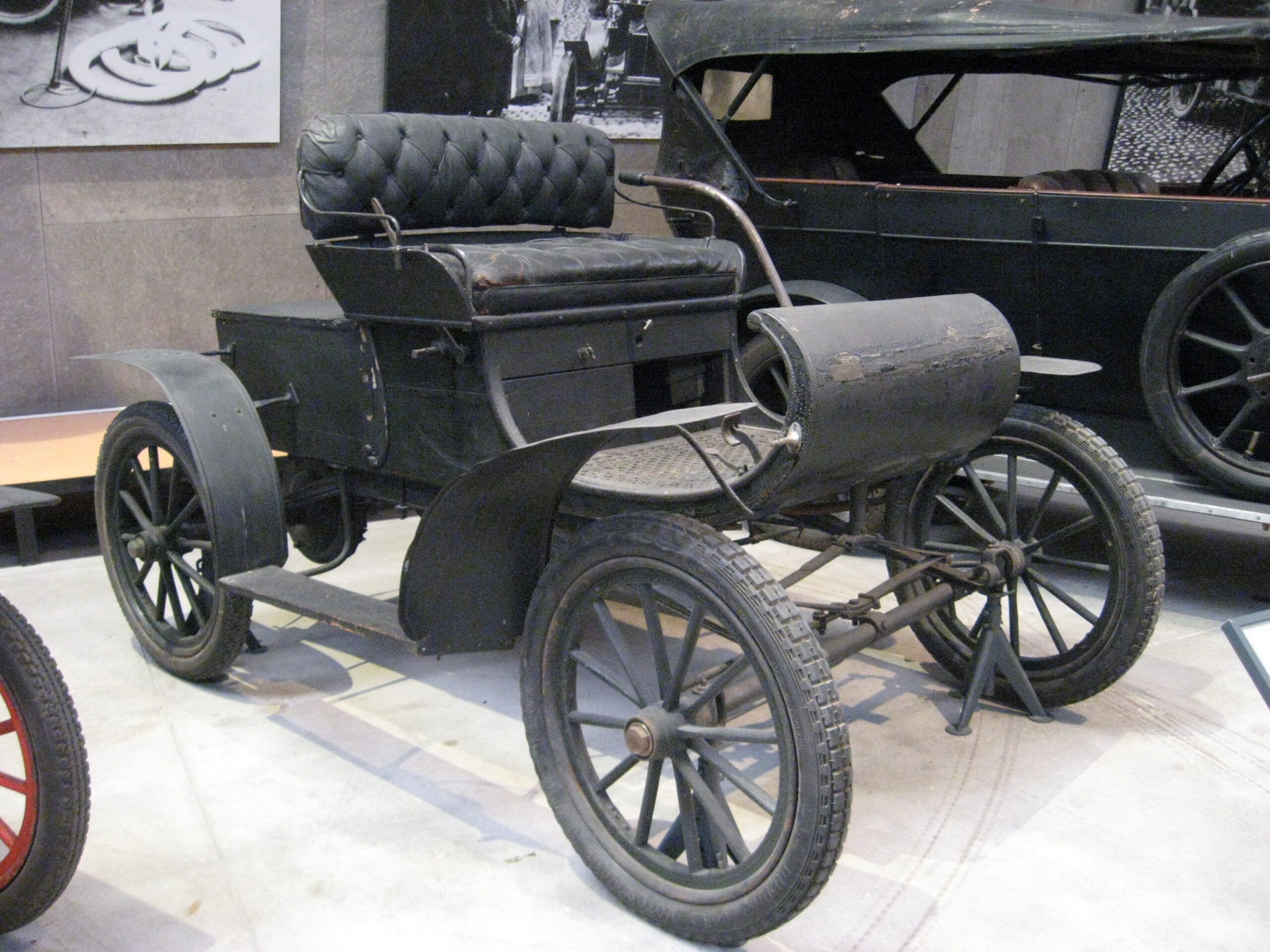
But 4-wheel steering adds a lot of cost and complexity to a vehicle, and customer enthusiasm for the device is limited. Quite a few high-end luxury cars now have it (like certain models of BMW, Porsche, Infiniti, and Mercedes-Benz) plus certain trucks (like the GMC Hummer EV and the Tesla Cybertruck). But the vast majority of vehicles still steer with the front wheels only, just like this Curved-Dash Oldsmobile from 1902.
1989 NISSAN MAXIMA “4-DOOR SPORTS CAR”
Listen to this commercial: “Sometimes I dream I’m in Italy, driving this incredible sports car…Here’s where it gets weird–the sports car has four doors! There’s no such thing as a four-door sports car, right?”

You’re right, there isn’t. I think calling this basic sedan a “sports car” severely waters down the concept of what a true sports car is. My Jaguar S-Type is more of a “4-door sports car”, but neither I nor Jaguar would call it that. A true sports car doesn’t have a back seat, for one thing. I’m sure a lot of MG and Ferrari owners would agree with me on this.
1999 SATURN 3-DOOR COUPE
Speaking of the number of doors, my father and I are watching TV and this commercial comes on. When the announcer says, “Why didn’t anyone think of this before?” Dad replies with a dismissive sneer as if to say, “You call that innovation? Just another gimmick.” Now I can tell you that having that little extra door would have really helped my me and my brother to get in and out of the back compartment of Dad’s Opel GT! But why there should be a rear door just on the one side and not the other was never really explained. And no other car company has copied the idea since.

Around 1990, I heard that General Motors was about to launch a whole new car division, adding to their existing five. It would be positioned below Chevrolet, have its own dealer network…and I thought, “Oh, no! Another Edsel! Didn’t these guys learn the first time?” And there would be an all-new factory in Tennessee, where the cars would be made by happy workers who had picnics together on wide green lawns. There would be no haggling at dealerships, and everyone would be so nice. Well, if that’s the right way to do business, why not make all of GM like that?

I checked out some Saturn cars and found them rather tinny and unremarkable, probably not up to the high quality standard of the Japanese cars they were competing with. (Small cheap cars really aren’t my thing, so…) But Saturns sold reasonably well (at first). In typical GM fashion, Saturn started sharing more components with other GM cars, and the unique Saturn “aura” slowly diminished. GM declared bankruptcy in 2009 and Saturn (along with Pontiac) did not survive the restructuring. People talk about how much money Ford lost on Edsel, but I have read that GM ultimately lost much more on Saturn, even adjusting for inflation–money that could have been used to improve existing GM products. But everyone was fixated on “fighting the Japanese” and so it was believed that a bold new approach was necessary.

It’s been such a long time since I first saw those commercials, and so much has changed. What can we learn from all of this? That a lot of things presented as “all-new” and “revolutionary” may actually be not all that significant–a flash in the pan. Meanwhile, things that really are going to change the world may arrive suddenly and unexpectedly–coming from a direction where you’re not looking. Or they’re brewing below the surface, unnoticed by most people, gradual–and then everyone realizes, “Oh, we’re living in a different world now.”

I’m not complaining about anything, mind you–I think this is an exciting time to for all of us to be alive on planet Earth right now and witnessing all these triumphs and foibles and technological advances (not just in the automotive field). And the fact that we in our lives actually get to participate in the whole scene in small ways and large is quite remarkable when you think about it!























I vaguely remember that one of the Big 3 American pickup brands offered a 3 door cab for a short time. Or am I imagining it? It is funny how the 3rd door on a Saturn coupe was a gimmick that died a fast death, while a 4th door on a minivan changed the world.
I loved the Joe Isuzu commercials. I recall reading somewhere that funny commercials often become memorable but are not always good at translating into goodwill and sales increases for the product being advertised.
A guy I worked with bought one of the new Maximas around 1989 or so (whenever they first came out). I remember the little “4DSC” decals all over the car. The one I got to ride in fit the bill, painted bright red with black leather and in the top sports trim level. It was a really nice car, and made for a very nice “sports sedan” (that became a thing after the BMW sedans became so popular).
Isn’t the Hyundai Veloster a 3-door coupe? Or is it a 3-door sedan?
Also think there was a Mini Clubman with the Saturn-style rear door on one side. And barn doors on the back, weird doors all over this thing
Well, if a car with 2 doors and a hatchback is a 3-door, and a car with 4 doors and a hatchback is a 5-door, it logically follows that a Veloster is a 4-door. 🙂
No, the F150 and Chevy/GMC Sierra had three doors on extended cabs for a few years in the 90s.
For many years Chevy Suburbans only had three doors. There was no rear passenger door on the drivers (traffic) side.
I remember that too only it wasnt just full-sized. I can speak for GM specifically as I dont know if the other 1 had them but i vividly recall 3 door Chevrolet S10s and Sonomas. Specifically I remember getting out of one after getting a ride to hockey practice as a kid. It was a square body so I believe it was an 86-90 S10.
I also remember my uncle pulling up one afternoon to our house in a brand new 1995 Silverado extended cab he had just bought and wanted to show us. So the full-sized did have them. At the time I always thought it was dumb that they had a rear door on the one side and not the other – i was pleasantly surprised a few years later in i think it was 01 when a cousin bought a new Silverado that has doors on both sides.
And technically speaking I could see the 80s era original Dodge Caravan/Voyager’s as inspirational for this concept with the sliding door on the one side (which it surprised me that it took them well over a decade to try getting doors on both sides).
I owned a Prelude with 4-wheel steering. I remember that it was a $2,500 option on an $18,000 car. Quite expensive. It was fun to drive. It was a little more like driving a boat than a car. I lent it to someone and they said the car was possessed. You just had to get used to using the steering wheel LESS. I have to get the wheels aligned after a snow bank incident. You had to align all 4 wheels every time. Quite expensive. I had fun with that car for less than a year when it was totalled by an elderly driver with diplomatic immunity from the local Air Force base. I always wonder how it would have been like maintaining the 4-wheel steering system over years. My other Prelude’s got 200K to 345K miles. The third gen 88-91 Prelude had a mechanical 4-wheel steering system that worked quite well. The revised fourth gen (92-96) Prelude used an electrical 4-wheel steering system. The old system was better. The option was dropped in the US after the 94 model year. I moved on to a 93 Prelude V-Tec. I wish that car also had the mechanical 4-wheel steering system.
When I saw this article’s title, I immediately thought of the 4WS Prelude. A friend of mine owned one, and I remember he loved to show people how the rear wheels moved. But the added complexity just didn’t seem to justify it’s benefits. He kept that car for about 10 years, and then got an S2000. I do occasionally see a 4WS Prelude driving around here, and would love to catch up to it someday.
The later electronic system had some degree of anticipation programmed in and was simply superb. Absolutely fantastic responses and it saved me on one occasion.
The S2000 is a somewhat different beast – one never reverses into a hedge in a Prelude.
I wish I’d not sold it…
I’ll take a three door sedan as long as the rear door is suicide hinged.
My 1952 Studebaker Land Cruiser has rear “suicide” doors. They are wonderful for loading groceries in the back seat.
But I wouldn’t go out of my way to buy one. Any car trunk is wonderful for that too.
I have no problem with Nissan and their 4 door Sports Sedan. I do, however, have a major problem with BMW calling their 4 door sedan/hatchback a coupe.
Always fun to see the things they tried in a retrospective view .
-Nate
Fun article – since I’m a similar age, I remember all of these very well.
Regarding the Joe Isuzu ads, I recently showed a bunch of them to my kids, who thought they were hilarious. Now, whenever we see an Isuzu (always a medium-duty truck), we all start talking about Joe Isuzu ads. But like you mention here, I’m not sure they were terribly effective for sales. Too bad – we need more good humor.
One could make an argument that the Four-Door Sports Car concept has been firmly planted. Seems like all luxury sedans now are more sporty and high-tech than traditional luxury. Meanwhile, it seems that the definition of a “sports car” has migrated from being a fun car with two seats to being a hyper-expensive show-off-mobile. One could make a case that a sporty sedan now is closer to the sports car archetype than actual sports cars.
Mazda rotary engines were unfairly compared to 4 cylinder econobox engines. The RX2 and RX3 were pocket rockets, with performance only equaled by V6s. And the RX4 performance was on par with mid-sized V8 cars, and wagons. When doing an apples to apples comparison the fuel economy was very comparable if not superior, My 74 RX4 4 speed wagon got mpg in the low 20s, meeting of beating GM midsized V8 wagons, and with better handling and vastly superior interior comfort.
That said, it did become a maintenance nightmare after 5 years. And don’t move to a great location where there is no foreign car parts or service available with a slightly aging import.
“NEW” is only one word of the three word lexicon used in marketing. The other two are “and Improved”.
That three word phrase really wouldn’t fit here, but I’m surprised it hasn’t been used (though I’m sure it has).
The fundamental flaw in the 3 door Saturn is coupes are supposed to be more stylish in large part from the fundamentally cleaner appearance of two doors, with minimal body seams and two panes of side glass(3 if there are vent windows of course). The Saturn’s little door behind a larger door just looks like a squashed 4 door…. And the fact that it’s asymmetrical from one side to another just made it silly looking. What’s the point of a coupe if it ends up dorkier than the sedan?
Funny enough I never cared for the Mazda RX8 for mostly the same reason(it at least was symmetrical…. But it’s still a “4-door coupe”(yuck). And funny enough it’s rotary powered so it uniquely contained TWO fizzled out items from this list
I think the Joe Isuzu ads were great, how else do you sell a sleekened Chevette other than with a lying salesman? They put Isuzu into people’s heads and the funny ads gave the Isuzu brand an image of fun and not to be taken so seriously which fairly well matched the product line through the years. If anything getting rid of Joe Isuzu in the 90s is why Isuzu went away! It’s not of course but an ad campaign from 20 years before the brand dissolved has no correlation IMO
The first generation 2007 MINI Clubman estate had a similar suicide door on one side only, which meant British rear passengers had to get out into traffic. Oops. It also had two doors at the back, so dogs were better served than children.
I drove a Hyundai Veloster with the third door, sensibly on the right side, for 10 years.A great car
I’ve owned six Saturn S series, three of which were three door coupes, and if I could find another with a manual gearbox and less than a zillion miles on it, I’d snap it up without hesitation. Having few passengers but lots of stuff to carry worked out brilliantly in those things.
My mother’s last car as a Saturn SC1. It didn’t have the third door, but it did have GM quality. That means it started to self-destruct the second the warranty was up. By 70,000 km, it had a water pump, radiator and a heater core. When she passed, I sold it for a thousand bucks to a GM lover.
I’ve owned two types of these dead ends. I had two Mazda Rx-7s with the rotary engine. They were lovely and I did not find them that bad on fuel. Comparable to carbureted V6. I also had a three door Saturn SC1 which my son now drives. It is a generally decent little car. The third door works ok but maybe not amazing enough for widespread copying.
“If the heater core leaked, you might as well throw the whole car away because replacing it required disassembly of the entire dashboard!”
Same on the oldest Tauruses. Quality was sure not job one on ours, but that was the biggest frustration as it ruined what should have been a great car.
It took about ten hours of labor to replace some internal heater folding doors on the 2015 RAV4. Now you have to re calibrate everything when you put it back in. A tech said he’d never seen both doors fail at the same time. I’m glad they did, I wouldn’t have liked to do that for each one.
After warranty, of course, even Toyota can get you.
Yes, even Japanese cars are getting a bit too complicated these days.
Mind you, since the heater unit’s practically the first thing to go in, it’s long been an access problem requiring dash removal.
It’s just that there’s not merely air and one wiring harness behind there these days!
Not only was the Hyndai Veloster a 3-door coupe, but the current generation Fiat 500 also has the third door. So no, the concept was not a one-and-done thing.
And like a previous poster, if I could find a 5-speed Saturn S-series with low mileage, 3-door coupe or not, I’d snag it in a heartbeat. had two S-series sedans, great little cars.
If you want to talk about features that appeared then (nearly) disappeared, how about fold-flat front passenger seats? My last daily driver (5-door hatchback) had one and with a completely flat load floor I could fit an appreciable amount of 8 foot long items in the car without issue. Every car should have this, yet today I don’t know if any still do.