
Imagine a world where there was no Internet–no Google search, no street views; no Amazon, no eBay, no Craigslist, no YouTube; no blogs, no social media, no email, no smartphones. In the 1980s, none of those things existed. How did we not die of boredom? Yet despite lacking the technology that we all take for granted today, the spirit of Curbside Classic–although not named as such–was still there. And I was getting the message out . . .
I was attending college at New Jersey Institute of Technology (NJIT) in Newark, and I was on the staff of The Vector (“With Magnitude and Direction”), the college newspaper. College newspapers are generally starved for things to write about, and I had some creative ideas that I thought were worth sharing.

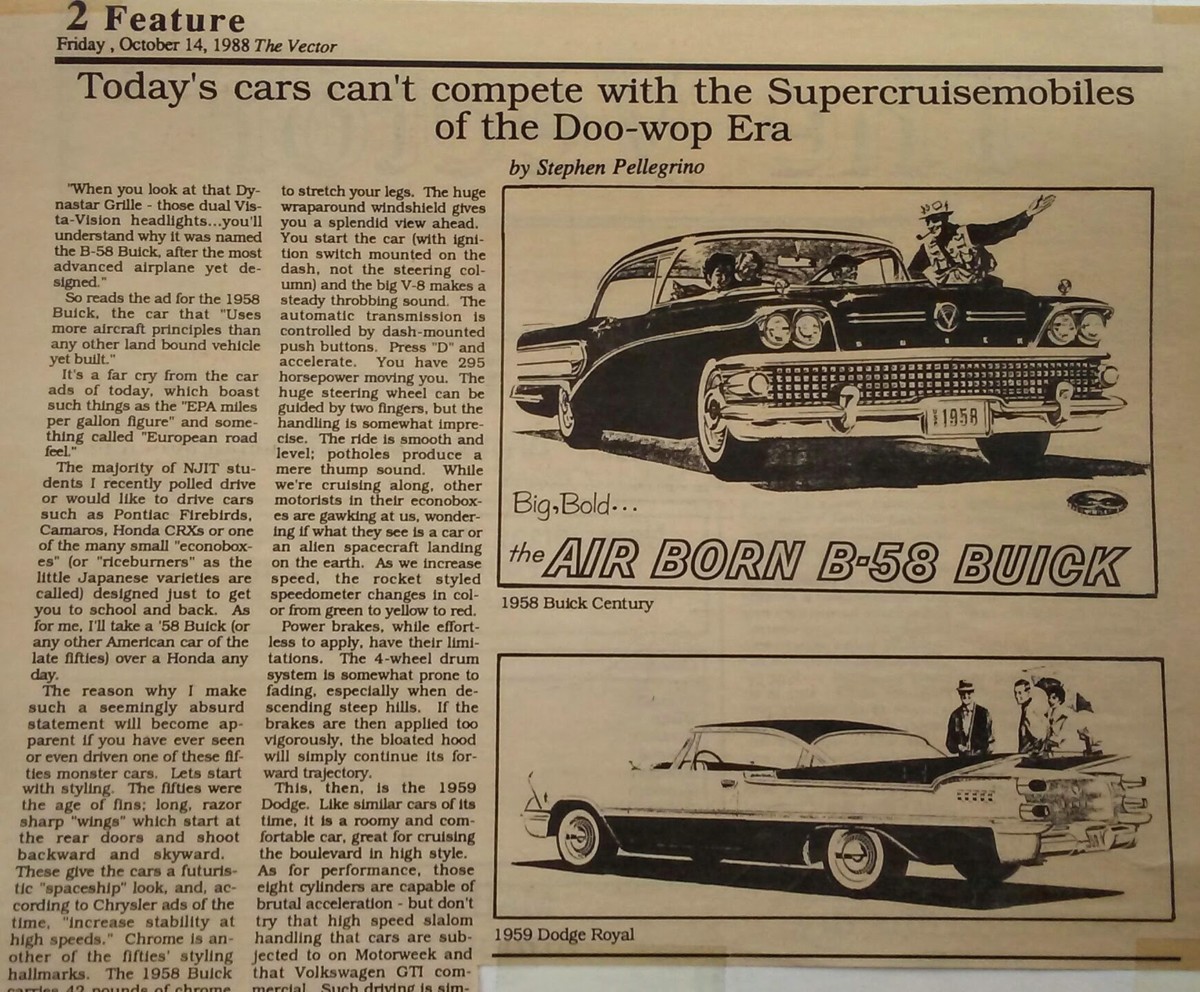
One of my fascinations was cars of the ’50s, so I wrote about them in this feature article, published October 14th, 1988:

If you’ve seen my previous CC posts, you’ll recognize some familiar “themes”. At this time, most surviving 1950s cars were either junkers with one foot in graveyard, or occasional well-preserved examples typically driven by older people who for some reason didn’t want to give them up. To me, their styling and charisma were utterly fascinating, and I hoped to possess a ’50s car of my own some day.
Photographs I would have liked to add to help bring the article to life:


I also wrote an article about how the 1939 World’s Fair predicted many trends in architecture and transportation:


One of my major projects for The Vector was a series entitled “Newark Then & Now”. I had become fascinated by Newark and its architecture when my family and I had the occasion to drive through the city several years before. Driving into Newark at that time was like a descent into Hell. Scary and shocking for little 12-year-old me who was raised in the suburbs . . .


Block after block of bombed-out storefronts, everything looking shabby–but there was an artistic quality in the architecture that I found inspiring.


Many of the streets were still paved with Belgium blocks or brick . . .

I later discovered older photographs of other landmarks of great architectural beauty that had long since been demolished. I presented these photos side-by-side with modern views of the same locations:

The series was very popular, and many people were surprised by seeing how different things used to be. Even the mayor of Newark at that time (Sharpe James) sent me a letter commending me on my work.

The Student Senate had purchased a van. It was a 1987 Dodge Sportsman with every available option including an accent stripe (which they paid extra for), that Bob Zotti said make the van look like a skunk. Occasionally we Vector staff members would climb into the skunk van and drive around, looking for things to photograph and write about. We drove around Newark, taking pictures and writing articles based on what we saw. All I can tell you is that the newspaper staffs at Princeton or Harvard were not going to kind of places we were and coming up with the material we were getting:


One of our most memorable trips was to see the giant replica of Noah’s Ark being built in the center of the urban wasteland by a woman named Kea Tawana.


Eventually the city did force Kea to dismantle the Ark, which was very unfortunate in my opinion because this was a true work of “outsider art” on a par with Simon Rodia’s Watts Towers in Los Angeles. It would have made a great tourist attraction, and it was sad that Kea had to undo all the work she put into building it.
Occasionally I would strike out on my own and take photos of streetscapes that I knew were doomed by upcoming urban renewal projects. The parked cars (which I wasn’t paying much attention to) would be considered genuine Curbside Classics if you saw them on the street now. Things like this have a way of showing you how much time has passed . . .


The following pictures I took show buildings which, to my knowledge, are still standing (but the cars have moved on to destinations and fates unknown):


Parking at NJIT was always a problem. So the staff come up with this little ditty to vent their frustration trying to find a place to park every day. A multi-level parking deck was eventually constructed, but it was completed long after we had graduated and moved on.


Looking back on it all; the articles, the photography, the cars, the houses, the experiences, the things I was trying to express–what was I really trying to say?
In 1960, Jean Shepherd, the great radio storyteller and raconteur read the following on the air, which was quoted in his biography. When I first read it, it didn’t make much sense. But after reflecting on it I now understand what he means (at least as much as I can). Maybe you can too.
“How can I say it? How can I say it? You know, when you’ve said it all. You still haven’t said any of it. You really haven’t, you know. You try to get it out–you try . . .
“I’m looking out, and I see a white ship way off in the distance, trailing a long black streamer of smoke. And I saw a white cloud and gray gulls. I could hear that wind beating down from the north . . .
“There was a kind of coolness in the air. There’s a coolness in the air in summer that says one day it’s going to be winter. It’s going to be winter. And in winter, there’s always a softness you can find that says it’s going to be summer. And so it shall be.
“I’m standing there, and I’m trying to figure out how to say it to you. I can’t. Never can. I guess that’s the final frustration. That nobody can ever say all of it to somebody else. No matter how hard you try, no matter how much you want. In fact, I think the more you want to say it, the least likely and the least able you are to do it.
“I’m standing there, and that ship just finally disappears. Hear it? Did you get?–listen. Listen–you hear it? I’ve been trying to say it. What I’ve been trying to say all along. Yeah. There’s not much time left. But you’ve got to be able to hear it. I guess you can’t. I guess everybody hears what he is hearing. Nobody else can hear it.
“Did you hear that? Oh yeah.
“You know, it’s going to be winter soon. Yes. Yes.”
-Quoted in Excelsior, You Fathead: The Art and Enigma of Jean Shepherd, by Eugene B. Bergmann (2005)























You cleared the bases with “Newark Then & Now”. Bravo!
Great article and storytelling! Thank you for documenting and sharing, so much important history.
Quite ironically, in the decade immediately before the Internet took off in 1995, there was significant grassroots growth in publishing. And somewhat of a renaissance, in the newspaper and magazine industry. The introduction of the early Apple Macintosh computers from 1984, and their desktop publishing capabilities, lead to somewhat of an explosion of small newspapers and magazines in the US and Canada. Early page layout programs like Aldus PageMaker and Quark Xpress, leading the way. The ability to affordably publish, and distribute publications, was now much more mainstream. And accessible to the general public. It provided much fresh opportunity for writers, editors, and production artists. Many publications came and went. USA Today was winning awards, and their infographics were considered leading edge in the industry. Good times for many in the field, and a brief window in time.
The printed words last blast then. Those born post 1995 can believe how us pre computer generation survived with out the Net and cell phones. The hardship of using the YellowPages to find a trades man or supplier .
The horrors of having to read books to do school work…
The decline of the print publishing industry was not overnight. It survived well into the 2000s, with plenty of people still gainfully employed in the industry. Many consumers, typically older, didn’t want to give it up. But it was obvious to everyone, it was a dying/dead industry, headed to being a niche.
As several industries faded, many new ones blossomed.
Thise cars in Newark were mobile, so unlike the structures, could get out of the way of the redevelopment. Most if them, anyway. But ultimately they would be sacrificed on the altars of EPA MPG and “European road feel.” UGH.
I loved college newspapers. While I didn’t write for my college newspaper, I served as one of the staff photographers, and later the photo editor. It was an enjoyable combination of independent and collaborative work – very rewarding, and great experience.
It’s great to read your 30+ year old work – definitely similar themes and writing style that you use today. I bet your classmates wouldn’t be surprised to learn that you have a collection of classic cars now. I like how your wrote that attempting to drive a 1950s car through a high-speed slalom would be in “bad taste.”
Too bad you never got to talk to Prof. Golden about his Imperial! The president of my college was a car enthusiast who drove an Alfa 164. I got up the courage to talk to him about it at one point, and he even let me drive it around town for a bit. He also owned a 1930s-era Rolls-Royce limousine – he took me for a ride in that car too. To this date, that remains the oldest car I’ve ever ridden in.
I briefly wrote for my college newspaper in the early 90’s. My nascent career never got off the ground, though. I wish I had thought to try to write car articles! I never was that established, though, that they would have entertained my crazy ideas. I wish I would have stuck with it, though. Would have been a more worthwhile use of my time than some of the other stuff I did.
Come for the 50’s cars, stay for the urban decay! I love this article, as it hits a few interests of mine: 1958 Buicks, the 1939 World’s Fair and “Ruin Porn”. I’ve long been fascinated with places like Detroit or the Bronx, once thriving cities with great architecture that became essentially abandoned economically and left to decay. I have never focused on Newark, but it plainly was another great example of this tragic trend.
I did a quick search and couldn’t come up with any Newark Then and Now type books. Are you aware of any? I’d eat up all your then and now articles. I’d love a series of CC articles, but honestly maybe you’d do better if you could get it published as a real book. How cool would it be to get pictures in three stages, with Newark in its prime at locations you took photos of in the 80’s and then take new photos of the same locations? I would definitely buy that book and I’ve never even been to Newark.
The Ark looks like quite an interesting project. It’s a shame it was not allowed to be fully realized. Perhaps you’ve heard of the one in Kentucky that was? https://arkencounter.com/
+1 on all counts. Stephen’s pieces have become some of my favorites here for the intersection of automotive and architectural elements, further cemented by my familiarity with his locale. These posts trike a chord with me, not necessarily from a “Ruin Porn” mindset, but because they tell a story of places that have weathered the ongoing storms of time. From prosperity, to dereliction and hopefully back. I still have a hankering to visit Detroit, but also Pittsburgh, Cleveland and a few other 19th and 20th century industrial cities, mainly to breathe in the history of them. Living in Harlem in the early 2000s, I always had the sense that there’s a vibrant energy in places that have sort of been through it all and are still relevant and thriving to some extent. It’s spiritual, in a way.
Maybe I could do a future post with some reprints of the “Newark Then & Now” series.
In the meantime, I would recommend Myles Zhang’s website, “Newark Changing”, especially the “Newark Metamorphosis” section toward the bottom of the webpage, with many stunning “before and after” side-by-side images. There’s also a “Launch Interactive Mapping Experience”:
https://www.myleszhang.org/category/newark-history/
Oh man, you should not have given me that website. I’m at work and I could easily fall down that rabbit hole and not emerge for hours. Really good stuff!
Reprinting the Then and Now series would be great. The cars in the foreground would easily fulfill the automotive content to be on CC, in my opinion at least.
My late FIL was an NJIT grad, when it was called the Newark College of Engineering. Newark seemed like a magical place during the ’40’s and 50’s until urban flight, decay and ultimately the Summer of ’67 when the end seemed near.
I didn’t arrive in Essex County until 1984 with 1.0, so for us and the weejuns, Newark was the Ironbound for great food and where one put on blinders to serve at the courthouse. A few clients were located in the old Ballantine plant, but that was pretty much it.
Things change, until they don’t.
“Uses more aircraft principles than any other land bound vehicle ever built”. That is hilarious. How about “affectations” rather than “principles”.
Nice work, but I would have had to take a less serious and more ironic/sarcastic tone in such an article, but then that’s how we both still are.
I’ve always been drawn to decaying American cities too. I used to hook school and take the bus into downtown Baltimore, and walk around all day, seeing it up close. Some years later, I actually lived in an old row house with some other white kids in a Black neighborhood; that was a good experience. But then that was in the early 70s; by the 80s or later, that might not have been so good.
I feel like this is the second time I’ve seen a 1958 Buick ad here recently, making the B58 analogy. Aside from Paul’s point that the Buick had little in common with any aircraft, I think the B58 was the worst example to have chosen. While it may not have been very successful, it’s advanced technology, high performance and “right sizing” were the complete antithesis of the ‘58 Buick. The B36 may have been a better choice.
Here’s an excellent “ruins” site devoted to St. Louis, you can spend hours here. Much of inner city St. Louis resembles Germany after the bombs ceased dropping in 1945; East St Louis is especially heartbreaking, as 60+ years ago it was a pleasant middle class city:
https://www.builtstlouis.net/
“Built St. Louis began as a way to document the destruction of the city’s historic architecture. Spurred on by the 1996 demolition of the Ambassador Theater, and shocked that the Arcade, Syndicate Trust, and others were similarly threatened, I began photographing them and posting the photos online that fall. Over the years it’s grown into a way for me to express both joy and outrage over changes in the cityscape…
It is not my intention to paint a negative or positive portrayal of St. Louis — just an honest one. But if I didn’t think the city was wonderful, I obviously wouldn’t be sitting here doing this. If my photographs are shocking on occasion, well, it’s because there are some shocking things happening out there…”
Another good site, thanks! My dad grew up in St. Louis, so I sent this to him.
I too was fascinated by the styling of late-1950s American cars by the late ’70s and ’80s. My family had a ’77 Bonneville in two-tone green which was actually quite over-the-top in style too, with as much chrome as a ’58 Buick or Pontiac, but in much more boring places like an 8 inch wide strip of chrome alone the rocker panels, with more around the windows and on the grille and taillights, rather than the seemingly random patterns on 1958 cars. But the boxy shape couldn’t compete with the spaceship-like ’50s cars with their tail fins, toothy grilles, and rocket afterburner taillights.
Some of those 1960 predictions made in 1940 that didn’t come true by the time you wrote the college newspaper article have arrived since then, notably automatic “safe following distance”, though not normally by radio control but rather radar, lidar, and digital cameras (radar is radio-based, but was just being invented around 1940 and was a heavily guarded military secret at that time; I doubt that’s what GM had in mind).
The photos of Newark look a bit to me like the nearby cities of Baltimore and Washington DC at that time. By the ’90s, many old vacant, boarded-up buildings were the result not of abandonment but rather big commercial developers buying out large areas of still-in-use old buildings during the preceding commercial real-estate bubble and evicting any tenants, then losing money or going bankrupt when it burst in the ’90s leaving entire blocks of boarded-up buildings. I lived for several years next to a vacant 6-unit apartment building (occupied only the first year I lived there). It was purchased by a developer who tore down the buildings across the street and wanted it for storage space. Occasionally I’d see someone moving something into or out of the building; otherwise it (and the yard around it) was completely abandoned. One day I drove by and that apartment was completely gone. Since then, the one I lived in was torn down too; the land there is too valuable for small buildings anymore.
Email did exist in the ’80s, and I sent and received my first in my freshman year of college in 1983 (we still called it “electronic mail”, I didn’t hear “email” until several years later). Wikipedia tells me it dates back to 1975. I do recall in the early days it wasn’t as standardized as it is now, and you sometimes had to know what type of machine or operating system was on the other end for successful transmission.
Really enjoyed this trip back thru time – when I used to commute from Central NJ (Clarksburg) into the city to work at WOR (longtime radio home of Jean Shepherd), I took the PATH train from Newark to WTC via NJ Transit from Metropark.
One night, the PATH as it’s known to do, apparently wouldn’t be stopping at Newark.
Nope, I had to get off at Harrison and walk to Newark Penn Station – only about a mile, but this was late at night….and working at WOR meant I was dressed in suit pants, collared shirt, nice shoes, etc.
Wouldn’t you know it? I made it without a scratch or even a hobo asking for change. It wasn’t the most scenic 30 minute walk, but things have gotten better looking since the 80’s.
I’d gladly take the music (and the cars) of the doo wop era. One of these days I’ll get to Lead East…
Great piece, Stephen. Like others have said, looking at then/now photos of places has always intrigued me. Paul mentions it above, but yes Baltimore is such a place.
Speaking of Baltimore, one of your photo credits cites WJZ from October 1, 1921. While the 1977-79 T-Bird in that pic definitely dates the picture to well after 1921, it’s the call letters of the TV station that I’m questioning.
WJZ is Channel 13 here in Baltimore. Maybe ‘JZ did a piece on Newark back then?
The WJZ call letters were on 770 AM (now WABC) from 1921 to 1953 before migrating to Baltimore.
Thanks Tom. I had no idea that the FCC would reissue call letters to someone else. I’ll have to look up the history there.
I always found it odd that there were only two letters after the W with that one, but I suppose in the early days, they thought that two letters would be enough.
Sorta like how license plates went. Are there even any ‘numbers’ left on a NJ plate anymore? 😉
Radio geek chat ahead: in the early days, pre FCC, stations were assigned either 3 or 4 letter calls that could begin with K or W. WBZ in Boston, WIP in Philadelphia, WJR in Detroit, KQV in Pittsburgh and KGO Sam Francisco to name a few.
The FCC didn’t have the hard rule it does now about “W calls east of the Mississippi, K calls west of it”. Do stations like WACO in Waco Texas and WOAI in San Antonio have grandfathered calls, same as KDKA in Pittsburgh and KYW In Philadelphia.
They’re allowed to keep the heritage calls if they can show lineage back to the original station (in most cases). That’s how you have WIP-FM, WJZ-FM and KDKA-FM.
The FCC also relaxed rules about stations owned by different outfits sharing the same call letters. If the TV and AM or FM were split, only one service could keep the original call letters. That’s why 1520 in Buffalo is WWKB instead of WKBW and Channel 9 in Secaucus/New York is WWOR instead of WOR.
The call letters would also travel around due to ownership swaps – that’s how KYW ended up in Philly and WJZ in Baltimore after being in NY.
What does this have to do with cars? Nothing, except that both are passions/obsessions of mine.
And for AM listening bliss, you can’t beat a GM Delco radio with AM Stereo and AMAX capabilities. Perry Como never sounded so good as it does in our 94 Fleetwood!
Not sure about the NJ license plates…but the most recent set my grandmother got still had numbers and letters. But they look very cheap not being stamped anymore!
Tom, thanks for that history on radio stations with three-letter call signs. One of those little things I’ve occasionally wondered about.
And below is a good WJZ advertisement to go along with this discussion – this is from 1941, commemorating the station’s 20th anniversary in New York.
Regarding NJ license plates, standard-issue plates have had more letters than numbers for about the last 10 years. Right now they have 4 letters and 2 numbers in the format A12-BCD format – it’s unusual for jurisdictions to have more letters than numbers (Ontario is another one that comes to mind, but it’s definitely uncommon).
I didn’t know three-letter call signs were that rare. Washington DC had a radio station WRC going back to 1923 as well as a different, later FM station with the same call letters, and still has WRC-TV channel 4, an NBC owned and operated station. Another intriguing local owned-and-operated station is WTTG channel 5, now a Fox station but originally one of three DuMont owned-and-operated stations, and the only former DuMont channel still using the same call letters today (TTG came from DuMont chief engineer Thomas T. Goldsmith, who is also notable for having held the first patent ever issued for a video game, from 1948.
Would be interesting to see some of those same locations today.
I will join the chorus of those who are glad that you saved your early work. I recall one time shooting some random pictures of a commercial/industrial area of Fort Wayne, Indiana in the mid 1960s. When the pictures came back, my mother let me have it for wasting film (“Pictures are expensive to develop!!!”) Now I wish I had taken more of them, and in more interesting areas.
Those old urban centers fascinate me too – and why some hang on while others go into ruin and decay.
To this day, that phrase makes my blood boil. As a little kid, I desperately wanted to learn how to take good pictures of moving cars — like those in car magazines. But that’s hard to do when you only have an instamatic camera and a mom who gets to judge what’s worth spending film developing money on.
Back then I split my time between my parents’ house and my grandmother’s apartment in Philadelphia. One week, I took my camera to grandmom’s house, stood in front of her building, and took a whole roll of pictures of moving cars. Somehow I talked mom into developing that roll, but wow, I got in trouble for wasting film like that!
I still had those pictures years later – I remember occasionally looking at them and cringing about how much I got in trouble – but they’ve unfortunately long since disappeared. They’d sure make a great CC post these days!
Precisely why I took up darkroom photography when I was about 12. It turned out I could burn through as much film as I wanted so long as I was doing the developing and printing in the basement. Starting in Jr. High, I supported my habit through selling pictures to other kids, so I never really had to ask permission to take pictures.
I was a photography buff when I was a kid, and generally was allowed to take photos and process them as long as they were still photographs. It was a different story with the Super 8mm movie camera though. The camera was expensive, the film was expensive (3 minutes 20 seconds of silent film per roll), and the developing was expensive. I wasn’t allowed to use it when I when I was a young kid for fear I’d drop it or something. My two older brothers (5 and 9 years older) were allowed to use the movie camera, but there was an understanding that only “important” things were worth committing to film, like vacations and holidays. As a result, there’s about an hour of footage of Disney World, the Everglades, Cape Canaveral, and a few other places, but hardly any footage of *us* or any people we know. If my family wanted to see me, they could walk into the next room in the house, why take expensive movies of that? There actually was one roll I took of me and my friends just playing around – one I’d love to watch now – but it was never processed. I was accused of wasting money shooting a whole roll of us just playing around in our front and back yards, and that unexposed film cartridge sat around for about 10 years before it was thrown out.
I recently went through my parents’ old still photos that I’d never seen because many of them are slides and I don’t have a projector or viewer, and some are negatives with no associated prints. I bought a film scanner a few years back to change this. Turns out there are hundreds of baby pics of my 9-year-older brother, but by the time I was born my folks were too busy to take many photos of me. It is sort of cool that my dad got into color photography early, which meant expensive film, expensive processing, and expensive individual flashbulbs (remember them?) if you were shooting indoors; early color film had a very low ISO. Fortunately he mostly shot Kodachrome so the slides look like they could have been shot last week (early Ektachromes faded to red and white; Polaroids and print film have that curious aquamarine tint and graininess that everyone tries to emulate with Instagram/Snapchat/VSCO filters nowadays). Anyway, am disappointed I still can’t find any photos of his ’53 or ’57 Chevys.
Flashbulbs? Did someone say “Flashbulbs”? 🙂
Me, I was a photography buff as a kid, too, but any images that resulted were a byproduct of playing with cameras and lenses and flashes and darkroom equipment—that’s what I really liked. I heavily favoured cameras from the ’50s to early ’80s—mostly screwmount Pentaxes; I eventually had a nice collection ranging from an early Heiland Pentax H2 from about 1959 through to the last dinki-di model, the ESII from 1974. Supplemented by other neat old cameras, like a German Kodak Retinette IA and a great big Koni-Omega Rapid M.
Now there’s a rather good camera in my (phone) holster all the time, I’ve finally got things the right way round: the images are the point, and the camera’s just an implement like a frying pan or a screwdriver.
Flashbulbs! Jeff, your pic there whacks me upside the heart. I had a grand collection of flashbulbs ranging from the little AG-1, same size (and base) as a № 194 or W5W automotive marker/repeater/dashboard bulb (on the right in this pic), clear up to giant ones meant to thread into a standard household light bulb socket. I was friends with a veteran news photographer, who told me of football photography monkeyshines: home team press photogs standing just beyond the home-team end zone, strategically firing clusters of GE № 50 / Sylvania № 3 flashbulbs in the eys of the approaching opposing team. That’s the one on the left in this pic, guide number 560 (for reference, the once-ubiquitous Vivitar 283 electronic flash has a guide number of 120). I had a bunch of cool oddities, like the № 5R flashbulbs, which looked black and emitted almost nothing but infrared light. And all kinds of vintage print along with ’em; boxes and literature. My storage went away and I had to sell the whole lot 21 years ago, and although the collection looked a lot like this page (scroll down), the money I got didn’t come close to those prices!
Daniel, I had a feeling you might be into flashbulbs.
Those bulbs are cool (I’ve seen those infrared bulbs before…so neat), but after viewing that page, what I really want now is that “slide ruler for all Wabash photolamps”. It’d go well with my slide rule collection!
Did Dodge use “stretch your legs” in their ads?
If so, this must be a spoof.
(At least I think it is).
Your photos of the Vector staff, and story of driving around looking for things to photograph and write about, really capture the spirit of a vibrant scholastic (be it college or advanced high school) journalism venture. I too was part of that scene, and loved every minute of it.
In fact, I started early (in Junior High) and by the time I’d reached the end of high school, I’d pretty much decided that I was going to do that – wander around looking for things to write about and take pictures of – for the rest of my life. My mistake was in telling my parents that…who in a move somewhat like JP’s mother apparently did about taking photographs…told me that THAT would be a horrible waste of money and time and that if I wanted them to pay for college, I’d have to choose a “real” major. Because, as they stated, “anyone” can write (and they noted that I could do that to my heart’s content once I’d figured out how to make a living) and so I’d better get it together and learn something valuable.
Yeah, well, I’m glad I’m not 17 any longer.
So, I love your story, much as I enjoy all of the articles you create for CC. I wonder (maybe not really, as I think I know…) how many of us here at CC have traveled similar paths along with our similar interests.
Very, very awesome! You had enough here for 4 posts on CC.
Those photos of Newark remind me of a time a few years ago when I drove through Gary IN. I had never been there before, and certainly not since. Just as you said, block after block after block of bombed out, boarded up, abandoned, decrepit buildings. I know next to nothing about Gary or its inhabitants, but it was saddening to see. My wife and I scooted through as quickly as we could.
Excellent photos and stories of Nork! (it’s only spelled N-E-W-A-R-K).
When I was a kid, my parents often took us on daytrips from our home in southeastern Ontario, to the Thousand Islands, and New York State. Boat tours of the Islands was offered from various locations, the major tour operators located in Alexandria Bay, New York and Gananoque, Ontario. The ‘highlight’ was a landing and walk around at Heart Island, and Boldt Castle. It was unrestored then (1978-79), and few visitors ever thought it would be repaired, or restored. It was a sad relic of the late 1800s glory years, when New York City millionaires had vacation estates, in the Islands.
The Thousand Islands Bridge Authority bought Heart Island and Boldt Castle in the late 1970s, and since that time, the restoration and transformation has been stunning. I feel fortunate, to have been able to see the estate at its worst. While appreciating the steady work over decades, to the major tourist attraction it is today, for the region. Not every former castle can be salvaged, but it’s nice to see some saved.
I remember visiting the castle when I was five or six (1982 or ’83), and they had just begun the restoration; somewhere in my parents’ slides, they have a bunch of pictures. It’s nice to know that they got it fixed up! 🙂
Excellent article! I went to college in Binghamton, NY in the 80s and photographed a lot of scenes there which were quite similar to what you captured in Newark. Much of the industry that the town had been built on had disappeared by then but it seems to be on a bit of a rebound these days.
On another note, that looks like an early sighting of J. R. “Bob” Dobbs in that first illustration. A ’58 Buick seems like exactly the sort of car he would have driven!
It’s crazy to think that in 1988 you wrote about cars from the 1950s and now if you wrote about 30ish year old cars, they would be from the mid 1980s. Those pictures are amazing.
I think you mean “30ish year old cars” would be from the mid-1990s now!
This was a great post.
Too bad you could not incorporate the rising crescendo of mad music that always accompanied the end of one of Mr. Shepherds amazing rants.
Here it is:
Steve, that was great.
Thank you.
78 never sounded so good.