

The 1979 Chevrolet Camaro was an incredibly popular car — model-year production topped 282,000 units, the Camaro’s all-time peak — and it still looks pretty good in its swaggering disco-era way, but what’s with this color? Astonishingly, more than 11,000 buyers ordered their Camaros in this flesh-crawling beige, one of the absolute worst colors ever offered on the Chevrolet sports coupe.

Today, it’s hard to feel much nostalgia for the years 1978 and 1979. For the most part, it wasn’t a great era for TV, movies, or music (and I say this as someone who has no problem with disco). The fashions were consistently appalling, and this was the peak of the auto industry’s Malaise Era, as automakers offered some of their ugliest, slowest, least-reliable models since the end of World War 2. The streets were full of stylistic atrocities like this bilious Oldsmobile Cutlass “Aeroback” sedan:

In such a grim climate, the great popularity of the Chevrolet Camaro is easier to understand. After a brush with cancellation earlier in the decade, interest in Camaro had picked up smartly, and a well-considered 1978 facelift had done a surprisingly effective job of updating the 1974 update of the 1970½-vintage styling.
The Camaro was now looking awfully big and rather thirsty: Even a 49-state six-cylinder car with the rare three-speed manual couldn’t do any better than 18 mpg in the rather generous contemporary EPA ratings. Consumer Guide also warned that the repair record of the 1978–1979 Camaro was below average. However, as with the contemporary Lincoln Continental Mark V, buyers didn’t seem deterred by any of that, or by prices that could easily top $7,000 (a relative worth of around $35,000 in 2025 dollars). Model year Camaro production hit 272,633 for 1978 and 282,582 for 1979, narrowly beating out the Chevrolet Monte Carlo as the bestselling Chevrolet specialty car.

Those Camaro buyers got fine smooth-roads handling (especially with the Z28 or F41 sport suspension), lots of muscular style, and … er, did I mention style? Even a four-speed Z28 wasn’t terribly quick by the standards of earlier or later eras, while the more common LG3 305 engine, now rated at 130 net horsepower, had good low-end torque (245 lb-ft at 2,000 rpm), but became wheezy past its 3,200 rpm power peak. The 305 still had that V-8 rumble, but I don’t think it was any quicker than a Toyota Celica, which was more economical, better-equipped, and probably more reliable.

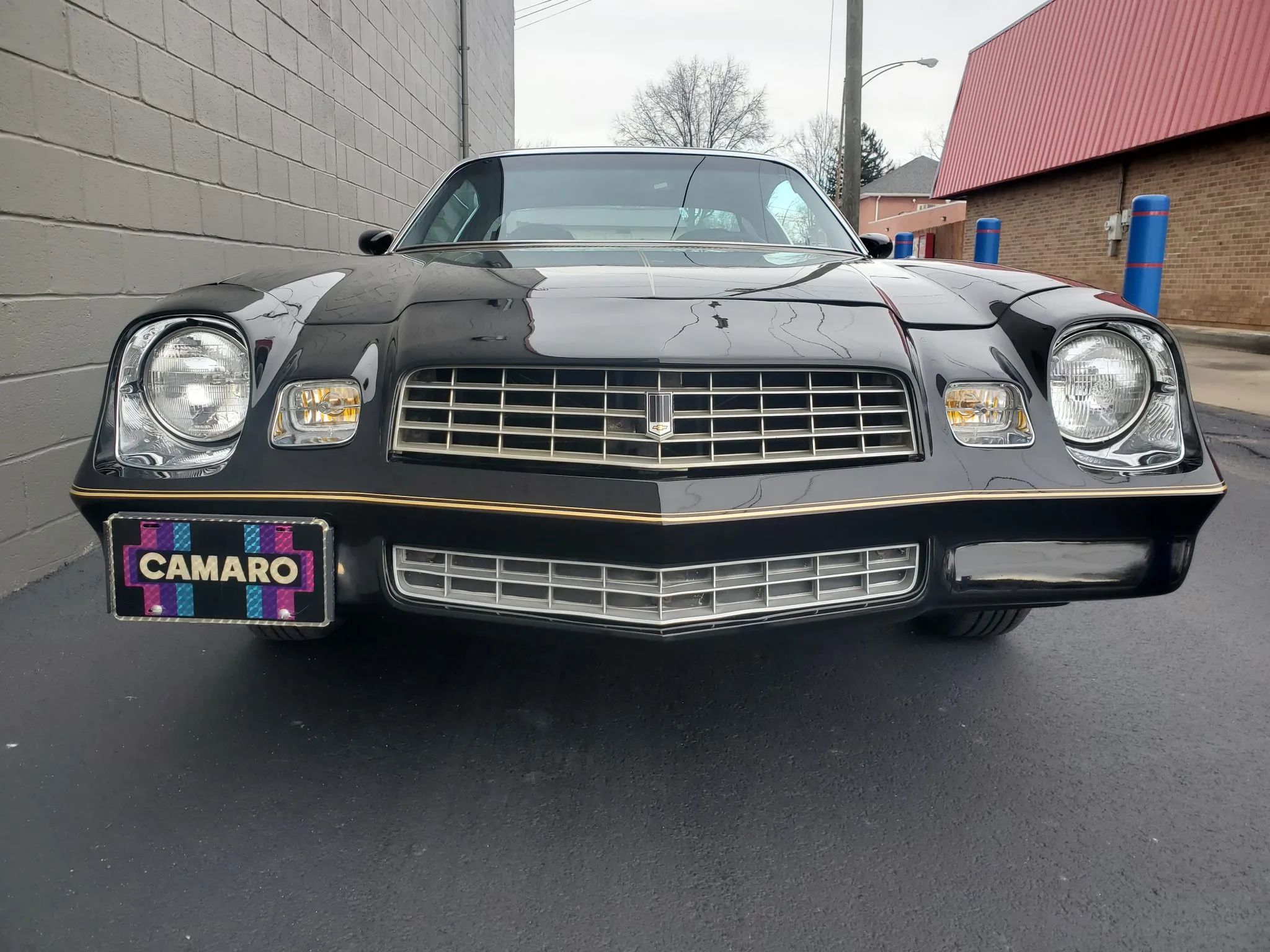
The Z28 is now disproportionately represented among survivors of this era (the Z28 only accounted for 30 percent of 1979 Camaro production), but while its scoops, stripes, and spoilers effectively sum up the Camaro image, the black base-model sport coupe pictured here was probably more representative of the typical late ’70s Camaro. It has the duckbill rear spoiler, a $58 option, along with dual sport mirrors and color-keyed Rally Wheels (with the still very common whitewall tires), but the original owner ordered the mild LG3 engine and automatic transmission.

Now, one of the many stylistic calamities of the ’70s was the inexplicable popularity of beige and tan as automotive colors. (For a while, it seemed like almost nobody ordered a Toyota Corona in any color BUT beige, and it sometimes showed up on the Celica as well.) Every era seems to have a favorite color or two that immediately seems horrendously dated once its moment has passed (for the early ’90s, it was teal), but even bearing that in mind, I’m at a loss to explain this:

That color! Chevrolet officially called it Beige (or sometimes Medium Beige), but it reminds me of the color that newspaper comics used to consider standard “flesh tone.” Outside of comics and the cosmetics counter, most people are not actually that color, of course — especially people of color — but the associations still cause me some visceral unease, exacerbated by the visual mass added by the Camaro’s integrated body-colored bumpers. It’s just too “fleshy,” which at the moment calls to mind the icky 2025 horror movie Together, starring Dave Franco and Allison Brie. (Don’t even look up the poster if you have a low tolerance for body horror!)

I’m scratching my head trying to fathom why someone would order a Camaro in this color. If this were a Chevy Malibu or a Toyota Corolla, I would shrug and mutter, “It was the late ’70s, what could you do?” However, Camaro buyers in 1979 had 14 exterior color choices, and this was one of the few choices that DIDN’T look good on the Camaro.

The second-generation Camaro was a pretty attractive shape, even on its second facelift, and while the extroverted Z28 treatment isn’t really to my taste, the car pulls it off well, whether in red …

… blue …

… white with blue stripes …

… Camel Metallic (which I think the average person would describe as copper or maybe gold) …
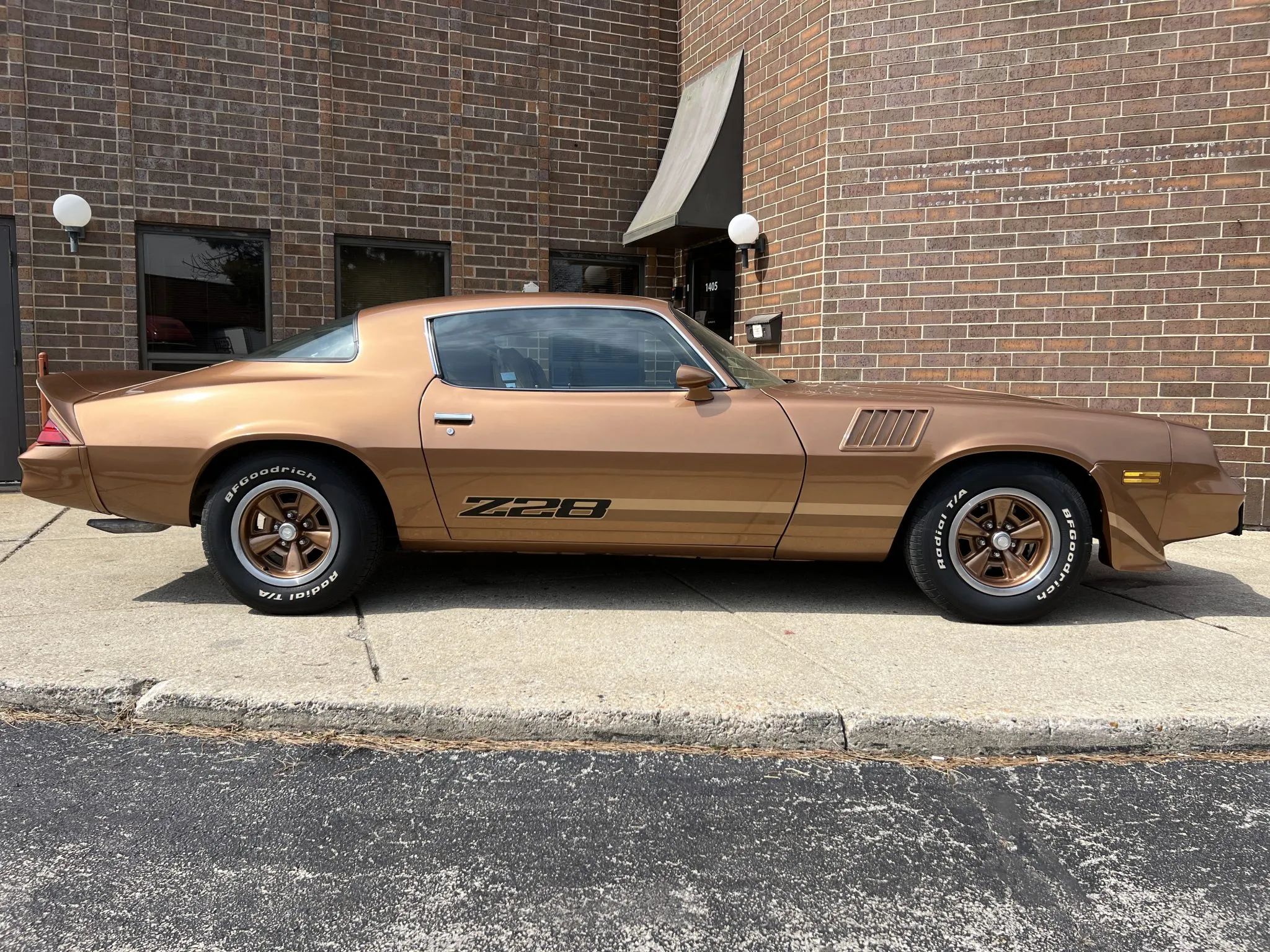
… or even Dark Brown Metallic, which is far from my favorite color, but has a kind of root beer richness that’s not unpleasant on the Camaro:

The only color choice that arguably looked worse on the Camaro than Beige was Light Green (called Pastel Green in some factory literature). This was the rarest Camaro color in 1979, so I had some trouble finding decent pictures of it, but its minty toothpaste hue was definitely not for every taste:

By contrast, Medium Green Metallic, which was almost as rare, is rather neat-looking, and certainly distinctive, like a giant Matchbox car:

Despite having so many better alternatives, 11,370 people still ordered their new Camaro in this abominable beige. I just don’t get it.

This car even has the optional color-keyed Rally Wheels, which would have looked especially repulsive with whitewall tires rather than the now-ubiquitous BFGoodrich raised white letter tires.

I’m not too crazy either about the interior color treatment, which is Camel with all-vinyl upholstery:
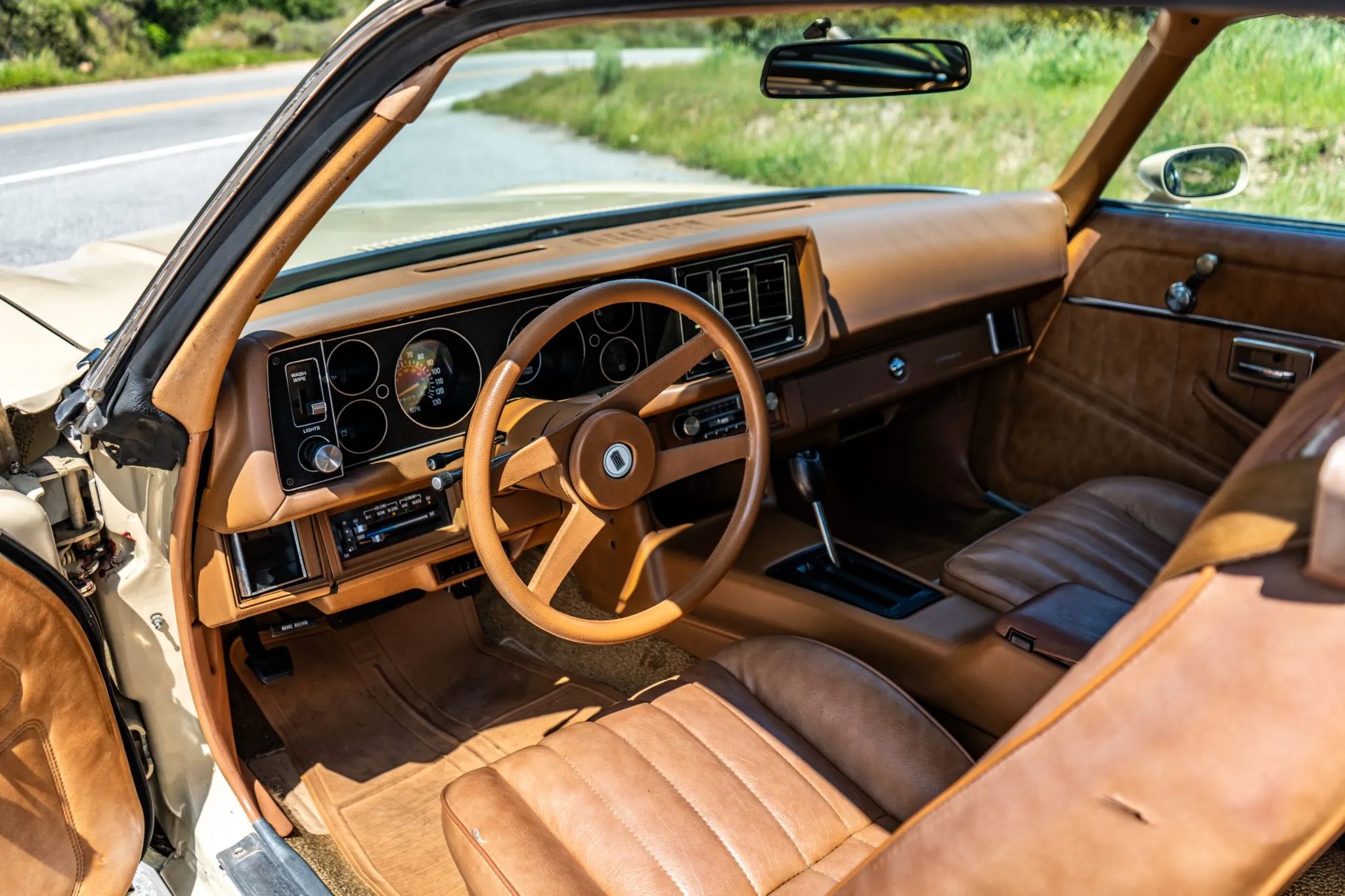
I think the mottled look of the upholstery was supposed to make it more like leather, but it’s awfully orange, and looks like a pumpkin you wouldn’t pick for jack-o’-lantern duty, or maybe lunch meat that’s been in the refrigerator too long:

The net effect of the color-keyed interior isn’t very pleasing, although the layout (also tidied up for 1978) isn’t bad:

Unlike the black coupe pictured earlier, this car lacks the U14 special instrumentation package (a $112 option), so it has only a speedometer and a fuel gauge, filling out the other binnacles with warning lights. (The easily nicked silver paint around the instrument panel edges was an unhappy GM affectation that even extended to Cadillac in those days.)

This car has air conditioning, which was very common on Camaros by this point: 78.2 percent of 1979 Camaros and 71.4 percent of ’78s had A/C.

Rear-seat habitability was never a big priority in pony cars, but this was about as good as it got in the second-gen Camaro:

Having owned a car with slatted rear window louvers, I have mixed feelings about those as well. They’re a pain to keep clean, especially in California, where it rains infrequently, and the inevitable clank-clank-clank over bumpy pavement is a definite downside. On the other hand, with the sloping back window, rear-seat inmates might appreciate the shade on sunny days.

I think these louvers might be a dealer or aftermarket add-on — I don’t see them on the factory option list — but they were a common period accessory.

If I were buying a new car in that benighted era (mercifully, I was not old enough back then to have to worry about that), I probably wouldn’t have picked a Camaro, even a Z28: I like sporty coupes, but with real performance still off the table, I think a Celica would have made a lot more sense. Still, I can see why a lot of buyers were swayed by Camaro swagger — even if a few of them chose some perfectly appalling colors.
Related Reading
Curbside Classic: 1978 Chevrolet Camaro Z-28 – Wherein The Author Finds An Interesting Camaro (by J P Cavanaugh)
COAL: 1978 Chevrolet Camaro Z28 – My Second First Car (by David Saunders)
Curbside Classics: 1978 Chevrolet Camaro Z28 and 1979 Ford Mustang Cobra–Two Right Answers to the Same Question (by Aaron65)
Curbside Classic & Driving Impressions: 1979 Camaro Z-28 – Nephew Aidan’s First Car (by Paul N)
Curbside Classic: 1979 Chevrolet Camaro Z28 – Paradise Express (by Joseph Dennis)























For music besides disco, the rock band the Knack hit #1 with the song “My Sharona” and ELO(Electric Light Orchestra) and Cheap Trick have some top 10 hits with “Don’t bring me down” and “I want you to want me: live at Budokan” in 1979. 😉
For the Knack I always preferred “Good Girls Don’t”. Another song that always send me back to those days is “Drivers Seat”, a one hit wonder from Sniff and the tears. There were lots more. I didn’t much care for most Disco, but the girls loved it so we played it at parties a lot.
Not a Camaro-specific problem. It begs the question: is there any car that looks good in such a color?
A bit off topic: “Don’t bring me down” was, in my opinion, the beginning of ELO’s decline.
I’ve never cared for Cheap Trick, ELO, or The Knack, and I’ve always particularly loathed “My Sharona,” one of those hits that’s so bad I risk injuring myself in my haste to turn it off if it comes on the radio.
I vaguely recall a ‘Nuke The Knack’ movement for the brief period they were popular.
The Cars debut album was in 1979.
Ah 1979….
I can see why some people would find it hard to be nostalgic for those days, but I was a teenage gearhead whose Dad worked at the local Chev-Olds emporium. I worked there on Saturdays and all of the summer of ’79 so these Camaros really strike a chord for me. My Dad taught me to drive in a ’78 Z-28 4 speed he had as a demo for awhile. That car also taught me that a screaming yellow, easily identified car wasnt always a good thing…
Any ways, when I saw the headline I said to myself “Nope, there was a worse colour”. But I see you covered it, that being light green. It looked even worse in person. Ordering cars was a privilege reserved for only a few of the managers, my Dad being one them. As the fleet and lease manager he didn’t get involved with Camaros much and so fortunately wasn’t the one who ordered a Z-28 and a Monza Spyder in that shade. Both cars hung around for a long, long time even though Z-28s were one of the dealership’s best (and most profitable) sellers. The guy who did order it ultimately lost his job.
We moved a lot of Z-28s in those days and I thought I had seen every colour combo, but I’ve never seen one in medium green metallic. I really like that one.
I laughed when I saw that Cutlass, my Dad leased one just like it to a local business owner.
I can’t argue about the fashion, but IMO the music was a lot better than what I hear today.
But you’re only 17 once…
Great article!
I don’t think the light green is so bad. If the rest of the equipment was right (manual, green Sport Cloth interior) your dad would’ve been able to tempt me into taking it off their hands for the right price…
If it wasn’t for the slight inconvenience of my having been 5 years old in 1979, that is.
I agree about the light green, not that bad. I’d take it 10 out of 10 times over the beige subject car.
I much prefer the Camaro’s cousin (brother?) the Firebird.
If some colors are were universally recognized as horrible, why did they offer them at all? Strike them from the palette.
If somebody really wants prosthetic limb beige, let them special order it. People whine about the lack of color choice nowadays, but at least there’s no danger of ending up with this.
You beat me to it: my first thought is that this is “prosthetic limb” beige. I think I first heard it described that way on Top Gear. If you’re aware and willing to live with that, more power to you. I really feel bad for the guy who bought something in that color as an “awe, whatever,” then had the resemblance pointed out to him. Oh, and unfortunately, we seem to be veering back around to this kind of color. Lots of clay browns, dull grays, olivish greens; if those blah colors are popular, prosthetic limb beige isn’t far from being a hit.
OK, I have to agree with you on this Camaro color being awful. I was never a fan of many popular auto colors during this time that focused mostly on earth colors. However, club music was still fun to dance to (disco not yet dead). I can see where you are coming from regarding men’s fashion as I just did a quick image search and what you find on the net is the worst of the worst and not totally representative of the era. The clubs I frequented would turn anyone away at the door wearing that stuff. At the time I was young & thin, working as the corporate interior designer for a very upscale fashion focused department store chain, much more European influenced. I had to dress the part and the GQ look worked for me. So thankfully I avoided being a fashion victim and was not in the market for a new car of this period as I was happy with my understated white 1976 Eldo convertible and my tailor-made white 3 piece suite (LOL).
I have to agree with you. Both this beige and the pale pastel green are simply awful on this car. Those terrible fleshy beiges were far more popular in the 70’s than they should have been. A friend’s father bought a new 76 Granada in a similar color, only Ford found a way to make the color even fleshier, and it was simply awful.
This reminds me of the prettiest color I ever saw a Camaro painted – a friend’s girlfriend bought a new 78 Camaro, in a 1978-only color called Dark Blue Green. It looked really sharp with its tan interior, and she drove it for quite a few years. My memories of that car only make this beige example look all the worse.
As one who graduated high school and started college in the fall of 1978, I have an easier time finding some nostalgia for the 1978-79 time period.
Also, it really surprises me that fewer than 1/3 of 1979 Camaros had air conditioning. Even in my conservative area of northeastern Indiana, cars without a/c were becoming the exception by the mid 1970’s, unless you were looking in the econobox or cheap stripper class – and the Camaro definitely was not in that group. I think I found the site where you got the figure, but I wonder if that bit of data is actually correct.
Your skepticism turns out to be well-founded. I checked Automotive Industries and Automotive News (which I should have done before), and they both list the Camaro A/C installation rate as 78.2 percent for 1979, 220,993 cars. I amended the text.
I was stuck with a rental car, an ’81 Mercury Zephyr in skintone, inside and out. I punished that car for that, and other reasons, I just hated it. I had dealings with a neighbor, “Poopman” (That was the name I gave him, it stuck, and spread, long story there), and he had a beige Olds 88. IMHO, only the very strangest people order a car in beige. A friend had a “Root Beer” Z28, and while I didn’t like it, it was light years ahead of beige. IMHO, only the awful “Avacado Green” variants were even close to beige in awfulness back then. The present champ is “Destroyer Gray”, or whatever the manufacturer calls it, is the worst color ever, even worse than beige, especially on a Charger or Challenger.
In Las Vegas in the later ’70’s, there were a lot of us who had modded F-Bodies that could beat stock cars from the peak muscle years. All it took was money and either you or someone you hired to turn the wrenches. There was a ’78 Z-28, black inside and out, that had a 383 stroker and it ran 12 sec 1/4 miles and sounded fantastic.
I call it “oops, we cleared the primer” beige and have even replicated it in scale models by doing exactly that.
When I think of this beige/tan/buff color on cars, it’s the Zephyr/Fairmont that come to mind first – especially sparsely equipped models. Seemed awfully popular on those cars, for some reason.
And I agree with you about that modern “Destroyer Gray” color… it’s a color that would seem to accelerate clinical depression if you have too much exposure to it.
“….. in the later ’70’s, there were a lot of us who had modded F-Bodies that could beat stock cars from the peak muscle years. ……. There was a ’78 Z-28, black inside and out, that had a 383 stroker and it ran 12 sec 1/4 miles and sounded fantastic.”
+1
I recall (well, it was late 80’s) a fella that had a 74-76 Camaro, Primer Gray, with “BUTCHER” spelled out on the rear bumper with runny paint and brush ‘font’. Don’t know what V8 was under the hood. The thing was wicked though. “Legend has it” he was unbeatable on the street back then. Quicker than my friend’s 70 Torino 429SCJ 4sp, which was no slouch by any stretch.
Good times.
You beat me to the punch on the gray on new cars, although I think the dull finish’s are worse. I was working at a Chevy dealership in 79 , lots of Malibu’s , Nova’s Monza’s and Chevette’s where sold in that beige . Also recall seeing many Beatles and Squarebacks in a similar shade in the early 70’s.
Who would have ordered this color? Chances seem good that it wasn’t the retail buyer. Perhaps it was someone at the dealership ordering cars for inventory. Or maybe – and I’m not sure if GM had something like Chrysler’s “sales bank” – Chevy had a bunch of that paint and just painted some cars in that color, and dealers bought them to sell.
I don’t know if Chevy had a “sales bank” like Chrysler, but the zone offices did have some inventory. Usually slower sellers like Monzas and Novas. Sometimes, in order to clear out some of the deadwood, the zone office would “suggest” a dealer accept delivery of some of the less desirable models in order to speed up delivery of popular models. “You want 6 Cutlass Supremes and 4 Z-28s? Might take awhile, I gotta move a couple Novas and a beige Camaro first..”
A lot of trading between dealers went on back then, so a car like this might be packaged with whatever Dealer “A” was desperate to get. You want the Corvette? You gotta take this fecal brown Camaro. Lots of this went on, probably still does.
It doesn’t look like this example was driven much, so maybe whoever ended up with it didn’t like it much either.
The beige car had 89,052 miles when the photos were taken (early 2024), and it had a variety of minor dings and nicks, so it was definitely driven, if not heavily. (I assume it was garaged, and it obviously had the benefit of an extensive detailing.)
And they didn’t care about the color because they *knew* they would sell. Maybe as the last Camaros off the lot, but sell they would. They were in demand and beggars can’t be choosers!
Ford just eliminated their tan option for the ’26 Maverick. Thank god. It was a one-year (non-hit) wonder. Like our ’66 Ford Ranch Wagon or ’75 Dodge Dart growing up (Dad…why????), there’s no color that completely erases a car’s style or coolness than tan.
I actually like the beige color, but only in certain applications, with those being off-road oriented 4wd pickups and SUVs/CUVs. On a regular car or even 2wd pickup, well, not so great. It’s just not a ‘classy’ color and seems more reserved for the lowest fleet trims, mostly just an alternative to white.
It’s worth noting that the 2024 Chevy Colorado had a Sand Dune Metallic that looked terrific on the higher trim 4wd versions. Like the Maverick’s beige shade, the color was discontinued.
I will also say that there are different shades of beige, some more or less objectionable than others.
I don’t think the interior is all that bad. Combined with a dark green or dark blue paint job, it would definitely look great. Even if the seat covers are only made of rich DuPonthian leather.
Quibbles about the beige color, in general, aside, I’m definitely waxing nostaligic about the Z/28, and it’s entirely due to the side stripe that goes around the front spoiler to the other side. Specifically, it’s the way it curves around the sides of the spoiler. That harkens back to those halcyon last musclecar days of the early seventies when that type of wild striping was all the rage. The Z/28’s performance might have been a shadow of what it once was, but it still looked the part.
Then there’s those window louvers. There were various types, with some being a three-piece design. Better were the one piece units, but better still were those made entirely of metal. IIRC, the plastic ones seemed to warp over time in the sun, whereas the metal ones retained their shape.
All the better to clank-clank-clank you with …
I can see the value of rear window louvers in a three-season climate. But, yeah, the clanking would get real old, real fast.
I particularly like the color, more than the car itself. I think it’s called Sahara Beige. I call it Milk Coffee.
It’s not called Sahara Beige. Depending on which Camaro factory literature you look at, it’s listed as either Medium Beige or just Beige.
> I’m scratching my head trying to fathom why someone would order a Camaro in this color.
Even though this was the era of huge à la carte option lists on American cars, many cars were still bought off dealer lots, resulting in compromise with colors and features. I can relate – my last two cars were purchased off the lot because my previous car suffered a major calamity and I couldn’t wait months for a replacement. I’d love to see stats as to what percentage of a given model were special-ordered vs. purchased from dealer inventory, but they’re not available. I’d wager a substantial percentage of beige Camaros were bought off the lot, by people whose first choice may have been a different color.
I wouldn’t have guessed 1979 was the high-water mark for Camaro sales. It was an old design by then, and it faced strong competition from the new Fox-body Mustang.
1978-79 wasn’t a great era for films, but there was plenty of good (or at least guilty-pleasure) TV, and loads of good music in pop, rock, r&b, punk, disco, and sub-genres like power-pop, new wave, and what eventually became known as yacht rock. And unlike today, quite a bit of the best music landed on the charts and blasted from radios everywhere.
Agree that 1979 Camaro sales numbers as the high water mark is odd. I think 1980 had some of the highest relative gas prices in US history. So, at the very least, I would think that, with its poor fuel economy numbers, Camaro sales would have dropped off significantly the following year.
Likewise, the new Fox Mustang, with better fuel economy, should have been selling way better at the same time.
If I recall correctly, gas prices went up sharply from 1979 to 1980, and hit an inflation-adjusted peak in early 1981 that stood for over 20 years. But gas prices weren’t very high for a large part of the 1979 model year (which would have ended in September 1979).
I was looking at Firebird numbers, and they too had higher sales year in 79. However, 79 was a facelift year, so, who’s to say? (I preferred (and owned) the previous Look (77-78).
It’s important to keep in mind the distinction between model year and calendar year.
The production figures are for the 1979 model year. Calendar-year Camaro sales fell by almost 20 percent from 1978 to 1979. The second oil crisis, which saw fuel prices soar and lines at gas stations, hit around April 1979, so it became a factor during the last few months of the ’79 model year. The Camaro wasn’t impacted as badly as full-size cars — the Impala dropped by over 26 percent, the Caprice by close to 29 percent — but on a calendar-year basis, the Fox Mustang DID end up selling way better. CY1979 Mustang registrations topped the Camaro’s by almost 45 percent (about 295K to 204K).
“I’d wager a substantial percentage of beige Camaros were bought off the lot, by people whose first choice may have been a different color.”
The question remains… why were beige Camaros “on the lot” to begin with?
Somebody must have thought it wasn’t a horrible idea. Maybe it looked better as a 1×2″ Swatch vs real life?
To the extent I can see any reason for it, I think it sold to people who wanted a light color (to show dirt less and/or with the presumption that it would be cooler in the summer), but didn’t want white and were not keen on the pasty light green offered this year.
That beige, or a slightly darker version of it, was quite desirable when first offered as “quicksand” on the Toyota Tacoma in 2017 or 2018. It hides off-roading mud and dust quite well. But I agree it doesn’t work so well on the Camaro. But I think the popular music of the late Seventies was wonderful. Early punk was evolving into New Wave and some rock and roll from Van Halen, Clash, Dire Straits and more. I suppose the Knack might be better loved here at CC if their big hit had been titled “My Corona”.
Not a huge Camaro fan .
They were called “belly buttons” locally because seemingly everyone had one .
I look at that massive DELCO R7 AC compressor and know where the wheezy V8’s power went .
Nice survivor all in all .
-Nate
Yeah, but the inside would be colder than a meat locker.
The “catalytic converter”, right under the passenger seat made soo much heat it would have stableized.
Been in many.
Almost bought an “81”; someone else agreed to pay more then I did.
Obviously not the best color for the Camaro, but the unfortunate color choice can’t ruin the fine styling. The light green is interesting, as I don’t ever recall seeing a Camaro in that color when these cars were new. Light green, with a dark green vinyl top, was commonly seen on the Buick Regal, Oldsmobile Cutlass Supreme and Pontiac Grand Prix for 1979. I even recall a few GM B-bodies painted that color.
It was one of those colors that was available for one or two years, and then quickly disappeared.
I was a teen at that time (graduated with the class of 1980). The GM F-bodies were the last vestiges of the 1960s muscle and pony car era, wrapped up in attractive styling that was not yet outdated. During this era, imported brands did not have dealers in many small towns and rural areas. People often took their vehicles to independent mechanics, and many were reluctant to work on imported cars. I ran into this with my 1977 Honda Civic CVCC during the early 1980s.
Meanwhile, virtually every small town had a Chevrolet dealer (often dualed with another GM make), and no self-respecting mechanic would refuse to work on a small-block Chevy V-8 hooked up to an automatic transmission.
The 130 mph speedometer is interesting, as I thought federal regulations limited speedometers to 85 mph beginning with the 1977 model year.
“My Sharona” was THE song of the summer of 1979. I was sick of hearing it by the end of the summer. Recently the satellite radio station played it again…and I’m still sick of it.
Google says it was September 1st 1979 (and canceled by 81, but many speedos were already stockpiled and were still used after the law was changed again).
Not sure how it would affect cars that were made prior to sept 1st 1979 (which subject car may be).
The door jamb sticker says the beige car was manufactured “by 4/79.”
My dad had a beige (think manilla file folder) 1978 Dodge Magnum XE. It had a brown Landau top, T-tops, brown custom pinstriping (way too much, in my 13 yr old opinion), and a brown “leather” interior. I loved everything about that car except the color.
One day in 1978, I offered to wash Dad’s Magnum. As I was positioning the car in relationship to the water hose…I backed into his 1977 Peterbilt. I figures I was dead and 13 years was a pretty good run. Obviously, I lived; but Pop had my step-mom trade it immediately after it returned from the body shop.
His replacement was a 1979 Dodge Magnum GT in white with red pinstriping and red interior. Much better color combo, IMO.
Ooh….a ’78 Magnum? I drove one (albeit green in color) once as a transporter for Hertz and loved it. Kind of the tail end of the old school cars.
My brother-in-law had a ’78 Camaro, in silver (before silver was on just about every car) with a red interior. It had the older style dash which had “wings” instead of flat. His had the 3 speed, don’t think it had air conditioning (this was up in Vermont, we had A/C on our large wagon, but not on any of our commuter smaller cars). I might have the wrong memory, but I think I watched the first Star Wars movie at a drive-in theatre sitting in it (yeah, I know it came out in ’77 but maybe the drive-in showed it later?). Also remember him driving it to vacation cottage at Harvey’s Lake, PA, for my Grandparent’s 50th anniversary…my Grandfather was all concerned that it didn’t have an inside hood latch and someone could steal the battery or something else under the hood. I drove it once, when we took him out for his bachelor’s party….I remember the heavy clutch, being used to imports it drove way differently than the ones I was used to.
I don’t mind the color too much, but agree it is odd choice for a Camaro. My Dad had a ’76 Subaru DL in the very common for Subaru yellow color, which I hated even more. In 1981 I bought a ’78 “Champagne Edition” Scirocco in a light metallic brown color which is still one of my favorites (the car and the color both). Moved to central Texas, had some body work done for rust and repainted it (at least once) due to faded paint…it lacked A/C, I guess I should have added it but instead bought an ’86 GTi (in silver) that had A/C.
I wonder if that color would look better on a 1968 Camaro? My 68 Mustang is Pebble Beige, which is a fairly rare color, for a 68. I do think all the chrome helps mitigate the car compared to none at all. Now in 1980, when looking for a new car that got very good gas mileage I settled on this 5 speed in brown. It was there, on the lot, maybe because it was brown, but I had no problem with it. It was very practical at the time.
The darker colors hide the front bumper overbite better.
I don’t recall the metal louvers on the Mustangs rattling.
Most of the plastic ones looked cheap, wouldn’t be caught dead putting on my Mustang.
That beige is bad enough (was it actually called hearing aid beige?) but the lack of a rear ducktail spoiler is a big fail too.
Clint you made me laugh. I was age 12 in 1963 and parents had a beautiful new 1963 T-Bird. As part of my $2.00 a week allowance, I washed parents cars every weekend. Dad would not let me remove the factory fender skirts (fender shields) to clean the white wall tires. So I had to move the car 1/2 wheel turn to clean the second half of the rear whitewalls. To do this I had to hang out of the drivers door to see the wheels rotate 1/2 turn. One day, hanging out the open car door, I hit the gas instead of the break, and our new 1963 T-Bird flew forward into our house. On the other side of that wall was Mom in front of our washer / dryer. The appliance’s flew forward and attacked her. The house wall was buckled but not a scratch on the T-Bird.
Also understand, at the time we lived on a high security SAC Air Force base with B-52s loaded with nukes flying over our home every few hours. First thing Dad thought when the house shook was a plane crashed.
So I drove our new 1963 Bird into the house. Dad rushed out, I went to my bedroom. OK, he is going to beat me, kill me. I spent the rest of the day in my bedroom, waiting to be beaten. That was it. Dad never said a thing to me. The T-Bird was OK, the wall was repaired, nothing was every spoken about the “incident”. Thereafter, I removed the skirts to clean the whitewall tires.
Today, I have a 1966 T-Bird convertible, with skirts. I keep my whitewalls super clean. But every time I clean the car, do I take the skirts off, of leave them on and just lean out the drivers door and rotate the ties 1/2 turn?
What a great memory, Alfred. As a child one tends not to remember ordinary life events. Once in awhile one or two do stand out, remain with you, and maybe change your character through life. This sounds like one of mine at six dealing with animals, taught by mother, and one at 12, taught by father, dealing with respect. Those two have heavily influenced me to this day 60 years later.
As usual, I will be one of the few liking that color. But the light green is even better.
And we need to have color keyed interiors back. I hate the all black interiors that are everywhere.
IMHO that beige Camaro looks better than most of the shades of grey/silver/slime I see in modern cars.
I agree with the author about that godawful beige, but I still like the late second-gen Camaro. The basic shape and most of the details remain handsome to this day and GM did a fine job of integrating the safety bumpers into the overall design. Like others here, I graduated high school in 1980, so these pictures evoke some fond memories of the F-bodies filling the student parking lot (along with some Celicas, a Scirocco, Datsun 280-Zs, and a couple of beat up MGs.
As far as the music goes, I spent that summer in Japan as an exchange student, and missed all the big hits as well as the infamous Disco Demolition Derby held in nearby Chicago. I came back to the U.S. feeling a little discombobulated, not up on what was trending and just never really liked the Knack, Cheap Trick, and others who had big hits that summer. The one group making their debut in 1979 that I did like was The Cars…go figure!
There are, as is well known, fifty ways to love your louver.
This made me actually sputter, well done.
Earth tones were still popular in ’79. That shade of beige does nothing for a Camaro. but it looked O.K. on G.M. trucks of the same era. I am with you on The Knack, ‘My Sharona’ was being thoroghly flogged on FM radio and the band was being touted as the second coming of the Beatles (even down to the black and white debut album cover). I didn’t see (or hear) it, and after that debut album it seems few did, and that was that. The albums I remember from that period were Blondie’s Parallel Lines, The Stone’s Some Girls, and Fleetwood Mac’s Tusk.
G.M. Van Nuys was working overtime in those days.
I’m the voice in the wilderness. Like the color very much. Ideally, interior of red, burgundy, blue, or green would be my preference.
I have to disagree with the author of this on just about everything that was stated.
First off, the music of 1978-79 was better than that of just a few years later. The cars were better. The girls fashions were better. As someone who graduated fom High School in 1983, I can assure you that 1981 was when all things bottomed out. That was the heyday of Journey, bad hair metal, and gimmicky new MTV style music. Visuals over everything else.
Would you rather have a 1981 Thunderbird or a ’78? Same years for a Cadillac? Even cars that looked the same or similar had weak, downsized engines or diesels or else looked like a cheap box (hello Ford and Chrysler).
I bought a 1981 Olds Cutlass Supreme when I graduated, in beige. Only 16,000 miles and pretty reasonably priced, due to quite a few dents on the roof and hood from a hailstorm at some point. It had the 260 V8 and was the slowest thing on 4 wheels, bar none. The only reason I bought it was that the sales lady at Bill Lee Olds in Mt. Clemens was a real cougar and she definitely knew how to close a sale with an 18 yr old that hadn’t bought anything more expensive than an electric guitar before that.
Back to the Camaro. My sister had a 1980 Camaro 6 cylinder in dark blue. The color didn’t really do it any favors either. That car was around for a while, too, as it ended up being passed down to my younger brother by the late 80s.
After a few years in a new Mustang GT, I ended up buying a 1972 Buick Riviera boattail, in beige no less.
All these beige cars looked fine to me. I like the featured beige Camaro here. The problem, as others have noted, is not the color but the cheap, ugly, aftermarket louvers. All of those green colors shown are uglier than the beige. The interior isn’t bad at all. I would rather have mottled orangey brown over the generic gray that most cars ended up with in the 21st century.