

Charting the history of Cadillac is often as much a matter of charting its decline as noting its successes. The 1990 Sedan de Ville was a little of both: It was a great improvement over the early FWD C-body Cadillac line and a solid commercial success, but it was also the last really good year for what had been the mainstream Cadillac sedan.

In 1990, Cadillac was still the No. 1 U.S. luxury car brand. It had never quite matched its late ’70s peak, and after rebounding somewhat from the early ’80s recession, Cadillac sales had slipped again in the late ’80s, falling from 304,057 cars in the 1986 calendar year to 258,168 for calendar 1990. However, it was still comfortably ahead of Lincoln, and while BMW, Lexus, and Mercedes-Benz now had more prestige, Cadillac outsold all three put together.

As it had been since the early ’60s, the C-body De Ville remained the mainstay of the Cadillac line. It had switched to FWD for 1985, and had received some useful improvements since then, including more power and increased cargo and passenger space. The Sedan de Ville accounted for about half of all Cadillac sales in both 1989 and 1990.

The two-door Coupe de Ville, once a bestseller, was dying on the vine; production for the 1990 model year didn’t reach 2,500 cars.

Cadillac also offered the FWD Fleetwood and Sixty Special, which were really just flossier versions of the De Ville, distinguished by rear fender skirts, a vinyl roof, and extra standard equipment. Industry statistics often lumped De Ville and Fleetwood production together, since there was little substantive difference between them. (For 1987 and 1988, the Sixty Special had had a 115.8-inch wheelbase, 5 inches longer than the regular Fleetwood, but for 1989, all the C-body sedans were consolidated on a 113.8-inch wheelbase, which split the difference between the long-wheelbase Sixty Special and the earlier 110.8-inch Sedan de Ville.)

The FWD De Ville/Fleetwood cars had fully independent suspension with automatic level control system, although “handling” in any enthusiast sense was still not on the menu. Antilock brakes were standard on the Fleetwood and Sixty Special and a $925 option on De Ville, although even with ABS, Cadillac didn’t bother to include rear disc brakes. A driver’s side airbag was optional in 1989 and standard in 1990 to comply with federal passive restraint regulations.

Cadillac had lost a lot of goodwill a few years earlier with the HT4100 engine, a downsized V-8 with an odd, Vega-like combination of cast iron heads and an aluminum block that had proven both underpowered and unreliable. There had been progress in both areas: Cadillac had bored out the V-8 from 4,087 cc to 4,467 cc for 1988, bringing a healthy increase in power and torque, and its mechanical reliability was better, if still not terribly good. For 1990, the 4.5-liter V-8 got a new port fuel injection system (replacing the previous throttle-body injection system) and a higher compression ratio, giving a reasonable 180 hp and 240 lb-ft of torque.

For buyers paying close to $35,000 for a new car, it was hard not to notice that the twin-cam 1UZ-FE V-8 in the new Lexus LS400 (which was initially in the same price range as a well-equipped Fleetwood or Fleetwood Sixty Special) had extracted 250 hp and 260 lb-ft of torque from only 3,969 cc, but the Cadillac PFI 4.5-liter V-8 gave the 1990 De Ville and Fleetwood decent punch. Cadillac claimed 0 to 60 mph in 9.5 seconds, and top speed was in the realm of 115 mph, about what the better ’60s Cadillacs could manage. This came at a cost in fuel economy, however: The (adjusted) EPA combined rating was now a mediocre 17 mpg, and the higher-compression engine required premium fuel.

According to Consumer Reports data, the reliability of the C-body Cadillac had improved in many areas: The earlier cooling system and air conditioning problems had largely been addressed, although the brakes remained troublesome, and, as GN’s father found out the hard way, electrical and fuel system issues could still be a headache. Nonetheless, Consumer Reports rated the overall reliability of the 1989–1990 De Ville/Fleetwood cars as above average.

These cars scored well in safety too. The Insurance Institute for Highway Safety Highway Loss Data Institute (HLDI) also found that the 1988–1990 De Ville and Fleetwood had significantly lower-than-average injury rates, comparable to other big domestic cars like the the Lincoln Town Car, Ford Crown Victoria/Mercury Grand Marquis. However, I’ve always wondered how much the HLDI data (which is based on injury claims, not crash tests) reflect the safety of the cars themselves and how much they just reflect the demographics of typical owners — these were not models that attracted young or aggressive drivers, so it was hardly surprising that they racked up fewer injury claims than a Camaro or Geo Storm.

I am not a fan of ’80s Cadillac styling (to my eyes, the only good-looking Cadillac introduced between the 1979 Eldorado and the 1992 Seville was the Pininfarina-styled Allanté, and it’s telling that Cadillac stylists disliked and resented it). The FWD C-body had many aesthetic lapses, including a hood-grille relationship that made both look painfully scrunched. However, the longer wheelbase and longer tail the Sedan de Ville and Fleetwood Sedan had adopted for 1989 did improve their proportions, mitigating the awkward relationship between the greenhouse and the rear wheel arches that had made the 1985 C-body cars look so hopelessly ungainly.

The four-door De Ville was still not going to top many lists of the handsomest Cadillacs ever, but it now looked more or less what people expected a Cadillac to look like, and if you skipped the bric-a-brac (like the still-optional padded vinyl roof and awful factory gold ornamentation package), it was generally inoffensive, albeit very conservative and a bit old-fashioned.

The Coupe de Ville was less successful in these respects. Two-door C-bodies retained the shorter wheelbase, so the longer tail made their proportions worse rather than better, and their cabriolet roofs (in your choice of “formal” half-top or full-length styles) made them look like refugees from the late ’70s. It’s not difficult to see why their market was evaporating.

As for the Fleetwood, with its clumsy rear pseudo-skirts and archaic halo-style vinyl top (a delete option that’s always looked to me like an automotive toupee), it seemed to be in the awkward position of trying to look fancier on the cheap. The De Ville wasn’t terribly modern by the standards of 1990, but the only thing about the Fleetwood that DIDN’T seem like a holdover from 1977 was the muted color palette.


If the C-body Cadillac still wasn’t very graceful to look at, it did have some practical advantages, including wide doors, good side visibility, and lots of interior room. The longer tail had increased trunk space, while the wheelbase stretch took rear legroom from “good” to “generous.”

Compared to the Lexus LS400 the De Ville and Fleetwood offered noticeably greater shoulder room, a bit more headroom, and a whopping 9.3 inches more rear legroom. Neither car was really wide enough for comfortable three-abreast seating, but the Cadillac had ample space in back even for lanky teenagers, and there was space under the front seat for rear passengers’ toes, an area where the LS400 fell annoyingly short.
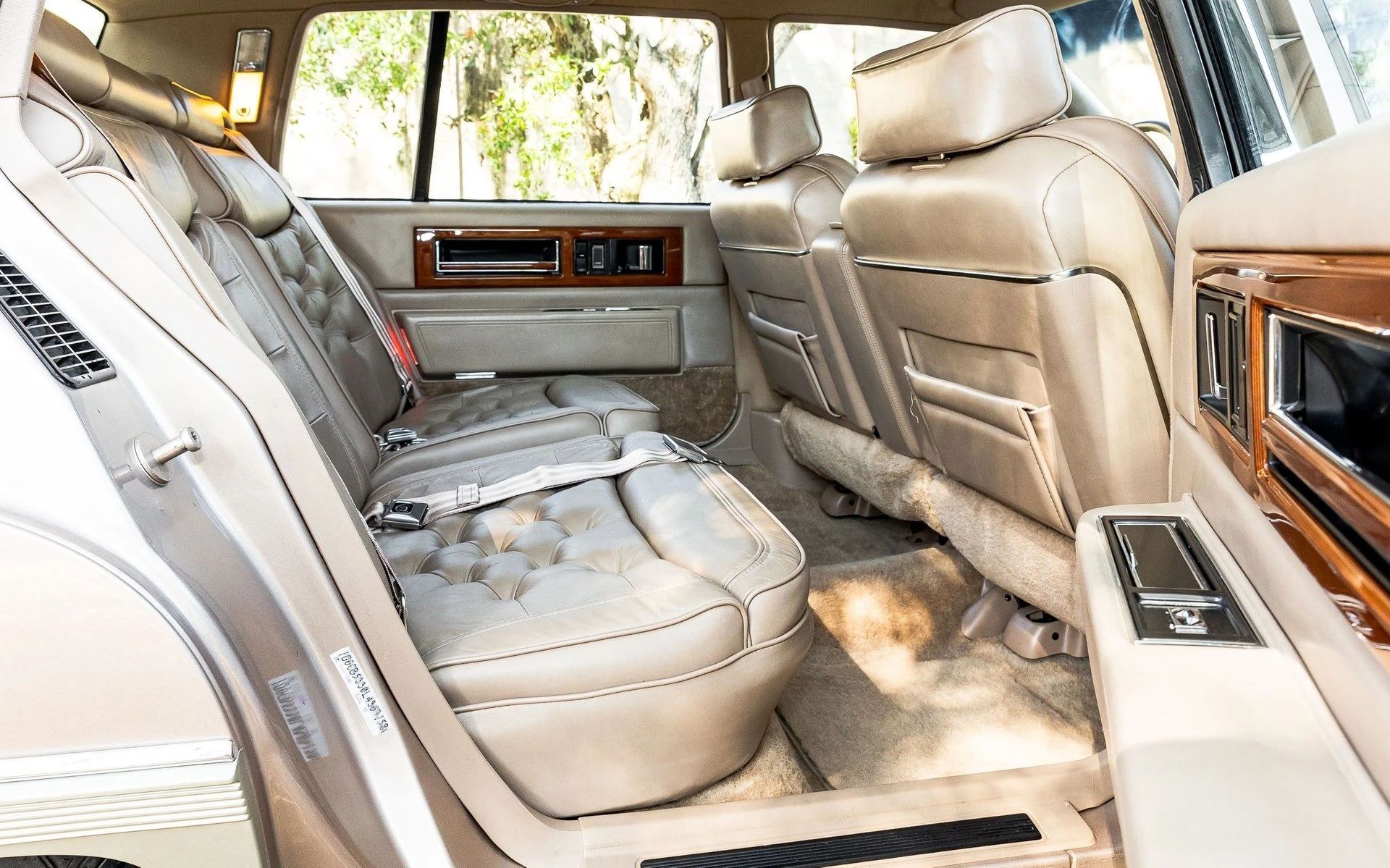
While all the space was welcome, Cadillac interior styling remained mired in the late ’70s. The blocky airbag-equipped steering wheel hub at least meant you were spared motorized or door-mounted seat belts (the RWD Brouham had the latter), but the rectilinear dashboard design still looks like something out of a pickup truck or full-size van, except that the truck would have had more actual instruments.
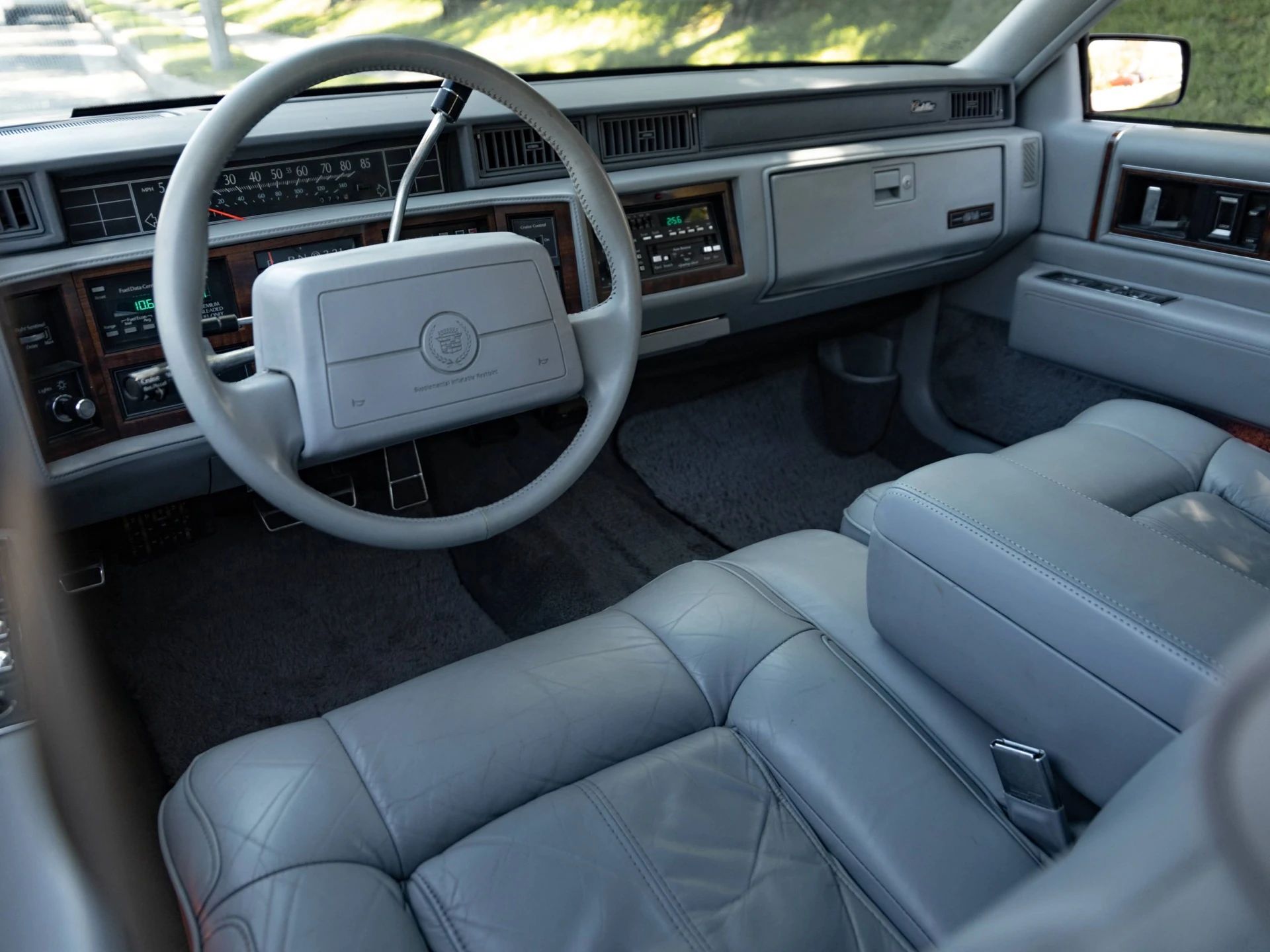
The walnut trim and digital instrument panel of the Fleetwood didn’t mitigate that feeling, and the pricier model’s button-tufted upholstery and easy-reader graphics underscored that the core audience was people my grandparents’ age. The median age of Cadillac buyers had actually fallen a bit since the mid-’80s, but the typical De Ville or Fleetwood customer was still in their late fifties or older.

As GN observed with his father’s 1989 De Ville, Cadillac interior quality left much to be desired as well, with upholstery and fittings that looked good in the showroom, but proved cheap and flimsy in service. Consumer Guide was impressed with the perceived quality, but Consumer Reports gave these cars spotty marks for body integrity and the reliability of body hardware. (If you’re wondering how that jibes with the above average overall rating, Consumer Reports overall ratings weighted mechanical reliability more heavily than fit and finish, on the logic that used car buyers would be more concerned with the former than with squeaks, rattles, and worn upholstery.)

Cadillac had been cutting corners on interior quality at least since the early ’70s, but I’m tempted to attribute some of the shortfalls of the FWD C-body to the growing emphasis on fleet sales. I don’t have a complete breakdown of fleet versus private sales for these cars, but by 1990, GM was already leaning heavily on fleet business to maintain production volume. The top 10 Cadillac dealers in this period, who were collectively responsible for about one-third of all Cadillac sales, averaged about 50 percent fleet sales, and some were well above that level. For example, America’s No. 1 Cadillac dealer, Bayview Cadillac in Fort Lauderdale, Florida, sold 12,528 cars in 1990, but only 1,684 of those went to private buyers.

If you don’t spend a lot of time reading the more business-oriented sections of car magazines and automotive trade publications, you might wonder why people make a snit about over-reliance on fleet sales — after all, isn’t a sale a sale? The problem is that fleet sales are usually heavily discounted, which encourages manufacturers to cut costs to maintain per-unit profits. Since modern fleet operators typically don’t want stripped-down cars, those cuts are made often in areas that aren’t on the options list, meaning that private customers are shortchanged so that the manufacturer can make more money on sales to rental car agencies and livery services.

Throughout this period, Cadillac spent a lot of time and energy on marketing clinics, which mostly told them they were going in the right direction. Clinic participants wanted bigger dimensions, traditional Cadillac looks, more space, and more power; Cadillac gave them all of that and more. (For 1991, the V-8 was stroked to 4,893 cc, giving a round 200 net horsepower.) Clinic respondents said they wanted stretch-out bench seats and digital instruments, and some of them undoubtedly still wanted vinyl tops, so they got those too.

While some Cadillac loyalists were probably pleased with the results, that core audience was shrinking. In the 1990 model year, Cadillac sold a very respectable 176,589 De Ville and Fleetwood models, about 76 percent of those the Sedan De Ville. Although the 1991 cars had more power and standard ABS, production fell to 147,998, then to 142,328 for 1992, and finally to 130,714 for 1993. The De Ville still accounted for over half of all Cadillac sales, but those were slipping too, dropping to 225,869 for the 1993 model year.

Of course, by 1993, the C-body cars were getting quite old, and Cadillac was preparing to unveil the revamped, more modern, even bigger 1994 De Ville. However, when they did, sales fell by an additional 10,000 units. Fortysomething Baby Boomers who wanted more interior space than a Ford Taurus or Toyota Camry were buying Ford Explorers, not Cadillacs; hardcore America Firsters who saw FWD as a tool of the International Communist Conspiracy were happier with the RWD Brougham (confusingly renamed Fleetwood in 1993). The Cadillac Seville, meanwhile, had finally rediscovered its “import-fighter” mission after more than a decade of awful styling and poor organizational judgment. In terms of sales volume, the De Ville remained the “default” Cadillac, but even Cadillac no longer seemed very sure what that should mean.

I’ve always found the FWD Fleetwood and Sixty Special rather tacky, but I have no very strong feelings about the 1989–1993 Sedan de Ville. It struck me as a decent $20K–$25K domestic sedan that was playing a little out of its league at over $30K, but I could see why people bought it, even if few of its virtues were in areas that have ever been priorities for me. The four-door De Ville was, in the main, a nice car — but it was a nice car for my friends’ conservative empty-nester parents, or maybe for middle-aged coworkers who were doing the math on early retirement, not something my generation or most of my Baby Boomer parents’ generation ever aspired to.

A while back, I wrote about the tipping point for Cadillac quality and style. I think these cars were a tipping point in a different sense: They represented the last time the traditional Cadillac formula still sort of worked commercially, and when straightforward big domestic family sedans with premium badges were still mainstream. (The De Ville/Fleetwood was No. 12 in U.S. passenger car sales by model for both 1989 and 1990.) While I never wanted one, it’s strange to think that they’re now mostly long gone — like the disappearance of a once-ubiquitous chain store you rarely shopped, but always relied on as a landmark.
Related Reading
Vintage Reviews And Commentary: 1989 Cadillac Sedan DeVille – Be Careful What You Wish For (by GN)
1989 Cadillac Fleetwood – Deadly Sin or Greatest Hit? (by Jason Shafer)
Curbside Classic: 1990 Cadillac Fleetwood Coupe — Sparkling Rosé (by Joseph Dennis)
Curbside Classic: 1991 Cadillac Sedan DeVille – Almost Doesn’t Count (by Laurence Jones)
Curbside Classic: 1991 Cadillac Sedan de Ville – Save Me! (by Tom Klockau)
Curbside Classic: 1992 Cadillac Fleetwood Sixty Special – Two Nice Leather Sofas, With A Car Around Them (by Tatra87)
My Curbside Classic: 1993 – 1996 Cadillac Fleetwood – End Of The Evolutionary Road (by BigTomBrougham)























The C-body De Ville undoubtedly appealed to customers that wanted a traditional choice: very conservative styling, V8 engine, plush interiors, quiet, and comfortable.
However, Cadillac’s design language seemed stuck in the late 1970s both inside and out; having models that cater to traditional customers is one thing, but having your entire brand dedicated to a specific (and sadly, declining) demographic really hit them hard when the 1990s turned.
This is not an issue of the De Ville as taken in context of the car itself – it did what it had to do and sold well, I recall them as a frequent sight back in the day.
Notice that no rust proofing in under car.
The underbody of that Sedan de Ville (which you can see by clicking the link) is not as pristine as the Coupe de Ville, but it’s pretty clean. I don’t know about the Fleetwood.
I’m likely in the minority, but having owned an 89 RWD FLEETWOOD Brougham DeElegance and a 93 Brougham (which was inferior to the 89),I agree that Cadillac was at a crossroad and took the wrong road. One that led it further from *Standard of the World *to today’s BLOATED SUVS at BLOATED prices. Give me a GREAT AMERICAN LAND YACHT any day.
I Stand with Rick W.
(So often, I might get a T-shirt).
A former neighbor bought one new. He was probably over 90 when he got it, and he told me that he was very unhappy with it because of several problems he had experienced. I always looked at these as cars for people who were dedicated Cadillac buyers, which had been a fairly large demographic. I’ll bet quite a few of these were their owners’ last new car.
Mercedes, Lexus, and even Lincoln needed conquest sales to thrive. Not Cadillac, at least for a long time.
Russians in the 80s preferred RWD, and saw FWD as a tool of the frivolous fashionable Capitalist Conspiracy. Lada and Moskvich were both RWD in those years.
Propaganda divides us!
I’m hoping it was apparent that I was being facetious.
GM lost its way starting with the lengthening of the ’89 DeVille wheelbase. Cadillac was no longer in lockstep with its C body stablemates- the Electra and 98. The C body Cadillac ran from ’85-’93. The C body Buick and Olds ran from ’85-91, when they received new styling (new windshields and A pillar side glass, etc. Meanwhile, an all new Deville arrived in ’94, on a K body ( Seville) platform. Moving forward, everything went more and more out of sync with the formerly in sync C bodies. It really spoke volumes about a company that no longer had complete confidence in what they were doing. The C bodies, with a 3 inch longer wheelbase than the B bodies, predictable over many decades, was frittered away at the very moment when a return to orthodoxy might have righted the ship.
The especially vigilants don’t understand jokes.
I have always thought that this generation of Cadillac, while being a relatively small, had the best proportions of any of the downsized Cadillacs of the era. Rear overhang, side glass area, beltline, C pillar design/size, wheelbase, refined rear end/tail light look, gentle curves of the hood/grill, front overhang (mostly), and overall cohesiveness of design is pleasing to the eye.
After thinking about it some, the only thing that might enhance the design a tad – would be to move the front wheels forward about 3″, which would reduce the front overhang slightly and increase the length between the front wheel opening and front door, as well as give the car a longer wheel base look. But having said that, the factory look is still very nice.
I have to disagree.
You can of course find it pleasing if you want, but I don’t think any part of this design is cohesive at all: The cabin, doors, and greenhouse don’t go with the front or rear, in the manner of previous generations of Nissan Versa. Stretching the wheelbase of the sedan partially mitigated the bowed-back look of the 1985–1988 version, but it’s still very jumbled overall, and further messing with the wheelbase would not help.
One of the reasons I took pains to find clean, well-scrubbed examples was to show what they looked like to prospective buyers, rather than beat-up used cars. There are just so many details that look clumsy.
Also, the saving grace of these cars was that while they were still enormous by ’80s standards, they were reasonably space-efficient. They were big cars, but they had a big interior and, with the stretched tail, a big trunk. Pushing the nose forward wouldn’t address any of their aesthetic failings, but it would make them bigger for the sake of bigness, also making them more unwieldy.
My wife’s grandfather purchased a 1993 Coupe DeVille (last year of this generation) in SoCal new. He’d always wanted a Cadillac for some reason and gave up a 1986 Toyota Cressida in its favor (we got the Cressida to my great delight). I did get several opportunities to helm the CDV on the run from Orange County to Las Vegas and back and I’ll happily admit it was mighty comfortable in all of its blue on blue glory and had no trouble getting out of its own way, at least on the straight and flat parts of the route. That being said, I’m not sure that it was really all he had imagined, within a couple of years it was replaced by a Lexus ES300 that he happily drove until the end.
Gold badges on orange peel paint, did the paint robot have too many lunchtime beers? Overall not a bad looking car compared to some of their efforts.
I was thinking that myself. Please tell me this is a bad respray, and NOT what Cadillac was shipping out. Can’t be factory, I just refuse to believe it.
The black Coupe de Ville had only about 13,000 miles when it was listed in May 2023, so the paint was likely original.
Buick had a much more compelling and stylish car out in 1991, the all new Jaguar(or jellybean) shaped Park Ave. Even had more horsepower than the Cadillac v8 if you opted for the supercharger.
Thats what really killed Cadillac in the 90s. Buick offered just as nice cars. That turned out long term to be a lot more reliable/durable and cheap to fix
This is a logical assumption, but the numbers don’t bear it out. From 1991 to 1993, the aging De Ville outsold the Park Avenue by a substantial margin. I was surprised, but apparently customers in that shrinking segment were still willing to pay for the Cadillac name.
I think Buick’s issue (well, one of them) in those years was they were usually paired with GMC and Pontiac, and the Park Avenue was BY FAR the fanciest, most expensive vehicle on the lot. Suburbans weren’t quite the “premium” vehicle they would become, and there were a lot of cheap Sonomas and Sunfires clogging the forecourt. The Cadillac dealer was (usually) a somewhat more upscale affair and more often with a standalone showroom and sales staff, at least insofar as LetThemEatCake-ism is concerned.
My point was simply that the theory that Cadillac was undermined by the niceness of contemporary senior Buick models, while a reasonable supposition, is not supported by the sales data.
What killed Cadillac was a shrinking demographic. I always thought Cadillac’s traditional type of luxury cars appealed to people born in the 30s or earlier. Of course there was a shrinking group of baby boomers in places in places like the Mid-West who were late adopters to luxury imports. Eventually more and more people caught on to the fact that it wasn’t cool to drive in a car that was aspirational to the Herb Tarlek wanna-be crowd.
By 1989 or 90, Cadillac’s sedan should have been fashioned along the lines of the ’88 Voyage concept. Instead, Caddy chose to align with the weak side of GM’s split personality. The strong side was involved in the historic Ford-GM wind tunnel race of the Eighties, which began in the Seventies and left the rest of the world in awe. The ’82 Firebird and ’84 Vette were some of its products, as were a slew of memorable concepts. The ’87 Corsica was a move the right direction, and the Taurus/Sable should have been the final final wake-up call. This Allante was more valuable capital wasted.
There was recently a multipart series on Dean’s Garage by Cadillac stylists of the time about the development of the 1992 Seville and Eldorado, and the degree of institutional malaise and sheer willful obliviousness at Cadillac specifically and GM more broadly was actually jaw-dropping (and I say this as one who’s always felt GM did almost nothing right in the ’80s). I had always sort of figured they’d started to get their act together after Irv Rybicki retired and Wayne Kady was gone, but boy, was I wrong.
FWIW, I think the Voyagé was appalling — in production, it would have been as whale-like as the 1991 Caprice, and I don’t think it would have sold well at all.
For anyone who’s banished the Voyagé concept from memory (a mercy, if you ask me), here’s an account of its development with lots of pictures: https://www.deansgarage.com/creation-of-the-cadillac-voyage-and-solitaire-concept-cars-part-1/
I see a bit of the Voyage in this car’s successor, it’s like they doubled-down adapting some of that car’s less-attractive elements into this general idea, figuring the Seville and Eldorado catered to the “younger” set. Mom’s ride for a while was an all-white version of that two-tone ’93 shown in the thread, blue interior, digital instruments.
You comment on how the grille on the earlier models did that front end no favors. I have to give credit that going with a more “landscape” than “graph paper” format on the grille did a world of good.
My problem with the earlier grilles is that their visual relationship with the hood makes them appear to be erupting out of the front end, which is not a felicitous association in an expensive car. The 1992 and 1993 grilles still have the same problem, but extending the chrome area onto the leading edge of the hood rather than under it reduces the impression that the car has suffered some kind of minor front-end shunt.
I’ve read those articles already but thanks for pointing them out. I like the Voyage. No, its not perfect. But as a starting point for a dramatic new Cadillac theme, I think it worked, whereas the ’92 Seville and ’95 Deville were more industry commonplace. Here’s an adaptation of the theme to a ’96 Deville to get a feel for a production version. Rather than using that car’s 113.8 wb, I kept the existing ’87-88 60 Special’s 115.8 wb to help with proportions, enable a rear seatback recline and save a little capital. Added those extra 2 inches to the front doors, and tucked in the rear overhang, both for proportions. Hidden headlights and flaps over the front wheels per concept. Of course the latter is a reach, but what the heck. As would the design quality targets, which would be higher than GM had achieved since ’57 Eldo Brougham. Car would be called Voyage and priced it at the top of the showroom. Then Cadillac would need to focus on a sophisticated crossover using the platform. The consumer interest was there had they put their ears to the tracks like Toyota did. And the AWD drivetrain was there per earlier Pontiac 6000.
I’m sorry, I think that looks awful, and I can’t see any market for that kind of thing by the mid-’90s. (These are of course separate considerations: There were lots of things that I thought looked awful that had a huge market in the ’90s, and things I thought looked great that flopped hard.)
The worst thing would have been if Cadillac had insisted on the accented final “e” as they did on the show car, which they styled as “Voyagé” — watching Cadillac replicate Ford’s earlier pronunciation pratfall with Merkur would have been painful.
I’m fine with the critique, Aaron. So, what was the answer? I don’t think it was the object of this article’s discussion. M-B, BMW, Lexus, Infiniti, Audi and even Lincoln were all staring Cadillac down at this time. The Cadillac C-body was in its 5th year for 1988 if one counts the reality that it was supposed to launch as an ’84, and had an early ’85 intro. What did Cadillac need to launch for 1989, and what Cadillac products of that era did it need to bump to do it?
A better effort on that Voyage.
I cannot look at the interior dashboard shot of the Fleetwood and reconcile it with the $32,000 price tag (!). Part of me wants to excuse it all and call the whole thing Camp, but I cannot in good conscience when Cadillac was deadly serious with their “Cadillac Style” marketing at the time, making it all wildly deliberate, so…
What fleets were buying Cadillacs back then? Were there that many rental Caddy’s in Florida? I can’t imagine enough funeral homes needed cars that often
Probably mainly rental car agencies and livery services. Like I said in the text, I don’t have complete fleet sales data, but at a bare minimum, no less than 15 percent of all 1990 DeVille/Fleetwood sales went to fleets, and that’s based on only 10 dealerships.
I would imagine many of these were leased by small to medium sized business owners who would turn them in after 36 months.
Not sure if these are counted as retail or commercial.
I don’t think that would count as a fleet sale unless it was purchasing or leasing multiple cars for business use (e.g., leasing a couple of Cadillacs for the senior sales reps). An individual business owner who leases their car in the company’s name so they can write off the payments is not a “fleet” unless they’re also buying other vehicles for the same business.
Factory warranties that provided a like loaner car came about during this period, and the larger rental companies (such as Enterprise) capitalized on it and bought many Cadillac’s and Lincoln’s for their fleets. I worked at an Oldsmobile/Cadillac and a Lincoln/Mercury dealer during the 80’s, and both had their own small fleet of rental cars. But they were much more Oldsmobile and Mercury than Cadillac and Lincoln, and when the manufacturers upgraded the warranties all that went away in favor of Enterprise handling it all.
Good article, Aaron. I have always liked these Cadillac’s, but if I had been a buyer when they were new I would have gone for a Town Car.
A buddy of mine had a 90 or 91 Sedan DeVille identical to the one above ( same blue exterior, same blue leather interior, etc). Nice riding car, but hell when you encounter a dip in the road for it would float up and down for the next half block.
Also, he had issues with the A/C. The auto temp control would set the fan to the highest setting, yet it took 5 to 10 minutes before the interior would cool down. Then the compressor was replaced once under warranty; then again just out of warranty. After much haggling, he got the dealer to split the cost on the 2nd compressor.
One day, he rode in my Camry and was amazed how cold the A/C was. Within three years he ditched the DeVille for an Infiniti Q45.
While I did not fit the typical DeVille customer, I had a brand new 1990 black Coupe De Ville that looked exactly like the one featured in the article (with the addition of wire wheels) at age twenty-five. After three years, I sold the car to my brother so that I could buy a Fleetwood Brougham. I actually wound up buying the Coupe de Ville back from my brother two years later because I liked it more than the Fleetwood; it was THAT nice!
Agree on all counts. What can I say about this car…for the sedan, maybe the best analogy is that it looks like Phyllis Diller after one of her early cosmetic procedures – better, but still “aesthetically challenged”. The Coupe de Ville is just wrong all over.
The only Caddy I could work up a little enthusiasm for during this era was the mid-90s Concours, which I thought was a nice call-back to the big, powerful Caddy’s of the 60’s. Of course, it had the Northstar, which burned brightly when introduced then left us with the typical GM let-down after a few years of use.