
(first posted 8/25/2012. Updated 6/1/2018)
For sixty years, Checker Motors had a record unbroken run of profits building a few thousand cars per year in a small little factory in Kalamazoo, Michigan. In 1981, it posted its first loss, $488,326, and its owner made good on his threat to stop production of the iconic Marathon if his workers didn’t accept wage concessions. But Checker continued to stamp out body parts for GM into 2009, including for the Buick LaCrosse.
The Carpacolypse of 2009 finally shuttered the ancient plant, but no need to shed a tear for the original owner’s son, David Markin: his wealth was recently estimated at over $100 million, until the Bernie Madoff scandal, anyway. And it was all due to a shrewd investment of $15,000 that his father made in 1920, which put him in the driver’s seat of Checker Motors. Let’s take a ride through Checker’s history. Taxi!

To understand the origins of Checker, one has to know that the taxi business was once very different than now: two or more companies competed fiercely in each city for the growing and lucrative business in those days. If you want the remarkable details of shady deals, graft and stock manipulation that created the two largest cab companies, Yellow and Checker, head over to coachbuilt.com‘s very detailed history. A slightly less detailed but also excellent Checker history is also at checkertaxistand.com. Let’s just say the upshot was that Checker Cabs wanted a custom built taxi, and somehow the son of a poor Russian tailor, Morris Markin, cleverly managed to manipulate himself (and some stock holdings he managed to get revalued) into the position to provide it, the first Checker Model C of 1922.

It’s important to remember that in the twenties, there were dozens of small car manufacturers, so in its early days, Checker’s scale wasn’t at all unusual. And the factory instantly became a profitable enterprise. And Markin expanded his holdings with Checker stock and profits including some large taxi operating companies and in later years truck trailer building (Great Dane) and other businesses.

During this period, taxis competed on prestige, size and comfort, as most working folks stuck to taking the streetcar or bus. The Checkers from the late twenties were large handsome cars, and as in the old coach-built tradition, often had a rear roof section that could be lowered in nice weather, as much as to be seen as to see.

Checker styling started becoming a bit adventurous in the thirties, but the full degree of that was still a few years off.

As always, Checkers were designed specifically for the job, both in their layout and rugged construction.

The all-new Model A designed in 1939 and went into production the following year. It featured a highly bizarre front end whose only redeeming feature was that it was recognizable from half a mile away. The debate about who designed it is still unresolved, but actually, from the front end back, it was quite a conservatively styled sedan with a highly unusual feature.

It had a remarkably advanced (and patented) optional steel rear laundalet roof section that could be lowered as seen here.

Needless to say, Checkers dominated the New York streetscape, as in this moody shot of Times Square from the forties.

Rather unusual for such a small company, Checker ambitiously explored advanced designs during the forties, including this one-off rear-engined prototype. Looking all the world like a giant Fiat 600 Multipla, it was probably for the best that it was not developed further.

But an FWD prototype, with the straight six in a transverse arrangement, was built and seriously considered. This is the first I’ve seen or heard about this, and it’s quite a remarkably advanced design for the times, looking much more French than Kalamazoo. Technical difficulties with the FWD transaxle killed it, probably for the best in terms of preserving the Checker’s reliability reputation.

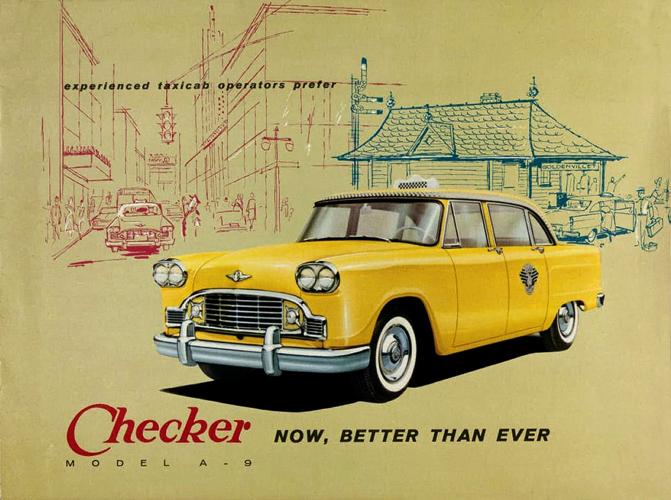
Instead, the very conventional new A2 of 1947 had traditional styling, and with minor retouches, became the iconic cab of the post war era.

Like the legendary later Aerobus, Checker was building extended wheelbase vehicles in the forties, like this six door, twelve passenger wagon. These were the shuttle buses of their day.

The Checker Coach is an often-forgotten chapter in the Checker history. CC’s Bus-master Jim Brophy did the full story on them here.

In 1955, an all new Checker was developed in the advanced styling studios (a corner of the factory partitioned off with drapes). The new A8 was designed to meet Manhattan’s new taxi regulations, and featured independent suspension on the front for the first time. Not that it made the Checker famous for its ride, however. The suspension engineering department lived in the janitor’s closet.

Interior space was always the highlight of the Checkers, and the Marathon’s tall roof, totally flat floor and two folding jump seats meant that up to five patrons could be accommodated in the rear compartment alone. Guess who got the jump seats? The pretty young lady. Beats sitting in the guys’ laps, anyway.

Here’s one of Checker’s many chassis engineers, pointing out the finer details of Checker’s legendary X-reinforced frame, the source of its ruggedness and flat floor.

The six and eight-door Aerobuses were the stuff of legends in their day. Unlike today’s stretch limos with their cut and welded frame extensions, these long boys sat on a completely unique and specially designed frame, and enjoyed a high degree of structural integrity.

Not surprisingly, the rugged Checker frame lent itself well to custom coachbuilding, like this Swiss ambulance. It was the Checker’s taxi cab image that probably kept it from more success in the US as a limo and hearse source. If folks couldn’t afford a Cadillac while they were still alive, they at least wanted to ride to their graves in one.

It should be pointed out that Checker production wasn’t all directed to taxis after about 1960 or so; possibly sooner. The Superba and Marathon sedans and wagons were marketed to owners who wanted no part of Detroit’s annual styling changes as well as its taxi-cab ruggedness.

Checker also made an extended body sedan, and pushed it as a limo alternative, including versions with padded roofs and even an opera window. But time was moving on, and the garish seventies made the Checkers look like stale bread.

Ghia made a one-off on a Checker chassis, the 1968 Centurion. I’m not quite sure whether that was at Checker’s instigation, but more than likely so. Who else? It had a very un-taxi like Italian leather and wood interior along with the requisite Nardi wood wheel.

In any case, it’s a handsome idea of what a modern Checker could have looked like. It has similarities with a number of contemporary cars; everything from a Toyota Crown to an Opel Kapitan.

Checker Motors operated most profitably with an annual production of 6-8k cars, but after 1970 that became increasingly difficult, due to major markets like NYC loosening their taxi regulations to allow conventional sedans to operate. They were obviously cheaper for the Big Three to build, and the fleet dumping practices of the seventies was Checker’s coffin nail as a producer of cars.

Checker had no real plans or ambitions for a post-Marathon future. Scion David Markin was more interested in playing tennis than Checkers.

The only significant changes made were those required by government regulations, such as the new bumpers beginning in 1974. Checkers were particularly impressive, but then it suited their environment. They should have had them all along.

In march of 1977, former GM President Ed Cole bought 50% of Checker for $6 million and began plans to build a completely new car for a new era. His concept was to build the new taxi, called Galva I, essentially a lengthened VW Rabbit. His untimely death some 90 days later death at the controls of his personal airplane was tragic. But work continued based on the VW prototype, although further testing found it to be unsatisfactory, with structural weaknesses.
There is no known image available of the Checker Rabbit; this one above is a similar concept built by the Wayne bus company. It too did not move past the prototype stage.

In 1981, four years later, Checker founder’s son David Markin revived a similar concept, this time based on GM’s new X Car Citation platform. Like the VW, it was initially a stretched Citation, as seen above. But once again, for various reasons that was not deemed a viable solution, undoubtedly because they would have been dependent on the Citation’s on-going production. As it is, the Citation’s lifespan was pretty short.

So a completely new body was conceived and styled, called the Galva II. The wooden body buck is seen above. To bring this idea into full development and production would have cost many millions, and Markin soon pulled the plug, at least in part due to the nasty recession of 1981, which would also be the beginning of the end of Checker’s marathon. A more detailed account of the FWD Galvas (although not without a few minor errors) can be found here.

In 1981, during the recession, Checker had its only posted loss after some sixty years, having survived the Depression profitably, if on a smaller scale. In a contentious affair, Checker decided to end production rather than give in to union demands. The last Marathon rolled off the production line on July 12, 1982.

But Checker continued to build parts for other manufacturers until 2009, when the downturn finally swamped them too. The little factory that hummed away for almost ninety years has been razed, leaving just the footings to mark where one of the more unusual automotive stories played out. Now it’s a pilgrimage site for lovers of the brand.
Related:
CC Checker Marathon: The Brooklyn Bruiser W. Stopford
CC 1967 Checker Marathon Wagon: Still being Driven by Its Original Owners PN
The Checker Motor Coach: The Frequently Forgotten Bus by Checker Jim Brophy
My Checkered Career With Checker Cabs: Kevin Martin























Back in the 60’s and 70’s, a summertime neighbor of ours drove a dark green Marathon wagon for years – actually, two of them. When they traded the first one, they ordered the second one color-matched to the first so no one would know they had a new car.
The local mechanic told me it had a Chevy 292 six, mated to a Ford Cruise-O-Matic, driving a Chrysler rear, and mounted on International pickup suspension parts. I never saw any of that myself, just remember being told.
Great people. Kept the second Marathon well into the 80’s and replaced it with a bright red Subaru DL wagon.
Interesting history… There is a elderly neighbor close to me that still drives a civillan Checker on a daily basis. This Checker has 6 inch wide rust holes on the top of its rear fenders but is still getting the job done.
Being the thrifty (cheap) person that I am, had I been shopping new cars in the sixties I believe I would have given Checker a hard look.
If you want a Checker of today, maybe you should look at the VPG MV-1
http://en.wikipedia.org/wiki/MV-1
American Designed/Owned/Made, Body on Frame. RWD. Tried and True drivetrain. Whats not to love!
That thing looks like something out of The Fifth Element!
Actually it looks like a giant Honda Element.
Unions should always be careful with owners who don’t give a f*** about the business. If the business isn’t vital for the owners, the owners would rather just fold than cave in. Push to hard and it isn’t worth the owners aggravation.
Here in Canuckistan, anyway, union bosses keep getting paid when the members are on strike or lose the job. Hardly an incentive to negoiate.
Was Checker paying their workers a decent wage? Did they get benefits?
Getting really tired of reading the anti-union B.S on car blogs.
Yes they were, having been represented by the United Steel Workers (not UAW, from what I’ve read).
Here’s an account from a commenter from an earlier version of this piece, someone who was familiar with the situation:
I was closely associated with Checker Sales and Service (1010 Stayton St., Ft. Worth TX) serving the 5 state area from 79 thru 83 and I would like to note a few omissions that you may have glossed over from everything I knew from our end of things at the time.
It was said (and I have never heard it disputed) that the reason Checker ceased production was that at the time the UAW was having to take cuts from all the major automakers and when it came time to negotiate the contract with Checker they demanded an increase. Mr. Markum said something on the order of; I know you have had to take cuts from everyone else, we will not demand any cuts and will hold the same but we can’t give you an increase. The UAW said that they get an increase or they will strike. Markum said strike and we’ll close. And on the eve of the strike in the summer of `82 Checker closed. We could no longer get any cars and what cars we had in stock were sold off in less than a week! I also remember that the only way you could tell a `82 Checker (last year) from a `74-`81 (the last change was in `74) was it had 2 tag lights instead of one.
This seems to be consistent with other accounts I’ve read. I am neither pro nor anti-union in a general way, given the many issues on both sides. But let’s just say that there have been many mistakes made on both sides over the decades. It appears that the union may have been a bit too aggressive in this situation. That won’t be the first time that’s happened.
If you can come up with credible information to rebut this account, I’d be glad to hear it. But in general, we avoid political issues like unions, except to the extent that it’s a significant historical aspect to the story.
Your comment saying this account is B.S. is in itself inflammatory; you’re making an allegation without any facts to back it up. I’m very close to taking your comment down; it’s not in the spirit of how we do things here. Consider this a warning.
The fenders of the 30s make sense; no corners = no corner damage.
as you might know I grew up riding in Checkers. We always liked it when the cab that showed up was a Checker, and were always less than excited when it was a humdrum ol’ Caprice or Chrysler.
It was a great tragedy that Checker got out of the taxi business. We are in New York this week. Most of the cabs are now Ford Escapes. What a disaster.
The rear door of the Escape is small, and high off the ground. It is not easy for somebody with a bad back to get into or out of.
I have taken to calling them No-Escapes.
I understand that New York has now contracted for a new Taxi by Nissan, based on NV200 cargo van platform, that has not been sold in the US. I am sure it will be a great improvement over the No-Escape. It even has its own web page:
http://taxioftomorrow.com/web/index.php
Outstanding article. I’ve only rode in Checker once or twice near the end of their reign, but that back seat room is really something, as you could park a small motorcycle in there with room to spare!
I always thought they looked like kit-bashed 1956 Chevys with a ton of parts from other cars!
I had been hoping you’d give Checkers a writeup. Nice job. I just wiki’d them last year, my ever-wandering mind having stumbled onto the topic.
This is the first time I had seen a picture of the proposed FWD Checker, there was a mini-van like version designed too with sliding doors, at least thats what I read. Most people dont know that Checker survived past 1982, it also interesting to note that the Checker factory starred in the 1978 movie “Blue Collar” with Richard Pryor, Harvey Keitel and Yaphett Kotto. Its a semi depressing/funny manufacturing movie about hardened auto plant workers.
The plant and office personnel were invited to the premiere of “Blue Collar”, and I was the chief expediter in the purchasing department at the time. The movie was quite a sensation to see – at the time – as it had many 4-letter words in it that were usually not in motion pictures around that time. If they were,l the film was given an “R” rating!! The copy I have is not “R” rated, and it does have every word intact – just like the premiere showing. It was held at Kalamazoo’s historic State Theater just past the Kalamazoo Mall in the downtown section of the city. Ronald T. Griffin
Does anyone out there also remember Mission:Impossible (the television show). Anytime they were doing something in a Eastern Bloc country, they always used Checkers as the government functionary fleet vehicles. Guess it was easier than coming up with a fleet of ZILs.
Yeah, I remember that.
The A8 is my favorite checker, but I’d get a Marathon if I could find one.
Also, “gas” was always spelled “gaz”. My friend and I got a kick out of that and still refer to gas as gaz to this day!
I think this is what prewar buicks, chryslers et al, would have come to had they resisted change. This was a functioning anachronism that I think I would have enjoyed owning. No big rust holes down here. Just cars that had the tar beaten out of them.
It might live to be 100.
I hadn’t read the Checker entry on Coachbuilt.com. Lord knows that my previous client paid for a ton of research that I had done on this site. Too bad it had nothing to do with my job description.
Coachbuilt.com is probably one of the most mindblowing sites on the web. Along with OldCarBrochures, these two sites are better than sex. Well, maybe not certain types of sex. In Woody Allen’s words–“sex is dirty, if done right”, or something to that effect. (How did I go from Checker Cabs to dirty sex? Must be the Benedictine in me)
I did not know about the linkage to Great Dane Semi Trailer Manufacturing operations.
A perfect place for a picture I shot through my rear view mirror last spring. Bloomington, Indiana has some Scion Xb taxis. Reading an article about Checkers by PN made me think of this one, for some reason.
If the xB had a trunk instead of a hatchback, I think it would look a lot like a mini Checker.
I’ve always thought the gen1 Xb would make the ultimate taxi: cheap, huge back seat, economical, reliable. Only shortcoming is the luggage space is a bit small. Roof rack?
There are several Xb taxis here, both generations.
Second gen XB fuel economy isn’t great and in Japan they were entitled to a cvt and a 1.8 instead of the 2.4L , 4 speed .Wonder how reliable these first gen toyota cvts are?
We’re talking about the US, not Japan. They already have their “Checkers”:
https://www.curbsideclassic.com/curbside-classics-asian/cc-global-1995-toyota-crown-comfort-japans-crown-victoria/
The Bloomington, IN taxi company was all Checkers til the cars dried up
Someone has two Checkers a few blocks away from me. They seem to have been sitting for awhile, but one of them is for sale. I keep meaning to go ask about it, but surely they want too much for it.
Interesting story. I would expect the fwd prototype suffered from poor steering lock. The photos of the Ghia taxi look like they could be the most flattering angles, I’m sure the front three-quarter view with that large C pillar, slab sides and tall greenhouse would not be pretty.
I have a vague idea I may have seen a Checker, but I’m not sure and they were never brought here. On the other hand I did see a London taxi the other week being used as a private car.
The idea of a special taxi vehicle is an interesting one – it has to cost more than a normal vehicle, but if there is nothing suitable… There were a very few MCW Metrocabs (a very boxy London taxi replacement) brought out around 1990 to have local drivelines (GM 3800) fitted, but they never really worked possibly due to lack of proper engineering development.
Know what? I wouldn’t mind that ‘bizzarre’ 1939 model. Certainly you’d never mistake it for anything else at the car show! A Checker of some sort is on my ‘I WILL own one someday’ list.
Great story on Checker Motors…I grew up in Kalamazoo and am quite familiar with the Checker story (even worked there one summer before the plant shut down), and the movie “Blue Collar” that Carmine pointed out. Also played in the Junior Development tennis program of which David Markin was a generous sponsor – he even lent the program an Aerobus for transporting our tennis team about to various events in the Midwest – good times! Great photos too in this article – nice job Paul!
I worked in the Purchasing Department from 1966-1982, when I was transferred down to the Production Department. Our department was responsible for the scheduling of the factory, as far as the different types of stampings and parts went. We were given schedules from the Detroit carmakers as to how many parts were needed, and where to ship them, and I was responsible for re-issuing a production schedule for the plant to use.
I just joined the Checker Car Club of America, Inc. and received 2 issues of ‘The Checkerboard’ magazine – it really is a fascinating ‘story’ – I even worked on the assembly line during the strike, being one of two employees who together operated the press that stamped-out those one-piece bumpers. My boss at the time told me about the film made at GM’s Milford Testing grounds, when that bumper passed the mandatory 35mph bumper crash test!!
The Checker really was a built-to-last vehicle, and during the 6-day war Israel had with the Arabs I joking told my boss the war could have been over quicker, if we had shipped some Checkers over there to use as tanks, putting gun-mounts on the roof!! I don’t know if he ever told David or not – my old boss passed away some time ago, after I had moved to Florida where I still live.
I could tell you stories about that place that are great!!!!!!
Ronald T. Griffin
Ronald, I’d love to hear you stories! I come from a Checker family, my dad bought several ex-taxi’s when I was very young and later on (IIRC early 1968) bought into a Checker dealership in the Cleveland suburb of Lakewood. On several occasions as a young lad I accompanied my dad on road trips to Kalamazoo to pick up new Checkers, one in particular I remember was a dark blue Perkins diesel powered ’69 Marathon. He also ordered a new ’69 Marathon for our family car, it was tan with a dark brown interior with pretty much every option that was available back the, including a ripsnorting (well, at least to 6 year old me LOL) 350 with a 4 barrel. That car could pass everything but a gas station! Alas, that car was jinxed, it seemed to have a target painted on it. Her very first accident was in a McDonald’s parking lot when a brand new ’69 Cutlass backed out of a parking space and right into the right fender below the headlight. Turned out it was a demo driven by the wife of the owner of a nearby Oldsmobile dealer!
Great stuff. That ’39 Model A is just crazy! I never knew these existed.
The only other country I can think of where there were specially-designed taxis is the UK. The big difference is that they’re still making the famous London Black Cabs, of course. By the way, Austin’s FX4 (the quintessential London cab) had competitors back in the day — ever seen a Beardmore or a Winchester? Neither have I, but they did exist…
http://www.aronline.co.uk/blogs/other-cars/austin-fx4fl2-rival-cabs/
I remember reading about the Beardmore, and seeing pics of it, but not the Winchester.
Thank you for the article Paul. The Perkins diesel engined one was most likely an Israeli spec seen before shipping. Checkers were reasonably popular over there in the so-called Service Taxi sector. A Service Taxi was always an 8 seater with jump seats at the back; it was often used on an inter-city service – you could take one as an alternative to the coaches or the trains. In the 50s this segment was dominated by Chrysler products – Desotos mostly and later Dodge Coronados – but Checkers took their place when Chrysler lost interest. Main competition came from Mercedes-Benz with its stretched mid-size sedans, but there were also some Fiat 2300s with stretched bodywork. All of these cabs had diesel engines to save on fuel costs and the US-made ones always used the Perkins “Mirage”, probably with no more than 80hp which provided them with lethargic performance (not that it mattered with the kind of roads and speed limits we had back then). This all changed when Checker in its wisdom chose to offer the GM V8 diesel (yes, that one) in Israel with catastrophic results – I think the engines were so unreliable there was even a court decision ordering Checker and Oldsmobile to re-purchase the vehicles they sold with these things. I have no idea how this affected Checker’s fortunes on that last year but it could not have helped… Not many survived but here is one, painted as an NY cab (most Israeli Checkers were black) and fitted with non-original high roof (pic by Talya Lavi).
Here’s a pic of the three modes of public transport, sometime during the late 50s early 60s. This is Haifa central railway station, traffic is facing Tel Aviv and the cabs are clearly Chrysler products.
PS: I forgot to mention Peugeot with their 403 and 404 station wagons with a forward-facing third row seat, those were also well represented back then…
Regarding the Ghia Centurian, It is well documented that the Ghia was not commissioned by Checker. With respect to Ed Cole, after Mr. Cole’s passing, David Markin continued development of the VW based Checker along with Victor Potamkin partnered with Jim McLernon, President of Volkswagen of America. The project was killed in late 1977 after the test mule failed all testing in the Chicago loop. Mr. Cole had nothing to do with the Galva Two project which was killed in 1982 when Checker stopped automobile production. Checker first explored FWD in 1947 with the Model D project executed by former Cord 810 engineer Herbert Snow and designer Raymond Dietrich
Oh, and the VW project was never called Galva. The original Galva project was a short lived exercise. Checker was partnered with US Steel. The project never moved passed clay models. And yet again Ed Cole had nothing to do with the original Galva projects. The only thing Ed Cole accomplished in his 90 days tenured was a general plant clean up focus primarily on the windows of the building. Additionally Cole paid 6M for the Checker’s Taxicab fleet business, not the manufacturing arm. Dolly Cole would continue to lead that business thru 1982, when it was sold back to Checker. The Citation project was conducted with cooperation with Fisher Body.
Fascinating article. Although I’ve never owned or driven a Checker, I have seen pictures of them. I like its shape. I would prefer it any day over the Toyota Prius.
Growing up and living here in Battle Creek, Michigan the sight of Auto haulers heading
with a load of Checkers toward the East Coast was a normal sight. In the earlier years
it was along old US 12 and then later on I-94. In my recollection some where painted and marked as “Yellow Cabs”. On one occasion I was watching the loading operation next to the plant in Kalamazoo but failed to get any photos.
In a personal opinion, the bumpers used after 1982 were much more austere but surely
gave the vehicles the rugged quality needed in the heavy traffic environment.
An interesting feature of the Chrysler product cab variation was the wider rear door that accommodated the extended wheelbase. Although I have not seen it mentioned here
during the war years and after the Parmalee was a business competitor in large cities.
I would like to see new concept checker front wheel drive about 1982.
Does that prototype not look like a giant Aries wagon to anyone else? The pointed nose with inset lamps is actually more Mirada than Aries, but the rest of the car looks like a “big K” with quite the massive D-pillar.
In 1961 to 1974, I owned 3 Checkers: a new 1961 Superba I bought in Boston and picked up in Kalamazoo and lasted 400 K until about 1969. The second one, a new 1965 Marathon I bought by phone from Vermont to Boston, was delivered by the salesman and his young son and they took Vermont transit bus back top Boston from Middlebury. The third one was a used 1967 Marathon fixed up with an extra radiator as it had been driven to Alaska and back. The kids loved them until they got older and their friends commented about the “strange” cars they rode in. Also the jump seats are not good for long trips and 6 kids fit better in station wagons. Service was great despite the distance of 40 miles. Mr. Muster was the service manager at Checker Boston in Brookline. The same was true for my repair friend in Worcester, the Abrasamas. In NJ the nearest was on the Mainline , 30 miles away, and too far.
Today I own 3 Checkers; 1968, 1972, and 1978, two of which could run, but last tried 4 years ago.Great Memories of Checkers !!!
The Checker owner’s club annual meet comes to the Gilmore Museum next Saturday, July 15th.
In preparation, the Gilmore has moved it’s Checkers into it’s main entrance hall, along with their other Kalamazoo produced brands: Roamer, Barley, Hadley-Knight, Dort and Michigan.
Great article. However, the picture of the VW Rabbit taxi poses some questions. This site says the stretched Rabbit prototype was actually built by Wayne Corp., a longtime builder of bus bodies.
http://www.icta.club/smaller-than-checker-proposalwaynes-vw/
Thanks for clarifying that. Someone left that picture here in a comment, and it was not attributed. I’d forgotten about the Wayne Rabbit taxi.
My parents bought a new Checker Marathon in 1968 to augment our aging 1959 Zephyr. Base six cylinder and manual everything, with only options being a limited slip differential , jump seats and overdrive. I’m amazed that my 5 foot 110 pound mom was able to drive it. But she did. We got 30 mpg highway and 20 mpg city. In the 1980’s it was my daily driver. I got quite an upper body workout parking that thing on the crowded streets of West Philadelphia. We used my Checker and the drummer’s Country Squire to haul a 5 piece rock band complete with PA to gigs. The trap case and my bass rig (Music Man HD 130 with 1×18 speaker cab) fit on the rear floor leaving the seat for passengers or guitars.
By 1986 it was starting to rust, so I sold it. I have many wonderful memories of long highway trips and cruising around town with 7 or 8 teens in the car.
The CC effect- seen at our local Winco Foods yesterday afternoon.
I think it’s actually quite nice looking in that colour and from that particular angle. Too bad they didn’t try harder to integrate the bumpers into the overall design. maybe with body-coloured caps or something.
I like the slab-sided chunky look.
About the same color as one that used to roam the streets in my hometown.
I believe it was a “69” model.
Did not have the the wide “whitewalls”, like this one though.
1. The Model D FWD, designed by Herb Snow was a success, the Model D was killed due to costs. The Checker suspension was not designed in a closet, it based on the 1955 Ford. Galvan was not based on the VW Rabbit. The Citation project was not Galva I, it’s the Fisher Body project. Galva II was developed by Autodynamics for CMC. Checker has no involvement with Gaia. Markin was active and passionate about Checker, he was not distracted by Tennis. The Hemings article has one error regarding the Fisher Body prototype, far fewer errors than in this blog
The exhibit at the Gilmore I posted one pic from last year was expanded and later moved to the carriage house when the Hudsons from the Hostetler collection were recalled.
A few more pix from the “Cars Of Kalamazoo” exhibit.
A few postwar examples
The Checker used in the “Taxi” TV series. This is the cab used in the opening sequence where the cab is crossing a bridge. After the series was cancelled, the cab was returned to Checker, where it was used around the plant
Checker, like some other automakers, benefited from other failed automakers. The Pitcher St plant had been built by Hadley in 1920. Hadley failed after 2 1/2 years and Markin bought the nearly new plant out of Hadley’s liquidation in 1923.
The car in the center of this pic is a 1922 Hadley-Knight.
Last year, the Gilmore hosted the Checker Owner’s Club annual meet.
1931 Model M
This car will never get finished. Should be sold to someone with the skills and capabilities to actually restore the rare car. The owner is one of those “I am gonna restore it someday” kind of guys
Checkers wore all the 70s brougham styling cues.
I got a ride in one of these wagons one evening in the 60s, from the Kalamazoo airport to the Battle Creek airport.
Actually looks pretty comfortable back there, tho the upholstery is pretty restrained for the 70s.
All in all, a pretty good turnout, considering these cars were built to run half a million miles and be thrown away like any other worn out tool.
Great photos Steve – I would encourage you to turn them into a post about the show & museum!
The National Automotive & Truck Museum next to the Auburn-Cord-Deusenberg Museum in Auburn IL has a good range of Checkers on display too.
Very informative story, Paul. I dream of owning a civilian Marathon wagon, someday. When we resided in Maine, I stumbled onto one of the eight-door wagons that had once been used to carry folks to the top of Mount Washington, over in New Hampshire – this was in the very late nineties – it was sitting behind an indie foreign auto parts store in Auburn – and the thing was still in pretty good shape. Some years later on, it had disappeared – I hope that someone had the foresight to preserve it.
For good measure, one more Israeli intercity Checker on the road to Jerusalem, sometime in the late 60s early 70s (pic: the Israel Sun). Seen in the background an almost finished section of the new Highway No. 1 which replaced the old, torturous two lane road at that time.
Great article, my understanding is that the movie, ” Blue Collar” ( 1980-81?) was filmed at the Checker plant. An edgy movie if there ever was one. The factory sequences and particularly the opening title and credits are amazing….it always made the factory look positively medieval. If you have not seen the movie…please do.
http://www.checkermotorcars.com
There is still some life left in the Checker marathon idea, this new owner ia trying to produce limited run pickups ala el camino, and 6 door limos of old parts stash.
One of my neighbors bought a new Checker wagon in 1961 that replaced his 1957 Plymouth wagon. I still remember the beautiful but tired 1949 Buick Sedanette that he owned when he first moved in. The Checker wasn’t pretty – practical though. My neighbor ran a Kosher butcher shop in town and would sometimes use his Checker to make small deliveries. He said that he could easily hose down the interior with no damage. Remember riding in it several times as well. His children and I were friends. Somehow, it was that Buick that stuck in my mind. It was black like the Checker. The Plymouth was green.
On TV and in movies, Checkers appeared as taxicabs, long after 1982. Example was in “friends” Phoebe would use her grandmother’s Checker cab, and once loaned it to Ross. Even though in real life, NYC rules wouldn’t have allowed them after they were a few years old.
During a vacation trip to NYC in summer ’83, hardly saw any Checkers. Most were evenly divided between Detroit 3. M body, LTD Crown Vic and Impala.
Dad bought a brand new Marathon in 1965. He and his business partner at the time drove to Kalamazoo so he could pick it up.
It was chroma black with a silver interior/grey carpeting. He ordered his with the 230 ci Chevy six/3 speed manual with overdrive. And jump seats. Later, he had an underdash a/c unit added.
By 1972, it became my car to drive to HS. I hated it at the time.
My stepmom kept it until 1990. i’m sure it had well over 200,000 miles on it at that time.
The NYC taxi rules were changed to allow standard size cabs, and room in the rear for only 3 passengers in 1954, the last year DeSoto offered an 8-passenger sedan. From the mid thirties until then, DeSoto and Checker were the only players in the NYC market, except for a brief Packard interlude.
But Checkers remained reasonably popular in NYC until the 70’s, both with drivers and passengers, even given spotty build quality.
I used to use a black car driver in the 90’s who previously drove Checker cabs. He told me one day he was climbing the ramp to the Queensboro Bridge, inbound with some tourists from LaGuardia, when the rear driver side door fell off.
Also, cab companies whose service area featured highway driving often added tie-downs to the front hood – they had a tendency to fly open at speed.
The 1978 film “Blue Collar” was filmed at the Checker Motors plant, where Yaphet Koto literally gets painted to death.
My family owned a taxi company when Checkers were still being built. We looked at buying a couple but they were very expensive. At the time I was scooping up really nice GM B bodies for absurdly low prices. In 1984, for example, I got a 1978 Impala with only 60,000 km on it for a whole $1000. It wouldn’t last as long as a Checker but when it wore out after 3-4 years, I’d just go get another B body to replace it. Eventually the supply dried up but we were out of the taxi business by 1998 so it didn’t matter. Nowadays I’d be looking for used, low km Priuses to use as a cab.
I can see such minutiae at times, and at others be so oblivious. I remember road tests for Checkers so I thought they were consumer market cars. Oh, I knew they were used as cabs, but I didn’t catch that was really what they were built for. This writeup reads well, suggesting they did as intended as taxis. A domestic version of the famed London taxi? Maybe, but that was a high bar and I’m not sure they met it. Still, built for a purpose and I guess willing to sell to the mass market, even if it wasn’t really their target.
But jeez, and I’m kind of contradicting myself above, did they have to be so ugly?
Too bad there is no underhood photo of the prototype with a transverse inline six to see the tight packaging …for the time
What a great, informative article with pictures .
Then the comments adding details .
In the 1970’s a running mate of mine drove for a fly by night cab company in Alhambra, Ca. ~ he’d beat those poor old Checkers mercilessly , the front of the frame had angled welded in ramps so it could hit a curb going 40 and skim right up and over it, amazing .
-Nate