

Thanks to this site’s large and eclectic crew of knowledgeable writers, it can sometimes be quite difficult to develop topics for articles. I’m not entirely sure how different CC’ers engage in idea management – I hope that will be addressed in the Comments – but generally what works for me is that I sit around and wait until something for some reason or another pops into my mind. Then, if that sticks around long enough (it often doesn’t) I come here to the site and use the search function to see who’s written about that thing at some point in the past. At least half the time, someone has already addressed my idea and so that will be the end of that. But every once in a while I hit a little patch of pay dirt.
Welcome to my pay dirt. The history of windshield “squirty things” and the story of how Trico, a Buffalo, NY-based company, came to dominate the development of this standard automotive accessory.
Before the human readers among you dismiss this as mere drivel – sometimes my perennial lack of concern with getting to the point causes the robot readers to quickly leave the virtual building (oh dear) – please note that we’re about to discuss something that not only has significant impact upon your ability to safely drive, but that also if you believe what you see on the Internet, is quite perplexing to some drivers.

It’s Not Quite Rocket Science – But We’ll Get There Eventually
Regular readers are familiar with Stephen Pellegrino‘s posts about be-finned space age wonders from the 1950s and 1960s.
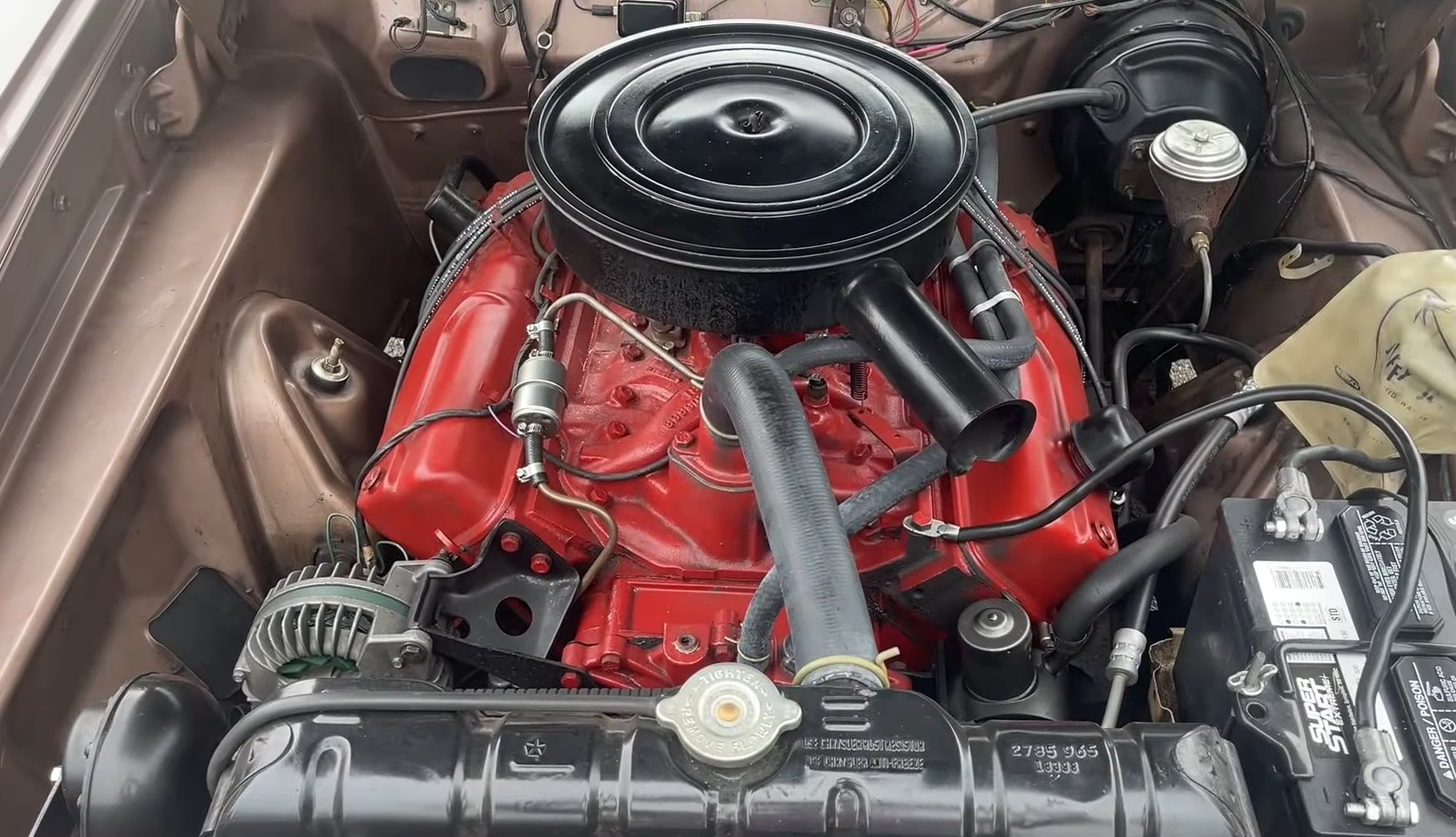
A recent post of Stephen’s about a 1962 Plymouth featured this under-hood photo. While Stephen provided this illustration for the de rigueur mention of the Plymouth’s engine (318 V8) and rated power (230HP), those details really mean relatively little to me, personally. No offense, but we all have our own fascinations and I will buck the trend and say that I have never been particularly interested in things like horsepower or cubic inches. It’s other things that capture my automotive attention.
That floppy tan thing on the left inner fender? Now you’re talking….

Here it is in its virgin incarnation, likely better than it looked on day one at the Lynch Road Assembly plant.

Many of those Plymouths were blasting off into their future with a Jiffy Jet bag under the hood.

Grab Your Hat and Get On to the History
It won’t come as a great surprise to most who keep up on their CC reading that the earliest automobiles did not have windshield wipers, much less windshield washers. We’ve had several deep dives into GM’s wiper systems and even a history of rear window wiper systems. I will say though that these histories tend to focus on more modern wiper systems that depend (often, but not always) on an electric motor to move various arrangements of mechanically-linked rubber squeegees across the windscreen.
So, it may fill in the picture a bit to note that a variety of inventors proposed and patented different devices that did not use squeegees or electric motors to clear early automobile windscreens. Notable among these early inventions were those by Mary Anderson in 1903 as later improved upon by Charlotte Bridgwood in 1917. Yes, both of the earliest credited inventors of windshield wiper mechanisms were women. Unfortunately, neither Anderson or Bridgwood managed to realize any financial success with their devices or the other automotive accessories they invented.

Anderson – whose invention performs much as a modern wiper system only “powered” by hand versus an electric or vacuum motor – seems to have eventually moved on from the world of inventing and wound up living a long life (she died in 1953) back home in Alabama…doing something else. Who knows what, but it was probably for the most part what white ladies did in Alabama in the first half of the 20th century.
It should also be noted that Mary’s invention was specifically intended to be used in “electric motor cars”, by which Mary meant electric street cars. While there’s actually no reason why the same device wouldn’t work in an automobile, it’s likely that in 1903 Mary simply didn’t have easy access to any auto manufacturer to whom she could attempt to sell her invention. This would be less of a problem for the next early windshield wiper developer.

Charlotte Bridgwood actually lived a somewhat more exciting life (something that might not be guessed from looking at her and Anderson’s respective photos). More important to our history, Bridgwood turns out to have lived in Ontario (Canada) and in the New York City area (Bergen County, NJ specifically). Bridgwood was a resident of a part of the country – New York City and the Great Lakes region (Buffalo, Rochester) upstate – that was in the late 19th and early 20th century equivalent to California’s Silicon Valley in the late 20th and early 21st century. There was practically no better place to be if you were an inventor, particularly of devices that might possibly use that new-fangled electricity thing.
It also turns out that New York was a hub for the nation’s entertainment business. Vaudeville was based in New York City and so when motion pictures were developed, it naturally meant that that emerging industry would also be situated nearby (Edison’s lab was in West Orange, New Jersey and other early motion picture “studios” were scattered around greater NYC and northern New York state). Bridgwood was someone who in a way stood at the intersection of the early 20th century entertainment and technology industries. She wound up in New York due to the entertainment industry, but stayed around for a whack at the developing technology sector.
Charlotte was a vaudeville actor known professionally as “Lotta Lawrence” and apparently had a whole career as an actor before starting to patent windshield wiping systems. There’s not much written about her vaudeville career – most writing about Bridgwood focuses on her windshield wiper invention – and otherwise she seems eclipsed by her daughter, Florence Lawrence.

Florence, also known as “The Biograph Girl“, and sometimes as “the first movie star”, was an early employee of the American Mutoscope and Biograph Company (which I covered in another CC article about upstate New York) working with the director D. W. Griffith. In addition to her work with Biograph, she was featured in early films from Vitagraph (Edison’s production company) and later IMP (International Motion Picture Company). These were the days where actors were generally not credited in productions and thus most viewers of these early films know Florence as either the Biograph Girl or the Vitagraph Girl or the IMP Girl. IMDB lists 299 credits for Florence, most between 1906 and 1918.
Fortunately for us automotive fans, The Biograph Girl eventually found her way back to working with her mother, who had by that time started a company, Bridgwood Manufacturing, to attempt (rather unsuccessfully) to develop automotive accessories. While working at Charlotte/Lotta’s company, Florence is credited with inventing a type of turn signal as well as a stop indicator. Neither of these devices used light. Florence’s turn signal was a type of semaphore (like on old VWs) and the stop indicator she created was a literal stop sign that would pop up from the rear of the car when the driver stepped on the brake pedal. This shouldn’t obscure the fact that both of Charlotte/Lotta’s (remember, she’s Florence’s mom) wiper patents reference that the devices were intended to be driven by electric motors. She actually patented two version of the device in 1918 (the “Wind Shield Cleaner” in January and the “Cleaning Device” in August). The Cleaning Device patent clearly states:
It is understood that the source of electrical energy for the electric motor is derived from the storage battery now generally used on automobiles and similar vehicles, but I do not limit myself to such a source of electrical energy as in many applications of the cleaning device other sources of power will have to be used.
Both of Bridgwood’s devices differed from modern wipers in that they did not move in an arc but rather parallel to the sides of the windshield frame with gearing at the top of the windshield to move the wiper arms. Also, the wipers themselves were rollers and not rubber squeegees. No, actually rubber squeegees that moved in an arc was Mary Anderson‘s invention; only without electricity. The fact that all of these inventions – mother’s, daughter’s, and Alabama Mary Anderson’s – performed functions that are eventually associated with different, improved, versions of related technology just illustrates the iterative nature of so many of the devices that we currently take for granted. It takes a lot of tries, some luck, and being in the right place at the right time to get something to stick.
Which brings us back to Buffalo.
Shuffling Off to Buffalo
Charlotte Bridgwood’s “Cleaning Device” may seem odd to us today with its side-to-side action, but in fact it was much closer to what was offered initially when wipers were first used on production cars. The first car to include wipers as a factory-installed option was the 1919 Pierce-Arrow.

Although I’ve yet to find pictures of a Pierce-Arrow with one of these systems installed, it likely looked like a lot like the “Rain Rubber” in the above ad…for those Pierce-Arrows with a two-piece windshield, and not all had that sort of windshield.
The Rain Rubber was a joint endeavor between Buffalo, NY inventor John Jepson and theater impresario/attorney/industrialist John Oishei (also of Buffalo). Jepson (for whom there is very little known, the best I can tell from searching his patent records is that he may have been a Canadian electrical engineer, relocated to Buffalo and generally employed designing component devices such as mechanical voltage regulators) had patented his “Wind-shield Cleaner” in May of 1916. His patent application did not reference Mary Anderson’s from 13 years previous. Nevertheless, nothing seemed to come of Jepson’s invention for another year until Oishei – after a 1917 close call nearly running down a cyclist that he couldn’t see through a rain-covered windshield – improved Jepson’s design for a rain/windscreen wiper that could be manually operated to slide across hinged windscreens. Oishei partnered with Jepson to found the “Tri-Continental Corporation” – aka, Trico – later in 1917 to market what was essentially Jepson’s invention now called the “Rain Rubber”.
Oishei bought out Jepson in 1919 and began to search for auto-makers who would license/use his device as OEM equipment. Not surprising, one of the first manufacturers to adopt Trico’s product would be Buffalo’s Pierce-Arrow.

Pierce-Arrow wouldn’t hold the exclusive claim to factory-installed wipers for long, as by 1922 they were standard on Cadillacs and either standard or at least optional on Packards and Lincolns. Given that one piece windscreens were increasingly common at that point, wipers in the style of the Trico “Crescent Cleaner” became more the norm. Trico’s early products effectively incorporated the technology that both Lotta Lawrence (side to side wipers) and Mary Anderson (crescent wipers) had developed; although it once again bears mentioning that neither Anderson or Bridgwood received credit for these inventions until two dudes (Jepson and Oishei) eclipsed them. Jepson by largely reinventing the wiper (which Anderson and Bridgwood had already invented) and Oishei through his mad skills around acquiring inventions and marketing them.

Suffice to say that once Trico’s technology (trademarked in the 1920s as the “Visionall”) took off, Trico became a huge player in automotive accessories. Trico ultimately became the largest employer in Buffalo during the 1920s and for a while its headquarters building was the largest building in Buffalo. Much of that building has been demolished today, but those parts still standing (it’s been redeveloped as housing) are still pretty impressive.

Even Santa Claus got into the business — notwithstanding the fact that the Jolly Old Elf had to ride with that lady who seems to have clearly known what had happened to Mary and Lotta and therefore was having none of this jolliness that Trico intended. Rather, she looks like she is on her way to give Mr. Oishei a solid kick in the yarbles if she ever found him.

But What About the Washers?
So much for wipers and the origins of the company that powered their adoption, as that’s not what we’re really here for, is it? We’re headed to a discussion of windshield washers, so let’s get to that.
Once the automotive accessories industry had solved the problem of wiping rain and snow off of windshields, attention turned to how to use those wipers to actually wash the windshield clear of dirt and grime. The obvious solution was to squirt some kind of liquid on the windshield in an effort to wash off whatever might be stuck to the glass.

A system doing just this was noted in Popular Mechanics in February, 1931. The innovation was intended to coat the glass with alcohol, thereby preventing freezing (remember that cars in the 1930s often did not come with heaters, much less defrosters). Unfortunately, it’s easy to conjure up what the problem would be with this arrangement. It was not necessarily the safest situation to be driving and simultaneously squeezing a rubber bulb to squirt fluid on the windshield and wipe it away with felt-on-a-stick.

To address this inconvenience, an engineer working for Trico, Erwin Horton, invented a “window clearing system” that did away with the rubber bulb and substituted a pressurized reservoir that would hold the washer fluid. According to an April, 1936 Popular Mechanics article, Horton’s invention was a “spray gun” that was “operated by hand from the dashboard”.
A closer look at Horton’s patent application shows a device that is remarkably simple, and remarkably similar to later iterations of a similar Trico-patented invention that utilized engine vacuum instead of hand operation to pump the fluid. The vacuum-operated version invention – initially patented in 1938 (also invented by Horton) – replaced the hand-operated pump with a vacuum-controlled diaphragm that was connected “to a source of pressure or suction supply, such as the intake manifold of the motor vehicle power plant.” Whereas Horton’s 1936 invention left it unclear as to how the washer system could be pressurized – it was suggested that a hand pump would work – his 1938 invention specifically used manifold vacuum. The 1938 patent application specifically notes:
It has heretofore been proposed to discharge, a clearing fluid upon the windshield with adequate pressure behind it, as by means of a pump, but manual operation was required on its liquid compelling stroke and this detracted from full control of the vehicle.
Of course, what was “heretofore” proposed was Horton’s earlier invention. Again, the 1938 invention is an example of the sort of continuous improvement that Trico, and all manufacturers, employ in the design of products.

Horton’s “Windshield Clearing System” contained most of the bits and pieces that would constitute a system sold by Trico for aftermarket and OEM installation starting in 1939. GM seemed to be the first to offer the device as a dealer-installed accessory.

The GM accessory utilized a square-ish glass jar as a reservoir. Notice how this 1939 bottle clearly indicates that the device was manufactured by Trico.


Trico’s advertising at the time indicated that their “universal model” could be installed in all GM cars.

In the 1941 Cadillac “Salesmen’s Data Book” it is said that the “Cadillac Windshield Washer is one of the most important safety accessories yet developed.” That’s quite a statement considering that in 1941, even on a Cadillac, a defroster was considered an accessory that could be installed aftermarket.
It’s “Automatic”!

Many early Trico wiper fluid reservoirs looked remarkably similar to something that your grandmother would “put up” tomatoes or green beans in. And yes, I did mean “wiper fluid” not just water. Often the owner’s manuals would say that the devices sprayed water, and maybe that was true until owners started to drive in winter and whereupon they quickly learned that water alone becomes useless in freezing temperatures. Fortunately, the efforts of a Marcellus T. Flaxman of Inglewood, CA in 1943 resulted in a patent for non-streaking “glass cleaning composition” that contained a sufficient percentage of alcohol so that it “might be desirable for cold weather uses”. It’s not clear if Flaxman came up with the idea to color the fluid blue or to use Trico’s invention to spray it on windshields on the road. Flaxman, who assigned his patent to the Union Oil Company probably envisioned the product being used as part of the service station process.

This would be a process similar to what these guys were performing in 1938 on this LaSalle. Herein may lie the reason why Trico marketed its windshield washing product as an “automatic” washer. Automatic versus relying on a gas station attendant to do it for you.

There of course should be an entirely different post about washer fluid, but since one of the things we’re dealing with here are the fluid-holding reservoir portions of windshield washer systems, it is worth mentioning that for many years GM sold its wiper fluid product – Kleer-View – in these really neat triangular bottles. These weren’t your grandma’s mason jars but rather purpose-molded glass designed to hold washer fluid concentrate that the driver was expected to dilute to its proper formulation and then fill the separate washer reservoir with. The bottles came with a special bracket to hold the glass bottle in the car.

Online, you can find quite a number of these for Corvairs (where the bottle is attached in the frunk) as well as Buicks and of course Cadillacs. I clearly recall as a six or seven year old being fascinated by this triangular bottle with its enchanting green fluid in my Grandma’s Monza Spyder. It was almost as cool as the black spiders on the hubcaps. Almost, but not quite.
One of the odd things about the Kleer-View setups in Corvairs – and I expect this is so in other contemporary GMs with the option – is that the cars came with a fairly modern molded plastic tank (and electric pump…something we haven’t even arrived at in this history!) as you can see in this 1963, but still there was the glass bottle of solution concentrate. GM kleerly wanted owners to utilize the officially-branded fluid.

Trico Got Around
While Trico’s connection to the systems used in GM vehicles from the late 1930s through the 1950s is well documented, it’s somewhat less clear s to just what other major manufacturers such as Ford and Chrysler employed. A closer look at contemporary literature and actual parts shows that Trico definitely got around to working with more than just GM.

In its 1949 Accessories book, Ford offered the See-Clear Windshield Washer. A little deeper digging though indicates that these aftermarket devices could be fit to Fords as early as 1941, so it’s possible that they were in fact offered as dealer-installed accessories pre-WW II just as had been the case with the GM/Trico devices on first Chevrolets then Cadillacs and Buicks.

Pump, You Up
It appears that the Ford-approved devices had much in common with the GM-approved ones actually made by Trico. The early See-Clear systems appear to have been activated by a foot-operated button, but unlike the GM systems that used a push button in the car to send manifold vacuum to pressurize and charge the washer system, Ford’s depended on the driver to manually pump the system.

Here’s the little foot pump.

And here’s the installation diagram that shows how the whole thing comes together.
It’s not clear to me as to whether Trico may have also held the patent on the Ford system (meaning that like GM, Ford might have also licensed the system from Trico just giving it a different name).

Trico produced something similar that was sold as an aftermarket product marketed as the Trico “Lever-Jet”.

Which brings us to the MoPar “Jiffy Jet”, which as the photo and caption above describes is essentially the Lever-Jet by a different name. I’ve never driven a Jiffy/Lever-Jet equipped vehicle, but I do recall the Jiffy Jet bag under the hood of the family’s 1961 Plymouth Suburban. If there was a lever pump on the floor, I don’t recall seeing it. Although knowing my family cars from that time, it could have been busted off and therefore inoperable. This being the first family car I can recall, I was a bit young for getting under there and fixing it myself…as I would later do with other vehicles in the original Sun household.

“Getting under there and fixing it” was of course something that I was very inclined to do with subsequent family cars. Which is how I came to encounter the washer components in my dad’s Simca 1000.

The Simca’s washer reservoir looked exactly like this, and somewhat disturbingly like a hot water bottle placed inside the front trunk (just like on Grandma’s Corvair). As I recall, this reservoir bag had no closing mechanism beyond folding that triangular part under the strap-like bit just below the outlet hose and the grommets. Filling that thing may have been my first automotive maintenance task. As well as reattaching that plastic hose when it came loose from where it was supposed to be. I don’t recall where the hose was supposed to go, but I do recall it coming loose and bringing the whole system to its knees until it was reattached.
I also can’t recall whether the Simca’s washer pump was manual or electric. I can vaguely recall the control to operate it, but frankly that was second-banana to the car’s very fascinating “country” versus “city” horn buttons. Being around five or six when I encountered those, I didn’t really understand those two settings to be about horn tone and volume as much as I associated them with the Aesop’s fable about the Town and the Country mouse. Hence the switch took on a kind of moralistic symbolism for me that signified what sorts of sounds would be appropriate in urban versus rural environments. Perhaps this is exactly what the French wanted to convey to small children living in Baltimore in 1965.
The Simca’s washer set up wasn’t in principle much different from a variety of after-market windshield washing systems that required hand-pumping the fluid out of the reservoir onto the windshield. The “Volks-Washer” system installed in early VW Beetles offered an alternative to the often discussed “gets its pressure from the spare tire” system.


A similar after-market product was offered in Germany by SWF (Spezial Werkzeugfabrik Feuerbach), now a subsidiary of European parts manufacturer Valeo. Valeo’s website says that SWF introduced wiper blades in Europe in 1927. If true, that would make them the “Trico of Europe” (and call into question just what the “three continents” are that gave rise to Trico’s name as I would have guessed that Europe would be one of the three).
Note that the system in SWF’s installation instructions looks very much like the See-Clear and Jiffy-Jet Trico products discussed above. And after all, even if the folks in Buffalo (Trico) had managed to patent pretty much all of the obvious ways to accomplish the simple task of spraying fluid onto a car’s windshield, it’s not terribly unlikely that the same ideas would occur to other folks in other places who would just as well steal the idea or bombard patenting agencies with ever-so-slightly different variations on succeeding patents. A simple search of US Patent Office records for patents successfully filed by Trico Products Corporation shows just about 3000 (to date) patents for all manner of windshield-related, and rear-view mirror products.
Mirrors? Yes. An interesting sidenote on John Oishei is that his brother, Charles H. Oishei, holds one of the earliest patents for an automotive rear view mirror. Trico was also in the mirror business for a while. A topic for another day here on CC.
Motors, Magnets, and 200 Year Old Vermonters
And since we’re already threatening to stretch the reading of this article into another calendar day, let’s get on to what can be the last part of our washer history saga. So lastly, we might ask how come when you go to wash the windscreen in your modern car you’re not either turning on a vacuum switch (a’la Mr. Oishei’s 1929 invention) or pumping away by hand or foot like you would be in a vintage Ford, Chrysler, VW, etc.? Electric motors of course, just as Lotta Lawrence intended! The realization of Lawrence’s dream is thanks to post-WW II small electric motor development. And the U.S. Space Program…but you could have guessed that what with their involvement in everything from zip-lock bags to Space Food Sticks.
Electric motors have existed in cars at least since Charles Kettering’s invention appeared in 1912 Cadillacs. Likewise, as has often been stated, electric-drive cars have been around since 1891 in the U.S.. Nevertheless, auto manufacturers were rather late in turning to electric motors to power automotive accessories. For example, while the first “power” windows (not counting decidedly weird versions of the technology that employed springs) were available on Packards in 1940, these were hydraulically operated. The same was generally true of devices such as powered convertible tops and power seats.

This Buick brochure page from 1946 notes that the car’s top and windows are hydraulically operated. We’ve already discussed the windshield washer system that would have been available on that Buick and it would have been vacuum operated. So it was in most cars until roughly the early 1960s when slowly but surely most vacuum or hydraulic power functions in cars were replaced by electric motors. The wide range of devices that could be powered and subsequently were powered by small electric motors exploded over the later part of the 2oth century to the present day.

It’s said that the typical modern car likely has 40 or more electric motors powering various car functions. This proliferation has come about through the explosion of small DC motor technology, and in particular the availability of relatively inexpensive motors. A key player in this business was a Japanese company – built from the literal ashes of WW II – named Mabuchi Motor. These are the folks who developed that little silver can motor that powers just about every battery-operated toy that you ever as a child (or maybe you still do this) pried apart with a screw driver just to see how it worked. Yeah, those people. Larger and slightly more robust (sometimes) versions of these things were adopted throughout the 1960s and 1970s to operate power mirrors, windshield washer pumps, door locks and the like.
I’ll save you the trouble of reading about the inherent frailties of traditional DC motors – which in fact were first patented in the U.S. by Thomas and Emily Davenport, a Vermont couple, in 1837 (he used it to power a printing press and thereby produce “the first magazine printed with electricity”).

The Davenport’s invention depended on a big hunk of iron to form the electromagnet at the core of the electric motor, and while electric motors got more sophisticated and certainly a lot smaller over time they still had several frailties related to that iron magnet…namely the wire windings necessary to create the electromagnet. These windings quickly fail under stress and overall these motors – in small versions – lack torque. This therefore limited their ability to inexpensively and reliably serve in high torque, constant operation, applications. Think about how often those silver-can powered toys failed and you get the picture. More robust DC motors could be produced, and ultimately were, but they are still somewhat fragile and heavy particularly when nearly instantaneous high torque is necessary. All in all, it seems likely that it was more reliable to keep using vacuum for those situations where a motor wasn’t absolutely necessary.
This was the case until automotive manufacturers demanded more and more motors to power more automotive accessories. In the case of windshield washers, the devices became required by law on all new cars sold in the US by 1966. What had been a convenient accessory before became something that needed to be installed in every car. By 1966, windshield wipers had for the most part all moved to the use of electric motors to power the wipers and therefore it became all the more logical to now just add one more motor to power the washers. And so we slid down the slippery slope of technology. If DC electric motors were going to be engineered reliable enough for wipers, and washers, and well maybe parts of the heating system, then why not put them in everyone’s doors to operate the windows and under the seats to scoot them back and forth and up and down?

Interesting side note…my 1976 Volvo still uses engine vacuum to power the flaps and doors in its heating and ventilation system, something not entirely uncommon in the mid 1970s. My 30 year newer BMW has 10 electric motors that perform the same functions as a bunch of fiddly hoses and diaphragms in the Volvo. Guess which one I would rather work on?
No, it’s not only that we’re too lazy to turn the window crank or pump the washer bulb. Our behavior, and the forces that drive and enforce it, are in fact all part of a continual cycle of supply and demand for innovation and consumerism. Just ask these three guys who just today won the Nobel Prize in Economics for essentially studying that dynamic. (OK, I don’t know if they actually talked about windshield washers in their research…but they could have.)
Just to wrap in the bit about the space program, and not to leave you hanging there on Space Food Sticks (you could do worse), I’ll mention brushless DC motors. This type of DC motor is mostly a product of research initially intended to support space flight. Those little silver can motors turn out to not work so well at very high altitudes; and their failure rate is unacceptable for something that needs to work continuously and autonomously for a long time. Finally, the low torque issues discussed above are also negatives in so far as employing brushed motors in spacecraft. All of this lead to the development of brushless motors and these due to their light weight, reliability, and high power have now found a home in your car (whether or not your car ever ends up flying like we back in 1957 thought they all would be doing by now). An ever-increasing number of those 40+ motors found in a modern car are of the brushless variety.

One downside of the increased used of efficient, small, powerful brushless motors in vehicles is that these motors require the use of rare-earth magnets as well as semiconductors to control their operation. Remember how during COVID “the supply chain” limited the finishing of many vehicles and slowed down new car arrivals? Limits on the availability of rare earth magnets and semiconductors were a big part of that supply chain issue. If we want our washer systems to squirt (not to mention our air conditioning to blow, windows to go up and down, and so forth), we’re going to need more and more of those rare earth magnets. Those would be the magnets that are made of minerals that come almost entirely from China and Myanmar (or in case that document “disappears”, there’s this).
Well, that’s ok, may we always have rubber squeeze balls full of alcohol. And good old American felt. It’s made out of lint.
Related CC Reading
Automotive History: The Mystery of GM’s Two Wiper Systems (The Answer Was Pretty Obvious) – And More Wiper History (P. Neidermeyer)























Thar 1961 Plymouth Accessories brochure is indeed pretty cool, especially so as it feature’s 50’s – 60’s super model Suzy Parker, who did vehicle print/catalog ads for Cadillac, Hertz, and even DeSoto… she is also featured in the splendid 1967 Buick “Stars” deluxe catalog…
I forgot that was Suzy Parker. I knew she was someone famous though. Chrysler really scored there.
Her Hertz ads are the best, like the ’61 Plymouth Accessories catalog pics, they show a real sense of humor, which in real life Suzy had…
Of all possible cars, you showed the runout DeSoto. Nothing wrong with that!
I said come on Suzy Parker everybody’s welcome to come
When you get to Suzy Parker, everybody gets well done – J. Lennon
I’ve always been rather attached to the woman on the 1957 Plymouth deluxe catalog. Laurie Petrie wholesome.
I love these meandering histories that take us in so many unexpected directions but, like the path of the kid in the old Family Circus cartoons, eventually get us to the end point. Not many people could pull off citing to my article on Space Food Sticks (thanks for that, btw) in a piece on windshield washers. I salute you!
I got plenty of exposure to those foot-pump washers over the years, including a genuine Jiffy Jet in my 59 Plymouth. My 68 Mustang used a similar setup, and there was just a plain squeeze-bulb on the floor of my 71 Scamp, which I believe served in Valiants/Darts/Dusters through 1976. They worked quite well, and I liked how you could aim the squirt either high or low on the windshield by how hard you stepped on the bulb. A really good hard jab would send washer fluid squirting over the roof onto the hood of the car behind, which was always a great way to irritate a friend who was behind you at a traffic light.
I remember the glass bottle under the hood of my family’s 64 Cutlass, but I don’t remember anyone ever actually touching it, because my mother had her car serviced at a local service station. Which reminds me of the GM washer system of the early 60s, which I found irritating. Ford and Chrysler electric systems worked like modern ones – push the button and get a steady squirt until you let off, so that you could get a short or a long squirt, as you needed. My Cadillac decided on the day it was built that any time someone pushed the washer button, you would get exactly 10 squirts (IIRC) to the windshield, no more and no less.
Now you remind me that I need to go look at my Mazda and find where the squirrel chewed the washer tube and get it fixed before it gets cold out.
I wonder if your Cadillac may have still been using a vacuum-powered system and therefore limited the # of squirts so as to not lose pressure. It probably wouldn’t have been seemly for a fancy car to have its squirters peter out due to operator over-enthusiasm. Best to have the car just keep a lid on such behavior?
My wipers were electric. I like to think of the design as Cadillac deciding that excessive use of washer fluid is a Cadillac owner’s birthright. “10 squirts not enough? Hit the button again and go for 20!” 🙂
Of course, this has sent me down yet another investigation, as I think that in the research for this article I ran across a particularly maniacally complicated GM wiper mechanism (which I believe was a Trico technology) that could have been used in your Cadillac (1963?). Here’s a video of how the motor works with the pump; and the main point (it’s a long video) is that the pump is actually a mechanical pump that is driven off of the wiper’s electrical motor. There’s a kind of cam-driven mechanism that insures that the wipers have to be running in order for the squirter (pump) to work. I believe – although it’s not made clear in this particular video – that the mechanism is designed to allow the pump to engage for only a certain number of squirts before the pump disengages. That could be your 10 squirts.
GM used these in a bunch of cars through the 1960s.
It’s a crazy Rube Goldberg device that was by the early 1970s large replaced by a somewhat less complicated version that decoupled the pump from the wiper motor and just provided a separate electric motor for the pump. Apparently the earlier version craps out frequently and is crazy hard to repair…
My parent’s 57 Plymouth had the floor mounted lever. The best feature was that if you stamped on it, even as an 8 year old, you could spray your older brother who was standing behind the car.
Jeff, I am grateful for your well-researched contribution to the oft-neglected study of windshield washer technology!
You inspired me to go down at least one rabbit hole. I understood how my VW windshield washer worked, with 30 psi of positive pressure supplied by the spare tire, but it was not obvious to me how a vacuum-operated system might have worked, even after I studied the detailed patent drawings you provided.
Hours later, I begin to understand that the vacuum pulled against a diaphragm that filled a pump chamber with fluid, and it was when the vacuum was released that the spring-loaded diaphragm forced the fluid through the spray nozzles. (This may have been obvious to other readers; I am not the sharpest knife in the drawer.)
As someone posted about vacuum washers in a Jaguar-owners forum, “In my experience the system is reliably ineffective.”
Actually, this point was unclear to me too, so thanks for the additional explanation. Using suction to blow is counter intuitive, just like when I first learned that some old refrigerators worked by using the heat of burning gas to chill the food inside.
I know I’d never have understood how that worked if not for seeing the patent drawings.
Thanks ThisWas! Always glad to be of help 🙂
On the topic of early windshield wipers, the VW spare tire method was actually the first thing I thought of. I always wondered what system (if any) there was to keep from using up all the air in the spare tire and, then, finding out too late that the spare was flat when needed.
Of course, I guess it would be possible to tell when the spare tire was becoming too deflated when the windshield washer ceased to operate (or just began to slow down).
People who write about these point out two things. First, the system came with a pressure check valve (it’s said that it was integrated into the cap of the reservoir somehow) that wouldn’t allow the system to operate if the pressure that the tire was pushing out fell below 30psi. You’d get no squirting after a while if you were to use the thing enough to run the tire pressure below 30psi.
Second, this system was invented during a time when motorists used full-service gas stations. The attendant would check tire pressures (including the spare) and top off the tires. I suppose if the owner really cared, they could instruct the attendant to make sure that there was extra pressure in the spare to insure that the washer system would work reliably until the next visit to a filling station.
I’m guessing that if one had one of these systems in their VW, the thing would work rather flawlessly….even though it seems like a wacky idea to us nowadays.
Thanks for taking us along on this deep rabbit hole dive, especially on a morning when I woke up way too early. It’s articles like this that make CC special.
In the early stages of the development of the Cybertruck, Musk proposed that it would have a single vertical wiper blade that would move horizontally across the big, flat windshield just like Bridgewood’s “Cleaning device”. Alas, It did not make it into production.
My ’66 F100 came with the optional washer, with a little button on the dash. I never used it, but I ended up repurposing the button for the horn, as the mechanism in the steering wheel died at some point. It took me a while, but now I instinctively reach for that button if I need to use the horn. I still have the plastic reservoir bag.
I’ve encountered vehicles with the horn button by design somewhere other than the steering wheel. It was something rather modern, and I thought that it was a rather bizarre design decision. On the other hand, repurposing the washer control to replace the broken horn button is genius!
Great article, Jeff, but it’s ironic that you’ve published it just after Trico’s parent company, First Brands, has filed for bankruptcy. Whatever the reason for their problems, it can’t have been because there’s no demand for windshield wipers.
I was just reading about that after you mentioned it. I had found (in the research) that Trico was sold…but I didn’t get current enough to figure out that it was sold to investors who seemed basically driven to run the company (and the other companies they acquired) into the ground. What a shame.
It doesn’t sound like the issues related to there not being a market for Trico-branded products.
They should have never left Buffalo 😉
First Brands also owns the Trico competitor, Anco. Others among their two dozen automotive parts businesses include Autolite ignition parts, Fram filters and Raybestos brake parts.
There may have been malfeasance in the company leading to the disappearance of BILLIONS of dollars, resulting in bankruptcy. The company claims debt of $10-50 billion and assets of $1-10 billion.
Great article, everyday is truly a school day !
I just put new blades on my 960’s headlamp wipers – discovered it’s got squirters there too but the left side one seems to be shooting blanks.
Headlamp washers are yet another rabbit hole of automotive accessories!
Then again, I’ve never actually known a vehicle with those where they worked reliably.
An interesting deep dive into a subject I was actually thinking about 3 hours ago when I had to start the day on 4 wheels rather than my customary two. It was cold and I hopped in the truck and it was a bit frosty. But once the washer fluid hit the windscreen it was a lot frosty.
And I just changed a blend door actuator last weekend on the subject of small electric motors and complexity.
There’s plenty of obscure topics left to cover I am sure.
Less one think that washer technology is fully mature and that there’s no further development, I hear that heated washers and wipers are now a thing. This is designed specifically to prevent people doing something that I used to do…which was to squirt the windshield as a way of melting frost. Not a good idea if it’s very cold and you don’t have very well-winterized wiper fluid.
Jeff, thanks for this deep dive into a random topic – my favorite kind of article on CC!
So much about this fascinates me, but particularly Mary Anderson. I looked up some more details about her. Seems that she was born on a plantation in Alabama’s Black Belt, but her father died at an early age, and shortly afterwards she moved to town (Eutaw) with her mother and sister. Eventually, they all moved to Birmingham, though Mary traveled quite a bit – she apparently was inspired to invent the wiper system after a slushy trolley ride in New York.
Unfortunately her invention was too far ahead of its time, and as far as I can tell, Anderson did not pursue other inventions. I found her listing in the 1910 and 1920 US Censuses, and she’s listed as having no occupation. In about 1913, Mary, along with her mother and sister, moved into a fashionable apartment in Birmingham. Some reports say that her mother had the apartment built, and that Mary and her family managed the apartment building, but I’m not positive about that. In any event, it was a beautiful building occupied by high-society people like the Andersons. Interestingly, the building was designed by Josephine Chapman, of the few women architects of the day (she practiced mostly in Boston).
The apartment building was demolished in the 1960s, and is now the site of an office building. The address is 2101 Highland Ave. in Birmingham. The photo below is the best picture I was able to find of the apartment building’s early days.
Just figured I’d dig another rabbit hole to complement your bigger rabbit hole here…
Excellent rabbit hole!
I have actually been to Eutau, AL, and facilitated the development of the Instructional Technology strategic plan for their school district some years ago (I’ve actually done that for a couple of dozen school districts in AL, but that’s a different story altogether). If I ever go back to Eutau I’ll have to visit their historical society and see if they have info on Mary.
Just this week I bought a pair of wiper blades though from Bosch, not Trico which I’ve not found quite as good as the Bosch Icon blades. To learn which size and style I needed, I (what else?) consulted the company’s website. When I visit auto parts and accessories websites, I sometimes out of curiosity see how far back the company sells their wares for. Does Crutchfield sell a car stereo that fits a ’56 Packard? Maybe, I haven’t checked. But I was quite shocked when I tried this with Bosch’s replacement-wiper site ( https://www.boschautoparts.com/g/wiper-blades ). Click on “add your vehicle”, then click in the field for “year”. Let’s see, it goes back to, what’s this, 1896? Evidently, Bosch will still sell you wiper blades that fit your 1896 Duryea. Check for 1911 and you can find wipers for 20 additional car brands, some of which are still around today, and many that aren’t but are well remembered. At the other end of the timeline they have replacement wipers for your 2027 Chevrolet – is Chevy really selling ’27s already? Anyway, I’m curious now, having read this article and learning cars in 1896 didn’t have windscreen wipers, how Bosch manages to sell replacement blades.
Windscreen washers have improved notably since I’ve been driving. The earliest ones sprayed two straight jets of water up the glass, activating the wipers at the same time. This inevitably smeared the crud you were trying to remove over the first half of the wiper’s arc, until they reached the narrow, vertical spray. My family’s ’77 Bonneville had a much fancier setup – three squirts of four jets, then the wipers start and there are a few more sprays, then just the wipers a few times before they retreat to their hidden home, all from a single button press. Cool, but it still smeared crud across the glass when the wipers first start. My ’82 Pontiac J2000 had a much better sprayer – GM called it “fluidic” – which sprayed a fan-shaped coverage pattern, reducing smear. My next car regressed to the two thin jets, and if you hadn’t used the washers in awhile the wipers would smear back and forth one or two times before the fluid arrived. But my next car, an ’07 VW Rabbit, finally perfected windshield washing with two fan-shaped sprays and wipers that don’t start up until the windscreen is wet to avoid smearing a still-dry but dirty windshield. If you shift into reverse, the rear window wipes once automatically even if off (if it’s raining in front of you, it’s probably raining behind you too). Also, after squirting the rear window it wipes a few times, then stops, then wipes one last time to catch the inevitable drip or two down the window. Brilliant.
I suspect that whoever designed Bosch’s wiper products site exercised a bit of database/web-designer’s license, reasonably enough expecting that few users would bother to select “1897” as the year and Duryea as the car (doing so, produces no results, at least for the product I was searching). Makes sense though since while there was an 1897 Duryea – the product of America’s first auto company, based in Springfield, MA – it didn’t even have a windshield, much less wipers. (photo of the Duryea motor buggy attached).
Later Duryeas did have windshields, and also wipers. There’s one in the Springfield Museums and it’s actually a copy of and original that’s in the Smithsonian in Washington. I had a work project with the Springfield Museums last year, and they are quite proud of their Duryea (and also all of the Indian motorcycles…another Springfield company) they have. Definitely a museum worth visiting if you’re able.
Random thoughts on wipers and washers:
The optional gasoline heater on early Corvairs was in the same general area as the windshield washer reservoir, and Chevrolet offered a special non-flammable washer fluid. If I had a Corvair with gas heater (which I don’t), would I be able to get suitable washer fluid today?
This from a road test, I forget in which magazine, of the Saab Sonett III: “The windshield washers, with four jets instead of the usual two, are tremendously effective.”
AUWM once got a question from a reader about why the ’61-’63 Lincoln Continental had hydraulically powered wipers. Aaron’s response was that the hydraulic motor was quieter and more powerful than an electric motor. Presumably the power came in handy with the Continental’s large wipers.
Interesting. This is making me think about the flammability of washer fluid. Does the diluted stuff have enough alcohol in it to burn? I’m far away from my garage at the moment, but I know just what I’m going to try once I get home.
Then again, maybe what they were worried about was that glass bottle of Kleer-View on the other end of the trunk. I could see that breaking loose in an front end accident (metal bracket be damned) and then potentially sloshing undiluted washer fluid back toward the gas heater. That would indeed catch fire. (there’s a Ralph Nader joke in here somewhere…but it’s late 😉 )
To the point about the vacuum wiper motor on Continentals, yeah, one of arguments against electric motors for a lot of automotive applications back then seemed to be noise (plus lack of reliability). One of the touted benefits of brushless motors is how relatively quiet they are. Having 40 old-fashioned noisy motors (the kind you’d have in the early 1960s) would have been pretty unacceptable.
Funny, as per the topic on subjects, I just saw something called Echo-Mate in a car glove box. Never heard of such a thing. Nonetheless, in a real true blue original untouched Curbside survivor that I will write up as a COAL for the owner.
I’ve never heard of that product either. Can’t wait to read about it!
My first car, a 1965 Austin 1800, had a manual pump for the washers. It was a black plastic piston that was mounted in the dash, beside the toggle switch for the wipers. It was fairly stiff to push, and not particularly effective, but none of the washers were effective in those days. I currently own a slightly newer Citroën 2CV, and it has a similar washer button. I don’t bother to keep the reservoir filled, so it does not get any use, but it looks like it is the same pump I remember from my Austin.
I’m glad this topic popped into your mind (and got stuck there).
Awesome historical background and a great read!
I keep seeing all these references to alcohol and WW fluid. We haven’t been able to get WW fluid with alcohol in it here in California for years now. Alcohol is a VOC and we have very strict VOC regs here in the golden state, some for good reason, some not so good. Never mind that with the evaporative cooling effect plain water, which is essentially what we get, well with a little blue dye in it, plain water will freeze on the windshield at around 40F. So on a cold, by Calif standards morning, go to use your wipers with the washer and you have instant ice. Which is really hard to see thru. Unless you import some bootleg WW fluid from Nevada or Utah or somewhere. Thinks about it, bootleg WW fluid.
You dug up and pulled together a *lot* of information and images, Jeff–for which I thank you also. Like Eric703, i find these especially tip-top at CC. It’s a welcome gift to all of us, and I have a feeling that Google will soon enough be sending WW-curious folk to your CC essay here. Congratulations!
Memories from my Chevy dealership childhood: That triangular glass bottle was standard in every Chevrolet I remember (can’t vouch for Corvettes, never looked under the hood of one, they were that rare in dad’s dealership), and I remember the hard plastic washer fluid reserviors. Quite a difference with Ford and Chrysler products which use a cheaper plastic bag. That was one of the things that impressed me about GM cars back then, they usually used a more expensive looking alternative to small parts than the competition.
What a terrific article, Jeff Sun, and on such an obscure topic. Who knew?
My old Falcon had that silly foot-blurter thingy, but it had some limitations. If needing to change down a gear, wash the screen and dip the lights, one needed three left legs (which I didn’t have at the time). And lest this sounds an unlikely confluence of events, it came up repeatedly, three times a week on my late-night twisty trip down a heavily forested, misty mountainside, back to suburbia from my work at a wedding reception joint at the top. Blessed be the invention of the small electric motor.
An online search on “windshield washer fluid heater” will get you hits on quite a few aftermarket units.