
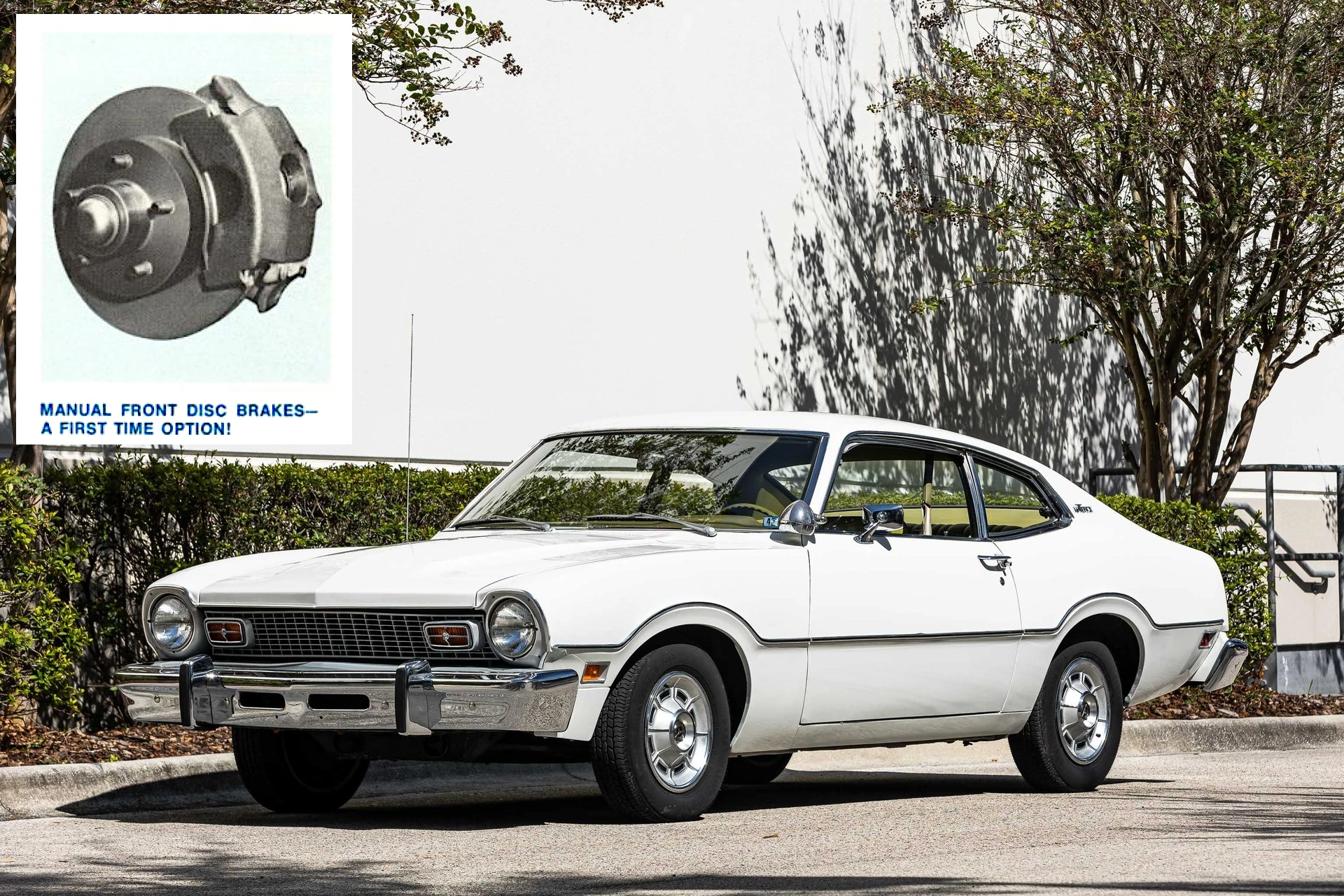
By the early 1970s, more than 20 years after Crosley introduced its groundbreaking but short-lived Hydradisc brakes, automakers were finally, grudgingly adopting standard disc brakes, at least for the front wheels. However, some models retained four-wheel drum brakes for a surprisingly long time. Which were the last new cars in the U.S. with drums all around? Let’s take a look.

Although automakers were well aware of the benefits of disc brakes in reducing brake fade, many manufacturers remained reluctant to standardize discs. U.S. automakers professed several reservations about discs, the principal ones being accelerated pad wear on heavier cars (which required ventilated rotors to reduce lining temperatures) and greater pedal effort without power assistance, due to a lack of self-energizing effect. (The unusual clutch-type discs Chrysler had used in in a very limited way from 1949 to 1955 were self-energizing, but they had other drawbacks.)
The biggest sticking point was inevitably cost, but car companies were also reluctant to impugn the effectiveness of drum brakes or to imply that drums were in any way less safe (even where they demonstrably were). Not only would that have opened automakers to legal liability, it would also have invited government regulations requiring discs and perhaps antilock braking systems. As it was, new federal regulations that took effect in 1970 required automakers to publicly disclose their cars’ braking performance in a standardized 60 mph to 0 test, data the NHTSA began publishing for the 1971 model year. Cars with disc/drum brakes didn’t always delivery outstanding performance in those tests (although cars with four-wheel discs almost always did), but cars with four-wheel drums frequently fared poorly.

Among domestic makes, only the Corvette offered four-wheel discs, beginning in 1965, but front discs brakes gradually became standard on more expensive cars, beginning with the Ford Thunderbird and Lincoln Continental in 1965. The Imperial followed suit in 1967, with Cadillac belatedly standardizing front discs on the Eldorado in 1968 and all other models in 1969. On most lesser models, front discs were optional, usually packaged with power assist, and not commonly ordered even on sporty models.

Front discs (and occasionally four-wheel discs) became standard on many imports by the early ’70s. Toyota, for instance, still had four-wheel drums on the U.S. Corolla in 1971, but standardized front discs on all U.S.-market passenger cars for 1972. From a technical standpoint, smaller, lighter cars didn’t need discs as much as big cars did, at least in areas with speed limits, but it was cheaper and easier to offer them, since lighter cars also had less need of expensive ventilated discs and could more easily get by without power brakes.

Domestic automakers gradually began to standardize front discs on cheaper models, but often seemed to wait to do so until the platform was up for redesign. Thus, front discs were standard on the 1970½ Camaro and Firebird and the 1971 Chevrolet Vega, but the bigger, heavier A-body intermediates didn’t standardize them until 1973. (Some manufacturers were less reticent about adopting discs midstream — Checker and Chrysler standardized front discs for 1972.)

By 1973, however, the trend was clear. In 1970, less than 40 percent of domestic models had disc brakes, but by the 1973 model year, the installation rate was over 76 percent. I don’t have a percentage breakdown for imports, but it was likely even higher.

So, what were the last holdouts?
Chevrolet Nova, Oldsmobile Omega, Pontiac Ventura, and Buick Apollo (1974)
The GM X-cars — the aesthetically challenged Chevrolet Nova and its Oldsmobile Omega, Pontiac Ventura, and Buick Apollo siblings — retained standard four-wheel drums through the 1974 model year.

Front discs were optional, but since GM was still reluctant to promote them, they weren’t often ordered.

Only about 25 percent of Nova production, 28.9 percent of Ventura production, 30.8 percent of Omega production, and 33.5 percent of Apollo production had disc brakes in 1974.

X-body customers who didn’t order discs were settling for very mediocre stopping performance. In the federally mandated braking tests, a loaded Nova, Omega, Ventura, or Apollo with drums all around needed 31 feet longer — two full car lengths — to stop from 60 mph than the same cars with front discs.

These cars would finally get standard front discs along with their much-needed 1975 facelift.
Ford Maverick and Mercury Comet (1975)
Sold as cheap wheels and initially offered only in poverty-spec form, the Ford Maverick and its Mercury Comet sibling didn’t even offer front discs as optional equipment until 1974.

In 1974, discs were even less common on the Maverick and Comet than on the GM X-cars: 24.5 percent of Mavericks and 22.6 percent of Comets had front discs, according to Automotive Industries.

For 1975, front discs were fitted to 44.8 percent of Mavericks and 48.3 percent of Comets, at an extra cost of about $75.

Front discs became standard on both the Maverick and the Comet for 1976, although buyers still had to pay extra for power assist.
Subaru 1400 (1975)
The Subaru 1400 (called Leone in Japan and elsewhere) is best known for its optional 4WD, but there were also price-leader FWD sedans, briefly marketed in 1975 as the Star Clipper (in two-door form) and Star Cruiser (with four doors), which apparently still had standard drums all around. This was almost certainly a price-leader stunt to enable Subaru to advertise prices starting at only $2,999, as the 1976 Subaru line boasted front discs across the board.

I had great difficulty finding even legible press photos of the 1975 base Suburu sedans; the yellow one shown above is a 1974 model.
Volkswagen Rabbit (1975)
Although it was brand new, the Mk1 Volkswagen Golf/VW Rabbit initially came with four-wheel drums in some markets, including the U.S.

As with the Subaru, this was a ploy to enable Volkswagen of America to advertise a starting price of under $3,000 ($2,999!). I’m not sure many Rabbits were sold without front discs, which were included with some of the major option packages, but there were some drum-braked cars:

Dodge Dart 6 and Plymouth Valiant/Duster 6 (1976)
The aging A-body Dart, Valiant, and Duster began the 1976 model year with drum brakes all around, at least in six-cylinder form.

Ordering a V-8 got you non-power front discs (with power assist optional), but you paid extra for them with the Slant Six.

According to the Dodge and Plymouth dealer data books, non-assisted front discs became standard on all remaining Dart and Valiant models as of January 1, 1976.
AMC Gremlin, Hornet, and Pacer (1976)
Given AMC’s longstanding econobox orientation, it will not come as a surprise to most that it was one of the last domestic automakers to standardize disc brakes on its cheaper models. The Gremlin, Hornet, and Pacer all had standard four-wheel drums through the 1976 model year.


The Gremlin, Hornet, and Pacer standardized non-power front disc brakes for 1977.
Volkswagen Beetle Convertible (1979)
With inflation and the unfavorable dollar-Deutschmark exchange rate making the $2,999 list price untenable, Volkswagen standardized front discs on the U.S.-market Rabbit for 1976, but that still left the antediluvian VW Beetle.

The Beetle sedan was gone from the U.S. market after 1977, but the convertible stuck it out through 1979, with its somewhat incongruous Bosch L-Jetronic fuel injection system enabling it to remain emissions-compliant for a while longer.

However, the Beetle convertible still had drum brakes all around till the end of the line. (Some were later retrofitted with front discs, but they didn’t come that way in 1979.)

As best I’ve been able to find, that made the Beetle the last new passenger car officially sold in the U.S. with drums all around, a year after even the Jeep CJ-5 had standardized front discs.

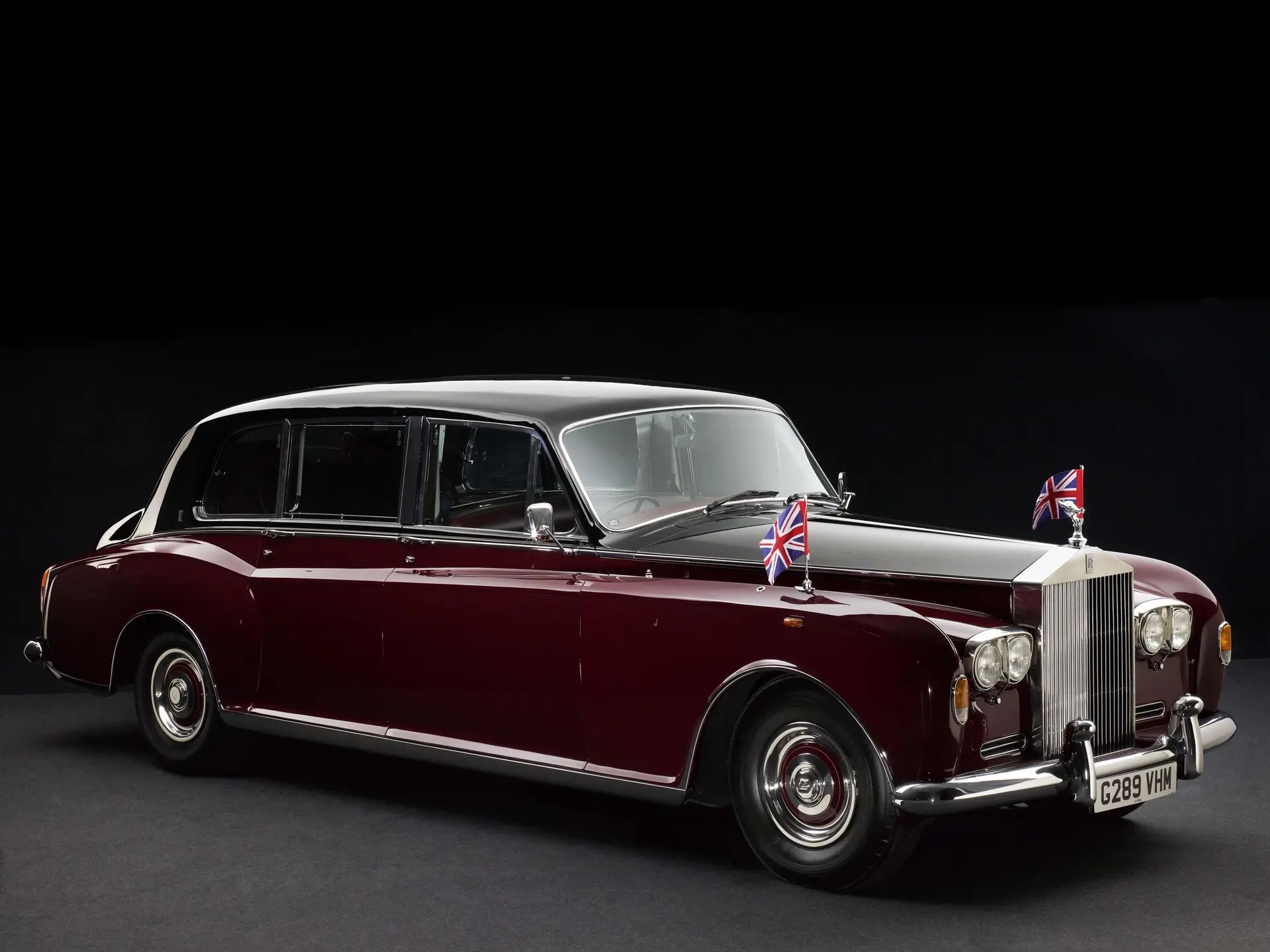
I should emphasize that I’m only talking here about the U.S. market. Cheaper models sold elsewhere sometimes retained drum brakes for longer, even on cars that had standardized discs for North America. There were also drum-braked cars sold elsewhere after 1979 that were not officially offered here, like the Rolls-Royce Phantom VI limousine, which retained drum brakes through the end of production in 1990 because they were quieter than discs.
I also haven’t made any survey of light trucks and vans, although I think most U.S. light trucks had also adopted front discs by 1979.
Related Reading
1949–1950 Crosley Hydradisc Brakes: The First Disc Brakes On An American Car (by me)
QOTD: What Was The Last Car Sold In The US With Front Drum Brakes? (by Paul N)























Apparently, Ford didn’t do too good a job with the disc brakes on the Mercury Comet. Dad had a 1974 four door with disc brakes which vibrated the car each time he pressed the pedal. The dealer installed new pads, but didn’t solve the problem. They didn’t want to replace the rotors. He had issues with engine stalling and the interlock as well.
As a WWII vet, I was never more surprised when he later pulled into the driveway with a Toyota Corolla.
There was a 15 year pause before he bought another Detroit vehicle.
Warped rotors would have been the actual problem.
@ 3Speed : the dealer was jerking your dad off ~ pulsating pedal on disc brakes is a sure fire indication of over torquing the wheel lugs .
My Ranger came to me like this, a $10 junkyard rotor fixed it right up .
-Nate
For what it is worth, AI says: “:1965: Front disc brakes were available as an option on the Country Squire.
1967: While drum brakes were standard due to federal safety mandates, optional front disc brakes continued to be offered.
1968: The power disc brake option became standard on all Ford-built car lines, including the Country Squire, according to the SAE International.
Disc brakes were offered as optional equipment on the 1965 Mustang.
AI is not trustworthy in any respect. The only part of that that’s accurate is the last sentence; front discs were indeed optional on the 1965 Mustang.
Ford first offered front discs as standard equipment on the 1965 Thunderbird and Lincoln Continental, then on the 1966 Galaxie 7-Litre. They were optional on the 1965 Mustang, and became optional for all full-size Ford models for 1966 and the Fairlane for 1967.
Re 1968-The sentence would be true if it was worded properly. What it should say is: In 1968, any US Ford product included disc brakes when power brakes were ordered. This coincided with the intro of a simpler, smaller & cheaper single-piston caliper designed in-house by Ford.
Previously , in 1965-67 , the Kelsey-Hayes 4-piston caliper was quite wide, necessitating a special wheel.
This made the option quite expensive.
In 1967, they were priced at $97.21. In 1968, this dropped to $64.77. In addition to 1965-67 Lincolns and T-Birds, Kelsey-Hayes discs were also standard in 1967 Mercury Brougham, Park-Lane and Marquis models.
These calipers were problematic, and prone to seizing, what with all the moving parts . FWIW, they included power assist on all but the 1965-66 Mustang.
Manual discs made a comeback at FoMoCo in 1971-79 Pinto-Bobcat and 1974-76 Maverick-Comet.
In the case of the Maverick, it was -1974:Drum standard, manual disc optional, 1975:Drum standard, power disc optional, 1976-77 Manual disc standard, power optional.
On Pintos, it was standard drums, optional manual disc until 1974, when they became standard. Power assist became optional in ’75.
I feel an obligation to urge people not to rely on (or even use) AI summaries: LLM AIs are not capable of understanding any kinds of nuance like this, and they will make up plausible-sounding facts that can badly mislead the unwary.
It’s best to think of “artificial” intelligence not as machine-made intelligence but as fake intelligence.
I love these analytical deep dive examinations that often reveal the greater realities of human nature — e.g., the powerful, ever-present need/urge to cheap out. Such a great, thorough article. Thanks, Aaron.
Wasn’t FIAT at the head of the pack in offering four-wheel disc brakes in the economy segment… on the 124?
The Great Drum Brake Saga reminds me of that late, intense period in the mid seventies to late eighties of super-low price of entry level economy cars, including strippers like the Pinto Pony and Chevette Scooter, the latter which notably did offer front disc brakes but deleted so much as the glove box door, and rear seat…foregoing actual die-cast emblems for decals. Ah yes, the Race to the Bottom. For 1975 VW offered an obscure and little promoted but now somewhat celebrated super stripper Beetle, the model 110 — with no exterior chrome, no flow through ventilation (and no crescent rear side vents), partial headliner, ultra-plain door cards (but again, with the fuel injection to pass emissions muster, surely only because it was… required). VW offered a similar de-contented version of the Type III, also quite obscure. These correlated to similar strippers in VW’s home market, e.g., the Sparkäfer, etc.
But its mind-blowing to think manufacturers would so readily comprise a vehicle’s safety to offer a lower price-point, and possibly a validation of the entire effort to mandate basic safety elements.
Renault had four-wheel discs on the R8 in 1962, which was unusual for a 1-liter car weighing about 1,600 lb. They were good-size 10.2-inch Lockheed discs, with a servo, offering 342 sq. in. of brake swept area — that’s bigger than some much larger American cars of the ’70s and ’80s.
In the light truck segment, Ford 4×4’s still had all drums for ’75. The first with standard front discs was GM for ’71, power boost optional on “half ton” models. I had the cheapest stripper C10 with them. Surprisingly, rear lockup was not an issue, even with an empty bed.
The Chevy trucks did have a proportioning valve, which must have been effective for rear lockup. Notable also that it was the last 2 model years or a 6 year cycle
My first thought was early-1980s base Honda Civics – no, although Honda was a straggler in offering radial tires, and later airbags and ABS without having to buy a more expensive trim level.
The ’79 Beetle does seem to be the last sold in the US with four-wheels drums. The sedan was offered through 1977 though; not until 1978-79 were they convertible only.
Oops, that’s what I get for trusting Standard Catalog of Imported Cars rather than checking contemporary sources as I did with the rest. I’ve corrected the text.
Thank you very much for gathering all the info and laying out the story for us. I lived through the era, but didn’t buy my first new car until many years later—by which time everyone had front- or 4-wheel discs.
In the hobby-car world, there seems to be quite an industry offering front-disc (or even all-four) setups for 1940s-50s cars (and perhaps earlier)…I’d love to drive a before-and-after and get a sense of the difference.
This is interesting. I am of the age where everything I or my friends were driving in the 70s were drums, so while I got comfortable working on those, discs seemed exotic. Now, of course, it’s quite the opposite.
I remember when the 1974 Imperial was offered with standard discs both front and rear. The rear discs went away when the car became a New Yorker in 1976.
FWIW, my 07 Honda Fit still had drums on the rear. They were apparently trying to save money anywhere they could!
Rear drum brakes are still being installed on new cars. Even the current expensive Audi e-tron eq4s and the VW ID series of new EVs have them. Nissan installed them on the Versa right to the end, IIRC. Other low end cars too.
My 2015 Fit still had rear drums, as well. I never thought the brakes were exemplary.
I have a 2010 Fit. With 62 percent of the weight on front wheels and braking forces tend to transfer it forward, what is the point of rear discs other than bragging rights and less capable and/or complex parking brake? What it needs is more “bite” in the front pad linings. Unfortunately, there is little or no aftermarket for brake parts.
I checked years ago. Checked now and there is a healthy choice of aftermarket pads, including track day.
I bought a used 1974 chevy nova with 4-wheel drum brakes while in the Army in 1984. It was an odd car, 350 V8, auto trans, AC, but drum brakes with no power assist. They did not stop very well. But the pedal pressure was high so that it was almost impossible to lock them up.
Just like the brakes on the 1968 Checker Marathon I drove in the ’80s.
It’s worth pointing out that VW had been fitting standard front discs on the Beetle (except for the basic 1200) in Europe, Australia and likely some other markets for some years already (since 1971, IIRC). I can sort of see the point in the front drums on the low-end sedan in the US, but the cabriolet was never cheap, so that is actually surprising that they kept installing drums on them right to the end for the US market. Pretty pathetic.
The first Rabbit I worked on had front drums and I was truly shocked that such a “modern design” had them. I saw a few of them over the years.
Speaking of those early Rabbits I came across one in a store parking lot just last week. Unsurprisingly it was a Diesel and it very good condition considering its age.
I started off in the 68 Cougar and it did have disc brakes. Then I was given a series of company cars while in college. A 1971 VW wagon auto, a 1972 Audi Fox auto, a 1974 Plymouth Duster 6 cyl auto, and last a 1975 Nova 6 cyl auto. All had drums although the VW and Audi were slow enough that discs would probably make little difference in normal driving.
I just drove the 65 F100 to pick up some 4×8 plywood sheets and had my 16 year old assist. He asks what is it like to drive manual steering and ordinary brakes. Said under 10 mph steering is tough but above I have good road feel which I like. As for the brakes you think ahead and mind the power of the truck. I have only locked them once at 15 mph when someone else wasn’t thinking.
The last car I had with drums all round was a ’69 Vauxhall Viva HB . When you changed the shoes you had to first make a sketch of where all the damned springs were located.
I had a 69 Viva HB, but with the 1600 OHC engine, and it had front discs. I bought my first car in 1968 (1965 Austin 1800) and it had power front discs. All my subsequent cars have had at least front discs. Even my Citroën 2CV has front discs (and inboard!). I think my 1998 Subaru Outback Sport was the last car I bought with rear drum brakes.
I had a late 70 Viva estate, that had discs but it was a deluxe according to badge, but this market standardized disc front brakes in the mid 60s, even Ausralian cars had pwr discs but drums were standard on their home market, as I found out by owning some.
A HA Viva taught me to do one side at a time so you have a reassembly pattern, I did them the hard way.
Hindsight can be a bitch .
VW made front disc brakes standard on the ‘Ghias in 1967 and went to some effort to not require a proportioning valve, it was a common and cheap bolt up up grade to any ball joint (1966 >) Beetle, why they didn’t offer it on Beetles remains a mystery .
-Nate
Pretty easy to avoid proportioning valve when most of the weight of the car is on the rear wheels. Ghia was much more expensive, so disc brakes, and radial tires, were easy for them to include. I have a ’69 Ghia. Stock brake parts are no longer easy to get. While no proportioning valve, the master cylinder is slightly different, and unavailable. Drum brake parts, no problem. ’67 gray market Beetle I had was front disc brake with four lug rims, German home market Deluxe 1500 model. It also differed from US export model is several other ways, including six volt electrical system.
I’d never have guessed a 1990 Rolls Phantom VI limo had four-wheel drums. Probably not the only instance of antiquated technology in these, not that I’d ever turn down a ride in one.
RR would have had double acting drums up front not the primitive single cylinder variety, Lockheed made that style forever, ok maybe not forever but my 51 Humber ten had double acting drums so a long time.
My first car, a ’64 Fairlane, has manual, all-drum brakes. It’s one of those things that’s a liability, but hardly an over-arching hazard next to several others I could name. It partly depends on how fast you drive though. At 50-60 MPH – the speed most cars of that era typically drove – they’re not terrible. At 80 MPH, a pretty common interstate speed limit these days, they will fade badly just bringing you to a stop once. When I restore it, a brake upgrade is very much in the works, and I think for any car intended for regular highway use it’s a no-brainer.
Anyway, it’s interesting how almost every manufacturer held onto drums rather than cycling to front disks as the components became commonly available and the advantages became obvious. But I suppose the bottom line can and will drive choices like this much longer than it should. Probably the most noteworthy car on that list is the Beetle: fuel injection and all drum brakes is very much a collision of old and new world technologies, so to speak. I’d also never thought of the upsides of drum brakes (although they seem pretty minor). Less noise makes sense, but another that comes to mind is that brake dust is going to mostly end up going to the inside of the tire rather than gunking up your nice rims.
Another advantage that’s been mentioned is that they take less force to actuate. That’s helps with hand-activated parking brakes: I think part of the reason rear drum brakes have held on more tightly than you’d expect is that parking/emergency brakes are more effective with drums. Some rear calipers incorporate linkage to mechanically actuate the caliper, but more sophisticated setups have a small drum built into the hub of the rear rotor. I’m sure the component cost on that sort of setup is over twice as much, so it’s no surprise on FWD economy cars in particular – where the front brakes do 75% of the work anyway – that drums are still easy to find. So while all-drum brakes held on much longer than I’d like, and I’d much prefer all-disk brakes, I have to give credit where due to the not-quite-obsolete drum brake.
Yes, the principal reason many B- and some C-segment cars use rear drums is that engineering a satisfactory parking brake is easier and cheaper. Self-energizing is a big advantage for parking brake duty.
For the record, the Crosley HotShot was the first US car with disc, albeit, a different version of todays. The thought of driving a 200-300 HP car on bias ply tires on 4 drum brakes, with a single brake line system, truly scares the poo out of me! I remember when self adjusting drums was a big thing. You just back up fast, and slam on the breaks. Drums adjusted.
There is a link to a post about the 1949–1950 Crosley Hydradisc brakes at the bottom of this post.
(The Crosley discs were pretty conventional floating-piston caliper discs, just itty-bitty by later standards. They were introduced about a month and a half before the Hotshot and were standard on all Crosley models for about a year.)
Drum brakes can be pretty efficient.
The Hillman Imp only had brake drums, and they do their work well. It helps that the engine is in the back. But I loath to have to them adjust every few months (2 adjusters per front wheel). The fact that there always seem to be one leaking cilinder when the car has been standing for a period of time made me buy an aftermarket set of discs. I am not sure these will be more effective, I have read they ask for a higher pedal pressure. But they will have less fade and that is a comforting thought when I go visit Norway next year.
I managed to avoid front drum brakes entirely. I drove imports until the 90s, and my American vehicles were never older than 1985. Even my motorcycles were mostly disc braked. So I last owned a car with rear drum brakes in 2017 and my current fleet is all 4 wheel disc.
I did have a tandem bicycle with a rear drum brake, since it was common to fit a second rear brake to control speed on descents in addition to the rim brakes to actually stop. The advent of hydraulic disc brakes on bicycles made that obsolete