

Does this denote the start of the season, as they used to say in London? The FBHVC (the Federation of British Historic Vehicle Clubs, the club of historic and classic vehicle clubs that aggregates their voice to relevant parties) promotes an annual event known as Drive It Day, to bring classics out of winter hibernation and onto the road and to support a deserving charity. It is held on a Sunday in April, to celebrate the ‘One Thousand Mile Trial, an 11-day round-Britain public test, that started on 23 April 1900 to “prove the viability” of the motorcar, and times with many owners getting on the road for spring and summer as well. Many marque and area clubs will organise something, and this is a summary of one such event, where four clubs gathered at the Shuttleworth Collection, an active museum dedicated to motoring and aviation history with a focus on Britain and pre-1939 flying. Here’s a mostly visual walk around of the informal display.

A line of Triumph, or Triumphs – TR3, TR6, TR7, Stag, Vitesse and another TR6.

This was my car of the show, based on the criterion of “which one would I like to drive home?”
A 1978 Daimler Sovereign Coupe, aka a Jaguar XJ-C 4.2 litre, perhaps my favourite Jaguar. This is a three owner car with an interesting life story, with registration in France and re-importation, and perhaps most important, a personable and engaging owner who clearly enjoyed his car and wanted others to as well.
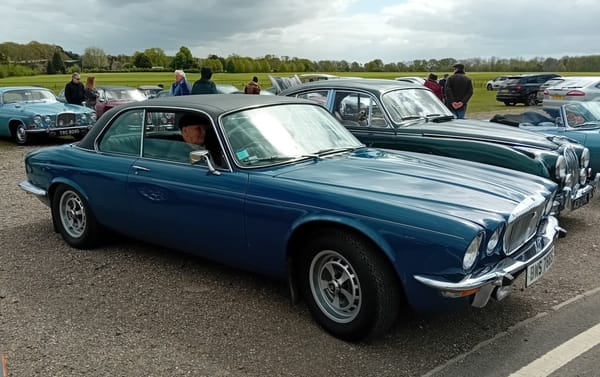
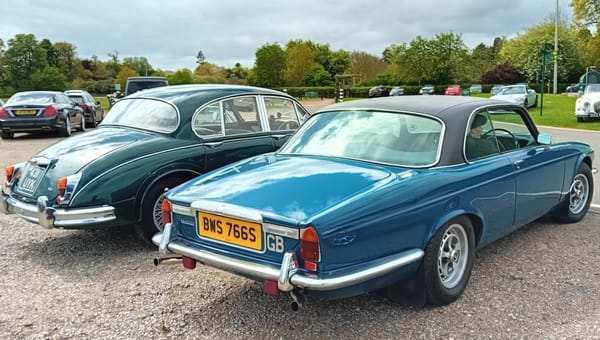

Alongside is a 1962 Jaguar 3.8, as the Mk2 saloon was formally named.

The unusual vinyl roof was first to catch my eye – a 1971 Austin 1300 Mk 3 saloon. Under represented in the classic car world – this was perhaps the most significant and influential European car of the 1960s.
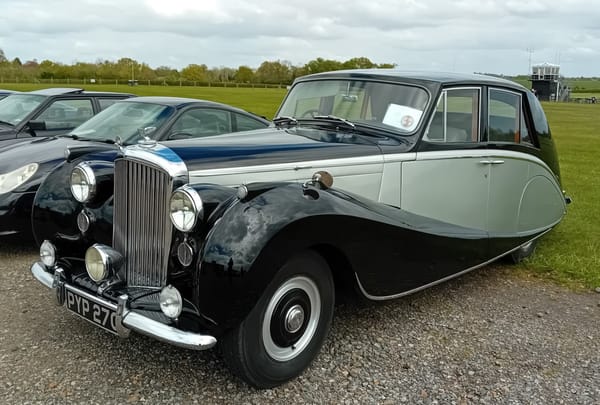
A 1954 Bentley R Type, wearing Hooper Empress bodywork. The R Type may have been a Bentley, and therefore an entry level offering from Rolls-Royce, but it was always a clear statement about the owner.

This example is currently for sale – if you have to ask the price, etc

One of the attending clubs was the local Vauxhall Owners’ Club – let’s celebrate some of Luton’s finest

A 1957 Vauxhall Velox E series – if you recall my piece about a recent trip to New Zealand there was one of these featured there, that does not yet quite match this standard.
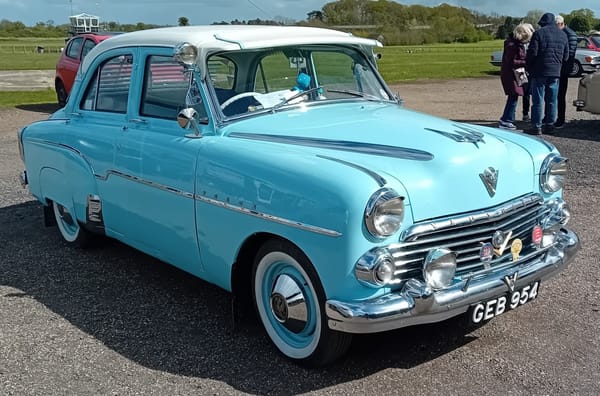
2.2 litres, six cylinders and all set to give the Ford Zodiac, rather than Rover 90 or Humber Hawk, a run for its money. But you can imagine how glitzy the upmarket Cresta was….

This is a 1954 Velox, with calmer chrome work.

The E series was superseded by the PA series Cresta in 1957. This is a 1959 car, part of the first generation. Same engine as the E series, but bigger all round and even clearer North American styling cues.

From late 1959, that awkward rear window became one piece and later still the rear fins were toned down, a bit.

Calmer but still North American influenced styling came with the PB series in 1962. This is a 1964 car in fact one of the few (maybe the only) remaining example that were modified with a luxury leather and wood interior by the Harold Radford company. Twin headlights and Jaguar seats were part of the package, as well as the picnic tables, additional instrumentation, electric windows and aerial.

In 19+65 came the Cresta PC, an attempt to take the name a little upmarket with a less austere and deliberately calmer but contemporary appearance. Maybe that succeeded, but the wheels have always looked lost to me. The engine range, in the UK, was now just a 3.3 litre straight six whereas Ford were offering a multitude of options on the Zephyr and Zodiac.

Perhaps not surprisingly, this was the last Cresta and the last big Vauxhall. The name died in 1972.

The 1972 Vauxhall Victor FE series was partly Opel based, sharing key elements with the Opel Rekord D, and stepped up half a step in size from the Ford Cortina challenging FD series. This is the sports saloon version, known as the Vauxhall Vx4/90 – 4 cylinders (in this case the 2300cc slant engine) and 90 mph, a designation used for the sports Victor since the early 1960s.
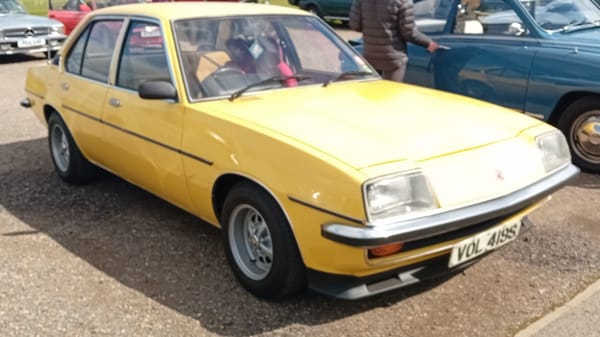
By 1975, Vauxhall was much further into the process of becoming a direct offshoot of Opel. The first Cavalier, a version of the GM U car, from 1975 was the first of the barely disguised Opel models in the middle market, aimed fair and square at the dominant Ford Cortina.

This is a 1978 2000GL; the only parts an Opel driver would not recognise were the big headlights and grille-less front clip. But it had Ford’s attention you can be sure. Later Cavaliers were British best sellers in the 1980s.

The VW Polo, of any generation, is a rare sighting at a classic car event. This is a 1988 1.3 litre second generation, larger than the Audi 50 derived first generation.

Many know these as “bread van Polos” – for obvious reasons.

Four headlights and flush wheel trims denote one of the posher trim levels and the rear spoiler framing the window denotes it is likely the Formel E version for economy, with a higher fifth gear.

Another car not regularly seen as a classic, or even as a curbside classic – the Ford Mondeo. In 1993, with this car Ford staked a very strong claim to class leadership in Europe in the mid-market. The Mk2 Vauxhall Cavalier/Mk1 Opel Vectra was fading, as were the Peugeot 405 and the VW Passat B3, and the Renault 21 had not really caught on outside France. Toyota and Nissan had capable offerings, but not to the width and depth of ability of the Mondeo.

This is a 2000 Ghia, so top trim level, in the less popular saloon format. The mid-market Ford had come a long way in just 12 years from the last Cortina 2000 Ghia. Arguably, one of the unsung milestones in the improving standards of mid market cars over the last 30-40 years.

Talking of Cortinas, how about a 1965 Lotus Cortina Mk1, in the iconic white and green livery?

This was the first fast UK Ford, a concept that it is still around (the Puma ST is the latest) and which have entertained generations of British enthusiasts.

A car we can all agree should be in the classic car park – a 1984 Audi quattro, the ur-quattro. The recipe sound simple – a coupe version of the Audi 80 with the largest 2.1 litre five cylinder turbo charged engine with a four wheel drive system derived for a VW Iltis all terrain army vehicle.

Do you know how many were built in 11 years – just 11,452. Surprised? I was.

The VW Karmann Ghia gets a lot of love round here – this is a 1973 model which was imported to the UK in 2003.

I’m not clear where it was imported from, as it doesn’t appear to have US specification bumpers, but please correct me – I’m not CC’s leading Karmann Ghia expert or advocate by any means.

Still, you don’t need to be a marque fan to recognise a well cared for and presented car when you see one.
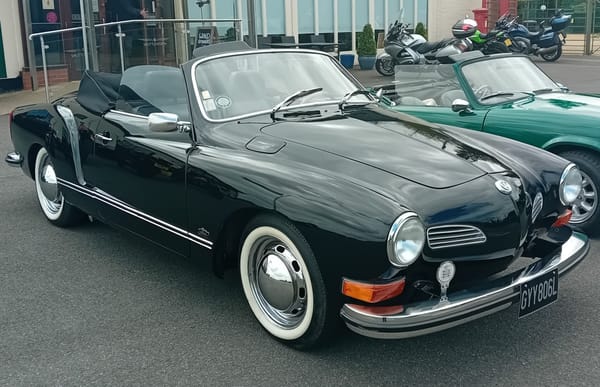
Being a 1973 car, from the Karmann Ghia’s year, it is a 1600cc.

And just one Alfa Romeo, but at least it was Rosso Alfa!

Here’s to the rest of the season!























Great stuff, Rog. While I can fully understand your pick of that particular litter, the fact that so many Vauxhalls were present would probably orient me towards one of those. And that would be the PA Cresta. That colour is really horrid, but the styling is so kitsch, it’s irresistible.
Another 65 3.3 Velox would do me just fine, Ivev owned a couple of PAs a 60 and 61 but the weapons grade 65 was a great car, it was clocked by a hot mustang at far more than the factory claimed was its top speed, but then it wasnt quite stock the six had been breathed on.
I had a 64 2.6 it would hold a genuine 100mph which was a 3.3 cruising speed, roads permitting
“Fire up the Quattro” – that’ll be the one for me, obviously. That one looks lovely in black, the way Ferdinand Piece always insisted his were painted, though in ’84 he was driving a SportQuattro (of which only two black ones were made).
The Quattro was mostly hand-built during its entire run which explains the low numbers (and partly the high price). Note that post 1986 the general platform and main body and interior pieces were no longer used for any of its erstwhile stablemate models so the fact that it soldiered on for another five years speaks to its legend and importance to Audi at the time, especially seeing as how Group B ended in 1986. The UK was (I believe) its biggest export market so they are relatively more common there than most places.
The Porsche 996 next to it is now (at least) 20 years old depending what year that one is, hard to believe that.
The K-G sure looks US-spec to me with those bumpers, red tail lights and the large front indicators. The black though, that’s not a commonly seen colo(u)r on those, at least not in ’73.
The difference in price between the Silver Dawn and Bentley R Type was less than 5%, so rather than being an “entry level” RR, it was more of an alternative to reflect the individual taste of the owner, as the two marques had different images and histories. This of course went on until the two brands were split again.
The KG is from the US. I’m not a fan of the non-period correct fat whitewalls and non-original wheels and hubcaps that are trying to imitate the old style ones.
Nice selection, Mr. Car(r)!
Loving that XJ Coupe – my favorite Jaaag.
The ‘Tina and the ‘59 PA Cresta Are wonderful, too and there is even a Vitesse and Karmann Ghia,
A Cavalier in metallic green was my dad’s last car when I was a kid, so some memories there, too…
Nice crop of Vauxhalls we had an emerald green 54 EIP Velox as family car until 64 when a 64 PB Velox 2.6 manual replaced it, the 65 PB 3.3 could out run any other 4 door sedan on the UK market, the PC Cresta was a very nice fast car the Ford offerings of that era were junk new their V6 engines were prone to various failures and spelt the end of big UK Fords here, Falcons from OZ were cheaper and didnt break down every other day, Big Vauxhalls vanished and we got inferior Holdens from OZ, again cheaper and far less refined,
No Hillmans present?
Mondeos had their moment in the sun when Kiwi Paul Radisich won the BTCC in one, not bad cars to drive in manual but they dont handle as well as others in the real world
My cousins Alfa roadster should emerge from winter storage soon 3.2 V6 in something that size is fast.He is going to bike shows so his toy wont get seen here.
There’s a major ‘All British Field Meet’ in Vancouver every spring, in the perfect setting of the VanDusen Botanical Garden. This year’s event is Sunday, May 18th.
https://www.eventbrite.ca/e/2024-vancouver-british-car-show-at-vandusen-garden-presented-by-hagerty-tickets-861181997537
Richard Owen posted a personal video tour of this year’s Vancouver meet – many beautiful cars.
I find it hilarous how much praise you heap on the 90s Ford Mondeo. Cause that thing flopped HARD here in the USA as the Contour. Priced too high, interior had as much room as a class smaller on the outside Civic or Corolla. And they were unreliable junk. The Contour combined with the ugly oval 1996 Taurus, Ford went from the top three to the back of the pack in terms of family sedan sales here in the USA.
On a lighter note I love the sheer sillyness of that 1959 Vauxhall putting on the full Detriot drag of the period. The fins, the overly busy roofline that doesnt work on a car that small, go home Vauxhall, you’re drunk.
I think Roger is likely more referring to the driving standard of the Mondeo as a cheap, mass-market company or family car, in which it was impossibly advanced over the same-role Cortina just 12 years before. And drive well, they surely did. Superb steering (a bit of a FWD revelation), truly fine handling, very decent ride and slick gearchange made them most pleasurable to throw around, and Ford – often seen as a very cynical cost-driven maker – achieved the excellence of feel by putting a lot of effort into the refinement of these things.
That said, they fell over in Australia too, similarly being too exxy and too cramped, but a friend’s 2 litre and another one’s sporty 2.5 V6 were just a delight to drive. (They both sold them before any reliability stuff showed up, but I must say, they didn’t seem hugely well-made).
Interesting show with a varied turnout. The Austin 1300 is a Mk2 version – the grille on the Mk3 models was simplified and the indicator repeaters on the front wings/guards/fenders were deleted.
Yes, XJ-C for me too. If it had been the 12-cylinder Daimler, you’d have spied a true rarity – somewhere, in the large stock of useless information in my brain storage, I seem to recall that there were only ever a few hundred of them.
And for a not-original thought, I can recall V12 coupes in very good condition going for pin money just 7 or 8 years ago, the value so conspicuous because the only alternative pretty 2-door Jag was an E-type at big money, and so I always intended to have one one day. Yeah, right. A 6 cylinder coupe in good condition (lesser than the one you saw here) is now at least $60K AUD (32K GBP). Shoulda, coulda.
“He wended his way to a waterfall,
And he should have gone there last week.
He carried a camera, legs and all,
But the day was hot, and the stream was small,
For he should have gone there last week,
They said.
They drowned a man there last week!”
(from Last Week, by Banjo Patterson, 1895. He was a famous Oz writer of verse such as the Man From Snowy River, still much quoted when I was a kid, but not now).
Poem link:
https://www.wallisandmatilda.com.au/last-week.shtml
Thanks Mr. Carr, lovely stuff. The C has always been my favourite Jaguar; Sir William got it just right.
I recognized the Mondeo right away as we had a ’96 Mercury Mystique. As justy notes, a wonderful handling car, a real delight to drive. However, it had a dark side. Just as the warranty was running out I had it at a dealer for another car seat tether strap anchor to be installed as we had another kid on the way. I asked if they could print a list of all the work done, the service tech said no, but then his eyes went wide and he said we had had $5,000 (in year 2000 dollars) of warranty and recall work done on it. It cost $20,000, so Ford did not make much money on ours! But off warranty, except for the water pump failing, it ended up very reliable. My sister ended up with it and it was still drive-able 9 years ago when she got a second had Corolla. Of the vehicles I have owned, the Mystique and the 510 are the two I miss the most.