

I recently posted a photo report from the Festival of the Unexceptional held this summer, in which I focussed on the British built (and badged) cars. Here’s a quick photo centric scamper through some of the imported models.


Long time Curbivores may be aware of my views on the Volo 340/360 series. As I don’t want to trigger another health warning, I’m able to report that this 1989 1.7 litre 340 is white, and in a tidy condition.


This is a 1971 Volvo 144 automatic, with just 63,000 miles – but do you remember 1970s Volvos in such colours? Alongside is a 2004 Rover Streetwise, a Rover 25 hatchback jacked up with crossover and SUV style cues, one of Rover’s last acts in the battle for survival.

Now part of the wider Volvo story – a 1972 DAF 44 saloon with the Renault engine and van Doorne CVT.


An inheritor of the van Doorne history – the Volvo 480 hatchback; the lower one seen alongside a second generation Opel Manta and a Rover 200 (R8) convertible.


Staying Swedish, a 1979 SAAB 900 Turbo S, the long nose derivative of the original 99 Turbo and with what are perhaps still the best alloy wheels ever. Alongside is a 1997 Volvo V90 2.9 litre.

A 1962 Volvo PV544, with the later 1.8 litre engine, and a very unusual sight in the UK.


Maybe you’d prefer a 1979 Alfa Romeo Alfetta 1.8, in an unusual but not unattractive colour? Alongside are a Citroen BX, in red, and another Rover Streetwise in blue.


Or how about an Irish registered 1998 Alfa Romeo 156 2.5litre V6, and its Busso violin? Not unexceptional, but still worthy of your time!


Staying Italian, a 1977 Fiat 128 saloon – another once familiar but now very rare sight. Like several cars here, it had a one family ownership story and carried childhood memories for the current owner.


The 128 was superseded by the Ritmo, or Strada in most Anglophone markets. Another absolute rarity, given its vulnerability to the rust worm and the general British disinterest in smaller Fiats and older Italian cars in general.

This is a 1982 1.5 litre example, and has covered only 30,000 miles.

The Strada, in its calmer second series, was also offered with a folding roof in a rather Triumph Stag like format. The styling may have been calmer; that’s also a code for more anonymous as well.


A 1986 first series (1983-1988) Fiat Uno, in the always rare Selecta format. Selecta denoted a CVT transmission, developed with van Doorne of the Netherlands, then part owned by Fiat.

The Uno was ultimately succeeded by the Punto – this is a 1998 example, the last year of the first generation.

The Strada was succeeded by the Tipo, another vanished sight. This is a 1992 Tempra, the saloon version of the Tipo, seen here in 2.0 litre form.
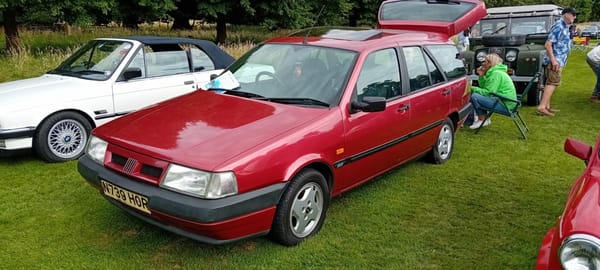
And this is the Marea, the estate version – a 1996 2.0 litre example.
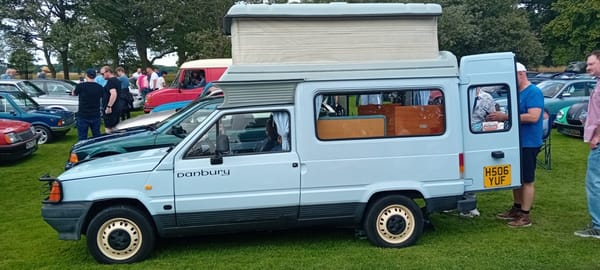
The Fiat Panda was Fiat’s entry model, sold below almost all other European cars, from the early 1980s. Through the 1980s, SEAT was a Fiat affiliate rather than a VW offshoot, and the SEAT Marbella was the Spanish built version. There was also a van version, known as the SEAT Marbella Terra.

Compact without doubt and not overpowered by its 903cc engine, but it could be converted into a usable motor caravan or RV, though no doubt lacking some of the amenities of larger vehicles.

Fiat had many off shoots and affiliations across Europe, probably more than any other maker, lasting through to the 1990s. Best known was probably the Russian link, with the Fiat 124 spawning the Lada saloon and estate (sold in Russia under the Zhiguli brand) from 1970 and lasting in gently evolved and adapted forms until 2012 in Russia and to 2015 elsewhere, notably Egypt. Russian production totalled at least 14 million.

This is a 1976 1.2 litre in estate form. Now a rare sight in the UK, not least because for a period in 1990s and 2000s when the UK became a net exporter of Ladas, as cars were shipped back to Russia for a second life.

When did you last see one of these? A 1988 Zastava Yugo 45, in the concours section? Yugo and concours in one sentence – it was that sort of day. Related to the Fiat 127, distantly, and made to familiar Iron Curtain standards, it sold on price and not much else.

Further up the tree at Yugo was the Sana (or Florida in North America). This was a big step for Zastava – Giugiaro design, licence built Fiat engines and, alongside the Skoda Favourit, arguably the most advanced car to come from the eastern bloc. Some have described it as Giugiaro’s Tipo and his next step from the Fiat Uno – big claims I suggest for something that was not as well developed in any way to meet such standards.
This is a 1991 car with the 1.4 litre engine. Sales in the UK ended very soon after this, as a consequence of the Balkan wars of the 1990s.

But my pick of the eastern bloc cars was this – a 1993 FSO Caro, the later derivative of the FSO Polonez, itself built on the platform of the 1967 Polski Fiat 125p. Newer engines, sourced from Ford, Rover and Citroen helped the entry in western European markets.

This car was first registered in the UK in 2017, brought over by a Polish immigrant who is now showing it proudly to the British. Not glamourous, not fast, probably not going to get you a hot date but clearly durable and dependable. All good FotU criteria. Alongside is a Skoda Felcicia Fun – a pickup conversion with a bulkhead that converted to a second row of seats, out in the open bed when deployed.

You don’t have to look too hard in the interior to see Fiat roots – who else had a gear lever at that angle?

France had some representation too. A Talbot Samba cabriolet and a Citroen LNA 11E, denoting a 1124cce engine. Both were based on the Peugeot 104. Extra points to the Citroen owner for getting a number plate that so aptly describes his car – it is the real deal. The Samba was the Talbot brand’s last roll of the dice, and only relevant new product after the Peugeot takeover.

The LNA was succeeded by the Citroen Visa; Tatra87 told us all we need to really know about these recently. This is a 1983 series 2 car, with the same 1124cc engine as the LNA.

And then came the 1986 Citroen AZ, a car that some say was originally destined to be a Talbot. And still with the same 1124cc litre engine

One day I’ll do a full CC on the Peugeot 305, perhaps the best family saloon from Europe in the late 1970s. In the meantime, here’s a late model 1987 1.6 litre estate.

The 305 was up against the Renault 9 (Renault Alliance) in its later years – this is a nice tidy example of a car we don’t see anymore.

Going back to the 1970s, the familiar Renault saloon was the 12 – this is a 1980 example, close to the end of the run.

But does it really compare with a 1983 Citroen GSA? Not for me, or any other Curbivore I suggest.

The GS and GSA had a big brother – the immortal and far from unexceptional CX. Was this the best four cylinder saloon of the 1970s? This is a 1988 example, with the 2165 cc Douvrin engine shared with Peugeot and Renault, and the sleeker plastic bumpers. Cool wheel trims too.

This CX Safari is German registered – you didn’t expect any Germans to spend their holidays bringing a forty year French car to a British car show that celebrated the ordinary did you, but some did.

The CX, born in 1974, was finally superseded in 1989 by the XM, platform sharing with the Peugeot 605 but carrying many Citroen genes on. This is a 1998 car.


A 1982 Renault 14 – Tatra 87 gave us a masterclass on this car recently. Hard to spot, but this is the facelifted second series. Complete hen’s teeth in the UK, and just about anywhere else.


A 1981 Talbot-Matra Murena coupe – a successor to the Simca-Matra Bagheera and the last in a long line of Matra sports cars based on Simca engineering. This was based on a reversed and mid mounted Simca 1308/Chrysler Alpine drivetrain (with the option of a 2.2 litre engine). Three seats across (not sure why to be honest), largely galvanised construction and an interior full of recognisable Chrysler items, it lasted until 1983 when Peugeot found reason to pull the plug. Peugeot then rejected Matra’s follow up suggestion, which became the Renault Espace instead, built by Matra in three generations until 2002.


Moving on to the Germans…a 1989 VW Polo Mk2, often called the bread van Polo for obvious reasons. This is a 1043cc, entry level car – smarter trims were available.


Larger but probably not much faster…a 1981 Audi 100 Avant (C2), the first Avant from Audi and when Avant denoted a fastback hatchback format not an estate. Slow, as it has 1588cc 85bhp engine.


And a 1980 BMW 316, the entry level BMW of the time in entry level specification and with some aftermarket wheels. Some may say the styling is plain; others that its lack of embellishment allows the basic rightness of the car to come through. Whichever, it is a great example.

And, finally, a couple of Japanese cars. First, an old CC favourite – the first generation Honda Civic, in this case a 1976 1169cc car.

And it’s got Hondamatic to boot!

Or perhaps you’d like this – a Datsun 120Y (or B210 depending where you live) which clearly escaped the attention of the tin worms that claimed so many of its family and friends and family?
So what’s your nominee for an FotU award? And what do you think I should have included instead of leaving lurking in the background?























What a fine selection! The Fiat Uno brings back memories of our trip to the UK lake district in 1999.
We had to return the car the next day and had already paid for the gas in the tank. There was a big football match between Germany and England happening so the roads were empty, and I thrashed the Uno around the mountain roads for several hours to enjoy the fuel. However the gas gauge didn’t really move, so we turned it in with a half full tank.
As if Part 1 weren’t sufficient evidence, Part 2 here shows more of my unexceptional automotive past. I spent four years in the backseat of our family Volvo 544, but less than a year behind the wheel of my Alfetta sedan before it was totaled. I don’t recall ever seeing one in yellow but it looks very nice. I also had a Volvo 140 for about a week, though technically I never owned it as I returned it to the seller (a friend) without ever signing any papers – or exchanging any money.
Well, I once had a Volvo 244 GLE under identical circumstances. I thought I was going to sell my 300E after the lease was up and our neighbors were selling their pristine Volvo for cheap. But after a week, I changed my mind, and they took it back. It’s not that I didn’t appreciate its qualities, but it was no W124. I was spoiled!
The 142 I tried was intended to be my daily driver, replacing my Vega, after I bought the Alfetta as a Showroom Stock racer. But I actually preferred the Vega. You had slightly higher standards with the Volvo vs the W124.
“And a 1980 BMW 316, the entry level BMW of the time in entry level specification and with some aftermarket wheels.”
I’m certainly not a BMW expert. But I grew up with these things. The rims don’t appear to be aftermarket to me. Alloy rims of this design could be ordered ex works as an extra for an extra charge. At least the rims on this brown BMW look very similar to the alloys available from the factory.
Maybe there is a specialist here who knows about it.
Those are very much factory alloy wheels, and quite common in the US on 3 Series.
Missed that event this year, the Swedes have it for me here. It is also nice to see the cars looking pretty standard, in many car rallies the owners seem to cover the grills in badges which you rarely saw when they were in normal road use
White band tyres on Volvos looks a bit incongruous in Europe, I really like the wide whitewalls on 1940’s and 50’s American cars, it does help to define the US aesthetic in my opinion, but except for the Fintail Mercedes, any kind of whitewall generally looks odd on European cars and I have almost no recollection of seeing them on cars in the UK over the past 50 years
At least in the US, the 544 would have come with wide whitewalls. As did the 122S until 1965.
In this country whitewall tyres denoted automatic transmission a very rare option until the 70s when it became the standard fitment on Australian cars
I remember the Fiat Strada, but have not seen one since probably the early 1980’s. And I am an ardent fan of those early Civics!
Somewhat curiously, the early Lada wagon (Fiat 124) stood out for me. It’s a really fine design, one that withstood the test of time. So clean, functional and effective. The Russians did well to get it for their near-immortal Ladas.
“This is a 1971 Volvo 144 automatic, with just 63,000 miles – but do you remember 1970s Volvos in such colours?”
Yes, I do. It is “Turquoise”, Volvo colour code #104. Not toooo unusual in those days. MY ’71 may have been its last year (or MY ’72) – not quite sure about it.
I believe I remember Volvos being available with a bright blue paint in the mid-1970s after they switched to the strut front suspension. My mother drove a 1973 144 that was “school bus yellow.” I don’t know what Volvo called the color or the color code it bore but it was definitely a match for school busses in our area or Caterpillar construction equipment. I also remember a very vivid orange being available at the time.
Think it was just “yellow” – see the colour card below. A solid light blue was added to the selection in MY 74 and was later on also available for early 240s.
Oops! The image was not submitted even though it was in JPG format. I’ll try again later…
Here I try it again – now converted into JPEG. Not sure if it will work …
For you these might be ordinary or even boring. However, for someone such as I living The States, most of these are new to be seen. Thanks.
Unexceptional, yet you include Hydropneumatic Citroens which were exceptional cars, the entire show seems to be a display of Fiats built by ant place that could scavenge up a socket set, those Ladas were hard cars to kill they eventually rusted off our roads and still I see the odd one still driving about, I owned a rust free 120Y in 98 I think in Tasmania, honestly an awful car but it was cheap to buy used little gas and would always start.it just drove like a 70s Japanese car ordinary in the extreme.
In ’79, when I was living in the UK, I considered a 5-year old Fiat 128 (in that pea soup green colour Fiat had then) to get around London, but rust was already an issue, so it’s amazing to see an unoxidized version here. I ended up buying the truly unexceptional, a first gen Ford Escort, because I just needed wheels and the ability to get it fixed anywhere. As Roger points out, so many of these everyday cars here succumbed to corrosion and I can’t imagine anyone restoring pretty much any of them, so the cherished family heirloom provenance applies to virtually all, I suspect.
And there isn’t a list of unexceptional anywhere that should include a Citroen CX or GS!
I don’t recall the Zastiva Florida ever making it to North America – at least not the US.
I would have been all over that Audi 100 (5000) hatchback, even if it makes the car look like an oversized Passat/Dasher.
The Strada was an oddball Italian take on the Golf, one which suffered from the US-mandated 5mph bumpers which messed up the intended headlamp/grille treatment. They were only sold here briefly before Fiat (temporarily, it turned out) pulled the plug on the US market. Actually, given Fiat sales here, I’d be astonished if Fiat doesn’t leave the US again soon.
Wonderful collection, and commentary, Roger. Much appreciated. Always love to discover, what compels owners to keep these ‘regular’ cars, indefinitely.
Another great series of pics and commentary.
Oooh, it’s hard to pick one isn’t it? The Lada is in an amazing condition — I’m old enough to remember when those were commonly seen in Western Europe, and they were all falling apart. This one must have led a charmed life.
The blue R14 is another highlight — in RHD, to boot! Must be one of a literal handful left in this condition.
But if I had to pick just the one, it would have to be that yellow Alfa saloon. I know, that would probably mean heartbreak and financial ruin in the medium term, but what a car.
Great show, thank you Roger ! As I owned a pea soup green Fiat 124 sedan in the late 1970s, and bought a X1/9 last year, my vote goes to the angular and unloved in North America Strada. On a nearly 5 week holiday in Europe this summer, found exactly one Fiat 128 depicted here near Oberbozen, South Tyrol, Italy, in apparently very good condition.
Would like to have taken it home with me !
I’ve seen that brown 316 in show reports from Rustival as well, it’s wonderful how such an “ordinary” car has turned into a complete head-turner of a car.
Lovely to see the big Safari. My dad used to watch the horse-racing interminably on the BBC, and the only thing I ever found of any interest was the big CX camera cars they used to follow the races.
My first car was a Volvo 343, which combined the Volvo 360 body (in 3 door form) with the Renault engine and DAF CVT. A dreadful little car.
Lots of great “unexceptional” cars here. thanks for sharing!
Just a little correction, the Tempra SW is Fiat Marengo, actually Marea succeeded the Tempra, however Marea SW remained called Marengo in some European Countries.
The DAF 44 had DAF’s own 850cc air-cooled flat-twin. It was the 55 that had the Renault engine – and a radiator grille.
It is incredible how these exceptional unexceptionals have survived – most have rusted in pieces.
Well, the 120Y gets the Festival of the Uninhabitable prize, the FSO Caro the Festival of the Undesirable one, and the Yugo 45 the F– off (into) the Undergrowth prize, all FoTU’s of a type. (The very lovely Alfa 156 wins honorable mention in the Festival of the Unbearable, due to its special ability to break one’s heart, and bank).
As has been pointed out, several machines here can’t possibly be called unexceptional, even if several of those several were about as reliable as the utterances of a narcissistic and imbecilic high-office candidate. A Citroen CX, for example, WILL one day fail you, and leave a stain and bill commensurate with its diva status, but before that, it is more exceptional than the opposite of that. (Sadly, and in contrast, a 120Y will remain doggedly loyal to you, bashfully requiring not even oil, but its wilting awfulness will also end you – it falls some where into some zone far below unexceptional, something more akin to a level of Repressed Trauma).
But Sir Rog, a first-gen Civic soars well out of any un- ness of any sort.
It was an outstanding car, a superb bit of design, with an engine superior to any over-lauded magic little revver out of Italy or Germany, an early FWd gearbox that was snickety-snick (when the self-fancying Euros could at best manage boingity-boing-boing), and proper all-independent suspenders that worked better than any of those same competitors using their weirdo torsions and cheap twisty stampings. It had more standard equipment than most Mercedes – actually, most public bathrooms had more luxuries than those ultra-Protestant Stuggartiens then, but I digress – and fit n’ finish at the top of ’73’s automotive tree.
The only things ordinary about it were the snotty heads attached to those who reviewed it, and the long-nosed attitude of disdain towards the badge. The former are now dead, and the latter is not only alive but has been long-respected everywhere since.
The engine in the Citroën AX (954/11241360ccw is not the same than in the VIsa and LNA. Visa and LNA (like the Peugeot 104 and some 205) got the X engine with the gearbox belox, AX got the new TU powertrain…
May I put in a word for the Alfa Romeo Alfetta? The press reviews will tell you about handling; you can judge the appearance by looking at photos. Nothing will prepare you or passengers for the remarkably comfortable never-want-to-get-out rear seats. The previous car, the 2000 berlina and Giulia have a similar quality. I sampled an Alfetta in Bresssanone in 2018 or so and was staggered at the way the seating was so well designed and so memorably comfortable. The driving position is also quite alright and nothing like the clichéd descriptions found as a matter of course in the motoring press (“knees for earrings” is boilerplate UK car review material”). The dashboard plastic is the fly in the soup; Alfa Romeo really lost control of quality on this point. The rest of the car is excellent.
Actually the Marengo was the commercial van/LCV version of the Tempra. The Tempra wagon was just called the Tempra SW 🙂 and the Marea was the car that replaced it, both as sedan and wagon.
And yes, the Citroen AX had the newer TU engine as pointed out by NBx. Also the 205 had it since the 1987 update IIRC.