
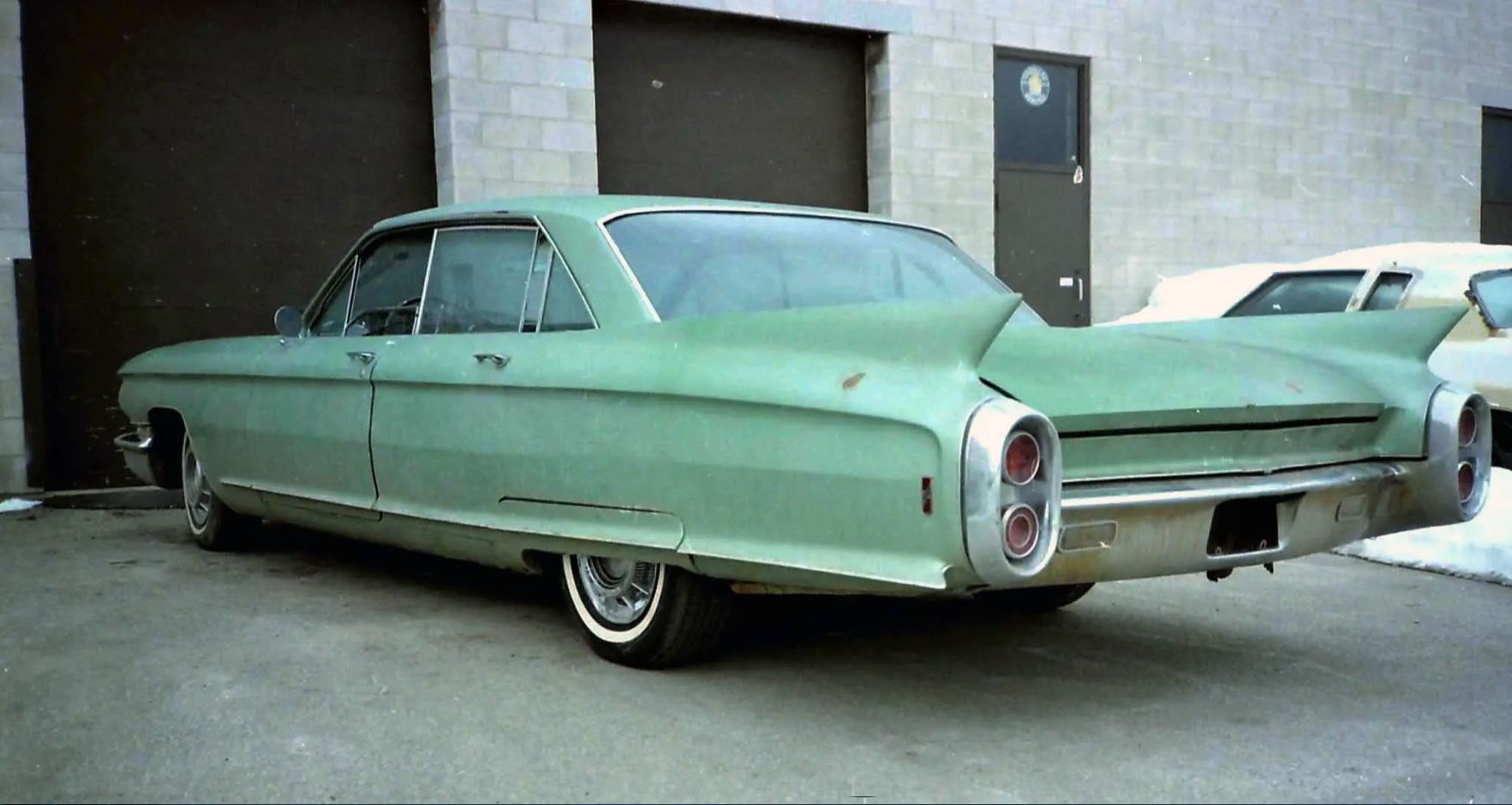
Caddy lovers, here’s something unique and very exclusive for you. And if you, Caddy Neophite Average Joe, wonder why that is, that’s because this ain’t your typical old Caddy sitting in need of rescue. Notice those somewhat demure fins at the back end of this beast compared to those sky-high ones on the 1959-1960 (regular) Cadillac? That’s the tell that this is no ordinary land yacht, but something much more rare and unique: It’s none other than an Eldorado Brougham by Pininfarina –Cadillac’s priciest model for that year (at $13,075 — $144,407 in 2025 dollars). All of 101 units were hand built in Italy by Pininfarina for ’60.

Ever since the Eldorado nameplate appeared in 1953, it had been presented as a unique, lofty, and exclusive Cadillac offering. Originally a 1952 concept car celebrating Cadillac’s 50th anniversary, it reached showrooms in convertible form in very limited numbers starting in 1953. Through the remainder of the decade, the Eldorado would stay in that low-production, exorbitantly-pricey position, although adding body styles as market trends shifted, with 2-door and 4-door hardtops joining the lineup soon after.

Cadillac took a bold step into the high-end Stratosphere with the 1957-1958 Eldorado Brougham. Hand built at Cadillac’s Detroit factory, it was priced at $13,074 ($149,871 in 2025 dollars), at a time when taxes were drastically higher and incomes relatively lower. Cadillac overshot, and lost a very significant amount on each of the 400 sold in 1957 and 304 sold in 1958. It was the classic halo car, but financially not sustainable.

Starting in 1959, 4-door hardtop Eldorado production was sent to Pininfarina in Italy, where hand production was significantly cheaper. Now, Neophyte-Caddy-Joe, don’t you get any funny ideas going in your head; Pininfarina hands notwithstanding, the Brougham’s lines were wholly GM’s.

What’s curious is how the Brougham’s fins differed so greatly from the rest of the reach-the-skies 1959 models. The background on the styling of GM’s 1959 models is well-known and covered, being a response to Chrysler’s 1957 Suddenly it’s 1960s! finned wonders and accentuated by an “anything goes” vibe at Detroit at the time. That said, by the time the Brougham was being styled (a low-volume, hand-built model, created way after the 1959 lineup’s design had been finalized), one can safely guess that designers were getting a general feel that a backlash against the whole Space Age fad was building.
In any case, the 1959 Brougham brought the fins to far more tasteful levels and predated what was to come from Cadillac in 1960 and the 1960 Brougham’s fins previewed the 1961’s, at least in their height.
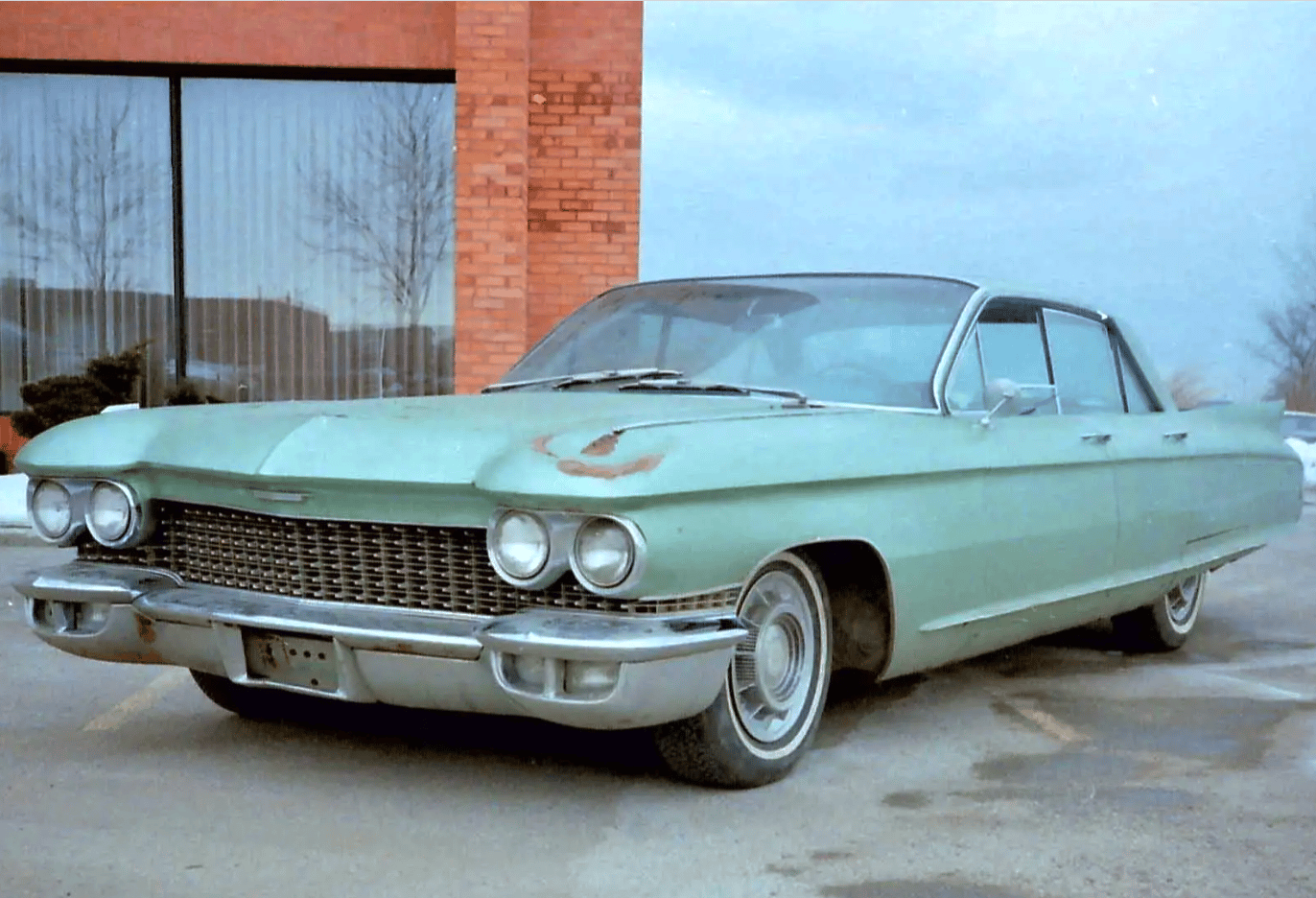
I won’t deny that I have some cognitive dissonance seeing this face and body along with those mellower fins. Not sure if I find the contrast between the extroverted 1959-1960 face and the rear that satisfying, but evolution isn’t always linear. Missing links aren’t always all that harmonious, but are fascinating nonetheless. And this Pininfarina-built Caddy being extraordinarily rare, only moves this find several notches into my “Oh Boy!” wonder gauge.

Cadillac had a good working relationship with Pininfarina in the ’50s, who had created several concepts for the brand including this 1959 Starlight Coupe. It’s very obviously not a GM Design center concept. Given Pininfarina’s ability to build handmade or low-volume cars for much less than it cost in Detroit, it makes sense that Cadillac had them build the ’59-’60 Eldorado Broughams.

It was a rather unusual undertaking for the time, although it did preview the Allante to some extent, although that was of course also a Pininfarina design too. It’s a production angle that gives the Brougham truly hand-built credentials, the epitome of exclusive:
“The Cadillac chassis and other usable hardware [crated separately] were shipped to Genoa, Italy (located about 100 miles west of Turin). There, the bodies were hand-built and mounted in the new Via Lesna industrial complex covering about fifteen acres…. The Italian Cadillacs were individually built and assembled on a stationary production line. Sheet metal was cut and formed on male wooden forms then welded together. Seams were filled with lead.”

I would think that even Neophite-Caddy-Joe can tell that today’s photos aren’t that recent; they’re part of a small batch of images loaded up at the Cohort by Dean Edwards, and seem to be from the late 1980s or early 1990s. Regardless, I get a sense this unique Caddy has been restored and must belong to some inaccessible collection nowadays (Update: no news of its fate has been documented. See comments section).
So, worn looks notwithstanding, this wasn’t your usual “old caddy”. It’s, instead, part of a unique, strange, and unexpected chapter in Cadillac’s history.
Related CC reading:























I wonder how many of these remain in the world today. I’ve never seen a ’59 or ’60 in person, but I have seen a few ’57s including one parked on a street in Geneva Switzerland 40 years ago. With its stainless steel roof and suicide doors without a ‘B’ pillar.
Oh NO, not that again, I remember those when I was a kid, didn’t like them then, but that 1960 Pontiac Bonneville was a different story!
“shipped to Genoa, Italy (located about 100 miles west of Turin).” To keep readers from confusing this particular Genoa, Italy from a different one? 🙂
I remember being amazed when I first saw photos of these. Of course, I had never seen one in my entire life, but saw only photos in some old car magazine. At the time (as a teen in the 70’s) I considered these a half-assed substitute for the “real” Eldorado Brougham of 1957-58. Perhaps this attitude came from looking backwards at a car with lines that were familiar to me from seeing old 61 DeVilles. I long ago officially renounced that position, and find these to be a fascinating addition to that small collection of truly, truly exclusive Cadillacs.
There are 20 towns in the US called Genoa and any of them might have seemed a more likely place for Cadillac production than Italy. 😁
Who knew that the Allante wasn’t the first Pininfarina-built Caddy?
Very interesting rare cool caddy. Love it..
These shots were taken at “Cadillac Joe’s” in Oakville, Ontario, circa 1990. The car was bought by a collector for around $10k at the time, with the idea that he would have it totally restored. When they did some preliminary pricing, they found out that the car is a unicorn, and shares only the drive train and a few other items like the dashboard with the production Caddies. The body and all trim is hand built by Pinninfarina, with leaded joints and no NOS or aftermarket support. The interior is unique and all leather. When they added up the sums in 1990, they were around $100k for a car that looks like a 1964 six window SDV on the top, and a cross between a ’60 and ’61 at the bottom. Most folks would have no idea that this is one the rarest production cars of the day. So the car sat in storage for a while, and about 10 years later, I saw it listed in Kijiji (Craigslist) for around the same money, but in worse shape. I don’t know where it ended up, but it would need someone with very deep pockets and some love for unusual cars. I’ve attached a few more shots showing some damage on the passenger side.
Interior
I knew about the ’57-58, and saw one IRL when it was nearly new. I didn’t pay as much attention to these and didn’t realize they were coachbuilt. Just figured they were a variant like C body vs D body.
I’m not exactly Caddy Neophite Average Joe, but I never realized that this car was special. I thought it was just part of the line along with the Eldorado Seville and Biarritz. Although it is reserved for the last page of the 1960 brochure, marking it as above the Fleetwood 75, it isn’t highlighted much beyond saying that it is a “custom motor car”. I saw that it has a different different roofline than the Seville, but it also has two more doors. Further study shows that the roof is unlike the other two styles offered for the standard four-door cars. The illustration is a front 3/4, so it’s not evident that unlike the other models, the fins do not have lights.
To me, it wouldn’t have been worth the extra money in 1960 because most would see it as the usual Cadillac. The whole point of blowing big money on a high-end car is so everyone knows that you have big money to blow on a high-end car. I assume that the paint and upholstery were hand-picked by the buyer but I don’t see much in the way of fancy equipment or styling. You could probably get your Seville repainted and reupholstered less expensively than buying a hand-crafted car.
But I am nostalgic for the days when buying a Cadillac still meant that you were buying something special. The Standard of the World.
Agreed Don. I never knew these cars were ultra-special until perusing my collection of vintage automotive literature. It looks quite plebian to me. Maybe seeing it in person is necessary for proper appreciation.
My understanding is the contract with Pininfarina was for 100 cars a year. Somehow they only built 99 cars in 1959, hence them building 101 in 1960.
The story is one was damaged in transit so only 99 made, so they made 101 the next year.
When I was quite young, my mother dated a man who had a 58 Eldorado Brougham and what was unique about this particular Brougham was that he had the fins shaved off. I believe by George Barris. Would be interesting to know if that car is still exists or not. Hard to imagine it in a junkyard.
I was a mechanic for a Cadillac dealer back in the early 60s so I remember seeing maybe 2 or 3 of these ever. They were gorgeous cars.
Maybe the Italian body guys at Pininfarina looked at the dimensions specified for the fins and said to themselves , that must be in centimetres – no way can it be inches!
I have known about these very rare 1959-60 Eldorado Brougham’s by Pininfarina. IMO not one of Cadillac’s most unique creations, but still beautiful and hand-crafted. A few years ago (hard to relate to time when I am old as dirt) I saw pictures of a custom car made from this rare and unique auto. I appreciate modern custom cars, but to take such a low production hand crafted classic car and modify it into someone’s custom creation made me sad.
One very unique feature was the rear quarter glass that moved laterally when the rear door was opened to allow more entry space! Imagine trying to get parts for that.
The green car in the photos is not quite stock. The rear taillights are from a regular ’60 Cadillac (probably the bumper as well).
Atomic Ken is correct. My father was car shopping in 1962 & our local NJ Cadillac dealer had a now used black Eldorado Brougham in stock. The salesman stopped & demonstrated the retracting rear quarter window feature as we walked around
the showroom.
Your photo shows the rear end of a 1959 Eldorado Brougham, which matches that shown the YouTube video above (screengrab attached). Apparently, the 1960 Eldo Brougham had the same taillights as all other ’60 Cadillacs.
Thank you! I stand corrected.
> Last Of The Hand-Crafted Cadillacs
….until the current Celistiq, which actually costs over twice as much (adjusted for inflation) than the Eldorado Brougham did. I don’t think it’s going to sell up to expectations – $350K+ is a whole lot for a Cadillac, plus not everyone shopping an ultra-premium car wants a hatchback, or an EV, or a car that can seat only four max. Nowadays they probably want an SUV.
I knew about these, but wouldn’t have picked it as one. But then I could count on one hand the number of Cadillacs (of all sorts) I’ve seen in my life.
On second thoughts, I’ve probably never seen one at all.
This car seems like Cadillac were trying to recapture the social position, and the esteem they were once held in before the war. Between the Pininfarina assembly and that huge price tag that came with it, I think it’d be fair to say Mission Achieved. I’d think the sales figures of these would certainly tick the Rarity box as well. It’d also be fair to say Cadillac has never again come close to this in the status stakes.
Yes, exactly. These 1959–1960 cars were really successors to the super-ultra-zoomy 1957–1958 Eldorado Brougham, which was intended (like the Continental Mark II) to return to the tradition of bespoke luxury from before the war. However, they ended up losing Cadillac a bundle of money despite the high prices. I think probably the best way to summarize the problem was that the cost escalated much faster than the perceptible value. (Or, to put another way, it was difficult to get people to pay $13,000 for a bespoke hand-built car that still looked a lot like a mass-produced Sixty Special costing half as much.)
Looks nice to me, very balanced so it looks good from any angle .
New York City, Manhattan, Lexington Avenue and 32nd Street. It is the spring of 1959 when a man sped around the corner in one of these in black. My first impression was that he had an early model 1960. Then I realized what this is. In New York City, one tends to see expensive automobiles rolling around. I saw more but not often of these Caddy’s. If I walked up Park Avenue north of 60th Street, I would see Rolls Royce autos parked at the curb with chauffeurs waiting for the owners to exit from their apartments. My favorite was a post-War (WWII) Rolls with the traditional open driver’s compartment with canvas roof. The passenger compartment seated five. There were opera lights on the “B” pillars. Impressive Cadillac. Be the first in your club to own one!
Bill Hines built a 57-58 Eldo Brougham into a custom. Hines had been around for a very long time, he was part of the custom car hey day and was famous for chopping tops, always with a stogie in his mouth. I saw him several times at the Paso Robles West Coast Kustoms Nationals. Hines as well as George Barris were rediscovered by a new generation of “Rockabilly” customizers, and in their old age, once more became sought after personalities. Hines died in 2016 at the age of 94 years old. I saw his Cadillac parked in front of the Paso Robles Inn during one of the events held in town.
Here’s a picture of Hines in his shop with the Caddy. He wasn’t the neatest guy in terms of his working environment. But the final result speaks for itself.
Here’s the pic.
Here’s the finished car. Unfortunately the car was completely burned up some time ago.
The 1959-’60 Eldorado Brougham was not the first low-production model/body style of a particular car farmed out to an Italian coachbuilder to lower the cost than making it in Detroit. Chrysler contracted Ghia to produce their 8-passenger Imperial limousine in Italy starting in 1957 through 1965 as it was far less expensive (shipping included) than building it in-house.