

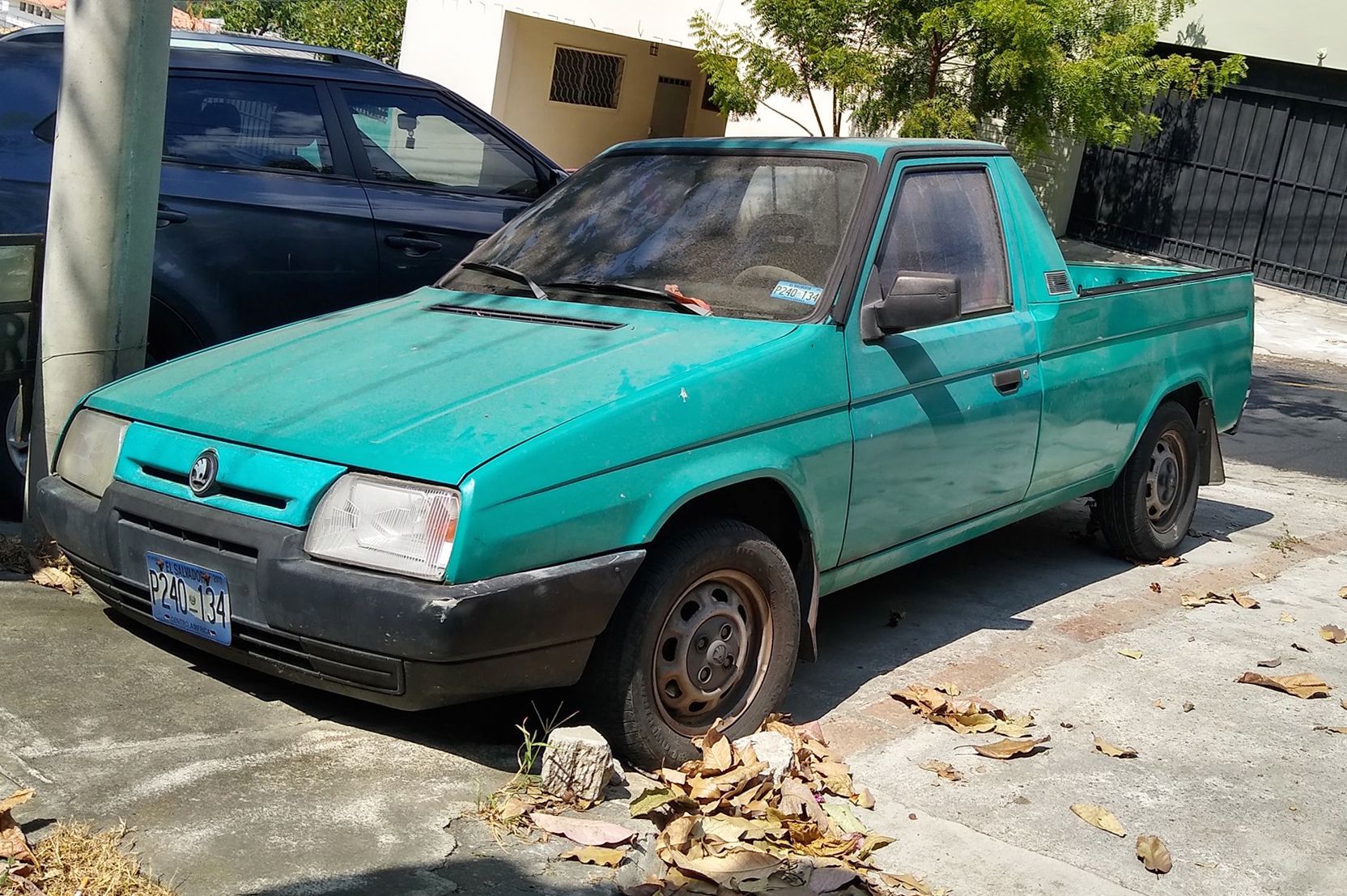
Let’s give a couple of minutes of attention to these little Škoda utes that have been toiling away since they showed up in the early 1990s. These boxy utilitarian subcompacts were derived from the better-known Škoda Favorit hatchback and have been part of the landscape in various nations since then, even if in very diminished numbers nowadays.
The utes are perhaps the lesser-known of the Favorit’s variants, a model that was a large undertaking for the Czech maker when it showed up in 1987, and that propelled the company into the 1980s with its transverse-engine FWD setup and origami styling. It would be Škoda’s last in-house design before being acquired by VW in 1991, the year the pickup version first appeared; a relevant event this survivor seems to be paying lip service to with its VW-sourced hubcaps.

Škodas are a fairly unknown thing in the US, which I find somewhat regrettable. The make has a long tradition and came from a European region known for relevant engineering advances in the early days of the automotive industry (think Ledwinka at Tatra, among others). Still, even if not that well-known in North America, Škodas had a pretty established presence elsewhere, mostly in the 1960s-1980s with their rear-engine models.
Understandably, for a product coming from what was then an Iron Curtain nation, Škodas lagged behind Western products in several areas. In Western European press, Škodas, like other Easter European cars, always fared somewhat poorly against other offerings, with lack of road isolation and other minor annoyances playing against them. They didn’t perform dismally, mind you, but they weren’t quite up to Western expectations.
Still, the company’s products were rugged, had good assembly, and sold on their lower cost and their easy to work on mechanics. And in the third world, from Latin America to the Middle East and Africa, they found a more forgiving audience and gained a clientele.

We aren’t going to do a big dive into these today, but as said, the Favorit was a big undertaking for Škoda. After three decades of rear-engine vehicles (all of them, offsprings to the 1000MB from 1964), the Favorit adopted the FWD transverse engine layout that had become the norm in compacts and subcompacts. It was a big move forward, with a truly 1980s hatchback body styled by Bertone that sprouted two variants; a 5-door wagon (Forman) in 1990, and the ute in 1991. Unsurprisingly, the model’s arrival was quite an event in its native market and became one of Eastern Europe’s most popular models.
Arriving late to the FWD train, these Škodas were generally playing catch-up, so most of their specs just sound compact-car correct for their time. Upfront, a liquid-cooled 1.3L inline 4 cyl. was placed transversely and powered the front wheels, while a 5-speed manual was the sole shifting option. Updates to the 1.3L engine (that dated its origins to the 1000MB days) included new combustion chambers designed in the UK, while Porsche engineered the powerplant’s mountings. Throughout the model’s 1987-1995 production, changes from carburetion to single-point fuel-injection, plus the adoption of catalytics in 1990, meant that power output went from 58HP in ’87, to 54HP by ’93.
In some nations, an additional 1.1L 4-cyl. was also apparently available, though information on that is scant.

Despite the 1980s appropriate styling, ease of manufacture was key, so, regardless of the design’s crispness, the overall styling is simpler than it seems at first. As with other Eastern European offerings of the time, assembly was planned from the beginning to make the most from easy-to-acquire materials and cost-accessible hardware –the underappreciated art of working with what you got, and not overstretching yourself.
So overall, practicality was the Favorit’s mission.

That practical mission is quite obvious in the ute version, with the bed’s severe lines making some contrast against the cabin’s sleeker shape. The plain rims with little plastic covers also speak to that simplicity mindset.
Not sure about the utes, but soon after VW’s acquisition, cosmetic enhancements began to appear across the Favorit’s range. From VW-sourced seats to improved interior materials and instruments. That, along with some other minor cosmetic exterior updates like a revised grille and enlarged bumpers. Some other minor pieces, from hinges and latches, got upgrades as well.

VW’s involvement in the Favorit models never reached powerplants, so no German mills showed on these. A fact that means these Škodas are likely living on borrowed time… at least, as long as they’re powered by their original hardware (hey, anything is possible!). Unlike the red pickup in our opening image (captured by riveranotario back in 2016), this teal one is now sitting on a San Salvador road and looks like it’s not going anywhere anytime soon. Still, up until recently, it was running and still working. Oh well, nothing lasts forever, and these vehicles just promised to be accessible transport, built to last. For the most part, with no Škoda support in this region for decades, it looks like this one played that role well enough.
Related CC reading:























Interesting and rare little trucklet .
-Nate
I had two of these, one Skoda 1.9 D and one vw petrol.
They were not fast but they were cheap on gas and actually quite comfortable compared to the Peugeot partner/citroen Berlingo vans we also had at the time.
Biggest problem was that though they only were 8-10 years old the firewall and windshield inset was leaking so bad that the floor had an inch of rainwater every morning when it had rained all night.
And obviously never got dried out and seats were rusted and therefore jammed,
But otherwise a pretty decent little car
Had no pictures unfortunately
I like the “Spanglish” in the last picture. “No Parquear” instead of “No Estacionar” (Do Not Park). Nice little truck though.
I think it’s very much the Eastern European take on the VW Caddy. And that’s fine.
It did become one. ..close resemblance of the Polo.
Just a comment on the red 120 pictured above. The grille was not for show. I remember these cars from new as they were quite popular in Uruguay, low price and much car for it (quality was another issue). The radiator was at the front, I can only guess why as there were lots of all rear cars with the cooler in the engine compartment.
Yes, I misremembered that. Those rear engine cars were water-cooled; and the radiator was moved to the front for the 105/120 models that appeared in 1976. Those Skodas were quite popular in Central America; like you said, much car for a low price. The father of a close friend of mine owned an early 1980s model and drove to Texas at least once with the family. Sounds crazy, but it fits with the adventuresome spirit of my friend’s father.
Škoda’s engineers (and Bertone) wanted a faster windscreen angle, but it was made more upright. This echoes the Mk1 Golf.
Apparently, the Commies-in-charge at the time interfered; too sporty, too western.
The old 105/120 was based upon an Ital Design proposal for a modern FWD car, but there was no money.
Honestly, some of the designs in their museum put BL’s efforts to shame. No wonder Czech(oslovakia) has a reputation for brilliant engineers.