

Talk about a survivor from a bygone era; a 1975 Imperial LeBaron coupe with oh-so-seventies opera-windows Crown trim and a green on green on green colour combo. Talk about a period piece! Nope, this ain’t the first time one of these shows up at CC, but one has to take a moment to admire these remnants of 1970s American-style luxury whenever they show up. When extinction came calling, it was a brutal thing and these leftovers are rare, particularly in the form of a 1975 Imperial; arguably, the last year of the nameplate, with a low 8,830 units built and only 2,728 of those being coupes.

Of those coupes, how many can there still be around, in Crown trim? And how many in this condition and colour combo? There were not even that many such ones to start with; part of the fun in the “customisation from factory” idea from those long-gone days. Check enough boxes in the order sheet, and chances were you had as uniquely trimmed a purchase as was possible.

A half-century has passed since these Imperials were new, and the full-size vehicles of this era feel like alien creatures from today’s perspective. A feeling even more prevalent when talking about two-door coupes, with proportions created to make a dramatic statement (More on that HERE). And in the case of the luxury makes, with the period baroque touches, anchored entirely to an era of optimism that was about to hit a screeching halt.

As fans of the make know, the 1974 full-size products from the Pentastar were conceived before that prosperity roadblock appeared in the form of oil embargos, inflation and more. As unlucky as could be, but as we know, the stars were beginning to align against the Pentastar in those years (lucky we launched that Duster!). Leaving those defining events aside, the lineup that arrived at showrooms for 1974 showed the maker still aimed to go mano a mano against the other Big Two. Within a limited budget, that is. In the case of the 1974-1975 Imperials, they were nearly the last gasp of Chrysler’s Cadillac-like aspirations (if we ignore that short-lived hiccup that tried to revive it later), and shared a great deal with “lesser” models like the New Yorker; from wheelbase to side panels bodywork to general hardware. Further accoutrements, trim options and distinctive front and rear clips were basically what separated the Imperials from their lesser brethren.

As known, the Imperial as a Cadillac-contender never caught on. Still, they were a lot of car for the money, and a 1975 model is quite a way to stand out if these old-style Detroit luxury rides are your thing. A DeVille or Town Car too common for you? Aside badge aspirations, Chrysler could build a luxury cruiser as well as anybody (as long as it was screwed together on a good day); about 5,200 lbs. of road-isolating road hugging weight, built with the company’s unibody technology, with plush living-room-like interior accommodations. Add a 440 Wedge V-8 with 230HP (215HP in ’75) for torquey, smooth highway cruising. And by 1975, just as softly sprung as the segment expected, notwithstanding Chrysler’s preferred torsion bar suspension.
In case you can’t come across a 1974-1975 Imperial, and still like that neoclassical grille on a C-body, get yourself a 1976-1978 New Yorker; the Imperial just rechristened, and which sold much better under Chrysler badges (which probably said a lot about Imperial’s standing as a division, something Aaron S. talked about not long ago).
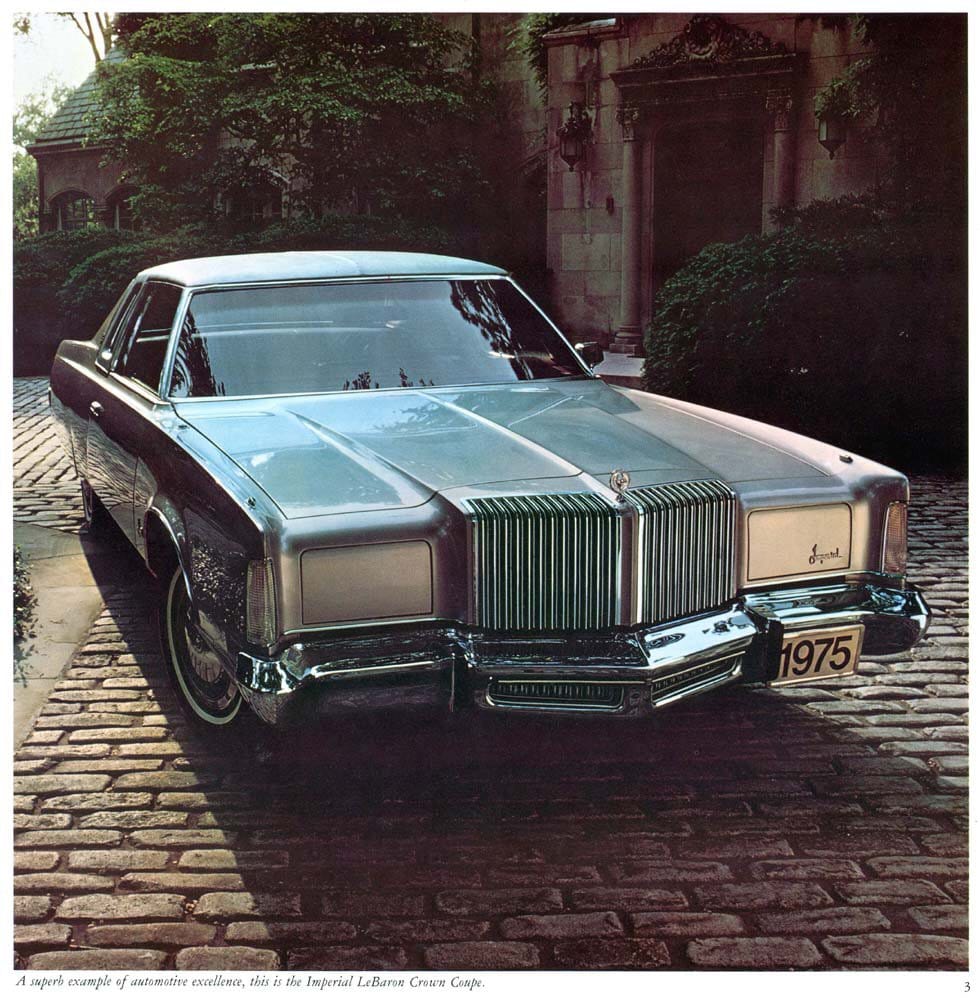
On a personal note, I’ve never been quite sure how I feel about the looks of Chrysler products from this era, something that applies to these Imperials. Traces of the distinctive fuselage-era can still be seen on these C-bodies’ profiles, but a lot of the remaining touches are clearly cribbed from GM and Dearborn. So, they have a weird quantum reality thing going; they feel like their own thing, and yet, they remind you of nothing and everything all at once. How did they accomplish that?

Today’s subject was found in Canada, land of the ever-surviving American land yachts. And in this shot, against a background of tall trucks and SUVs, one can see how much automotive expectations have changed in these past decades. A nineteen-foot cruiser, low to the ground, filled with a living-room-like interior and with only two doors? Yes, that was a thing. If you want to know what that was like, get one in green on green on green, fill it up, and put on some green polyester polo shirts before driving.
Related CC Reading
Curbside Classic: 1975 Imperial LeBaron Coupe – The Last Real Imperial
1974 Imperial LeBaron Crown Coupe – A Chrysler By Any Other Name, It Sold Better As A Chrysler
Who’s The Longest Mega-Coupe In The Land?























Next to it the HR-V with its’ unimpressed-cat-meme face couldn’t offer a better contrast.
People, of course, still called them “Chrysler Imperial” until the very end, after 20 years.
The “St. Regis” opera window package was really clever cost engineering, the wind-down rear quarter windows being replaced by fixed ones meant it probably cost about the same for Chrysler to make but was an option, presumably an expensive one, to the end. Without it this was one of the last true hardtops from Detroit and the 4-door was the last 4-door hardtop in 1978 (after the post sedan’s last year was 1977).
I was going to mention the same thing re: opera windows. Around 1974 two-door hardtops went out of style in Detroit, replaced by opera windows (a few cars had both a roll-down hardtop-style rear window and an opera window, which also met the new style requirements). Both GM and Ford redesigned the roofs on their big cars to accept opera windows and (usually) delete the window adjoining the front window. Chrysler though just put some sort of filler panel in place of the hardtop rear side windows to make a smaller, enclosed window space, which accounts for the fat C pillar. I don’t think the effect works all that well; it looks like a converted hardtop.
I have the exact same HR-V (2023+) and in this photo, I didn’t realize it was so big because of the green barge as a reference. The packaging for this latest gen is deficient: the K20 2.0L is as lost under the hood as an inline-six in a Ford Falcon. HR-V sold elsewhere in the world is a completely different concept.
That is the greenest Chrysler I’ve ever seen. The Millennials and Gen Zers chasing luxury today would be amused to see that this was a common luxury expression in their parents’ and grandparents’ day.
Gorgeous barge. Thanks for the essay.
Came to agree. Love the Big Ones. (and 2 doors), but even the 4dr HT looks great here.
Also love the way the “incorporate” the bulky Bumpers (especially rear) into the design, rather than just a Big Chromed Steel RR Tie.
Props to the designer/s.
I experienced a new 1975 Imperial two-door when it was new and it was the most comfortable highway cruiser I have driven. My friend had traded his 1972 Mark IV on a new 1975 Imperial burgundy red w/burgundy red fabric interior. Many weekend trips Richmond VA to DC to go clubbing. Separate road trips to West Virginia, North Carolina and one Richmond to Miami long haul. The Miami trip was memorable as I drove directly from Richmond to Fort Lauderdale straight through and was still rested enough to go dancing that night. That was about 925 miles only stopping for gas & burgers. The Imperial did not seem strained going 95-100 mph on the Florida Turnpike. During this period I had many road miles in the Mark IV and shortly after in my 1976 Eldo conv. For long distance driving the Imperial was more comfortable then either the Lincoln or the Cadillac.
A little side note is I was a college student at the time and made a few road trips to NC to visit parents. Driving a Lincoln, Imperial, Cadillac, Dad never asked about the cars. But he would need to get groceries 5 mins. away, borrow my cars, and be gone for hours.
The Emerald City 🙂
That white one, poised next to the gas pumps, looks like one I used to see running the streets round “Falls Church VA” Would a been late “80’s-early “90’s”, time frame.Best of memory…was red inside,
For a “15ish”, year old ride; recall it appearing sound/ sturdy.
1975 saw the introduction of Chrysler’s first PLC, the Cordoba, one of their few seventies’ successes. But it was an intermediate size, a competitor to the Monte Carlo/Grand Prix/Torino Elite/Cougar. Chrysler did not have the funds to create a full-size, luxury PLC in the Eldorado/Mark IV class.
And that’s where these Imperial two-doors come in, but just couldn’t pull it off. And, as is well-known, things imiproved markedly with the follow-up New Yorker Brougham, which was for all intents and purposes a decontented Imperial that could be loaded up to the same level (but for more money).
When we owned our Starlight Blue ’77 Gran Fury Brougham in the mid-80s there was an identical one in Jade Green in our town that we often saw parked on Main St., such an appealing color.
When thinking about the ultimate trip car, having owned a ’74 Lincoln Town Car, ’75 De Ville, ’76 Olds 98, ’77 Gran Fury and ’78 Newport, I believe I’d take a ’76/77/78 New Yorker Brougham over any of them, my cousin had a light green metallic ’77 NYB. The Mopars had a much stiffer body structure and a superior way of accommodating the mandated collapsible safety bumpers that avoided rotting away and looking stupid with those awful plastic fender and bumper extenders, a major flaw of the GMs along with their flexible frames. The seats in the NYB are also ultra-comfortable, more so than the others imo. Make my NY’er Burgundy with similar color velour interior please!
Having owned ’74 Olds 98, ’75 Town Car, ’75 Sedan Seville, ’76 Olds 98, and, 77 Gran Fury Brougham, I’d take a ’76-78 New Yorker Brougham as my long trip car of choice. My cousin had a light green metallic ’77 and it not only had a much stiffer body structure than the GMs and Lincoln, the seats were more comfortable and Mopar had a more satisfactory to the mandated safety bumpers, without the stupid deteriorating plastic bumper and fender extensions used by GM. It ran stronger as well. The green is handsome but make mine in Burgundy please!
Sorry for the duplicate, for some reason sometimes the initial submission appears to have failed then suddenly just shows up after a considerable interval. Other times it’s immediate, or just fails to show up ever. Happens all the time, weird. My very old and slow computer may be at fault
Happens to me too. Sometimes our comments seem to go into limbo. I think it’s a WordPress thing. Sometimes our innocent comments trigger the spam filter.
People with access to the ‘back side’ of the site and who know what they’re doing (i.e. not me!) may find a comment in the ‘trash’ folder (where the spam goes), and fish it out. I suspect a ‘good fairy’ found your comment and put it where it belonged.
I’ve seen this before. It ‘seems’ that if it just reloads after hitting “submit”, you’ll see your comment, BUT if you have to ‘reload/refresh’ the page, the comment won’t show because of the 15 minute wait before comment is “posted on the site for all to see” – including you.
That’s how I understand it.
1975 saw the introduction of Chrysler’s first PLC, the Cordoba, one of their few seventies’ successes. But it was an intermediate size, a competitor to the Monte Carlo/Grand Prix/Torino Elite/Cougar. Chrysler did not have the funds to create a full-size, luxury PLC in the Eldorado/Mark IV class.
And that’s where these Imperial two-doors come in, but just couldn’t pull it off. And, as is well-known, sales improved markedly with the follow-up New Yorker Brougham, which was, for all intents and purposes, a decontented Imperial that could be loaded up to the same level (but for more money).
I have a question for those who know more about them.
Is the “1975 Imperial LeBrown coupe” a model I’ve never heard of before? haha. Just had to get that in there.
What an amazing car, I wasn’t aware until this article .
The green really suits it, thanks for showing in other colors .
I agree, it looks like something GM would have cranked out at that time .
-Nate
Many years ago (mid 1980’s) my wife and I were attending a local Grace Brethren church. One of the pastors was a younger man who I’d known in my teens.
One of the elderly couples had a special order 1975 Imperial sedan. Pastor Steve had told this couple how cool he thought their car was and the story was told that the wife didn’t drive and the husband ordered his cars the way he wanted!
Their example had cloth not leather, no tilt and no cruise control because he felt they were not necessary.
Surprisingly, when the husband passed, he left that ultra low mile car to our pastor.
Great article
As a kid I remember reading comparison tests between the Imperial, Lincoln Continental, and Cadillac (usually the Fleetwood Brougham, but sometimes a Sedan deVille) in various car magazines (usually Motor Trend, but also Road & Track and Car and Driver0. The conclusions were always pretty much the same and they said that the Imperial handled the best (because of torsion bar suspension), while the Lincoln was the worst handler, but had the best ride. The Cadillac always cut the difference with a balance between ride and handling was in the middle. (I’m sure that “handling” was a very subjective term in these contexts.)
I have to say that I admire the Imperial in general, although some years they were better looking than others. My favorites were the huge fuselage-style ’72 and ’73 models, but I like these, too. I have to give credit to the designers who managed to create a different and more upscale appearance for the Imperial even while using the same basic parts as the lower-priced New Yorkers and Newports.
Fairly recently I saw where a black on black ’75 Imperial LeBaron Crown Coupe hit the market and it had supposedly been owned by the late Agnes Carpenter (mother of musician Richard Carpenter and the late singer, Karen Carpenter).
The original plan was to drop the Imperial for 1974, but then a Chrysler exec saw the waterfall grille design sketch and they decided to put it on the ’74 plan, at least according to Collectible Automobile.
I really like these final true Imperials. The waterfall grille and front clip were an inspired differentiator, and the rear clip continued the strongest design element of the fuselage Imps. My one niggle is the frenching at the forward C-Pillar base but it’s a minor irritation.
The interiors were as good as anything Lincoln or Cadillac put out, and the return of the ’65-’68 center dash tray was inspired.
The Chrysler New Yorker Brougham was a bit de-contented, but almost all the goodies were available as options. One o my uncles had a four door ’76 in triple dark green. Very stately.
I quite like the colour. As huge early-seventies luxury coupes go it’s not exactly bad-looking, but it doesn’t exactly look like a Mopar product. Disappointingly generic, apart from those gorgeous greens.
The Imp had 4 wheel discs, I can’t recall if the NYB had them as optional, my brochures are all packed for our move to CO.
About 1980, I drove the family’s 1972 Thunderbird and Dad had a ’79 Olds 98 Regency, while Mom drove a ’77 Mark V, her prior a ’75 Continental Town Car. My older brother, career Navy, was being transferred from Lakehurst to the Phillipines. He dropped off belongings he didn’t plan to move by the family home, including a cream ’76 New Yorker Brougham coupe, maybe 35,000 miles. The idea was to sell it, but when Dad saw the typical Chrysler severe depreciation, he decided to list the ‘Bird and the New Yorker, whichever car sells first we would keep the other and I would drive. If it was the ‘Bird, the folks would pay my brother the difference.
I drove the New Yorker a couple of times. Compared to what we were used to, a definitely more taut suspension, far less roll, but comparatively impact ‘harshness’ from the front torsion bar suspension. The seats were well cushioned but sat lower on the back and shoulders than the ‘Bird seats. Very nice car, but I wasn’t that disappointed when it sold first.
Beautfull.Wish I had the money to buy it.