
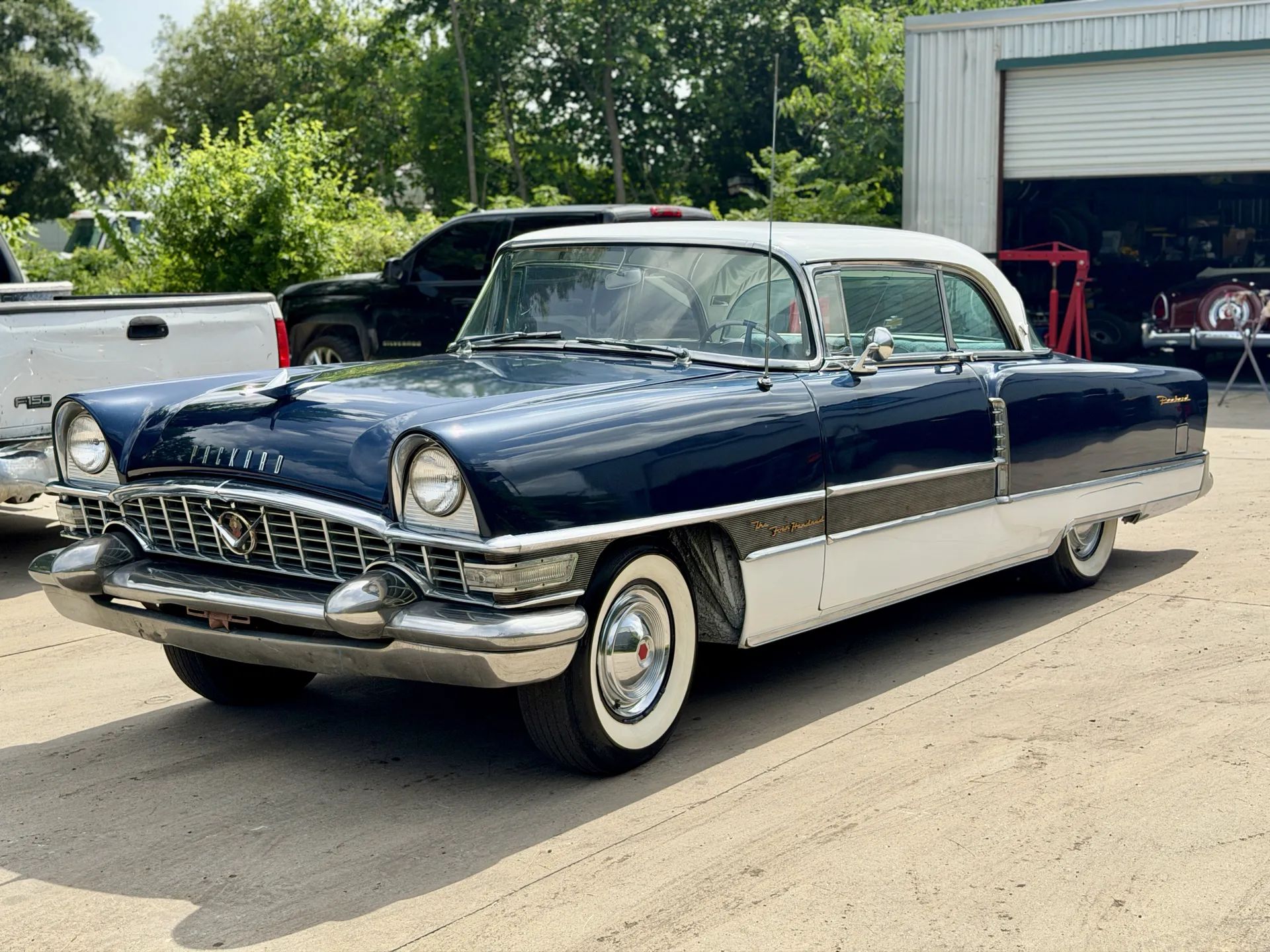
There’s been a lengthy discussion on the AACA forums recently about changing attitudes toward restoration, the subject of debate being a pair of long-dormant 1955 Packard Caribbeans. A couple decades ago, those were no-argument $100,000-plus cars that would have likely gotten the full treatment, but today, restoration costs and declining real-world value make that proposition remote. Therefore, is it OK to simply “get them back on the road?” I think so, but that’s less of a concern with this running and driving 1955 Packard Four Hundred, which is a project that needs some TLC but is perfectly presentable. It’s for sale with no reserve on Hemmings Marketplace in Houston, Texas.

The Packard’s door tag tells us that it is indeed 1-of-7,206 Four Hundreds built in 1955, and it’s a fairly early one, the 526th to be specific. With a base price of $4,080, the Four Hundred ranked just behind the Caribbean Convertible in exclusivity, but this one’s had a few changes along the way. The paint code of “MV” tells us that the original colors were a two-tone combination of a White Jade top and an Onyx bottom, while the interior (85) was “White Orchid Cloth and Black Patent Imitation Leather,” according to the Packard Club’s reference data.
The seller does mention that the car was repainted at some point in its past but is otherwise original.

But there will be issues for the new owner to deal with. Aside from a parasitic draw in the electrical system and an engine that could use a tune-up (although it seems to run fairly well in the advertisement’s accompanying video), there’s the suspension system to deal with. The 1955 Packard Four Hundred had a front-and-rear torsion bar system with load-leveling capability; it was called “Torsion-Level Ride,” beating Chrysler to the punch by two selling seasons.
You could probably see that our featured Four Hundred was sitting quite high in the front. This Packard-produced video shows us how the system is intended to work.
Jay Leno’s garage also discusses “Torsion-Level Ride” on Leno’s 1955 Caribbean. It’s apparently not uncommon for these systems to need some repairs, as you might expect. I spent the better part of an hour examining how everything works before reminding myself that I don’t plan to buy a 1955 Packard, so I don’t need to fix this car myself.
But rest assured it can be done, as many people have braved the trail and left their advice on the internet. See a discussion on the Packard Club here.

The Four Hundred had Packard’s brand-new 260-horsepower, 352-cubic-inch V8, an engine that was designed for almost unlimited growth over its life; unfortunately, it would only stick around for two years before Packard production switched to Studebaker’s platform and the South Bend assembly line. Backing up the 352 is the other part of the car (aside from the suspension) that would give me a little pause: the Packard “Twin-Ultramatic” automatic transmission. In theory, it was a lot like a Buick Dynaflow, a torque-converter automatic that didn’t shift in the traditional sense. Apparently, there were some reliability issues at first, but I suppose that if a car’s been kicking around for 71 years, this must be one of the good ones, right?

The interior looks like it’s in good shape, although the color combination has been changed to match the exterior paint colors. The dashboard is magnificent, and the dash pad and upholstery don’t show any obvious signs of rips or tears. The Four Hundred does have power brakes and power windows, and given that the seller takes the car for a drive with the windows down, I’d guess that they work.

The Packard will need an exhaust system and a new set of tires, and there’s a little rust on the passenger rocker panel that the new owner may want to do a spot repair on.

But like many of the commenters on the AACA Forums have pointed out, you don’t need to do a full restoration to enjoy an old car, and that’s one of the best things about living in the 21st century. You can get a car cleaned up, get it running reliably, and enjoy it, and I think that’s what the new owner will do with this pretty Four Hundred.
Related Reading
Curbside Classic: 1955 Packard Four Hundred – Bravely Facing Forward (by Jason Shafer)
Curbside Find: 1955 Packard Caribbean Convertible – Going Out In Style (by Rich Baron)
Curbside Classic: 1956 Packard Patrician – Please Proceed to The Lifeboats (by JP Cavanaugh)























Very pretty car, stylish in 2dr hdtp version.. Cool v8 power… Too bad so many great cars went under
Nice – I find these technically interesting due to their suspension system, which, according to Jay Leno, works really well when in good fettle.
Having in the past done restorations, Io now like to make a vehicle terchnically as good as possible and then drive it, not worrying too much about shiny paint. My latest project has “patinated” original paint and I think I’ll leave it that way.
I really like this Packard – unusual, presentable and pretty much drivable – I’d be all over it at a car show…
A very nice example of Packard’s quality. I had a 1955 Patrician 4 door sedan, sme color exterior, but a green interior. The Packard 352 ci V8 was extremely smooth. One of the interesting quriks of the 1955 Packard line was their electrical system, the actual Packard wiring was insulated with Packards own developed insulation, Hypalon. The cars were the only US cars to have a poaitive ground 12 volt system, for 1956 Packard followed the rest of the US manufacturers cy switching to a negative ground.
Transmission, the Ultramatic was a 2 speed gearbox with a very interesting torque converter, it was in some ways similar to a Dynaflow for torque multiplication, but it had a lockup clutch like most modern automatics have. In normal driving you used only the torque converter with the two speed transmission in high performance was reasonably adequate in normal traffic. If you needed a quicker take off, the second drive position would start in 1st gear, shift to direct and then the converter lockup. Since 1st gear was a 1.82:1 ratio, it was sort of a giant Powerglide with a locking torque converter.
The “torsion Level” suspension had one quirk, the main tosion bars ran almost the entire length of the wheelbase, the “levelizer” bars ran from the center of the frame back to the rear levers of the main bars. As a result of the front suspension having king pins, there was no anti-dive geometry possible, the car would actually bottom the front suspension under haed braking, then would slowly even itself out, if you took of using 1st gear the design of the rear suspesion (trailing arms and Watts linkage) the car would stay pretty level. There was a disable switch on the for left end bottom of the dash and when we wnt to a very nice restaurant that had valet parking, I showed the yound attendant it’s location, and asked him to please turn it off when he parked the car,as kids loved to go sit on the rear bumper and then get off, running the battery down. Needless to say, it stayed off when parked at home.
Doesn’t this car have a green interior? Looks green but it’s hard to tell.
I’m a big fan of these last real Packards, I find their styling more appealing than their Cadillac contemporaries.
I kind of stirred up the topic about fixing a car up, versus restoration, over the years on the AACA forum. While I appreciate a fully restored car, what are we supposed to do with all the cars that are in pretty good shape, but far from Concours condition? Just let them sit and rot? Tear them apart as parts cars? This featured Packard is in very good condition, the two Caribbeans discussed on the forum are in much poorer condition, but look like they could be rescued and resurrected. They would not be show worthy cars, but they could be fixed up into presentable and interesting drivers. Over time, and with subsequent owners, a car can be steadily improved, which is often the case. Even if they are not improved, they can be preserved and maintained.
If a person wants a “perfect” car for serious showing, it is now easier and cheaper to buy an existing correct restoration than to try to completely restore an “average’ example. Many members on the AACA forum are quite interested in show competition, and don’t want to deal with “driver” quality vehicles. That’s fine, but I feel that most average hobbyists aren’t interested in sinking 100,000+ dollars into a full correct resto. I’m one of the hobbyists that likes old cars, but can’t, and won’t, take out another HELOC loan to finance a hobby project. I see quite a few older survivor cars displayed at my local Cars and Coffee events and I make it a point to welcome and encourage the owners to drive and to continue to maintain and improve their cars. These owners are often younger people that have an interest in the hobby, but aren’t in a position to spend a lot of money on their cars. I like to see all kinds of cars being rescued and put back on the road.
I’m with you 100%, Jose. Although I’ve enjoyed attending concours car shows in the past, I’ve had no desire to own something that nice. It takes a perfectionist mentality and/or a need for other people to approve of what you’ve done, and I just don’t have either of those to any great degree. Still, I’m glad some people do and I enjoy seeing their work, but I’ll always make a beeline to the well-worn car on the show field.
At the very least, I’m glad that the mentality about getting old stuff on the road with expedience rather than spending years or decades to make something better than new is changing. There are a lot of old cars out there, and plenty of them are lots of fun with comparatively little expenditure.
If someone’s willing to troubleshoot the suspension on this one, it might be a great buy. I wonder if it’s an electrical issue; the brake lights don’t work and it seems like they’re tied into the load-leveling system.
The various electrical gremlins don’t sound particularly insurmountable, but membership in some sort of Packard discussion group would definitely be in order.
With that in mind, a little research, work, and the relatively low buy-in could make this Packard quite a cost-effective and unique car show attention getter.
,,,If someone’s willing to troubleshoot the suspension on this one, it might be a great buy. I wonder if it’s an electrical issue…
That would be the case, if the vehicle was sagging to one side. Watching the seller’s video, sagging at the rear with constant bumper stop bottoming out brings up a more peculiar issue of which shouldn’t be present, when each side has its own longitudinal torsion bar anchored at the levelling motor. It’s as if only the bar halves springing the rear axle have weakened
Handsome, holdout.
Given that a professional restoration can start at $40K and easily run to $100K there aren’t many cars that warrant such a treatment by producing a positive return. Spend $100K of a 427 Cougar GT-E, yes, and a few other choice cars, but otherwise no. A Grade 1 car is a perfect original with the key word being perfect and it is accepted that the restoration was done by a professional shop. A Grade 2 is an older Grade 1 or restored to basically original condition but not going over board on panel gaps if you catch my meaning. I shoot for Grade 3 which a a nice presentable car in body, interior and mechanically. Grade 4 needs a lot of work in every category and rust is making it’s presence known. Grade 5 being close to junk. This Packard I would rate a 3- based on what I read. Collector Car says a Grade 3 is almost $27K. Can this even hit $20K? Being no reserve we will know in three days.
Even $20k seems on the high side. As of this writing, bidding is still at $4,200. Given the Grade 3 shape, if it goes for not much more, seems like it would be worth the trouble and expense for someone who knew what they were doing, especially a Packard fan.
Another good looking survivor I hope gets a chance .
I’d be very concerned about the passenger side door not being closed in two pictures, that’s getting to be fairly common on many oldies and often finding a good latch or striker plate is tricky .
For the average old Packard enthusiast I think this is going to be a bargain .
Parasitic drains are common and usually not difficult to find, just takes some time and patience .
-Nate