

What happens when a store you’ve always loved goes out of business–or your favorite brand of cookies isn’t being made anymore–or the new version of something you’ve always bought isn’t quite as good as the old? Well, that was the situation traditional Nash and Hudson buyers faced come model year 1958. The newly formed American Motors Corporation had discontinued the big Nash and Hudson cars due to poor sales. But there was an attempt to keep Nash and Hudson loyalists in the fold–a larger Rambler called “Ambassador” (a Nash name). But would this new car appeal to established full-size car customers who were ready to trade in?

Hudson buyers had kind of gone through this same experience already back in 1955. The famous “Step-Down” Hudson (introduced in 1948) was a bulletproof, solid, good-handling, fast car with decent power. Its low, sleek, “slug-like” design was very futuristic in the late ’40s, but by 1954 it was considered very out of date, especially compared to competitors Oldsmobile and Buick, with their OHV V-8s and wrap-around windshields. But to people who could appreciate them, Hudson’s special virtues could not be denied.

Nash and Hudson merged to form AMC, so the “all-new” 1955 Hudsons were based heavily on existing Nashes. Certain Hudson features were retained such as a Hudson-like grille and dashboard, and two of the famous Hudson-built 6-cylinder engines were still available, along with a Packard-built V-8.

To my surprise, Mechanix Illustrated’s automotive tester Tom McCahill (who was very into car handling and speed) actually gave the 1955 Hudsons his seal of approval:
“The 1955 Hudsons have lost none of [their superb roadability] … the car gets around the tightest bends just as well as it ever did…. These Hudsons are great, safe road cars and the brakes are as fine as any I’ve ever tested on an American car.” He added, “If you’re an old Hudson fan, you’ll find the ’55 Hudson your dish of tea.” The new Hornets (both 6 and V-8) were also faster than the ’54s in 0-60 and top speed.

The 1956 Hudson was basically the same car as the ’55, but with all-new “V-Line Styling”. The traditional Hudson emblem is in the shape of a “V”, so the idea here is to plaster “V” shapes all over the place, including the grille, fender tops, interiors, etc.

Hudson’s 1957 model featured minor styling revisions, but the big change was under the hood–a brand new AMC designed V-8 (shared with Nash). It displaced 327 cubic inches and put out 255 HP (and it did so “smoothly and quietly” according to one magazine). There were also changes to the steering and suspension that improved handling ease. To me, these improvements make the 1957 model the best of all the 1955-57 AMC Hudsons.


In the early postwar years, Nash was producing a car somewhat similar in concept to what Hudson was offering. One year after the introduction of the Hudson “Step-Down”, Nash introduced the “Airflyte” – a car with even more terrifying looks than the Hudson! Like Hudson, it was a sleek, roomy, low-slung sedan with unitized body construction. Lest the car be accused of having something as primitive as “wheels”, the front wheels were covered halfway by a single continuous fender line which extended to the rear. This gave the effect of an enormous streamlined mass levitating over the road with no visible means of support! It also reduced space for the front wheels to turn, making the cars handle more clumsily than they normally would have.

After a 1952 “Pininfarina” restyle of relative purity, the Nashes became even stranger looking with each passing year, although retaining their unique virtues. This culminated in the final 1957 model, which introduced to the public for the very first time (along with a few other makes)–quad headlights!

Now it’s 1958, and “What to do–what to do?” The compact Rambler is selling great–117,000 units! Meanwhile, Nash and Hudson are only selling about 3,500 cars each–unsustainable! So the decision was made–ax Nash and Hudson, but offer a slightly bigger Rambler and call it . . . Ambassador!

But wait, wait! Not so fast! Look:


Before AMC pulled the plug on Nash and Hudson, there was a plan to offer the 1958 Ambassador in both Nash and Hudson versions, with slightly different looks for each “make”. But this plan was scrapped as the decision was made to unify all cars under the one successful name, “Rambler”.


So what does this new Ambassador offer to current Nash or Hudson owners? A potential buyer might be thinking: “Well, it’s made by the same company formerly known as Nash–a name I know. It’s got unit construction. It has the same excellent Nash/Kelvinator low-cost air conditioning. It has the same 327 V-8 engine as last year’s Nash and Hudson. There’s a V-line in the grille, like the Hudson, but no mechanical safety linkage in the brakes like the Hudsons always had. It drives like the previous models–what I’m used to. The compact size should make it easy to maneuver. But it’s a little less roomy inside, particularly width. The price is about the same as previous Nashes/Hudsons. Has the reclining seats. The trim and assembly quality seems fairly high. Might be good.”


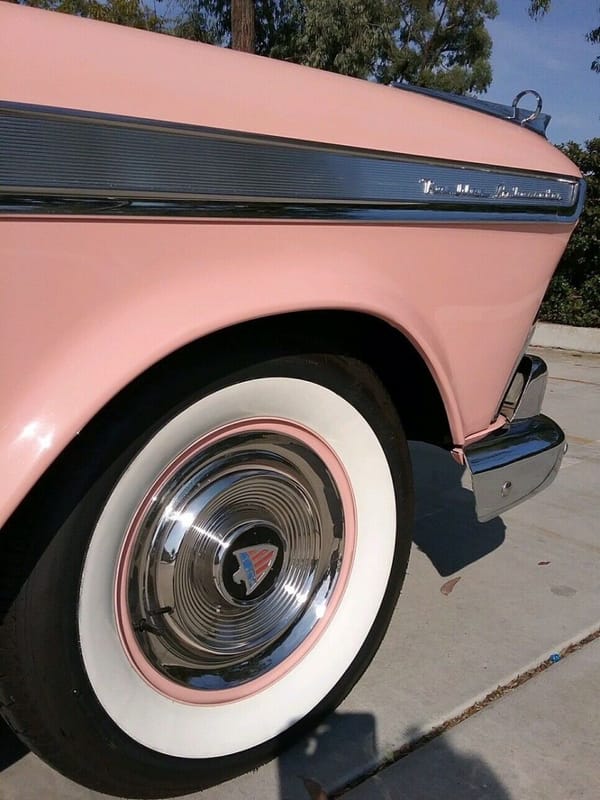


At the end of the 1958 model year, Ambassador sales reached roughly 7,000 units–about the same as 1957’s Nash/Hudson total. So things remained pretty much status quo in this price range. However, sales of the lower-priced compact Rambler surged to a new high–119,000 units. In addition, 42,000 even smaller, bargain-basement Rambler Americans were sold. The verdict–cheap sells!

Nevertheless, the Ambassador model was continued in 1959. AMC photographers did their best to make the Ambassador look as glamorous as possible.


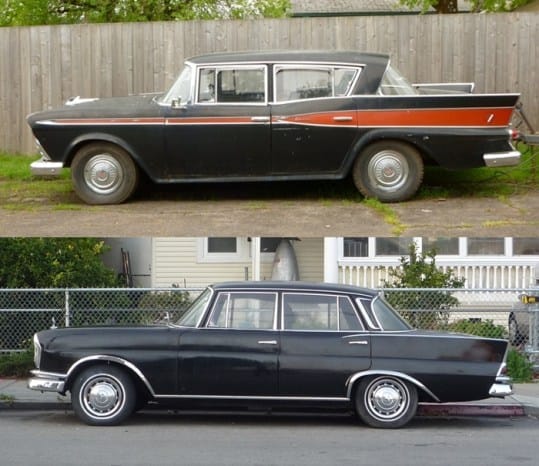
In theory, Ambassador should have been a hit. Compact cars were a growing trend in 1959, and the idea of a “compact luxury car”–tightly built, with high quality trim and upholstery and good performance in a more convenient size seemed like a winning combination. Sort of an American version of what Mercedes-Benz was doing in the 1960s and ’70s.

However, there were a few things wrong with this theory. Consumer Reports (and other automotive magazines) reported that despite the Rambler’s clear advantages, these cars were “not thoroughbreds.” Because they were constructed using older Nash componentry, the steering, ride, and handling were not up to the high level now set by the “Big Three” competitors in this price class.

So which would you rather have–the blocky-looking Rambler Ambassador or a sleek, all-new Wide Track ’59 Pontiac? The starting prices for both were about the same (about $2850). You could also get a Torsion-Aire ’59 Dodge or a super-plush and roomy ’59 Mercury for about the same money.

Then there’s the prestige factor (or the lack of it). When you’re spending a little over $3000 for a car once a few optional extras are added on, you want something that will impress the neighbors. Despite the Ambassador’s added length and slightly better trim, most people will see it as just another Rambler. And Rambler is perceived as being a low-priced, economy car. As Tom McCahill said, “The Ambassador looks like a Rambler with a longer name.” Maybe if AMC had called it a Nash or a Hudson things would have gone better?

Despite its identity crisis, things did get better for Ambassador in 1960. A styling refresh certainly helped, and sales climbed to 23,798–a big increase!

But then AMC stuck a really ugly front end on the ’61, the primary advantage of which was to make the 1956-57 “V-Line” Hudsons look classy and artistic by comparison. Sales tumbled.

So in 1962, the “big” Rambler body and chassis were dropped, and the Ambassador was the same size as the smaller-sized Rambler Classic. Nearly all the upscale pretense and distinction the Ambassador once had was gone.
American Motors’ identity crisis got worse from here. In 1966, the decision was made to drop the Rambler name and all cars became “AMC’s”. (Rambler stayed on for a few more years as a “series name”–the small cars were called “AMC Ramblers”.) Everyone knew what a Rambler was, and the brand had a good reputation. AMC meant little or nothing to most people. The company started to make big cars again, in a futile attempt to compete with the Big Three. Nash and Hudson were long gone, so Ambassador was trotted out again, along with Matador (a name used by Dodge for one year only, 1960) and few potential customers knew or cared what these names represented (A big car or a small car? Luxury or economy? Competing with Chevrolet or Buick or what?) This culminated in the ridiculous commercial above, in which the company actually admits that no one knows what a Matador is, but anyway it’s a good car and you should buy one!

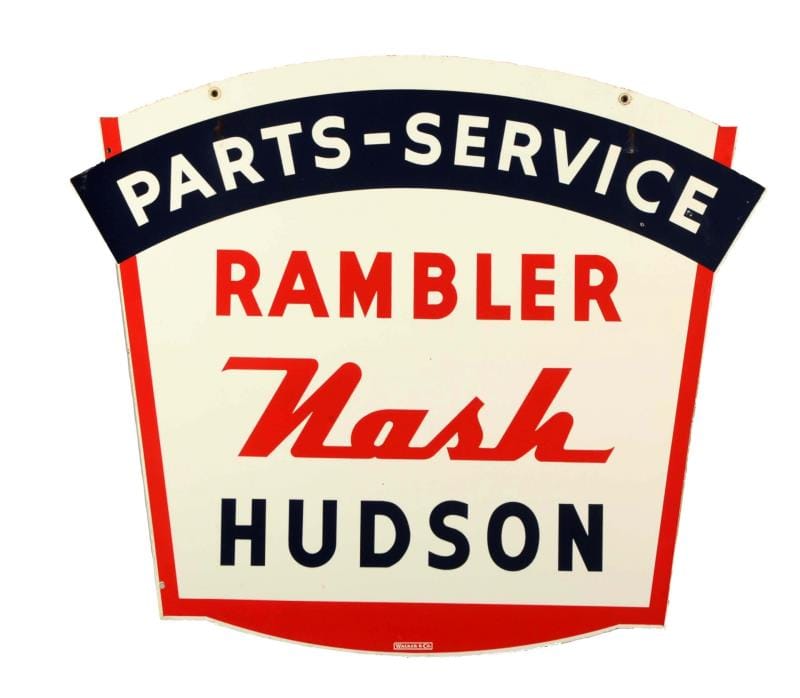
I think the lesson here is that brand names mean something, and the intangibles they represent can be hard to duplicate once they’re gone. And when they’re gone, it’s almost impossible to revive the names once again. It could be argued that Nash and Hudson were “old hat” and no one wanted them anymore, but I think that keeping the three brands (Rambler for compact economy; Nash and Hudson as distinct mid- or full-size luxury models) would have served AMC better than the rather haphazard marketing approach the company took in the post-Romney era.























Was the 1959 Rambler the first car to be offered with separate head-rests?
The Rambler name was phased out in stages. First in 1966 from the Ambassador and Marlin, then in 1968 from the Rebel and finally in 1969 when the “American” name was dropped and the compact used “Rambler” as its model name. The AMC brand name and badging were adopted for 1970 when the new logo was also introduced.
Your presentation with comments is excellent. Your conclusion regarding brand names in on spot. Thanks for the essay. I remember in the early 1960’s a mother explaining to my father, in his store, her woes that her daughter is dating a guy who owns a ’58 Rambler because the seats recline into a bed!
AMC handled the equity in their plethora of brand and model names about as well as BMC…
This car just looks very “post wwII, eastern European”. It doesn’t convey “fun”.
At some point, the idea that well-known names have value became known as ‘brand-equity’. To this day, there are some in the auto industry that simiply refuse to die and truly mean something. A couple that I can think of that have lasted since the sixties are, of course, Mustang and Charger to the extent that, to some, Mustang means Ford and Charger means Dodge.
It is, indeed, a pity that the execs at Nash/Hudson/Rambler didn’t clue into this idea and couldn’t, somehow, utilize it to better effect. Switching from Rambler to AMC after the merger wasn’t a particularly bad idea; it just could have been executed better, maybe with styling that was a bit more sedate and not so ‘out there’.
At least Rambler didn’t pull a Studebaker and slap on goofy stuff like headlight pods and double tailfins.
I was amazed to see that you featured a `58 Ambassador 4dr. I remember seeing in Hemmings awhile back! This is one extremely rare car, and I think it’s mostly original. Notice it has power windows, which probably only a fraction of 1% were equipped with. But the main feature of this rare Ambassador wasn’t even demonstrated–it is a highly prized 4dr. HARDTOP with no B-pillars!!! There can’t be more than 1 or 2 of these that survived; I’ve only seen a dark copper `58 Ambassador wagon hardtop, but THIS is the only 4dr. hardtop I’ve laid eyes on!! You should have had the photographer lower all 4 windows!!
Great article, Mr Pellegrino, as usual.
The featured ’58 resembles what it possibly is, a series of corporate panicked who-knows-if-we’re-sinking decisions. Nash? Hudson? Rambler? Lifeboat? Mayday?
My god it was an ugly car.
The featured car, while impeccably restored, just seems off styling-wise to me. It’s as though a Checker Marathon and the Dodge La Femme had a bastard love child. Especially in that color.
That was my first thought when I saw the article’s first photo.
As I read this very well written essay, I got down to the 1973 “What is a Matador?” commercial, and there at Curbside, was dear old dad from this tryst, right there in the very first second of the video… a pink Checker Marathon.
While this color was probably not a recessive gene in the fifties, assuming this color is normally a recessive trait, the genetics here makes complete sense as to the parentage of our featured ’58 Ambassador.
EDIT (upon further review)… The Marathon couldn’t have been dear old dad without the use of a TARDIS… Apparently, this Ambassador predates the first Marathon by a couple of years… my bad.
A nice little car .
-Nate
Contemporaries suggested that what AMC did regarding brand names were good ideas. It is for us, from 50 years later, to suggest otherwise. Hindsight wasn’t an option then. AMC didn’t make mistakes with their brand-equity. They had much bigger problems than names. We aren’t smarter than they were. They were actually witnesses to the challenges we’re blind to. They were committed to doing the best they could, and they did. Problem was, American buyers were enamored for those cars that even today, command high collectable prices. Even today, a 1969 Mustang is worth more on the market than a 1969 Javelin. A Dodge Coronet, is worth more than a Rebel, or a Matador. There has been a top of the line AMC Ambassador listed that has low miles, special paint treatment, and superb condition that can only bring in a fraction of what a Camaro that same year is selling for.
So you see, even today, we don;t value these cars higher than the Detroit 3 line of cars, so exactly how can we make any argument that suggests that AMC could have just named their cars differently, and find success?
Very well put. Just because time has passed does not make us any smarter than those who came before us. Just as now, they had to deal with what was real for their time, not what someone 50 years later thought.
I really like the pink Ambassador except for that tumor, I mean tire planted on its rump. I can never understand why someone thought it was a good idea, as well as attractive, to add extra inches of length as well as weight to the rear end of a car. However that is just my opinion and my thinking is not based on the trends of the time as stated above.
I can remember these cars when they were practically new and always found them interesting.
This is an enjoyable write up of an automotive era in the USA of which I was a serious teenage student, but of a manufacturer (well two) that I tended to pass over in my reading of car magazines and ads.
I knew Packards and Studebakers because I either drove them or stumbled across them in my family’s cohort, and I mourned their later demise because of that familiarity.
Sadly, there were no close up experiences with either Hudson or Nash other than reading “On The Road”, so their passing went unmourned by me. My father did speak highly of “Twin H-Power”, but that didn’t sound so great to me at the time. Perhaps I thought, it was more of an old man’s reminiscing about old times.
What overwhelmed my, and many others automotive attention? The answer lies in the included photo of an Art Fitzpatrick and Van Kaufman ad for the 1959 Pontiac.
This attraction could be attributed to the relative immaturity of my 14 year old brain, but obviously more mature minds, with the ability to pay for such products, were also paying attention.
This was an era when advertising was clearly shown to be persuading more than selling. It did not start then; Paul N’s Beetle post showed small people in big bugs. But Fitzpatrick and Kaufman perfected the “art”.
A low-cost, low risk solution. All it had was a longer front end. The 1958 recession, which was a huge boon for Ramblers undoubtedly crimped Ambassador sales. And the boost the Ambassador got in 1960 was most likely a reflection of the improved economy.
These Ambassadors were a very rare sight back in the day in Iowa City, where the other Ramblers, especially wagons, were extremely popular with university families. They were the Volvo wagon of their time.
Nash was the supreme amortizer, so it seems odd that they didn’t continue the Hudson fail-safe brakes. If Foster’s books are right, they adapted the system to the Hash platform in ’55 and ’56, then abandoned it. After they owned the rights and knew how to make it, there was no reason not to continue a valuable (and lawsuit-preventing!) feature.
Like that “sleek, cartoonish, Hudson”!!
AMC’s marketing confused people. Nash, Hudson, Rambler as the cheap car at a Nash and Hudson dealership, Rambler as a brand that spanned all price ranges, Rambler as a model again as the cheap car at AMC dealers and finally AMC with a side order of Jeep all in less than 15 years.
I cannot agree on the brand equity in the “Rambler” brand name. Rambler had been a Nash model – my mother called them “Nash Ramblers” the rest of her life. I think of the Rambler like I think of the modern “Ram” trucks. How many people do you know who still call them “Dodge Ram”? I know a lot of them. I know some who even call them Dodges. Rambler just never sounded right as a brand name. But it was a great model name.
American Motors had started as the umbrella name to existing brands, the way GM was the umbrella to Oldsmobile. AMC became an umbrella with a single brand – that eventually was – AMC. Also, these were clearly the place where Nash customers went. I am not sure longtime Hudson buyers were quite so comfortable there, except maybe when they bought one from their longtime dealer.
But the 58 Amby matching sales of the 57 Nashes and Hudsons – that was no small feat for a mid-priced car in a terrible economy. That price class really crashed in 58, so the Ambassador was quite successful by comparison.
By the late 1960’s the “Rambler” name was lot poison ~ it was viewed as an old ladies car .
Yes, I now know there were good and even great Ramblers but that’s how it was then .
-Nate
Rambler was a weak, tentative sort of name….close to the word ” trembler”….at least that’s how I saw it as a boy.
I can’t help but wonder how different a picture would have been painted had Hudson held back on debuting its Jet until the time that smaller cars became a thing…? Hudson managed to sell 70,000 cars and make a $8 million profit in ’52, then lost $10 million on nearly the same volume in ’53 because of the dreadful expense of producing the Jet that year, when small cars (especially homely-looking ones) just were not market appeal…even less so when said homely small car in its stripped version cost $200 more than a Ford or Chevy, both of which were engaged in a price war at the time. That was what caused the merger, and George Romney’s eventual deletion of the Hudson name (Nash was thrown in as well mainly to make him look like he wasn’t just targeting junior-partner Hudson, but Hudson president A.E. Barit saw through the ruse and resigned in a fit of pique). Had Hudson used that money to make a new V-8 Hornet and/or Wasp, like they should have in ’53, would they have lasted a bit longer than they actually did? All purely speculation; what-ifs aren’t facts.
Indeed, I agree there. And it isn’t the first time Chrysler pulled that stunt. They turned the Imperial, previously a high-end trim option for Chrysler-Division cars, into a separate division to compete in the luxury class…yet all through its life most people still called it the “Chrysler-Imperial.” Unable to make its own identity (among other issues at Chrysler), Imperial disappeared in ’75 with little notice; even two later attempts to bring the name back went hardly noticed.
That’s how I feel about their pickemups and other trucks they market under the “Ram” name. It also makes for snide comments when they are involved in collisions: Too much Ram, not enough Dodge.
It’s also good to remember that the Ambassador had the same cabin size as the standard car. The extra length was all in the hood. I think they would have sold much better if there was more passenger room for the extra money.
>>What happens when a store you’ve always loved goes out of business–or your favorite brand of cookies isn’t being made anymore–or the new version of something you’ve always bought isn’t quite as good as the old?<<
My grandfather demurred and bought an ………………………
EDSEL! The Hudson dealer in NJ became an Edsel dealer so grandfather got a fully loaded 1958 Edsel Citation, turquoise and white 4 door.
A lemon. Never bought another Ford product, switched to Chrysler and got a new one every year hence until the 1965 New Yorker, which he kept until his passing – now that was a great car.
Based on your description, your grandfather’s Edsel would have looked like this:
Too bad it turned out to be a “lemon”. Another black mark on the Edsel reputation. This Citation hardtop (top of the line) would have been a real luxury “dream car” in its time.
I’m always amazed at the writers here that literally make up the story. The 1958 Nash Ambassador was ready for production. Even promotional film exists of the 1958 Nash Ambassador. Romney simple at the very last second, killed the Nash and Hudson name….it’s that simple…..a couple weeks before production was slated to start, he killed the name…there wasn’t big marketing decisions made. If you look closely at any 58 Rambler Ambassador Wagon, you’ll find the name Nash stamped on the rear bumper in the center where a trailer hitch goes. It’s that simple, no plan, just a whim of Romney to kill the Nash and Hudson name…..Mason was rolling in his grave.