

Ford produced almost 1 million of these full-size Fords in 1960, and how many remain today? Very few. Not known for their longevity, I would say about 95 to 99 percent of these ’60 Fords were gone by 1975, based on my own car spotting experience. It always amuses me–what rather unique set of circumstances allowed a car like this to survive while most of its brethren were crushed long ago and forgotten?
From Craigslist. Location: Fairlawn, NJ (next to Paterson). Price: $6555.

Well, technically it’s a Galaxie Town Victoria; not a Town Sedan. It has the base V-8 (292 cubic inch Y-Block), power steering, and power brakes.

I’ll start by saying that I’m not a fan of these ’60s style mag wheels. They’re good looking rims, mind you, but they don’t belong here. To me, this Galaxie is a true nostalgia piece; a rare artifact from a time often fondly remembered, and a car so rarely seen today. So if I were to purchase this car, the rims have to go and we get the original 1960-only wheel covers. I would also prefer whitewall tires, but if these blackwalls are the correct radial size and in good shape, I would keep them.


Ah, there’s that distinctive rear that I remember from years ago (and about in this condition). For some reason I saw more Galaxies than the lower-priced Fairlane 500s and Fairlanes. Just as I saw more Chevrolet Impalas than Bel Airs and Biscaynes of the same year. Arizona license plates–so that’s why this rust-prone Ford hasn’t dissolved into a pile of brown flakes!
I found out that Consumer Reports wasn’t particularly enamored with the all-new 1960 full-size Fords (the V-8 they’re referring to is the 292 version which our featured car has):


However, in another part of its review, CU did praise the new Ford for its excellent ride and good handling on open-road curves. Overall, the CU automotive writers preferred the all-new Falcon, though I have to say, this Galaxie is like a limousine compared to the rather spartan, choppy-riding, and not-too-roomy Falcon.
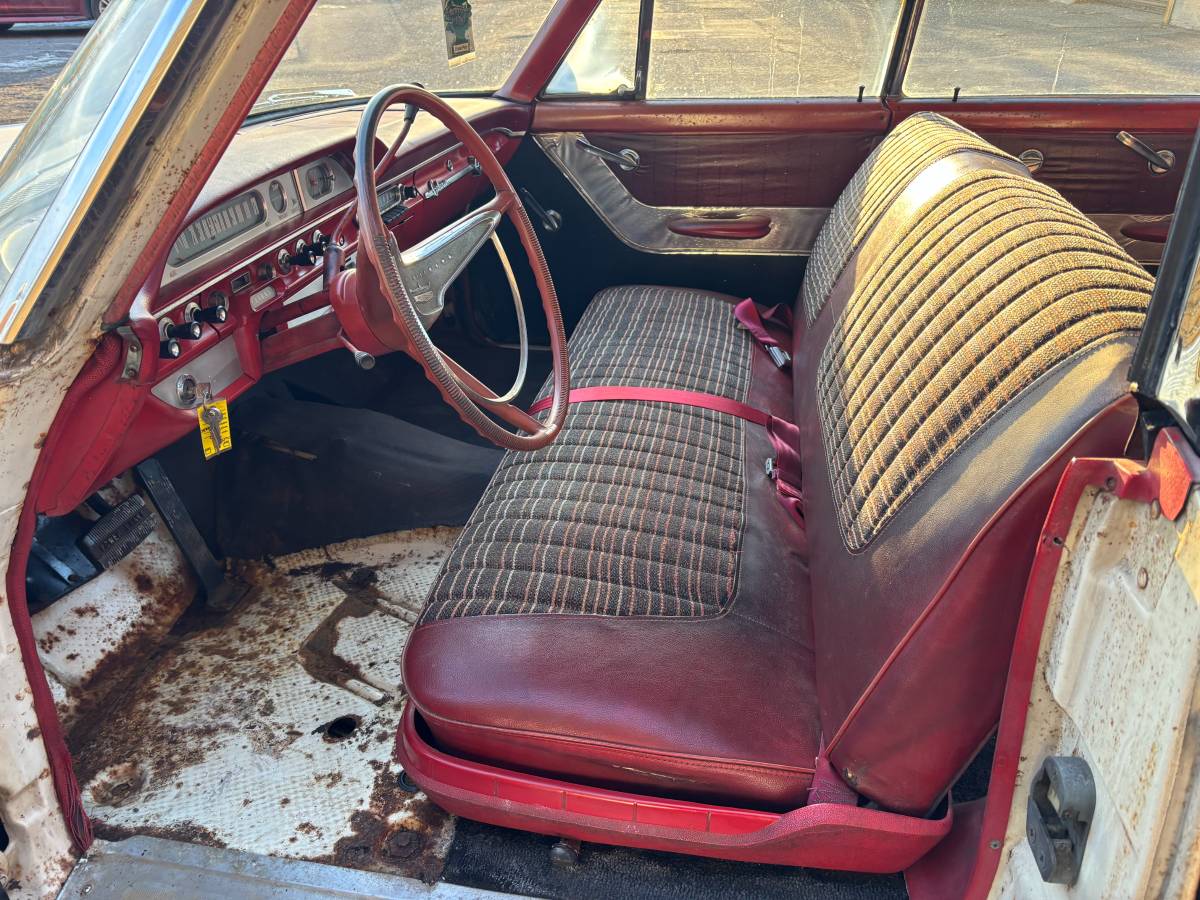
I’m liking the fact that the original upholstery is intact and in fairly good condition. We would need a new carpet set, which I would put added Dynamat-type insulation under.
Rear compartment:

Dashboard shots:


This example has the optional Cruise-O-Matic Drive, with its two drive positions. Select D2 and the car starts in 2nd, then upshifts to 3rd. In D1, 1st gear (Low) is engaged, and the shift pattern is 1-2-3. Even though I’m right-handed, I appreciate having the ignition switch on the left, which enables you to turn the engine on and off and retrieve the key while standing outside the car.

I like studying details like this electric clock. I have to tell you that if you have a car of this vintage and the little clock keeps accurate time, it’s a very useful thing to occasionally glance at as you drive. I’ve had quartz conversions done and I have been very satisfied with the results.

Here’s the venerable 292 cubic inch “Thunderbird” Y-Block V-8, putting out an advertised 185 Horsepower. That’s 40 more HP than the 223 six in my ’58 Ford. But a 1960 Galaxie Town Victoria weighs 500 lbs. more than a ’58 Custom 300. So maybe the performance of both cars is about the same? The brass cooling system tank was put in place to accommodate the new downward-sloping hood.

1960 Ford buyers got a vastly bigger trunk than before. Trunk lining and jack appear to be original.

So I’m kind of liking this survivor ’60 Ford. It’s got a lot of things going for it like the condition of the upholstery, door panels and dash pad; the fact that the engine runs, and the rust situation doesn’t look too bad. White is an easy color to match, so a lot of brown areas could be touched up to invisibility from several feet away. I like the price too: $6555 (negotiable?) You can’t get much in the collector car market for that amount these days. If I were “in the market” I would go check it out.

What would this ’60 Ford be like to drive? I would assume it would be much like this ’62 Mercury I once had, since both cars share the same body shell and lots of other components. But my Monterey had the thundering 390 cubic inch V-8 with 300 HP! It purred like a kitten and had tremendous torque–I believe it is a much more refined engine than the old Y-Block. The Mercury also had softer suspension tuning and a very “Cadillac-like” feel on the road.

Compare dashboards: Same basic design as the ’60 Ford, but the Mercury version is a lot fancier!

Here I am with my ’58 Ford Custom 300–it’s another odd survivor that “should have” been crushed, but somehow wasn’t. The fact that it was kept in the original owner’s family and passed on from father to son is what saved it. What a difference in personality from the ’58 to the ’60–even though both cars share engines, transmissions, and lots of other parts. I have to say the ’58 is a very likable car, and not “very large and unwieldy” as Consumer Reports described the ’60 model. It’s a foot shorter than a ’60, rides a little firmer, and with power steering handles very well. I’ve had it for about 12 years now, and it has been the most trouble-free old car I have owned.

Here’s a Ford publicity photo that I think shows off the new Ford styling in a dramatic way. This is a Fairlane 500 Town Sedan, one step below a Galaxie. It has a wrap-around rear window (which I actually prefer) instead of the flat window on the Galaxie.

Here’s what our subject car looked like when new–and it could look this way again if it finds a new owner who wants to put a fair amount of love and care into it and restore it to its former glory.
Further CC reading:
eBay Classic: 1960 Ford Fairlane 500–Finest Ford of a Lifetime by Stephen Pellegrino
Curbside Classic: 1960 Ford Fairlane–Upstaged By The Rest Of The Cast by Jason Shafer
The Mystery Of Why The 1960-1962 Ford 292 Y-Block V8 Was Such A Slug Is Finally Solved! by PN























I have always had a strange fascination with these 1960 Fords. And you are right, these all seemed to be gone from the roads by 1975 (or even 1972 or 73 by my experience), while 1960 Chevys remained out in small numbers all through the 1970s (and even Plymouths, built in much smaller numbers, were more common after about 1972).
I am also fascinated by steering wheel designs that lasted for only a single year, and this is a prime example. This wheel design never looked right to me. Everyone else must have agreed.
As the former owner of a 1961 Thunderbird, I can attest that the left-handed key is also great for one other thing – you turn the key with your left hand as you hold the shift lever up with the right in order to engage the sloppy neutral start switch.
The steering wheel looks like something out of War of the Worlds.
Sounds like my 63 comet convertible I sold last year… Same starting method…!!!
I like the syling of the full sized ’60 Ford outsized as it is. The ’58 was a good package overall though the headlights never seemed quite as well integrated as the ’57 or ’49 -’56s for that matter. My mother was known to drive a ’53 Customline and ’58 Fairlane 500 in a spirited fashion. Even as a 12 y.o., I had to remind her what she was doing to the tires with burnouts and the two-ton twist. I agree the wheels don’t do justice to this ’60 Galaxie.
Nice enough wheels, but not for a four-door.
Andy Griffith fans will note, the 1960 Ford was the 1st Mayberry police car, even though a ’59 was used in the pilot on the Danny Thomas Show. Since the show aired in late 1960, it wasn’t seen long and a new 1961 Ford replaced it. I don’t remember the car much, but my folks had a ’62 Mercury like that, same color, it was my moms favorite car. The under hood shots indicate the “rusty geyser” of years ago, and I thought the expansion tank was copper. Guess not. I remember some 1960 Fords had tail lights in the bumper( Galaxie?) that was cool. Ford had such great designs then.
I seem to recall reading those bumper taillights were actually accessory reflectors. Must’ve been popular in your neck of the woods.
The “white” color of all the cars that came down the Ford assembly lines for 1960 is actually a cream off white. Not at all hard to custom mix but it isn’t off the shelf generic white.
As for how they drive: their braking is average for a car of that size and weight in 1960, meaning that any guest who tries it out will exit with a hair on fire warning that you must see your mechanic immediately because your brakes are shot (which they are not. That is as good as drum brakes of the era were).
You will also learn that you can not make any quick U turns on 2 lane roads. The 1960 full sized Ford – Edsel – Meteor has the turning radius of an Olympic sized swimming pool. It earns the designation of land yacht, literally. With practice you can pull off that U from a left turn lane with 2 lanes to pull into. If you just have one lane make a regular left turn.
These cars are roomy and fun head turners. They are not performance champions if judged by 2026 standards.
Corinthian White, very similar to the later Wimbledon White.
Nice car and I love the dual circuit brake conversion. Someone really must have enjoyed this rig. Hopefully the floors are ok.
I absolutely love this model year for Ford, though I’m starting to prefer the Canadian Meteor for its nicer grille treatment. Something I remember reading about these (likely at CC) is that they exceeded the statutory width in a US state, and were therefore deemed to be a truck and it was only a waiver that reclassified them as a car. Perhaps one of the CCommentariat could help.
Sure, Don. The story’s in the Feb ’93 Collectible Automobile. Just which states’ laws were contravened isn’t mentioned, but apparently Ford was threatened with having to fit big rig style marker lights to all new full-size Fords. Ford was allowed to get away with it for 1960 only, on the understanding that ’61’s cars would be back under the 80″/2032mm limit.
Thanks Peter.
Ford had the most modern-looking big cars for 1960; nearly everything else still had fishbowl windshields, tail fins, and other ’50s holdovers.
Was that ridge that runs across the car just under the beltline what caused the car to be so wide? 1961-64 Fords used the same basic body yet were narrower.
Man, my parents purchased a 61 ford wagon that was sold by Calif State after it was released from govt service. is the first US car i remember riding in. bone stock stripper. 3 sp column standard 6 cyl, recirculating heater. no other options. from there we eventually got a 63 country squire wagon with V8 & overdrive around 1970. and externally, i see almost no similarity in the styling of this thing to our 61 & the far more iconic 63s . sure, length is similar & interior instrument cluster is similar to the 61, but the rest? IMO, little family resemblance.
Neat survivor but I hope whomever gets it does a full restoration as the rust is right at the tipping point, unless properly treated in ten years this car will be dust .
My 1962 base model wagon had the 292 CID Y-Block and two speed slushbox, it was adequate, I even towed single horse trailers with it .
I’d think that one year only steering wheel & horn ring might make a good mod in a later model Ford Hot Rod, everyone would be asking “where the hell didja find _THAT_ ?” . =8-) .
Not bad cars but tricky to drive quickly as the steeling was incredibly slow .
-Nate
That was my thought too, Nate. There’s patina, but this is under-surface rust. And it’s widespread.
One reason Ford retained the left side ignition switch was that some Ford engines still used a manual choke. The right hand location of the choke knob made it easy to activate the starter with the left hand while controlling the choke. Despite the dashboard similarity, the big Mercury integrated the shifter control into the steering column while the Ford still had the separate open shaft for the shifter. Never understood why Ford used 2 separate steering column designs during those years. I think Ford was one of the last US manufacturers to use that open shifter shaft.
I am a fan of the 1960 Ford styling. I seem to remember reading somewhere, the width of the 1960 full size Fords was an issue. Were the width of cars in 1960 regulated? These full size Fords were very wide in 1960, and for some reason I think I read these Fords were 1/2 inch too wide? The 1961 full size Fords did get narrower.
I believe that back then many vehicle regulations were created by individual states and the ’60 Ford violated an overall width requirement in some states. It technically required marker lights. Ford was able to grease enough palms (that is me editorializing without facts) to make the problem go away for a year.
This is also why in 1957 four headlight cars could not be sold in some states.
These cars always struck me as being large simply for the sake of being large. It was maxed out on width and that trunk is huge. I have never been much of a Ford fan and cars like the 1960 full size Ford are a main reason.
Of the big 3, Ford probably did have the most sloping hoods on many of their marques as opposed to more blunt front ends on GM and MoPar products. Correct me if I’m wrong, but the remote top tank was only done by Ford for the reason you said.
The only one I’m not sure about is Corvette but I can’t tell from online pictures where the top tank is.
The top tank is required to allow air bubbles in the coolant to escape into the air space on top and eventually breathe thru the vented cap.
For some reason I recall being fascinated by this car back in 1960. Why? How would I know I was only 6. Unlike Paul I was more interested in baseball and tropical fish. Cars sat on the back burner other than washing them as I didn’t like dirty cars. This year Galaxie still fascinates, and you are right, how they just outright disappeared vs other Fords…
You have to wonder what Ford were thinking, to make a car so wide. Wider than any other US car. Wider than regulations allowed, IIRC. And looking at the front-to-rear depth of the trunk, why they made it so long as well. You’d just about have to send an obliging child in to climb in after your luggage. Were they thinking cars would continue to get larger? Were they trying to put more distance between it and the Falcon? Or did they think Chevy was going to keep getting bigger?
I know it was a different world 66 years ago, but it’s hard to imagine the mindset that thought such girth was viable, let alone being a good idea. A Ford that’s wider than a Cadillac…. (shakes head).
I’m not sure how much the Collectible Automobile piece goes into it, but the 1960 was a crash program based on the arrival of the 57 Mopars. Ford took a very handsome concept called Quick Silver and adapted it to fit the road car platform architecture which IIRC was taller than the underpinnings of the concept car. Perhaps that taller basis required the car to be excessive in other dimensions in order stay looking good.
They do mention it. And I get your point about proportions and that carryover chassis. But I’m having no trouble at all visualising 3/4″ off each side; so to the average viewer I don’t think the extra width would have made much difference. Look at the last photo above, with the model leaning out of the window – she has room to rest her arms on the ledge and space left over!
I’d have thought that the studio staff would be aware of that maximum width requirement though, even if it was just some states. Unless they just thought “We are the mighty Ford Motor Company – who are you to dictate to us?”, and relied on being able to bully their way through.
I’d have to look at the CA that discusses this, IIRC an interview with Buzz Grisinger. I think the shock value of the 57 mopars is that they looked so wide compared with the previous gen and everything else on the road. GM did an excellent job with their 59s to reach that same appearance of width.
Again IIRC, it was the height of the firewall under the windscreen that differed mostly from the Quick Silver concept. Parsing that out, with greater height there one would need greater width to retain the same sense of proportioning. And then one would need greater length or else the vehicle might look a bit stubby, hence the gain of one foot over the 59 Fords. These calculations would be reliant mainly on looks, as that was the success of the 57s mopars (it certainly wasn’t build quality hehehe).
I think your statement about FoMoCo’s hubris speaks volumes, particularly as they succeeded in getting this model through albeit with promises for 61.
Tbh, losing that chrome beading alone might have done the job, but the looks would have suffered significantly
A foot longer than a ’59 – strewth! Just as well we skipped that generation of Fords here.
Great find. It’s a bit ratty inside, but cleaner than most survivors of this age and era.
And you are one remarkable preservationist with your 50’s cars, including the 58 Ford above. Excellent. I still like the red Chevy though.
Never particularly liked 60 Fords, but I rather like this, and it’s probably the wheels that make me look twice. I would be keeping them on it.
Car looks pretty solid, a bit of chemical rust treatment here and there, keep it garaged and out of the weather, sort mechanical items and just enjoy.
It’s great to see one of these as a survivor—and I agree about (in Great Lakes Rust Belt) these disappearing faster than the 1960 Chevrolet.
In simple terms, a ’60 wagon was our family car during my elementary school years, so this is wonderful nostalgia for me–including the dashboard. I guess the car is a remnant of Detroit’s peak years of making each model year look greatly different from those before and after. I love the styling—but can’t pretend to be objective about it. My Father was career FoMoCo, and our ’60 wagon was his first new car.
Over-80-inch-width: A big story in the U.S. papers that fall, with each state “making an exception” in one way or another.
If I lived closer, and had a third garage slot, this one would tempt me. I’ll hope it finds a devoted next owner who won’t let it slip away, having survived all these years.
No wider than the ’61/62 body really, it was just those silly side fin protuberances sticking out, all they had to do was shave them off to get it under the statuary 80 inch requirement. There Wass no benefit to that useless width inside vs ’61.
Best of all, it’s a Four Door Pillarless Hardtop! A body styling that’s been ignored for far too long and as a result is unrepresented at classic car shows.
Car shows often show row after row of 2 door coupes and convertibles to the point that the rare cars are now the few 4 door pillarless hardtops that appear.