

I hate to use the word “fake” in this case–better I should say “faux” or “trompe l’oeil” (because saying anything in French makes it sound more elegant–and this car is élégante et très distinguée in its own way). Its design can be described as Streamlined “Art Deco”–a term which itself is a shortened form of Art Décoratif, after the Exposition Internationale des Arts Décoratifs et Industriels Modernes, held in Paris in 1925.

Seller’s description:
This is VERY rare 1942 Chrysler. Production stopped a few months into 1942, making this a one-year-only body style. This car is extremely complete, unmolested survivor with only 18,000 miles and a ton of documentation. It came off the road in 1952 and was purchased by an older gentleman in the late 1970s. He sat on it until my father purchased it a few years ago. My father is in his late 70s now, and good intentions aside, he is not going to be able to get around to giving this the attention it deserves. This car runs, is very complete, and extremely solid. There is only a small rust hole in the spare tire well in the trunk. Interior is complete, minus the rear seat cover upholstery, which was taken off to be repaired, but never returned by the upholstery shop.

Let’s start up front. Such a pure, clean design! So much less “busy” than other cars of its time. There’s a reason . . .

“Beauty is born in a wind tunnel.” Did you know that?

The De Soto version was even more streamlined-looking–with hidden headlights!

The horizontal bright-metal fender stripes continue the “Airflow” grille theme, suggesting swift and effortless forward motion.

View inside.

If you thought that imitation wood trim on dashboards, steering wheels, and door panels was purely a 1970s thing, you’re wrong! Although I’m not sure if they’re trying to emulate stained burl wood or marble. Either way, I find this a lot more appealing than the tacky ’70s stuff. Is this bakelite?
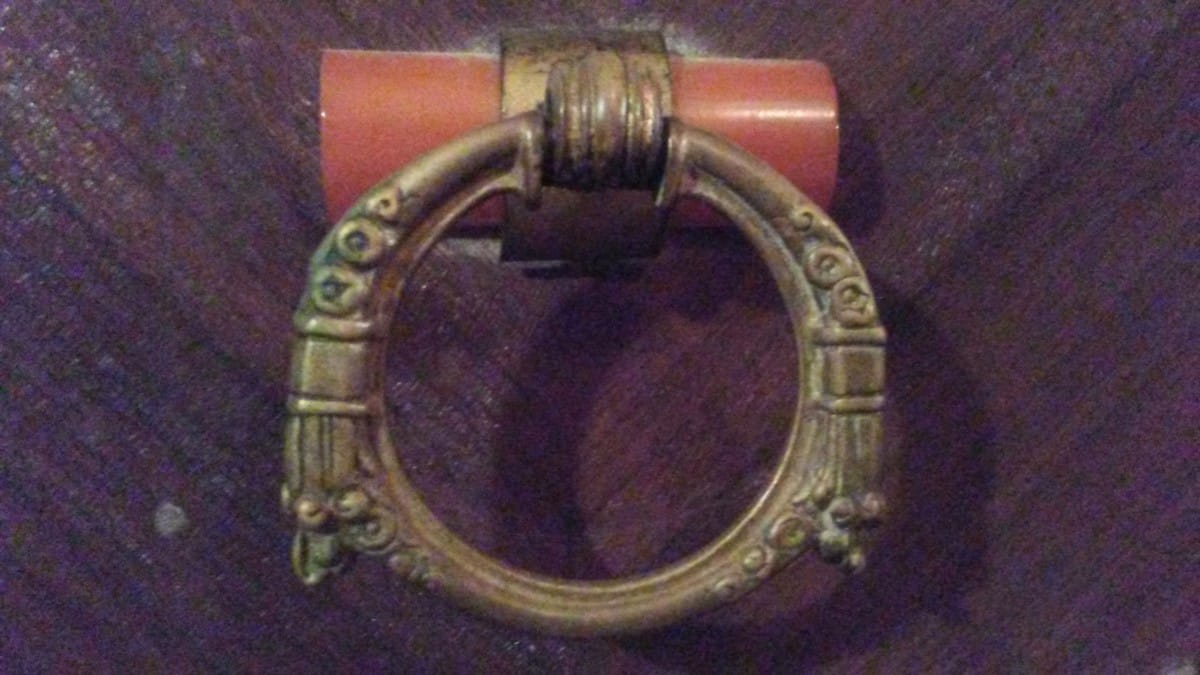
I have an Art Deco waterfall dresser from 1935, and the drawer handles have little orange bakelite “straps”.

I wanted to see the grained veneers in their original, finely-polished glory, so I found this photo on the internet. This is a 1942 New Yorker with “Highlander” trim. The decorative trim is in matching red instead of cream.

This is what I call “lost design”. Did you know that the speedometer on a 1942 Chrysler has a little golden crown and fan on it? Very few people living today would recognize it, and therefore like so many other ephemeral things, it sinks into the vast ocean of lost and forgotten artifacts.

Don’t you just love this seating comfort? If people today could ride in a car like this, they would probably love the thickly upholstered seats; tall, upright seating position; and the airy roominess unencumbered by consoles, headrests, and seat belts. Of course, today such a design would be highly illegal.

Big flathead straight eight, 323 cubic inches, 135 horsepower. The horns probably sound like an ocean liner! The tall black canister is an air cleaner. In 1942 this New Yorker, with its “Airdreme” styling, Fluid Drive, artistic and plush interior, and whitewall balloon tires–with the whole carriage being pulled by 135 mighty horses–would have been perceived as the height of automotive sophistication and modernity. So much of a “World of Tomorrow” advance over the horseless carriages of just a few years before!

This 1942 Chrysler turned out to be the last of its kind. After World War II, the new 1946 models replaced the Airflow grille with a busy “harmonica” style, and the luxurious wood/marble grain trim vanished from the interior. The De Sotos lost their unique hidden headlights. There was a general belief among people at the time that postwar quality was not as good as prewar. A classic example of this is the 1949 Ford, which was referred to as “a tinny piece of junk”–not up to the level of the Fords of old. Even today in the New York metropolitan area, real estate ads refer to “prewar” apartment buildings, which are perceived as being more solidly built and more artistic in design than postwar construction.

I once owned the great-great-grandson of the 1942 Mopars, a 1990 Chrysler Imperial. I couldn’t help noticing a few similarities. Covered headlights like De Soto; and does this count as an “Airflow” grille?

Half-vinyl top, wire wheels, wide whitewalls, thick fender chrome that wraps around from the bumpers–these are all designed to evoke prewar classical elegance.

The lush interior was also trimmed in “fake” wood, but I felt that it was much more tasteful and nicer looking than the excesses of the 1970s/early 80s. (Brochure image)

When I decided to give up the Imperial, I bought a 2005 Jaguar S-Type. The wood trim (this time it’s real) reminds me of the 1942 New Yorker’s. It looks similar in color and shape. Jaguar calls it “Bronze Madrona” wood.

Bold, flashy, classical design built with quality appeals to me–whether it’s prewar, postwar, or in the modern era (but there’s so little of it in recent years!) Today’s cars are more refined and mechanically/technologically superior to what has come before. We gain certain things, but then we lose certain things when Version 2.0 comes out. Such is the paradox of “progress”.
See also:
Ralf K Outtake: 1942 De Soto–Hidden Headlight Pioneer
Curbside Classic: 1948 Chrysler New Yorker–A Straight-Eight Survivor























“Fake” & “faux” have since the 1980s been complementary rather than the latter being an affectation. The convention is that if something is described as “fake” then it’s bogus, an imitation intended to deceived while “faux” is a cheerful admission of emulation and it can now be a virtue (faux fur). Even the respectable Humber and high-priced specialist Facel Vega used dashboards of painted steel which convincingly looked like burl walnut.
I’ve never been sure whether my fascination with the 1942 models is due to their rarity, but almost without exception the 46-48 cars were horribly restyled versions of some really nice designs. And Chrysler especially had the designs of the 42’s down beautifully.
Wow, these were beautiful cars! Thanks for the article.
Look up Di-Noc. Faux wood used in 80% of cars by 1940. Applied to flat metal, then the metal bent into shape.
https://www.curbsideclassic.com/automotive-histories/the-history-of-di-noc-as-different-from-the-real-thing-as-night-and-day/
The dashboards and trim on these and many other cars of this time were not Di-Noc, but as the author notes, it was painted in a fax style. This was very common at the time, also on other applications such as interior house/office furnishings and such. Di-Noc was used primarily on the outside.
I get the impression that the trim on these is not painted, but are molded slabs of bakelite-type plastic with the artistic grain integral with the piece itself.
Bakelite is one of the few plastics that seems to have an inherent quality/interest to it, rather than being simply an anonymous replacement option for something else.
Hand painted dashboards and interior trim alone would warrant article of its own. I saw a show with a older gentleman who used to do that professionally on production. vehicles
Wow ~ such a nice survivor .
I love the Toyota in pic. # 6 even better .
I thought the high compression “Spitfire Six” was for DeSotos .
-Nate
I’d always considered the mid-thirties (specifically, 1934) Chrysler Airflow as the number one art-deco car. It was definitely way ahead of its time.
With that said, a case could be made that the short-year 1942 New Yorker (and, even more, the hidden-headlight Desoto) are strong contenders for the number two spot.
I think these ’42’s are magnificent, practically good old Artie Decko himself, but I wonder if the ’46 re-style was reactive? That is, did the ’42 cause a bit of a stir back then?
It COULD be argued that it looks like it’s wearing a huge steel gag around its mouth, and those bug-eye headlights – a bit too close together – are expressing the surprise at this.
The lights were indeed a bit outwards and the dramatic grille removed post-war.
The plastic is Tenite, a cellulose-based thermoplastic made by Eastman.
Thanks – I was wondering what the material was. I guess by the 1940s, Tenite was considered more upscale than Bakelite?
And just to build on this theme, here’s a 1940s ad for Tenite, highlighting its automotive applications:
Lots of vague references in the ad:
“This car is extremely complete” – it’s either complete or it’s not. It’s like saying it’s extremely four wheeled. Trying too hard.
“This car runs, is very complete, and extremely solid.” Is that to say it’s better than being extremely complete and very sold?
“There is only a small rust hole in the spare tire well in the trunk. Interior is complete,” no extremes or exclamations here. Are we to doubt their intentions?
All kidding aside, I can’t really see the point of stating all these characteristics of an 80 year old car for sale. It’s obviously in wonderful shape, and could easily, with the right amount of money and time, be restored and displayed in a museum. I don’t think this one will ever see a Concours now will it?
Great find, and an excellent read. A trip back in time. I hope this shows up in a movie one day.
Just to add to AUWM’s comment, Tenite, as I understand it, was made by the Tennessee Eastman chemical works at Kingsport, Tennessee; thus the name.
Amazingly, it’s still in production!
https://www.eastman.com/en/products/brands/tenite
Is the 42 Chrysler still available
If so please email me
https://www.facebook.com/marketplace/107720275918046/search?query=1942%20chrysler
I have long been fascinated by the unique front end designs on the 42 Chrysler and DeSoto. The postwar updates were downgrades.
Hand painted dashboards and interior trim alone would warrant article of its own. I saw a show with a older gentleman who used to do that professionally on production. vehicles