

Here’s an interesting comparison: a base model 1956 Clipper Deluxe vs. a loaded 1958 Packard. Isn’t it ironic that the Clipper—very much a genuine Packard—lacks its maker’s famous name while this ’58 Packard is really a Studebaker? As to which one looks and feels more like a genuine Packard, there’s no contest.

And then there’s the fact that there is big price spread between these two: the ’56 Clipper Deluxe started at $2731, while the ’58 model listed at $3212 before options. I thought this Maltese Gray example I found was a real anomaly– a bottom-of-the-line Clipper (call it a Clipper Stripper) with manual transmission, small hubcaps, and strangely enough, factory air conditioning! If someone walked into a Packard dealership in 1956 and wanted to spend the least amount of money (but still had to have A/C), this was what they got.

And what they got was–one solid, beautiful piece of machinery! I’m thinking this might be the most attractive front end of any full-size American car of 1956. Pure Packard all the way! Ah, but this year Clipper was a separate make–a car of medium price built by Packard. Meaning that it had the engineering features and much of the luxury and stature of the big Packards, yet was offered at a much lower cost.

You have to wonder who would’ve ordered a new Clipper this way–probably a no-nonsense engineering type who wanted solid bones and functional features, but no frills. Hence the dull gray single-tone paint, the manual transmission–but with the potent new Packard V-8 engine and the sensational Torsion-Level ride which, for ’56, was now standard equipment on all Clippers.


It turned out that the 1956 Clippers and Packards would be the last of their kind. 1955 had been a disappointing sales year, but sales in 1956 dropped by almost half–so low that it was no longer viable to keep producing cars in Packard’s Detroit factories. Packard had merged with Studebaker, so it was decided to base future Packards on the top-of-the-line Studebaker President Classic. They would be manufactured in South Bend along with other Studebakers.

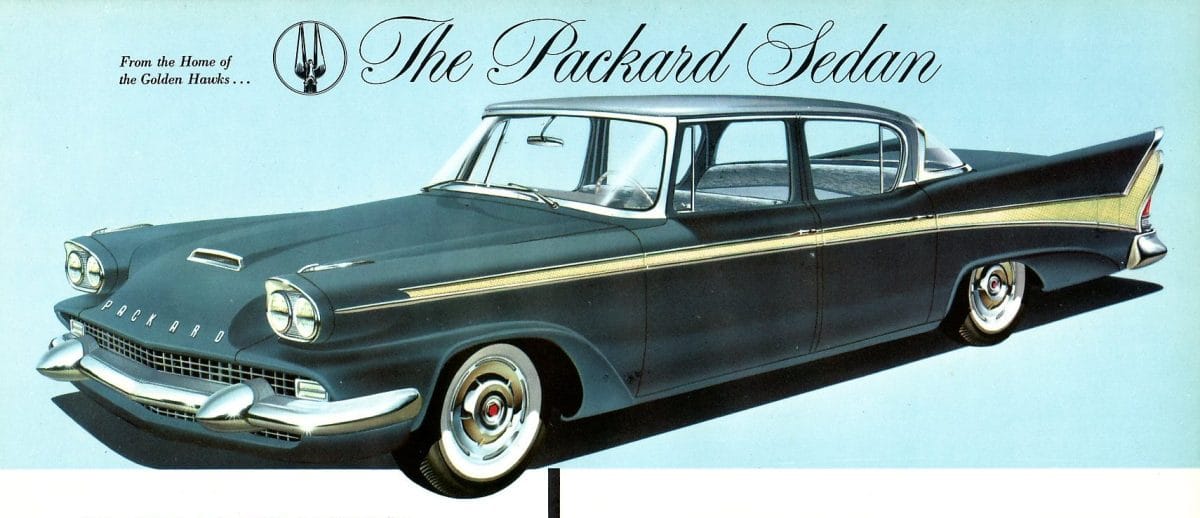
1957 Packard sales came very close to the (now very low) break-even point, so it was decided to press on with the same strategy in 1958. Which brings me to this shiny example, resplendent in glossy black, currently for sale on eBay. This is basically the 1957 model, restyled in such a way as to make it look as up-to-date and jazzy as possible (without spending a lot of corporate money in the process). The Clipper name, which had been retained for 1957, was dropped for 1958.

Compared to the rather austere and upright ’56 Clipper Deluxe in gray, this ’58 Packard seems sleeker, more flamboyant, more exciting, with its dramatic tail fins and gold “lightning streaks” along the sides. You have to wonder what people who owned 1956 and older Packards who wanted to trade in on a new Packard thought of it.

Every attempt was made to replicate the luxury and character of the Packards of yore: a broad grille with Dagmar bumpers, Clipper tail lights, gold Packard gauges, luxury fabrics, lots of insulation. On paper, the 1957-58 models seemed to compare well with the 1955-56 Clippers: The car’s overall length was almost the same; the proven 289 Studebaker V-8 delivered about as much performance as the Clipper V-8; the Borg-Warner 3-speed automatic was less “touchy” than the old Ultramatic; and the coil-and-leaf suspension, while not up to the sophistication of the 4-wheel torsion bar setup, was improved over previous years. The customer benefit was a car that was potentially more reliable and less finicky than the Packards of 1955-56.


Of course, the big question is, “How does it drive?” Not quite like the previous Detroit Packards, to be sure. One magazine article from the time stated that the 1958 Studebakers/Packards drove much like the 1958 Fords. I own a 1958 Ford Custom 300 and I can tell you that the Ford is a very pleasant car to drive, with easy steering and good handling, and suspension that is on the firm side but still adequately cushioned. But this is just theory; the only way to know is to drive one of these cars yourself.

So I’m thinking this could be a rather pleasant-driving machine, especially since it has power steering, power brakes, automatic transmission, and Twin-Traction. (But no A/C). With all of that, this nearly-loaded ’58 cost almost $1000 more than a bare-bones ’56 Clipper Deluxe without options!

Of course, the critics will describe this car as dressed-up Studebaker wearing the Packard name (which of course it is), and dismiss it out-of-hand for that reason. I find a modern parallel between the 1957-58 “Packardbakers” and the 2005-06 “Saabarus”. The Saab 9-2X was basically a Subaru Impreza, but with Saab styling cues and an interior that retained some of the quirky features of familiar Saabs. But here’s the thing: If I walked into a new car showroom in 2005 and the salesman told me, “This is the new Saab” I would believe him without question. Because I’m not sophisticated enough to know that the body looks just like the Impreza. And I’m sure a lot of 9-2X buyers never realized that either.
Did anyone in 1957 or 1958 think the same thing about these Packards? There were a lot fewer brands and cars back then, so probably not.
So who were the people who bought these 1957-58 Packards? Probably some diehard Packard loyalists who may have known about the Studebaker-Packard merger and thought “This is what a Packard is now–I’ll stick with Packard.” Or people who liked Studebakers and saw this as a distinctive, ultra-luxury Studebaker. The car may have appealed to some prospects who didn’t know or care about platform sharing and found something endearing about the new Packard–perhaps the color and pattern of the upholstery fabrics; or the fact that the car is easy to get in and out of and doesn’t seem so bulky; or the flat floors that allow you to easily whisk out dust and dirt; the perceived glamour of the Packard name; the fact that they personally know their Packard dealer; who knows?

Whoever bought 1957-58 Packards and why, there weren’t nearly enough of them to keep the game going. Sales in ’58 dribbled down to only 2,034 of the sedan, hardtop, and wagon, plus another 588 of the Packard Hawk, well below the nearly 5,000 units sold in ’57. S-P gave up–nearly all 1959 efforts were focused on the all-new compact Lark, and the Packards and full-size Studebakers (except the Hawk) were dropped from the lineup. The Lark, which was again based on older Studebaker componentry, was however a car very different in character from prior Studebakers and Packards. It was much smaller on the outside, much more plain, with no fins or classical Packard references. It sold very successfully, and saved S-P from the brink of disaster (temporarily).

The 1955-56 and 1957-58 Packards will always be among my favorite cars, though I like both generations for different reasons: The 55-56s were big, beautiful cars, brilliantly updated in styling from the 51-54 models. The powerful V-8 engines, 4-wheel torsion bar suspensions, and artistically wrought interiors made them luxury automobiles in the finest tradition. The Clippers retained a lot of those attributes but in a slightly smaller size. The ’57s were an attempt to keep the Packard name alive, and the result was a pleasant and distinctive-looking car with a lot of good features. The ’58s were just so over-the-top–late ’50s design taken to fanciful extremes. Seen in person it is dazzling and almost surreal–that to me makes them exciting. So few were made, and that rarity, to me, makes them extra-special.
Further CC reading:
A Nice Set Of Curbside Finds Along The GAP Trail by Slant Six
Curbside Classic Goes Shopping: For A 1958 Packard by J. P. Cavanaugh























I too think the 1956 Clipper is special, I’m photographed one several times. This photo is from a Packard museum in Warren, Ohio.
The 56 Packard, along with those on the 1960 Chrysler, are my favorite tail lights.
I really like that 56 Clipper. The unusual single-color body saves the car from some of the Clipper’s awkward 2-tone treatments and the 3-speed transmission insulates the current owner from having to deal with the oddball Ultramatic.
The 58? I rather like the styling of the 57 Packards, but the 58 is more problematic. In profile, the long front clip makes the car look like it is sagging in the front – maybe even melting. The fins on the rear are more successful, but not by a lot. The interiors is where these cars shine. Other than the fatal flaw in the dash pads (which saw them all sag and lose their shape as if deflated), the interiors were nicely done. The one benefit of the 58 over the 57 is that you can avoid the supercharger.
It is a shame that Studebaker could not find the money to keep a senior car in production for 1959, whether called a Packard or (probably better) a Studebaker President.
Is that a four cylinder AC compressor on the Clipper ? .
-Nate
Any Packard with factory air is an amazing find. I don’t think I’ve ever seen one in person. Yes, it would be fascinating to learn how it came to be built that way. Maybe a Texas car?
By 1956 a lot of the kinks in the new Conner Avenue assembly plant had been ironed out, and reportedly cars were much better assembled than in ’55. It’s a pity that so few people cared.
Even Caribbeans rarely had air conditioning. I would have thought A/C would be a fairly common option on a luxury car, especially a Packard (first car in the world to offer air conditioning from the company) but they are rare.
When I look at that ’58 I see a Studebaker Lark very heavily made up. Has one body ever seen such extremes of front and rear styling?
On eBay it was listed for $15K buy it now. Bidding reached $7909 which didn’t reach reserve. Notice the bidding went at $100 increments as two bidders, out of three, searched for the reserve ceiling. Now what were we saying earlier about cars from the 50’s having a now limited audience and value in today’s world? Does the seller keep on trying, and probably fail, or face reality and lower his price? Nice car but…
I had a 1955 Partician (the big Packard) 352 ci V8 and the twin Ultramatic. It was definitely a premium vehicle. No AC, but everything else was there, power steering, brakes, two heaters. one under the front seat for the rear passemgers, torsion level suspension, power windows. Very nice car, rode beautifully on the road. A good friend who owned a local salvage yard gave me a complete set of the optional Kelsey-Hayes wire wheels for it.
Today’s Lincoln is like the ’57-’58 Packards. Lower Fords with Lincoln styling. We all know how that worked for Packard unfortunately. Imagine if Packard survived to today. At least it would be competing with Cadillac.
On one shot of the 56 interior there is some wire semicircle duct taped to the back of the front seat over the transmission hump. It’s not on the other interior shot and a photo search showed nothing similar on other clipper sedans. What is it?
I think the 57 looked a lot better than the 58. Keep the fishmouth grille, but dump the bolt on headlight pods and the double fins, and maybe do the cathedral headlights. Couldn’t hurt.
Love the 56 Clipper, looks great in that single tone with red wheels.
I like how the taillights are done so they don’t look like fins from the side view. With its Packard V8 and manual transmission, it is a very cool car.
The comparison of the Packardbaker of 1957 and ’58 to the Saabaru is apt. I think of several cars over the years that were not, in and of themselves, bad cars, but that didn’t live up to their luxury billing and were not good values for the money charged. Other cars that shared this ignominy include the Cadillac Cimarron, the Lincoln Versailles, the Fusion-based Lincoln Zephyr and MKZ, and the Jaguar S-Type and X-Type.
One thing I’m not clear about is how the ’56 Clipper was titled – CEO James Nance wanted to completely separate Clipper from Packard so the latter would sell only full-luxury models like Cadillac, and got states to register the cars as “Clippers” rather than “Packards”. But customers revolted and wanted their cars to be Packards, and the company relented sticking those small Packard badges on the trunk lid, and supplying dealers with Packard badges to place on Clippers already on the lot. Did Clippers sold from this point on get registered as “Packards” or still as “Clippers”?
’57-58 Clippers did get real ’55-56 Clipper gauges, but they were different than senior 55-56 Packard gauges, which were gold or silver rather than black. Several real Packard/Clipper parts did make it on to the ’57-58, including the gauges, hubcaps, the “slipper” taillights, some badging and trim, and the Twin Traction limited-slip differential. Other parts were designed to resemble “rear” Packard parts, like the door armrests and trim. 1958 Packards got distinctive hoods with traditional Packard contours not shared with Studes. It wasn’t a crude badge-engineering job it’ often made out to be
I wonder what SPC would have done had the Packardbaker sold well. The large sedans and wagons were all dropped for 1959, converted to the Studebaker Lark. Would they have built a small Packard sized like a Lark? In later decades there was a market for upscale small cars, like the BMW 3-series, but such cars barely existed in 1959 and would have likely been a difficult sell.
I visited the Packard museum in Warren, Ohio, last week, and it’s worth a visit if you’re in the area. Lots of beautiful cars from the beginning of the marque until the end. I knew Packard essentially died in the 1950s, but I didn’t realize how quickly the company collapsed. In 1953, sales were still decent, and the company was mostly debt- free. Three years later, after a series of bad decisions, most notably the disastrous merger with Studebaker, and a cut-off of credit, Packard was essentially dead.