

First-generation Rabbits (i.e., Golf, elsewhere) have been featured at CC numerous times; it’s a site favorite. I spotted this American Hare, near the snow piles and salty parking lot, on a fine February evening in New Stanton, PA; a mere four miles from the former VW Westmoreland assembly plant. A survivor from the brief era when Volkswagen built its compact cars on American soil.
Maybe this American-built Volkswagen Rabbit L has found its way home? Or maybe it never left?

Early Rabbits have finally become somewhat scarce, but this one is still hopping, doing basic commuting duty. Some replacement panels and rust patches exist, but that is par for the course for a well-used American rebadged Golf.
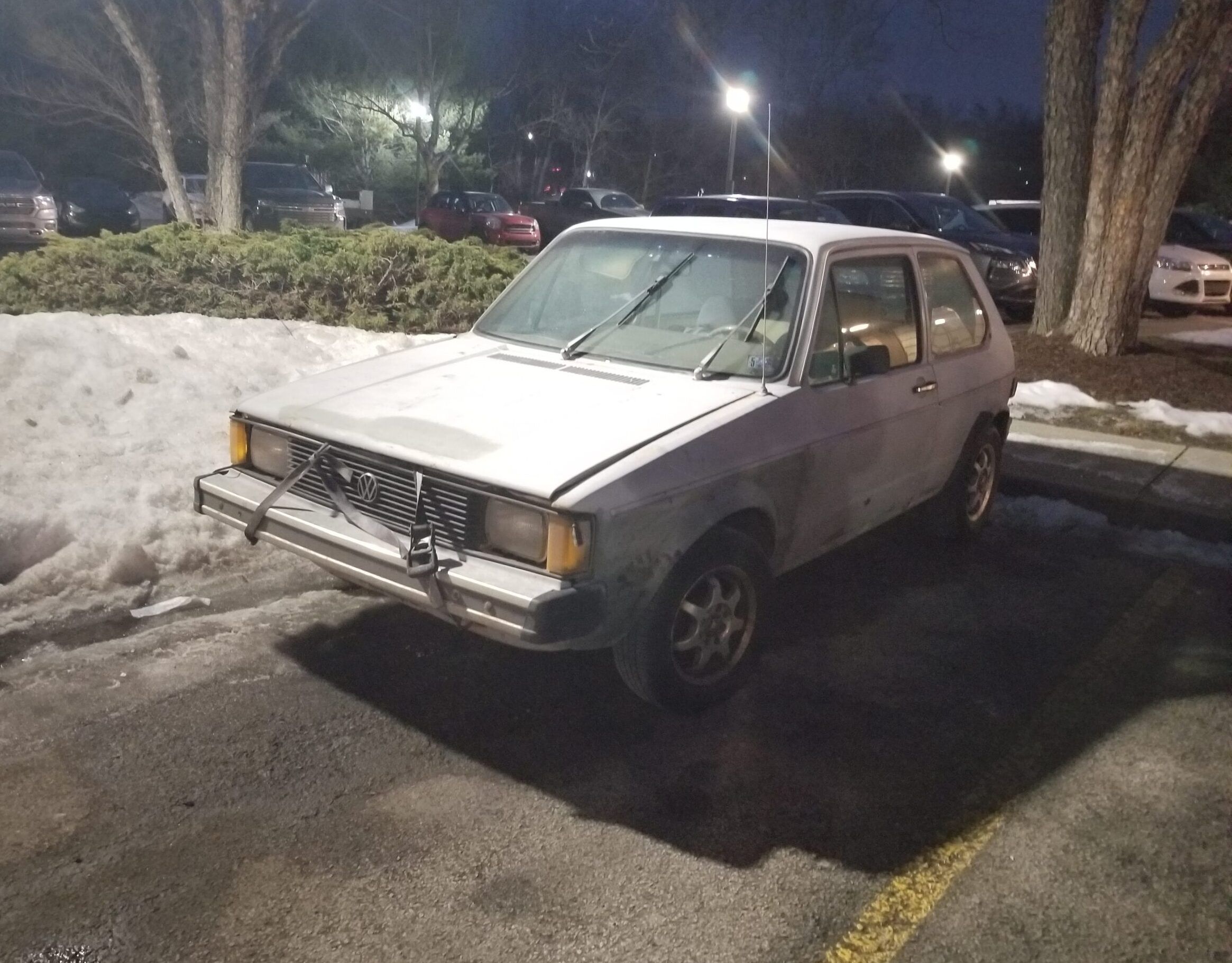
The optional ratchet strap holding the bumper up gives some character to this well-used VW. This one carries the styling updates that US-built (Golfs) got: wraparound amber signals up front, larger tail light lenses, plus bigger squarish side reflectors. That, along with plusher and fancier interior trimmings. A Westmoreland product, built just a few miles away from where I found it.
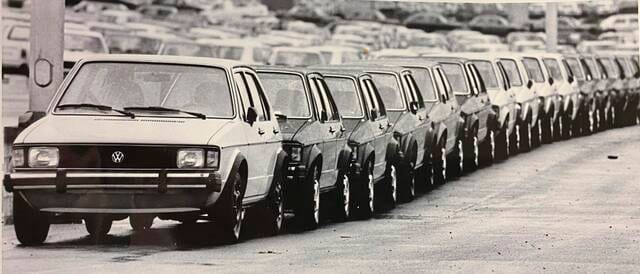
Maybe our feature car is in this picture from 1982?
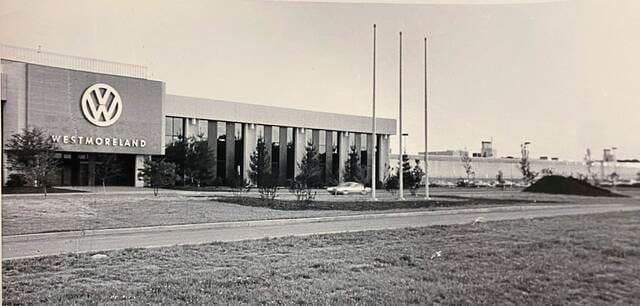
VW ceased operations at the Westmoreland facility nearly 40 years ago in 1987.
The plant began life in 1968 as a Chrysler Corporation facility, but the corporation’s brass at Highland Park decided against starting up any operations. The facility was uncompleted and dormant until 1978, when Volkswagen began operations there. It opened to much fanfare, touted as the first foreign car maker building on US soil since Rolls-Royce had left the States in 1931.
As a Chrysler fanboy myself, I would have loved to live near a Chrysler production plant, but I would have been too young to drive over to see anything or ogle at the new Chrysler products sitting outside at the rail and truck loading areas. I guess it was never meant for Chrysler to be there anyway.
Most of the old factory still stands. It has been home to various ventures since 1987, including Sony and a Community College campus, among other things. And I have worked with some folks over the years who were employed at Westmoreland Assembly. Some of the factory workers continue to get together every year and reminisce about their camaraderie and time spent together in their younger days at the Volkswagen facility.























Interesting to see this article today as just yesterday I passed a Rabbit of the vintage shown. It was sort of beige, in very remarkable shape, and was being driven by a younger man with an older woman in the passenger seat.
Here in Kingsport I see allot of the unique cars.
Very neat and pretty impressive that it may have survived in Pennsylvania all of these years. If that’s the case, it’s remained quite un-rusty.
I do believe that this is a diesel Rabbit. I can’t make out the wording under the Rabbit L badge on the rear hatch (where it should say “Diesel” if it is a diesel)…but the electrical cord sneaking out of the front grille is a tell. This time of year, in a 40+ year old Rabbit diesel, some block heating is most certainly in order.
It most likely is a diesel, as I’ve found their survival rate outnumbers gassers by about 10:1, if not more. It became a cult object due to their economy and ruggedness.
I did see a nice GTI the other day; folks are definitely into those now as collectibles.
I did not get to hear it running. It was at the New Stanton Cracker Barrel when we were there for dinner. It was parked when we arrived and was still there when we left. Someone who maybe works there, or someone enjoying a long dinner?
I was not able to make the badging out either that night.
A lady friend asked me about 25 yrs ago if she should buy a 1982? diesel Rabbit, light blue manual trans. I drove it with her and pronounced it sound and said it was a good one. She opted for something else, forget what, but at least with the prospective of time it was indeed a good vehicle. I like diesels, was profoundly disappointed by GM’s versions, but did have a diesel Peugeot 504 wagon as a driver after the 2nd gas “crisis”. These VW diesels are great, love to have one… just in case!
My brother knew a couple people who worked there in the “early 80’s”. Sister’s neighbor worked there when it was a “Sony”, facility.
She was a contract worker.
In my shady used car days, the Rabbit was a featured product. They were so easy to work on that just a simple toolkit would disassemble the entire car. Motor swaps took minutes. The diesels lasted for years with only simple service.
Alas, the American cars were not as good as the German ones. VW hired a bunch of GM folks to run their Westmoreland factory, and they set to work decontenting the Rabbit. They also introduced colour-keyed interiors, which came in such lovely shades as green and baby blue. The decontenting was everywhere. Even the wiring harness was cheaped out. They softened the ride and destroyed the wonderful handling the German cars had.
VW learned their lesson from the Westmoreland debacle. People drive VW cars because they drive nice, not because they have blue interiors. My VW is built in Mexico, but it is identical to a German car.
Interesting take on the state of affiars that transpired at Westmoreland. Thank you.
The discussion that these Westmoreland VWs weren’t as well built as the German cars is a long one, and I do recall – as someone who owned one of the PA-built diesels (1984 and for about 10 years after that), it was a constant topic of conversation with those who drove the German-produced ones in Europe. i.e., that the American-built cars were somehow ruined.
I do believe it’s true that the handling was softened somewhat and the interiors were “Americanized”…but I honestly don’t know if the quality was necessarily that much worse. To wit, nearly any Rabbit of this vintage you encounter here in the US is going to have been made in Westmoreland…and you still see them around; particularly as Paul points out the diesel ones.
Mine was one tough little car, and I kind of liked the velour upholstery.
” People drive VW cars because they drive nice, not because they have blue interiors.”
What are the arguments against blue interiors?
In the East Bay side of the Bay Area I haven’t seen a Rabbit this century. It has nothing to do with rust as in other states as much as people have moved on to the new and dumped the old. I can name some other common cars that all of a sudden were gone from the streets and Craigslist in what seemed like a matter of months. Then this month there have been a few tremendous surprises such as a super clean 87 Mekur Scorpio for sale near me.
Great catch! It’s been years since I’ve seen a Mk1 Rabbit. I see VW Pickups occasionally, GTIs sporadically, but Rabbits? Never. I hope you get to see/hear it again to figure out if it’s a diesel or gas.
I had a 1980 Rabbit “C” model. 2 door, yellow. 1.5: DIESEL w/4-speed.
Drove the pants off that car from 1987 to 1992.
LOVED the fuel mileage. About 48 on average.
Previous owner put brand new Michelin’s on it when he sold it to me. I used those tires until they wore out. Then I put a new set of tires on it (I forget what brand) and then turned around and sold it.
Good little car. Had a 50 watt Alpine 7 band graphic equalizer plugged into the stock Grundig am/fm radio. Had a pair of 6.9’s set into that cardboard trunk lid behind the rear seat.
Sounded pretty good.
Fun little car.
I’ve mentioned my misadventures here with a first year (1975) Rabbit that was built in Germany. It was a relability nightmare. Then I replaced it with a 1979 Westmoreland Rabbit (first year for those built in the US). It was improved in terms of reliabllity but was slower and softer. It was much quieter though, and I liked the light blue interior and exterior colors. Also, more of the interior was covered with (blue) vinyl, so there was less exposed painted metal.
No argument against blue interiors .
Nice to see this rare Westmoreland survivor still going against all odds .
The Westmoreland cars had less sound deadening and were noticeably noisier inside .
It’s interesting how the Diesels have become serious niche collector cars as most Diesel engines had serious problems or failed by 60,000 miles .
I often wonder if perhaps the average American simply failed to maintain them properly as the survivors I see around So. Cal. typically have original paint and still look decent .
-Nate
“…as most Diesel engines had serious problems or failed by 60,000 miles .”
These small VW naturally aspirated diesel engines require strict adherence to the timing belt replacement interval (every 60,000 miles / 100,000 km). Special tools are required, which are no longer available in all workshops.
Saw a VW diesel Rabbit on Interstate 77 in east central Ohio last year. It was going about 45 MPH and spewing fumes but it was running.
Dieselgate of a bygone era?
Well – presumably already adapted to the latest US environmental standards.