

As with pets, we automotive types tend to believe that cars often resemble their owners. A “truism” that has become less applicable in recent times, perhaps, but when it comes to classics, is there a model that tells us more about its owners than an old VW bus? Or, in this case, a Double Cab pickup?
Here are two curbside finds from San Salvador, sitting at opposite ends of the spectrum and making a pretty good case for it. Preconceptions aren’t something to encourage, I admit, but with finds like these, how can you avoid them? After all, aren’t you already forming some ideas about who the owners of these two might be? And while we may get their owners completely wrong, what we can say with certainty is that these two currently have very different missions in life.

Let’s start with the easier lifestyle to figure out: the “relaxed vibe” of the green one. The stickers plastered all over it provide plenty of clues, too. There are lots of surfing-related ones, a few skateboarding ones too, and some promoting animal welfare. (Above the four paws hanging from the rearview mirror, this message in Spanish: “Keep your distance because if a dog crosses the road I brake abruptly.”)

If you wonder, surfing has become something of a thing in this region in recent decades, and we have some pretty good waves for it. And I guess it’s not just my imagination—or some sort of national mass delusion. A few international surfing events have even made their way here in recent years.
This shot also shows the microbus-derived third door, which certainly comes in handy, surfing or not.
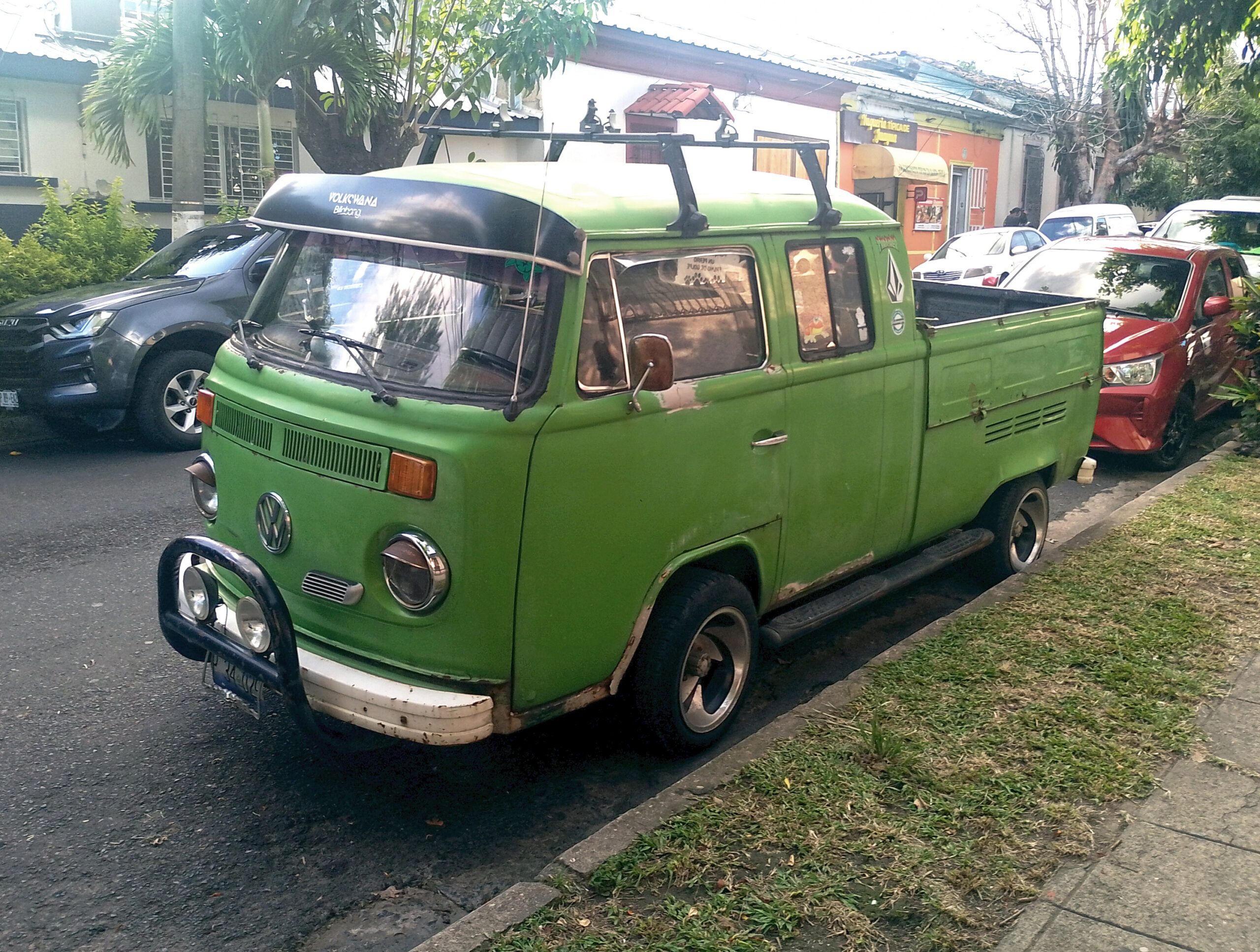
While originally an unexpectedly successful niche product (Paul’s detailed post, HERE), the VW bus and pickup have become perennial lifestyle vehicles. There was nothing quite like them at the time, and one could argue there’s still nothing quite like them today. Sure, there are plenty of newer, more powerful double cabs available, including some perfectly decent used ones at attainable prices. No matter. VW T2 fans just never seem to be able to live without their vehicles.

More lifestyle hints in the cabin.

There’s no doubt that today’s curbside finds belong to the second generation, which arrived in 1967. As Paul previously noted, sales of the VW T2 pickups seriously dwindled once the “chicken tax” came into effect in the 1960s. Any second-generation Double Cab still around in the U.S. was most likely a dealer service vehicle—or a more recent Brazilian-built gray-market import.
But how about these in San Salvador?

No “chicken tax” was ever applied to these over here, so they had no major hurdles to clear. But complicating matters, we got German, Brazilian, and even Mexican-sourced VWs over here, sometimes simultaneously. The differences between them are minuscule, but I’ll take a guess that these are German. Mexican VWs didn’t arrive until the 1990s, with some easier-to-identify mechanical changes, while Brasilias were the main Brazilian-built VWs sold here back in the 1970s.

Today’s second Double Cab is clearly living a more traditional life, much closer to its original intent. It clearly seems to belong to a “traditionalist,” a type that can be one of several, but certainly someone who has kept it as it was meant to be. Not something common over here, if you’ve followed my posts over the years.
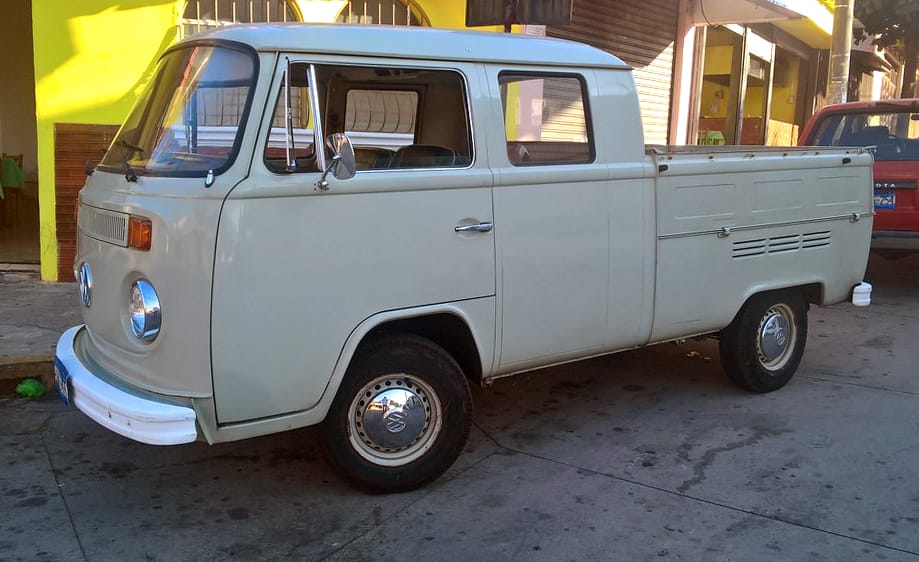
This one seems to belong to the owner of a small store on the outskirts of San Salvador, and has been a permanent fixture on this corner for several years.

I’ve never seen it carrying any heavy loads, but there are signs that it gets occasional hauling use. Like the “green surfer”, no garage-queen life for this one, either.

I had never seen this VW’s owner until recently, when I spotted it turning left at a traffic light. I wish I could say otherwise, but there were no surprises when I saw the guy behind the wheel from afar: middle-aged, wearing a plain white buttoned-up short-sleeve shirt, calmly going about his day and looking like the picture-perfect image of a small-business owner as if straight out of the 1970s. All very normal-looking, more or less the image I had formed somewhere in the back of my mind.
Preconceptions are not to be encouraged, I know. But when it comes to cars, sometimes it’s just all too easy.
Related CC reading:























Here is a gray market double cab diesel 2WD at a big annual car show in Marshfield, Massachusetts.
Now THAT is cool! Love the Porsche wheels too. I’ll bet you turn a lot of heads with that, and I had no idea those even existed! I had to look it up (Transporter T3 Double Cab Pickup, aka Doka). And I spent a month in the late 1980s one summer in Germany while in college!
in contract to the current array of double-cap midsize pickups available today, one gets a >=6′ bed, though it’s not full-depth all the way across. But I think the compromise would be one I would take. Thank you for the pictures!
No fourth door….I guess that was done for structural integrity.
With those rims and that color, the green machine looks like something that should be available via Hot Wheels. ==;-}
Almost certainly it was done for reduced cost. The bus had optional doors on the driver side, so structural issues were not likely.
As a kid growing up in the early 1950’s, it seemed that all of the cars had faces. And amazingly, they resembled their owners. Today, not so much.
I once had a crazy dream about that – it was based upon the BMC Farina cars and how the owners had increasingly ‘Upper Class Twit of the Year ‘ facial expressions to match the badge/grille of their version.
I might have been on the beer that evening…
I believe that the Chicken Tax was specifically created to eliminate VW pickups from the US market. I don’t remember seeing more than 1 or 2 in my long lifetime but they must have been very popular if they were targeted by the Big Three.
The VW pickups and cargo vans were not the target of the “chicken tax”, the intention was as the name vaguely references was to get US raised chickens back on German dinner tables, not to benefit the big 3.
Germany had imposed a tariff on imported chickens which of course did not sit well with US Chicken farmers. They stood to loose $X in sales based on the total volume of chickens exported to Germany prior to the tax and in the short term were looking at an oversupply condition leading to a collapse in price.
So ironically the US decided to play the classic game of chicken, and went looking for a product imported from Germany that was worth about the same in dollar volume as the lost Chicken exports. They landed on the VW pickups and Cargo vans and wrote the tariff to capture those segments.Germany of course didn’t back down and the US tariff written broadly enough to capture imports from any country stuck.
That’s not to say that the big 3 haven’t benefited from the tax over the years, but they have also suffered due to it. A more recent example is the Transit Connect all of which were imported as passenger vans until that loophole was retroactively closed and a big bill came due.
Both of these are second generation Typ II’s, 1973 or newer .
Nice to see they’re still cherished in their own ways .
The “chicken tax” was against the flood of cheap Japanese pickups, they made an end run around it by importing them sans bed and had the beds added before selling
I once had one of the very first double cab Typ II’s, it was a ’59 VW out sourced the body to a builder that used a reverse, “suicide” third door .
-Nate
I don’t recall ever seeing a DoKa in England.
Vans (over-restored or customised ) have become such a cliché among the surfer-poseur set they seem totally lame now.
A ratty worker version would still be cool.