
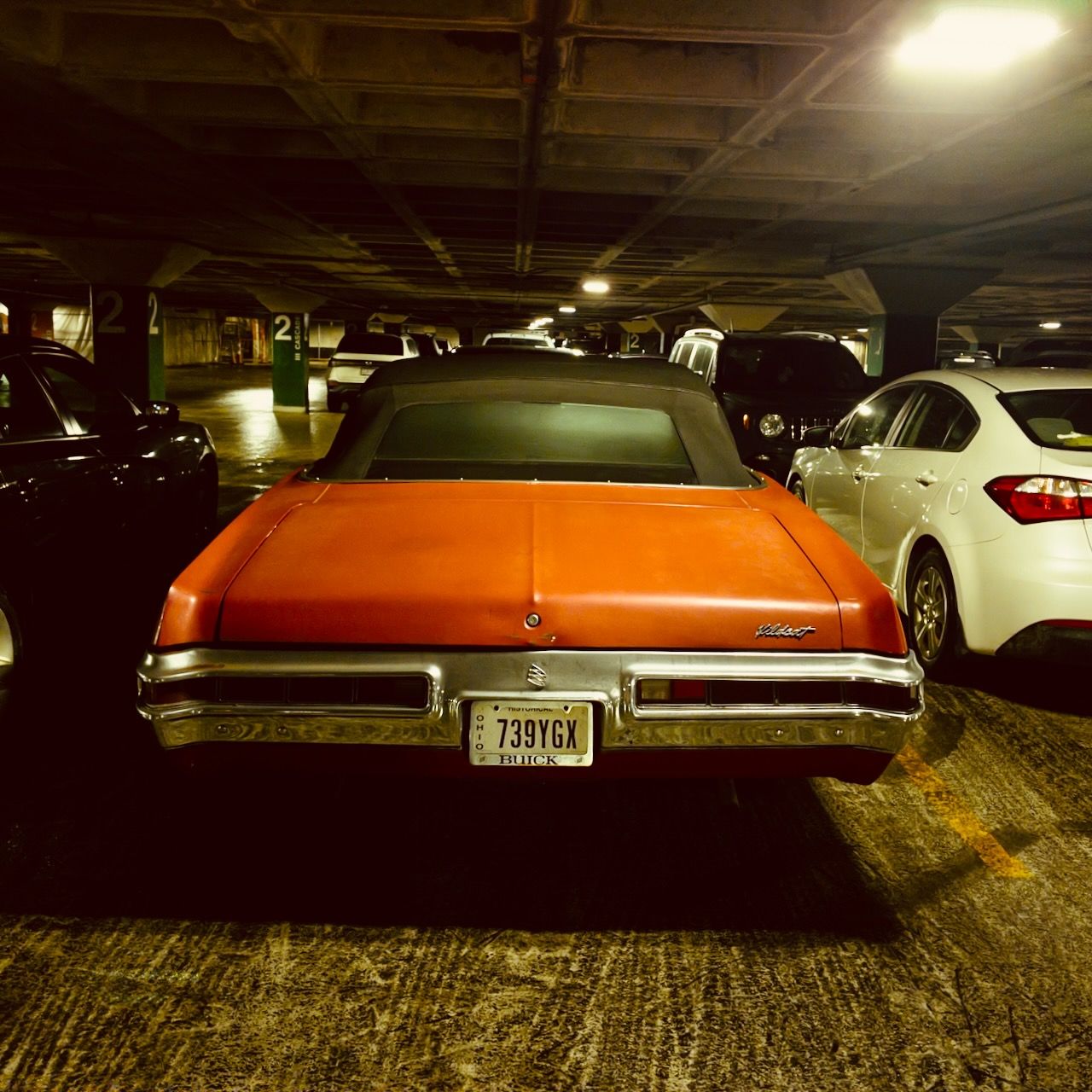
I volunteer at The Akron History Center, and it’s fascinating what surprises one can find in the parking deck where volunteers park. Among the best finds this past winter was this especially special 1970 Buick Wildcat convertible. Last year of the Wildcat, Buick’s classy, sporty and substantial luxury performance model of the time, and of which only 1,244 units were built in droptop form in ’70.

In its full-size B-body platform, the Wildcat’s presence is hard to ignore. The bright orange of this one made a vivid contrast to all the monochromatic SUVs in the parking garage, with the lighting –along with its Buick-face– making for a forceful impression.

Regrettably, in the tight parking space, I wasn’t able to capture the sides. Here it is in full, as seen on the 1970 brochure. The car’s overall lines, with its 1960s coke-bottle feel, along with Buick’s updated spear motif on its flanks, make for one of Flint’s sassiest designs of the day, especially in convertible form.

I was vaguely aware, from my car crazy days of my youth, of the Wildcat, a cool-sounding name that never turned household-known in the way Mustangs or Camaros did. Regardless, the model lived from 1963 to 1970, serving as Buick’s big-size luxury-performance model in the go-fast-obsessed 1960s. Sportiness with a Flint touch, of course, generally delivering vitality not racously, but with poise (Though wilder options were available, as a period review attests).
For 1970, the Wildcat still had the credentials to deliver, with its V8 grown to 455CID, offering 370 HP, 510 lb ft torque @2800 rpm, and riding on a 124″ wheelbase for an overall 220.2″. Voluptuous, exhilarating, sexy and energetic are among the adjectives that have been thrown the model’s way at CC over the years. Not the kind of car to carve the canyons aggressively, but sporty in that All-American way; gobs of power and torque to eat the miles serenely, and move forward in an exhilarating manner if wanted. The model would cease to be after 1970, but the concept would live on a bit longer in the milder 1971-1973 Centurion.

Parking garages make me nervous — get in, get out, as quickly as you can. So I missed some details on the Wildcat in that first encounter. Some days later, I went back to see if the car had an automatic or a manual transmission, and discovered it had been covered. Well, a mystery to be solved on a future occasion.
Related CC reading:
Curbside Classic: 1965 Buick Wildcat – Sabre Tooth Car Or Dodo Bird?























I’m forever at a loss to understand why Buick thought it was a good idea to eliminate the Wildcat badge and replace it with Centurion.
I love it! Great catch, and I like that a historic Buick was found at the Akron History Center.
I have only recently become aware (or re-aware) that the Wildcat didn’t live past 1970. I can remember being confounded when I would misidentify one of these (or a Centurion) in traffic as a LeSabre back in the day.
What a rare car. Thanks for sharing it.
Around 1990 I spotted a rather forlorn looking Buick on a more residential area of Seattle’s Capitol Hill, on closer inspection it had a faded For Sale sign price; $750. I purchased it from the laid back physician owner.
I was living in a 1920s brick apartment building with heated underground parking at the time. I spent the following winter gently rubbing out the paint and polishing the beautiful Buick chrome road wheels. I proudly drove it to the car show.
Not a Wildcat, slightly different trim and lacking the lovely Wildcat interior but such a sporty body.
That is/ was a good looking machine!
My friend had a full-size Buick convertible in 1970-71 but I think it was an Electra 225 in blue but could have been a Wildcat. I joked that his front hood was bigger than a football field.
Great find. I always thought these were mighty attractive.
I had a friend in high school who worked with me in summers at our lake resort restaurant. She had a new 1965 Buick Wildcat convertible, white top, red with red interior, 465 decal on the air cleaner (torque not hp), and a four speed manual. Fantastic car that I got to drive a couple of times, the torquey engine could get that big heavy car up to speed very quickly. I read somewhere on the web that its zero to 60 time was around 7.4 seconds. Felt that way if not in fact. This one was a special order car; her husband’s family owned a Buick dealership in the Cleveland area. Never saw another Wildcat with the four speed manual.
Piece of “classic, americana”!
A high school classmate was picked up daily by his mom in her brand new ‘67 Wildcat fastback two door hardtop — bright red with a black bucket seat interior. All of those ‘67 GM fastbacks (Impala, Catalina/Bonneville, Delta 88, LeSabre/Wildcat) were stunning but the Wildcat with its extended length and fender skirts was especially sleek and took the roofline to a whole new level. I used to wait to catch a glimpse of that beauty every afternoon.
….just like this!
That Buick went from a name as cool as Wildcat to name as milquetoast as Envista in 50 years speaks volumes.
Had a high school friend who bought a 1968 Wildcat a few years out from graduation while he was working for my father’s business. This was in the early 1980s. It was red with a black vinyl top. It had been run hard and had the expected Ohio rust. I think he paid $800 for it. It ran OK but needed the starter replaced. More often than not it refused to start so he was perpetually late for work. But he refused to get it fixed. The longer this went on, the more it irritated my father, who eventually fired him. He would still come around on weekends where I lived with my parents. Dad didn’t mind him being around and helping me in the shop and yard as long as he didn’t have to pay him. But my mom always fed him and he liked her cooking. One Saturday the starter finally gave up the ghost entirely. He got so angry that he threw a brick at the car and put a big dent in the rear quarter panel. I gave him a ride to his house and he left the Buick sit at my parents’ yard. It sat there for a few weeks but he refused to buy a starter for it. Then he put a for sale sign in the windshield. No one would buy it because it would not start. It sat there for several months more until a neighbor offered him $50 for it. He took it! The neighbor towed it away with his tractor and the Wildcat was never seen again.
I remember these when new, I had no idea so few were made, as a sprout back then I knew beyond a doubt that a Buick Wildcat was a seriously fast and special machine only bought by those who had the $ and special knowledge =8-) .
_Far_ to big for me but a coupe with the 4 speed would be a very fun car to set up for high speed road work .
-Nate
In 1970 this would have been painted with enamel paint, instead of the modern day ‘clear coat’. So the oxidized surface of this Wildcat could be hand compounded and waxed, then it could look a lot better.
I used to use Blue Coral polishing compound & wax on my Aunt & Uncle’s 1970 Buick Estate Wagon. This part of detailing is nearly a forgotten art… This was taken by me in spring 1975