
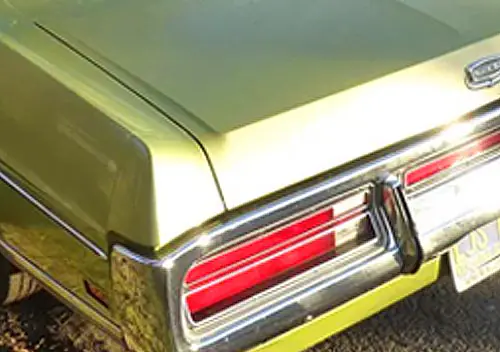
For those of us in the Northern Hemisphere, today is the winter solstice, which means the start of winter and the shortest day of the year. As the days have gotten shorter, I found myself thinking of this green-over-green 1971 Continental Mark III I saw a few months ago, whose rich extra-cost “Ivy Moondust” metallic paint (paint code E9) offers a welcome reminder of spring on a rather gloomy winter’s day. Let’s take a look at it, and at the other Moondust colors Lincoln offered for 1971.

I freely admit that I have little grounds to complain about winter. I live in Los Angeles, where you have to drive to snow if you want to see it, and even nighttime temperatures rarely drop much below about 40 degrees Fahrenheit (4.4°C, for those of you in the metric world). There are deciduous trees in this neighborhood that have been shedding leaves all over everything, but there’s still green grass on the ground, and while the temperatures are mild enough that I took the air conditioner down weeks ago, it’s warm enough that I still sometimes need a fan. (“Cry me a river,” say Midwesterners subject to lake-effect snow.) However, I don’t get out much of late — my health is very poor — and so the shortening days wear on my mood.

This 1971 Mark III is from another locale with little reason to grouse about winter; it was sold some time ago by Orlando Classic Cars in Florida. I happened upon the listing a while back while working on an ultimately abortive idea of finding examples of every Mark III exterior paint color, and for some reason it stuck in my head. Its Ivy Moondust metallic green paint (paint code E9) is very spring-like — not early spring, with buds just beginning to reappear, but late spring, when things are getting really lush again.

Most domestic luxury cars of this era had some fancier extra-cost color options, with special paints offering a higher-than-usual luster. Cadillac had its 1963 Fire-Frost options (which used aluminized polyester flakes), followed from 1964 by the more familiar Firemist colors (which I was surprised to learn were not metallic, but actually used tiny flakes of borosilicate glass). Beginning in the 1970 model year, Lincoln added a set of four special “Stardust” metallic paint options, which used fine bronze dust rather than the aluminum more typically found in metallic paint. These new paint colors were also available on the Thunderbird, although Ford Division used different color names.

I wanted to show you examples of all four 1970 Stardust colors, but I could only find two of them, beginning with this Olive Stardust car. Unfortunately, all of the exterior photos from this July 2025 Bring a Trailer listing were terrible — bad lighting and abominable cropping — so they don’t show off the unusual color to good effect at all. (On a Thunderbird, Ford called this same color “Olive Fire.”)

The photos of this Bronze Stardust Mark III were better, although its brown vinyl top did not look to be in good shape. On a Thunderbird, this color was called “Bronze Fire,” which seems apt. Unfortunately, I couldn’t find any cars that were definitely in either Green Stardust or Red Stardust, the other two Stardust options for 1970.

Starting sometime late in the 1970 model year, Lincoln renamed its special paints “Moondust.” For 1971, these colors now used either bronze dust or aluminum dust, depending on the hue. (Incidentally, if anyone knows of any good contemporary references discussing the composition and properties of these various high-luster optional paints, let me know in the comments — I’m particularly curious about the Fire-Frost and Firemist processes, but I’ve been looking for more detailed information on and off for a year without much luck.)

In addition to the Ivy Moondust of our featured car, the 1971 extra-cost color choices also included this Ginger Bronze Moondust (paint code 39).

I’ve never much liked brown cars — and you’ll forgive me if I still classify this as brown — but if one wanted a brownish car, this would certainly be the way to go. The high luster dispels the usual murkiness I associate with brown cars of the ’70s, at least as long as it’s well-polished.

This one is triple-brown: In addition to the dark brown “cavalry twill” vinyl roof, it has a Medium Ginger interior with a leather-and-vinyl low-back Twin Comfort seat.

Orlando Classic Cars also previously sold a nice ’71 Mark III in Red Moondust (paint code C9).

This was a really attractive metallic red, quite different from the gaudier Lipstick Edition reds Lincoln and Ford offered a few years later. The combination of the color, the high-luster paint, and the white vinyl top makes me think of an ice cream float made with some fancy strawberry soda.

Like the roof, the upholstery is white, which I think would like better if the leather didn’t have a shiny, plasticky sheen. This was strangely common on domestic luxury cars of this period, and it makes me miss the more attractive natural grain leathers used some years earlier.

Sadly, the only example I could find of Blue Moondust (paint code D9), the fourth 1971 Moondust color choice, was shot indoors, which does the color no favors at all.

If I could see this triple-blue car in daylight, I think it might be my favorite of the bunch, but a lot of the sale listing photos are bad enough that they make the car look like one of those 1/24th-scale die-cast models.

The interior is dark blue leather and vinyl, if only you could see it.

To my disappointment, the Ivy Moondust car is not triple-green. It does have a dark green vinyl roof …

… but the interior is what Lincoln-Mercury called “Light Gray Gold.”

In some lighting, you would probably call it brown, although it seems to have a yellowish-green cast to it. I’m not sure where the “gray” comes in, but that’s what it was called. (Folks, this is why you want to include the actual paint and trim codes in your ad and auction listings, which Orlando Classic Cars fortunately did for these listings.)

If it had been my car and my money, I probably would have gone all the way and ordered dark green leather, but this is not a bad combination with the Ivy Moondust exterior, if you don’t mind feeling like you’re deep in the woods.

In the not-too-distant past, I’ve said some unkind things about these fancy paint options, not because they’re unattractive (some of them are lovely), but because I was disgruntled with the prices. Lincoln-Mercury charged $131.20 for Moondust paint, roughly what Cadillac charged for Firemist colors at this time. That’s a relative worth of about $1,150 in 2025, which seems excessive even if the paint itself was more expensive than the normal metallic variety or required special handling. It strikes me as “what the market will bear” pricing: A 1971 Mark III listed for $8,421 (a relative worth of about $74,000 in 2025), so there was little question that someone who liked one of the extra-cost colors would be able to pay the premium, however outrageous.

A similar logic seemed to apply to radio pricing — the AM/FM stereo in the Ivy Moondust car listed for a painful $306.90 (a relative worth of almost $2,700 today!). I suppose it was in for a penny, in for a pound in this lofty league.

I know that for some of you, these battleship-class personal luxury cruisers are still the last word in four-wheeled motoring, and you’ll brook no criticism, implied or otherwise. They’re still really not my cup of tea, but I love some of the color combinations, and the Mark III has many fascinating details, from the automatic headlight dimmer to the nifty infinitely variable hydraulic windshield wipers.

Not all of it is to my taste, but I enjoy looking at it, and there’s plenty to see, inside and out.

The weather forecast predicts a gloomy Sunday even in Los Angeles — the sun may not show its face at all before it sets at 4:47 p.m. — but this extra touch of green has made me feel a little better. I hope you all feel similarly.
Related Reading
Curbside Classic: 1968-1971 Lincoln Continental Mark III – Right On The Mark (by Paul N)
1969 Lincoln Continental Mark III, Inside And Out – Unsubtle But Effective (by me)
Curbside Classic / Cars of my Father: 1970 Lincoln Continental Mark III – Lemon Yellow (by J P Cavanaugh)
1977 Lincoln Continental Mark V: Bigger Than Ever, This Defiant Dinosaur Was Rolling In Green (by me)




First, it’s sad to hear about your health.
I’m 62 and have been on a rapid decline this year. I’ll spare the details but my heart goes out for anyone who’s living with chronic pain.
Second this article is timely. I recently sold my 1976 Mark IV. The husband of the couple from whom I got it has passed away and the memories were too much. But it made me think about a Mark III for about one and a half minutes! You see I’ve met anyone who owned one that said “this car is crazy reliable!”
So I’ll choose to stick with my 78 Fleetwood Brougham .
Hey, i wonder if the saddle metallic paint was extra cost?!!
Merry Christmas and here’s to a healthier 2026
I kind of like that Blue Moondust!
I too wish you a Happy Holiday and certainly a Healthy New Year.
I’m not big into old American iron, but these are beautiful cars. Thanks for digging these photographs up and sharing.
I’d be happy with either the Blue Moondust and regal black interior, or the Red Moondust with the impossible-to-keep pristine white. The brown is a little too 70s sadness for me.
Hi, firstly wishing you a happy and healthy Christmas and new year, it’s great to see cars with such a range of colours and also the interior pictures too. In the U.K from the ’90s onwards it feels like a monochrome motoring world!
Albeit some Kias now seem to be available in green it’s still rare.
Here is hoping your health IMPROVES!! Thanks for the excellent article on cars with COLORS, not the achromatic WGB (WhiteGrayBlACK) of today! These Marks certainly look very inviting, both exterior and color keyed interiors, as opposed to boring blACK found in 95% of todaze vehicles. 🙂 DFO
Ginger Brown, Ivy, Blue and Red are my order preferences. I dislike vinyl roofs.
My ’75 Torino was copper-brown which I really liked. I miss browns.
Given the metal content in the paint and the sheen, I guess this is a basecoat/clearcoat paint system which could partly explain some of the extra cost.
Even with less than optimal pictures, all of these colors are standouts. I’d drive any of these cars now especially with a TBI setup or ideally with a modern drive train.
I’m sorry to hear about your health Aaron.
I poked around some and it looks like Ford only used single stage paints during this era. The difference with moondust apparently was metal flakes and buffing / polishing. Current repair practice is to use base coat / clear coat.
I also ran across something I haven’t previously considered: painting before modern paints and modern spray techniques.
It seems a huge bottleneck existed at the end of the model T production line waiting for varnish to dry. Cars were parked wherever they would fit.
Henry must have loved that…
The vinyl top was actually standard on the Mark III by 1971 — it had been theoretically optional in 1969, but only 95 cars were built without it, and so it became part of the package. I guess people just saw it as part of the aesthetic.
The green puts be in mind of Nori Green offered at Lexus. The red is much more attactive and subtle than most of the reds offered today, the brown is, well, brown, and the blue seems of that shade offered by Japan Inc through most of the 1970s and much of the 1980. But a nice effect on this particular car in any of them.
That being said, did you happen to come across a breakout of what colors were actually ordered in what quantity/percentage? Of the Mark IIIs that I’ve come across in person (maybe half a dozen over the last few years, mostly in the junkyard), the majority by far seem to have been black with one teal green/blue ’69 outlier.
Unfortunately not. I was hoping that I’d find some listings where the seller had gotten a Marti Report for the car (not uncommon for pricier Ford products, especially the Mark), but I didn’t find any for the Moondust or Stardust colors.
I”ll take the Red Moondust any time. Thanks for bring us these paint comparisons and everything else you do here at Curbside. Your efforts boost my mood during the winter blues. I hope your health improves.
The Ivy Green of the featured car is just fantastic. Overall though, all of these bronze-dust metallics are great. The brown (Ginger) looks terrific as well. It reminds me of the brown (Tahitian Walnut Metallic) that my family’s 1971 Town and Country was.
The automatic headlight dimmers on these cars look so anachronistic! I can’t say that I’ve noticed those on these Lincolns before. I have to think that if I were ordering one in 1971, I’d have opted out of choosing one of those. Who needs to look at that thing outside on the cowl all of the time?
Happy Holidays to you Aaron, and here’s hoping that you are able to get outside and enjoy some of that great Southern California weather in 2026!
Of the Big 3, Ford has historically been the provider of the widest color palette, and then in the most attractive colors and this article on the Moondust colors for the Mark III is a great example. Those are some truly terrific looking cars.
I’m not a fan of Fords, and the reason is exactly that: I’ve been suckered into buying a few, simply due to the color, and would then pay for it later with mechanical issues.
The bottom line is, it’s a love/hate relationship. To this day, I still find that Ford offers the colors most pleasing to my eye, but I always recall those past purchases based solely on color did not pan out for the best.
Your articles are always so terrifically well-researched and engaging. Thanks again. I added some references this year to a few Wikipedia articles concerning the nature of Firemist; I’ll see if I can find more. https://en.wikipedia.org/wiki/Metallic_paint#Fire-Frost_and_Firemist
Gorgeous Marks… What a bunch of heavy drinkers but a lot of class..!!!
I love the Mark III styling. And the size had yet to grow to enormous dimensions like the Mark IV and V. I also liked the Mark VII where they brought the size back down.
4.47 sunset !! You were lucky !
Here in Scotland it was 3.45pm and sunrise is not till 8.45am
Lots of beautiful cars here and what wonderful colors one used to be able to get, inside and out.
I’ve never been a huge fan of the Mk III, the styling is pleasant but seems contrived. The interiors, though, I love. Great looking dash and steering wheel with a quality, comfortable look to the seats and doors.
This reminds me of a Mark III I seriously considered buying in the late 80s, although I think it was a lighter shade of green (in an era where Lincoln offered at least 4 shades of green). It is nice to see these in top shape – they were lovely cars.
You remind me that my father’s 1970 Mark III (painted non-metallic yellow, definitely not at extra cost) was a well-equipped car other than having an AM radio.
I hope things look up for you in the coming year.
Can This Ivy Green “Moondust” 1971 Lincoln Continental Mark III Chase Those Winter Blues Away?
Don’t know for sure, but I’m willing to try over the holiday period
How about a 1969 “Baby Blue Continental?” I used to see this one often at UCLA. Not the most common color combination. It had a dark interior not white as I would prefer. Beautiful car nonetheless.
Growing up in West L.A. I saw many of these in just about every color, particularly around Beverly Hills and Brentwood. I love the styling. Be well!
When I was a kid in the 70’s, there was someone in the neighborhood that had a Green one just like the featured car.
These were (are) so cool, and HUGE especially to a small kid.
I can honestly say that I don’t think I’ve ever seen a Red one of these before. Quite nice indeed.