

Cars, like songs, are bound to be plagiarized—sometimes accidentally, sometimes not so accidentally. Everybody copied the Italian coachbuilders in the 1950s and 1960s, but here are four examples in American automotive history where designers clearly knew that they were lifting a prominent design element from somebody across town.

The first example is one that is obvious to me, but the cars themselves are so relatively obscure that nobody seems to have given it a second thought. This is a 1934 LaSalle Convertible Coupe, a totally new design that saved LaSalle from extinction, at least for a few years. Legend has it that General Motors was considering dropping the brand, and Harley Earl, with all the showmanship he could muster, unveiled this car and told executives that “this is the car you are not going to build.” That did the trick. It’s possible that Earl had a soft spot for LaSalle, as he was responsible for the design of the inaugural 1927 model (which was itself heavily influenced by Hispano-Suiza).
Credit for the 1934 model is given to stylist Jules Agramonte, and the LaSalle’s art deco hood-side louvers and tall, narrow grille looked gorgeous on the big LaSalle. Priced in the upper-middle range, the LaSalle got an Oldsmobile-based flathead straight-eight in lieu of its previous V8, but the bodies were built exclusively by Fleetwood, the bodybuilder typically reserved for Cadillac’s most prestigious lines.

Considering how few 1935-36 Willys 77s you see these days, it’s possible that you didn’t know that it bore a small-scale resemblance to the 1934 LaSalle: It’s clearly obvious in the tall, narrow grille and the five hood-side louvers (per side). Unfortunately, the styling didn’t at all translate to the stubby little Willys; it lost all its grace along the way, and the odd “half-freestanding” headlamps did the mug no favors. The trail is murky, but the talented Amos Northup is often said to have been responsible for the Willys lineup through the 1930s. He was the guy responsible for the Willys-Knight “Plaidside” Roadster, the Graham Blue Streak (with its skirted front fenders, the first in the industry), the unique 1933 Willys 77 (this car’s predecessor), and the “Sharknose” Graham of 1938. I simply find it hard to believe that he’d do something as derivative as this.
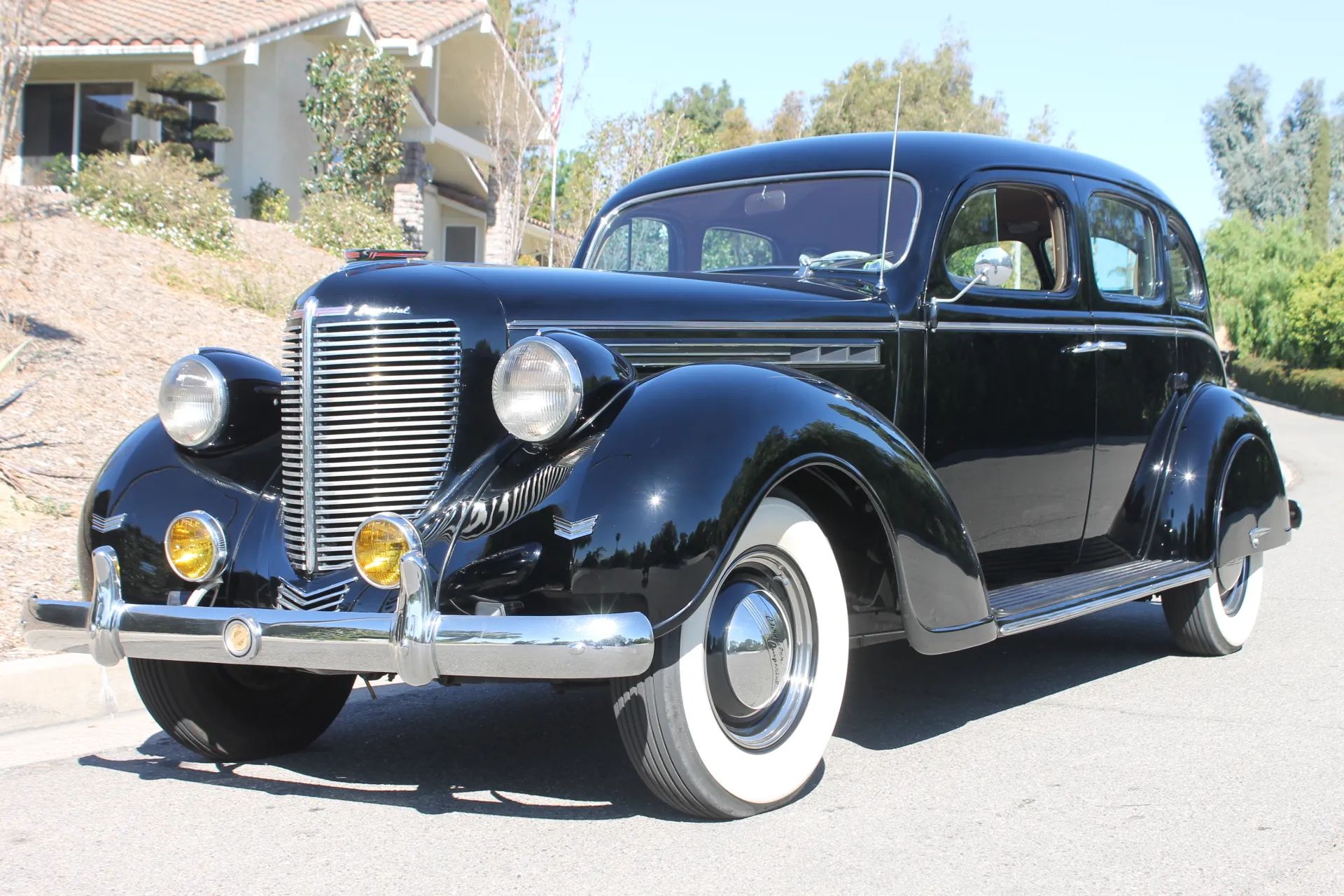
Side note: Did the 1940 Ford steal its “chevron” taillights from the 1934 LaSalle’s fenders? How about the 1938 Chrysler Imperial pictured above? Did the LaSalle steal them from somewhere I’m missing?

Let’s leave Willys, Ford, and Chrysler behind and jump forward to the 1960s. Buick was well known for its “Ventiports,” a styling hallmark harking clear back to 1949. While some Buicks did away with the “portholes,” such as the 1953 Skylark and this 1964 Electra 225’s linemates, the Wildcat and Riviera, they were still a prominent feature of many of those near-luxury cars from Flint. They came in all shapes and sizes, but by 1963 and 1964, Buick had settled into a rectangular theme. They were often an integral part of the side trim, too.

That’s why it’s so strange that Mercury would steal such an obvious brand trademark for the 1965 Comet: Its three pseudo-Ventiports are tantamount to art theft. On the other hand, everyone was stealing the 1963 Pontiac’s stacked headlights, so perhaps Buick’s ire was tempered by the fact that most people would have noticed them first; after all, they were located right up front.
With that being said, I have always liked 1965 Comets, maybe because I really like Buicks and 1963 Pontiacs.

It wasn’t the last time that Mercury would look to the Tri-Shield to find styling cues. This time, they copied a car that itself seemed a little too heavy-handed in its “retro” themes, the 1968 Special/Skylark. Buick dug through its “greatest hits” catalog and picked up the classic 1950s “Sweepspear”; on fifties Buicks, the Sweepspear was a piece of stainless steel trim, but on the 1968 intermediates, it was pressed right into the side of the car itself. Combined with its “skirted” rear wheelwells, the rear end is, to some, a little ponderous.

Mercury partially solved that problem by giving its 1969 Cougar more open, rounded wheelwells in back, but that doesn’t excuse the fact that the Sweepspear is virtually an exact duplicate. It’s change for the sake of change, and I can’t help but wonder how much better the Cougar (and the Skylark) would have looked without it.

Poor Buick must have thought that their styling studio was infiltrated by double agents. One of the most famous bits of industrial piracy was a copy of the 1971 Buick Electra 225 (seen above). Introduced in 1971 and updated through the 1976 model year, the big Buicks were handsome, popular cars.

And that is why the popular car magazines of the time (Car and Driver comes to mind) lampooned the 1974 Dodge Monaco by picturing it and the Electra side-by-side. Look at the kick-up at the rear door, the body line extending from the hood and descending in height into the quarter panel, the grille, the front bumper, the headlights. It’s flattering for people to respect you so much that they copy your ideas, but this was perhaps a step too far.
Aside from the obvious trends such as stacked headlights and eggcrate grilles, can you think of any other motifs that were blatantly copied by stylists? Imitation is, after all, the sincerest form of flattery.
Related Reading
Car Show Classic: 1936 LaSalle Series 36-50 – Almost, But Not Quite, A Cadillac (by JP Cavanaugh)
Curbside Classic: 1969 Mercury Cougar – Premium Ponycar (by Tom Klockau)
Car Show Classics: 1968 Buick Skylark/GS400 – For The Appreciation Of Stepchildren (by me)























2024 Polestar 2 vs second gen Scion Tc . The first one is like a 4-door version of the second one with regard to the ‘A’ and ‘C’ pillars.
I never understood why Buick used the 225 in its naming of the Electra. What does a Slant Six have to do with luxury and brougham?
The only thing missing from that Monaco are the ventiports.
I believe “225” was based on the length of the car.
Yup, and when Buick first introduced the Electra nameplate for 1959, there was both a regular Electra and an Electra 225. The regular Electra had a longer wheelbase than the cheaper models, but the same tail; the Electra 225 (except the convertible) also had a stretched tail with more rear overhang. The short-tail Electra didn’t last very long, but the Electra 225 continued into the ’70s, even though it wasn’t always 225 inches long.
I can think of a few just off the top of my head. The “Bunkie beak” sported by various Ford products ca. 1970 was very obviously cribbed from Pontiac, and the 1970 Mopar E bodies, Barracuda in particular, were a blatant ripoff of the 1969 Camaro. The first gen Chrysler Cordoba borrowed more than a few styling cues from the “73 Monte Carlo. GM was the undisputed styling leader in those days, even if they weren’t the leader in market trends.
I’m sure we’ll read of many more as the thread progresses.
I used to think the same about the Mopar E bodies, and while the general proportions are the same, as the years have passed I see enough differences that further separate them.
But that may be just me.
The roof pillar treatment of the very influential 1938 Cadillac Sixty Special was borrowed without apology from the Panhard-Levassor 6 CS Panoramique:
https://www.lanemotormuseum.org/collection/cars/item/panhard-et-le/
I think the greenhouse of four-door Colonnades was also supposed to be a nod back in that direction.
The greenhouse of the 1985 Toyota T160 Celica Liftback (the first FWD Celica) was inspired by the Panhard 24, which I think Toyota admitted at the time:
https://www.gazoline.net/essais/panhard-24-bt-le-dernier-souffle-du-vieux-tigre/
The Citroën Traction Avant resembled, probably deliberately, the 1934 Ford.
The Chevrolet Vega two-door sedan was very heavily cribbed from the Fiat 124 coupe.
The 1968 Dodge Charger cribbed the Coke-bottle fenders and flying buttresses of the 1966 Pontiac Tempest/Le Mans/GTO.
“The greenhouse of the 1985 Toyota T160 Celica Liftback (the first FWD Celica) was inspired by the Panhard 24, which I think Toyota admitted at the time:”
And the Fastback Toyota grafted onto the first generation Toyota Celica was “inspired” by the ’68 Mustang, which I believe Toyota also messed up to
I always thought that the 74 Dodge looked more like the LeSabre than the Electra, especially in the rear.
This is a very interesting subject. Obviously the Lincoln folks unabashedly borrowed the classic Rolls Royce grille theme, first in a modified form for the 1968 Mark III. This popular styling theme became an even more blatant copy for thr 1977 Continental sedan and Mark V coupe. Eventually, in North America, this grille theme seemed more a Lincoln theme than a Rolls Royce one.
Over the past recent decades, Ford copied Audi with their Five Hundred, and their last generation Fusion, and Ford copied the Aston Martin grille. Yet Ford did hire the Audi stylist for exactly that reason.
Hyundai had copied Ford’s SUV styling so clearly, it would have embarrassed a plagerist.
The 1960 Valiant and Lark? “Identical cousins, Cathy and Patti?”
The entire retro look from 25 years ago was plagerism. The tacky PT Crusier and Prowler, we cringe-inducing embarrassments, while the New Beetle, T-Bird, Mustang, MINI, Fiat 500 and VW’s new i.d. Wagon, resurrected earlier generations. Maybe it’s not copying if it’s just copying it’s earlier look?
I wouldn’t say that Ford copied Pontiac’s nose because both designs were from the same designer. Same with the 61 Continental and 65 Chrysler.
How many cars 20 years ago had that odd tail rear fender styling treatment that showed up on the BMW? Even Volvo did a version of that eyesore.
Let’s see, large chrome bumper, round single headlights round turn signals below headlights in bumper, large pointed grille, subtle bladed fenders… Am I describing the 1970 Monte Carlo front end or the 1968 Javelin/AMX?
…
Interesting – I never saw that before.
Who was the first automaker to say, “One backup light is enough? ” Jaguar put an engraved glass one over the license plate, but I think the 1958 Plymouth was the first to center it under the bumper.
Another overused trope is the honking big chrome badge logo smack in the center of the grill. It looks like a cowboy’s belt buckle.
If I ever sell my yellow 1966 T-Bird convertible, I WANT that 1969 Cougar convertible big time.
I am a retired designer and taught the principles of design for decades. Principles being: balance, contrast, emphasis, movement, proportion, repetition, rhythm, and unity.
If you are not familiar with design of the past (history) you can not interpret new designs for the future.
I don’t think anyone doubts that we must learn from history, Alfred, but these were straight-up ripoffs of cars that were still in production.
Just didn’t like that line on the 69 Cougar and I am a Cougar fan although mainly 67-68. Now imagine if the 68 was a convertible?
This picture was posted on here in the comments back in 2015. Not bad!
Nicely done. Now tell me you wouldn’t care for one. I’d take this over a Mustang every day of the week along with many other ‘verts. Well there is one Mustang where I might make an exception when it comes to looks.
The Hofmeister Kick at the C pillar. Borrowed by a bunch of automakers, originally seen on BMW’s
The split front grille. Again used by a number of manufacturers, originating post mid sixties from Pontiac.
This last one maybe needs some more thought, but those bonnet bulges on the Mercedes 300SL gullwing, I’m trying to think of an earlier example but I reckon the 300SL is the first of a trend that would be seen on numerous vehicles sometimes practical, sometimes shorthand for power and performance, oh and spoilers when did they first sprout forth from the trunk of an otherwise ordinary family sedan? Interesting stuff to ponder…
I’ll go out on a limb and suggest the 1988 Mitsubishi Lancer was the first sedan with a deck spoiler. Not the crazy contraption seen on Evolutions, but they had to begin somewhere. The first production car with a spoiler was the 1962 Ferrari GTO.
I don’t know the first 4 door sedan to sport a factory spoiler but I can confidently say it was before 1988. For starters the e28 M5 a few years earlier than that, but going back further I’d probably wager the XW or XY GTHO Falcons (which were all 4 door sedans) in Australia might have been among the earliest
I’m pretty sure a rear deck spoiler was offered on the Australian Ford Falcon GT four-door a good 15 years before the Lancer.
BMW popularized the hoffmeister kink and make it part of their identity but they surely didn’t invent it, 49 Chevys had what would be called a hoffmeister kink in 1949 if it had a roundel on the hood.
The 1990 Pontiac Grand Prix STE sedan cribbed the clear lightbar between the headlights from the Mercury Sable. The lightbar look spread across the rest of the Mercury lineup in the early 90s, but only the Pontiac sedan STE had it.
Ford owned the look so many forget that the smooth side window aero styling that made the Ford Taurus so radical was cribbed from Audi.
The front of the 1973 XB Falcon, from the 70 Barracuda. Funny that the base Falcons and Fairmonts looked the most Barracuda like, while the driving lights on the GT and GS Packs lessened the look somewhat.
I’m glad Dodge copied the Buick, I think it’s a great looking car, anyway, Shit box Buick doesn’t have quite the same ring to it as does “I don’t believe it, it’s that shit box Dodge again”
All the european cars that copied or were inspired by the original Corvair – from NSU, Hillman and Fiat, through to BMW…
2nd gen European Ford Granada that was inspired by the Fiat 130.
All the current chinese vehicles inspired by the porsche Panamera, Taycan and Macan…
As an old Designosaur in the Ford studios once said “plagiarize, plagiarize, but always please your eyes”…
Don’t forget the 53.54 models from GM and Chrysler, they look very similar to each other also!