

On September 21, 1973, the new Mustang II was introduced at all of Ford’s over 6,000 United States dealerships. Production started in August of 1973 in order to produce enough cars for dealers to have inventory to show and sell. This particular car was produced in Dearborn, Michigan that August and carries serial number 491, making it possibly the oldest surviving Mustang II in existence. However, that survival will be short-lived as this car is a Dead Car Rolling; it will most likely meet The Crusher around the end of May.

Mustang II. Failure? That’s perhaps been the conventional wisdom of those either not in the know or at least not around at the time. Yet its 1974 model year tallied up 385,993 examples, a model year total that the Mustang has not matched since. That’s no failure, and it likely got Lido first dibs in the dessert line at the Ford Cafeteria for some time. But yes, sales dropped off dramatically (comparatively speaking) in the second year to 188,000, then 187k for 1976, 153k in 1977, but ended with a flourish in 1978 with 192,410 produced, perhaps as people wanted their own little reminder of Farrah and Jaclyn, and Cheryl too (sorry Kate, you may be my type, but we’d not be taking that Pinto anywhere) as Aaron Spelling’s brand of spell-binding television mastery had a full head of steam in its first two years.
First year Fox-body Mustang (1979) didn’t beat first year Mustang II (but did get close) and certainly each of the last twenty years have totalled less than any year of the Mustang II bar 1977; all told the per year average by generation puts the Mustang II in second place, only beaten by the first generation (’64-’73).

But did this pony charge hard right out of the gate? Actually, no, first month sales were considered disappointing with around half of the number produced finding homes in no small part to Ford somewhat misjudging demand by producing more well-equipped, thus pricier, models than more basic ones. However, just over a month after introduction, on October 17, 1973 the oil embargo was announced and gas prices quickly rose, supplies became limited, and all of a sudden, Ford’s little pony car came up roses and was off to the races!

While available for 1975, the 1974 model year didn’t even offer a V8 model, which in hindsight probably wouldn’t have turned out to be popular anyway what with gasoline prices and all. Complete dumb luck on Ford’s part, who knew that people would be clamoring for more efficient vehicles? And while efficiency is all relative (any Mustang II looks like a profligate drinker compared to today’s offerings), only two engines were offered to start, a 2.3 liter four-cylinder (Lima) producing 88 wheezing ponies and the “power option”, a 2.8 liter six-cylinder (Cologne) increasing that herd by 17 for a total of 105hp.

Available models for 1974 were the 2door notchback in base and Ghia trims, the 2+2 hatchback, and the Mach1, only available in hatchback form with the “power” engine option. However, the opportunity to customize was great with a decent amount of standard features but lots of opportunity to spend more on stuff, mainly cosmetic or comfort oriented. “R” as in Racing was really not the focus (or result) for 1974, and the car seems to agree.

This particular car is obviously a 2+2 hatchback model, and quite well equipped. One wonders if it sold on day one, two, or if it languished for a bit as it would have been quite a bit pricier than the $3,328 (almost US$25,000 today) it base-priced at.

Let’s see what we have here. Built in August of 1973, the VIN 4F03Z100491 translates to:
4 – 1974, F – Dearborn Assembly, 03 – 3 door hatchback, Z – 2.8l 6cyl, 100491 – 491st produced. Ford sequential serial numbers of the era start with 100,000 with the first car carrying number 100,001 from each plant. In the 1974 Mustang’s case, production likely started at Dearborn and then it was also assembled at San Jose (Milpitas), California – So there WILL be another car with the same last 6 digits but most likely Dearborn started first.
With almost 386,000 produced for the model year, the line on the first day would obviously not be galloping at full speed, yet there was still a need to get as many vehicles to as many dealers as possible, making it definitely possible that this one was produced towards at least the end of that first day of production. If each plant produced half of the total and worked every weekday for a year, that would require 742 cars per day per plant; include both days every single weekend and it still requires 528 cars each day from each plant so the math could actually math for ol’ number 491 here…

Looking at the lower codes at the bottom of the VIN label, Body 69F means hatchback, Color 5U is the code for Tan Glow Metallic, Trim BU denotes Light Tan Corinthian (!) Vinyl with Mateao Insert Low Back Bucket Seats, Trans 6 is a Borg-Warner 4-speed manual transmission, Axle G is the 3.55:1 non-locking rear axle, and finally DSO 76 is the Denver Sales Office (a regional code).

As noted above, this one has the 2.8l V6. Backed by the 4-speed manual. As the hatchback, I guess this is probably the version that would have struck my fancy. Yeah, probably over the Mach1 which I just don’t see as being all that special with the exact same powertrain as this one but a higher price.

That sure is a lot of stuff crammed into that engine bay. The AC on top doesn’t help and seems like it would get in the way of servicing everything else. I’d imagine the V8 for 1975 would be even worse, and didn’t even add all that much power, though torque did improve quite a bit.

Maybe the engine options really did rob the Mustang of its legs. It Must have been so. I wonder if the lack of a V8 made people ang-ry. The II perhaps struggled to keep itself on top at the stoplight grand prix.

Let’s peek inside. It’s a little foul but you’re used to that in non-red interior cars by now. Look beyond it, this isn’t smellavision. Wood dash! Standard, who knew? Vinyl (Corinthian) – it bears reminding that not until one year later did ol’ Mr. Fantasy Island begin to extol the virtues of the presumably more decadent leather version at Mr Iacocca’s next employer, clearly the lure was being planted early. The seats were part of the Luxury group although they were standard on the Ghia trimmed notchbacks.

A tachometer and 120mph speedo were also standard, as were the little gauges, no upcharge for what GM would have called the “Rally Gage Pack”. I’m not a huge fan of fake burl walnut (give me a real Jaguar any day) but this interior is SO much better than for instance the Ford Granada’s…I could picture sitting in traffic in this while playing with the AM Philco radio and slowly going insane as I perhaps watch the temperature gauge rise until things start moving again.

Standard 4-speed manual as the imports were starting to include 5-speeds. But the console is not standard, that was a bucksy option, with the fake stitching included as well. Ashtray easily accessible, I wonder if a Mustang driver was more into Marlboro, Camel, or KOOL? Not Newport, and probably not Virginia Slims. Winston? No. Hmmm. I was about to turn four years old when this car was introduced so really have no idea, what brand would a Mustang II owner prefer?

Another pricy but likely welcome option placed to the lower left of the steering wheel. The captain of the ship controls the climate. Whose handwriting is that? Iacocca’s secretary’s? His third grade teacher’s? Mrs. Ford’s?
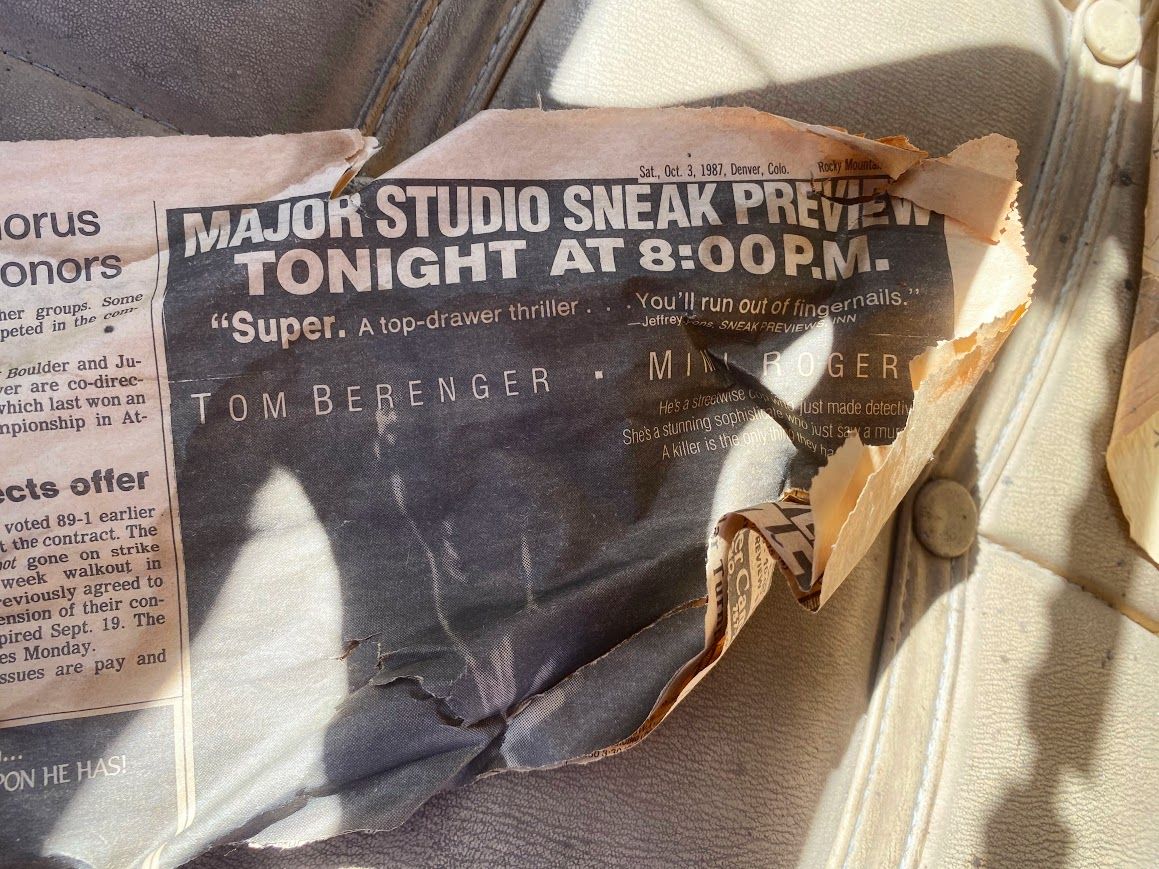
I was wondering how long this car had sat around and found a chunk of newspaper behind the seat. Denver Post, October 3, 1987 (Saturday). I was in my freshman year of college about to turn 18. And apparently there was a sneak preview of what must be “Someone To Watch Over Me” playing that night. Assuming (I know, I know) people try to clean out their car occasionally this car may have been parked after 15 years of use. The odometer read 4x,xxx miles which I assume really means 14x,xxx which is about right. I suppose it’s likely it was going to be “restored” for the last almost three decades and then the owner ran out of…motivation. And his heirs finally had it towed here.

There was a lot of detritus in the back. The hatch wouldn’t open without a key so this is the only way to look back there. Some of this stuff looks newer than the late 1980s such as the cabin air filter on the left, maybe random garage stuff was tossed in here to add to the weight for the payout. But this is what it looks like with the rear seat folded down from the driver’s door, it’s pretty capacious.

And here’s the same thing but with the +2 wedged up against said detritus, it should go back a little further, one isn’t as erect in the back seat as it seems. Or, maybe? Depends on the company? Anyway, it looks slightly more comfortable than the rear seats of a Pinto which this car is largely but not completely based upon. PSA – for more info, please search (our) archives or check the links at the end, we’ve done several excellent Mustang II posts about its gestation etc. and the Google AI is always wrong so don’t rely on that.

From that back seat perch one can see the front laid out like a landscape.

I will say the front seats could use a little (or a lot) more lateral support, a view that apparently I am not the first to espouse, many of the period buff books had similar, uh, concerns, amongst other assorted musings.

In case you got kidnapped there is a handy reminder straight ahead of the passenger seat describing what the miscreant was driving which would be handy if you managed to get away and went to a police officer for help. “Beige car with air conditioning” isn’t going to cut it. Details matter. Just the facts, ma’am. Bring it! Any opportunity to tase someone, bro!

It is somewhat difficult to look away from the seats. I like the contrasting stripe on the seatback. And while I do like me some good button tufting in general, I’m not sure about the strap motif or the tuftery in a Mustang, but they DO look comfy. Maybe it’s like sitting in Lee’s Lap of Luxury, I dunno. Very mixed messages though, not really the sporty runabout message one might have been straining to hear. This is perhaps the interior (all of it) that the Maverick should have gotten for at least a mid-cycle refresh, no? Anyway, time to slide off Lee’s lap and start to exit this carnival ride…

Let’s check the tire pressures of our 13″ Goodyear Custom Steel Radial in size BR78-13 – which is apparently equivalent to an ST175/80R13 tire, and, as AI confidently informs me, is “commonly used for trailers”. That’s probably slightly embarrassing to have to get replacement tires these days at Tractor Supply…

I’ve historically not been overly inclined to be partial to this generation of Mustang, preferring almost any other (except for probably the slightly earlier “Grande” version) were it to come to the matter of me being parted with my money in exchange for one. But for some reason this one sort of spoke to me. I’m not sure what it was saying exactly but it was trying, kind of like Rocky. And I suppose this was my response; I generally can’t be bothered to write about a car that doesn’t on some level interest me and my interest here isn’t just to debase it. I’m semi-grudgingly kind of liking it and perhaps understanding what might have appealed back in yesteryear, although I have never driven (or ridden as far as I can recall) in one. This is likely the last the world will see of this particular car, perhaps one of the longest lived specimens of its kind still extant. Does anyone know of a lower production-numbered one?
Related CC reading:
Curbside Classic: 1974 Mustang Mach 1 – The Soul Survivor, by Dave Skinner
Curbside Classic: 1974 Ford Mustang II Notchback – Mustang II, Recognition Zero, by Joseph Dennis
Curbside Classic: 1975 Ford Mustang II Ghia – More Pinto Carlo Than PintoStang, by Joseph Dennis
Curbside Classic: 1976 Mustang II Cobra II – Ford’s Deadly Sin II, by PN
Curbside What If? CC Builds A Better Mustang II, by PN























Mr. Iacocca always got great press in his heyday at Ford. From the Time magazine archives an article published October 15, 1973 entitled: “AUTOS: The New-Model Gamble”
“The car getting the most flamboyant promotion is the Mustang II, with which Ford President Lee lacocca hopes to repeat the personal triumph he scored by bringing out the original Mustang in 1965. After years of growing longer and heavier, the Mustang has been restyled into a car a bit smaller than the original—one of the rare cases in which Detroit has shrunk the size of an existing model. The Mustang II’s recommended basic price is $2,895 (about $500 more than the 1973 Mustang), but fully equipped with options it can run to more than $4,000; lacocca sees it as the first of a new class of “luxury small cars.” Ford introduced the Mustang II to the press with a glittering stage show featuring fireworks and aquatic chorus girls.”
I love this so much. The ’74 has always seemed more special among the five model years of Mustang II since: a.) it was the purest expression of what Ford had set out to do with this generation; and b.) the ’74-only grille looks more attractive and finished to me than what followed. (And yes, I’m aware that the fuel filler door had also been raised for ’75.)
The contrasting stripe on the seats has also been a curious detail to me – I wonder what they were going for with that, but it doesn’t look particularly objectionable. Jim, you mentioned the apparent lack of lateral support with these seats, which I’d probably agree with, but they also remind me a bit of the seats in an ’85 Renault Encore I had some experience with while growing up.
The color scheme of this MII is so ’70s it hurts, in the best way. Love that it was a 2.8L V6 with a four-speed. This is probably how I would have ordered mine. An excellent find.
Oh I didn’t find the seat stripe objectionable either. And yes the color combination really did work, extending all the way to the red pinstripe on the exterior. Most Mustang II color combos in/out seemed to work well from what I can recall or see in the brochures at least.
I’ve ridden in one of these in the UK in the 1980s (a 2.3 Ghia notchback). Plenty of room up front, not much in the back, though the rear of the front seats were thoughtfully sculpted to give a little knee room (just enough for me and I’m all of 5′ 3″). Slightly longer than a contemporary Ford Cortina but on a shorter wheelbase.
Wow, what a find, and what a shame! I’m such a nerd about production details like this (and a lot of other things)…this is one of those circumstances where you just wish you could have found this car’s person in time for it to NOT be at the scrapper.
I tend to geek out over little details or options and especially serial numbers for some reason. I guess it keeps it fresh, there’s always something new to find…If it was the original owner it would have been very interesting, if not the original owner I’d be curious if they even realized (or cared?) the VIN was so low…
What brand of cigarette did Mustang II owners smoke? Based upon one data point, it was Kool. My dad’s best friend had a Mustang II coupe (and rather well equipped if memory serves) and he loved Kools. The interior of that Mustang II had a definite menthol smell that wasn’t as off-putting as it might seem.
As an aside, he later went to work for the Air Force, teaching at an airbase near Brindisi in Italy. He took the Mustang II to Italy with him and later traded it off for a European Ford Escort. So his MII may still be in Europe somewhere…
This is indeed quite the find. Hopefully it has some parts harvested; are the Mustang II front ends still popular to transplant onto some vehicles?
Very kool, thank you for the insight. I guess I’ll see how it goes over the next month or so, it looks like someone had taken the doorpanels but I came across it a couple of days after it got placed but before the weekend warriors descended on the place so mostly still complete…Dave Skinner may have stripped it to the bone by now, he’s in the area too and maybe the Soul Survivor needs some spares…
Little late to the game, as I’m down in Albuquerque dropping off a Honda Element at my daughters house (someone tagged the rear bumper on her previous Element, and the insurance company totaled it).
Anyway, I’ll be running over on Monday and gathering up as many parts as are still extant- Those bright trim strips on the bumper are unobtanium these days and look pretty good in the picture, and I need an oil pan for an upcoming project.
The Soul Survivor also shows an August ’73 build date, but the VIN ends in 132149 (out of San Jose). It sees Ford was pumping Mustang IIs out at a frenzied pace that month.
I saw it again today about an hour before you wrote your comment actually, and it’s mostly the same. Someone had a go at the (damaged) grille and headlights but it’s all laying on the hood now. I didn’t notice anything else obviously different or missing in walking past it. Bring gloves if you are going to poke around inside…
It’s at Aurora UPAP, btw, which you probably realized from the background. Good luck!
Great find there Jim. Have no love for these but sad to see it go to the crusher.
The circle of life, my friend, the circle of life…Look for its spirit in your next washing machine.
A 4-speed with AC? Nice!
Speaking of ashtrays and cigarettes. Just the other day I was talking with my friend and I don’t remember exactly why he brought it up but he repeated the old trope of “Why are you selling the car?” “The ashtray is full!” Yes he is from my era and apparently his father had shared that old line with him just as my father had with me.
As far as what brand Winston was still the #1 seller in the early 70’s.
I dated a woman in 1984 who had a Mustang II Ghia notchback. 2.8 V6, automatic. At ten years old the (also tan, but maybe fabric??) interior was in not much better shape than this one. A pretty miserable car but I was forced to drive it a few times. I did have the opportunity to watch these (and Pinto’s) being assembled at the Milpitas plant a few years after this one was built. As an observer, it seemed that speed, not attention to detail, was Job 1. At every assembly station, the workers rushed to throw the parts on, so they could relax until the next car came along the line. Maybe the lines ran slower, but it was much more noticeable in the Ford plant, both on the Pinto/MII and F100/150 lines, than in the nearby Fremont GM plant which I also toured around that time, where they were building the then-new downsized A Body rear-wheel drive intermediates.
As you well know, the Milpitas plant became a huge shopping mall in 1994, and Fremont became Tesla in 2010.
My late aunt, who passed last year at 96, learned to drive in her mid-40s. Her husband, a lifelong Oldsmobile man, let her choose her own car and it was a Mustang II in what was probably the same color as this one. 4-cyjlinder, auto, well equipped including air conditioning. I drove it when visiting and while its engine did not give it much pep, it was enough for the time and gas prices. Having driven a rented Chevrolet Vega weeks prior, I could not help noticing the the “feel” of the two differed. The Vega, though a strippo econobox, felt like its designers wanted it to feel like a big car. The Mustang II, though well trimmed and optioned, felt like a sporty car.
That’s interesting, without any personal back to back comparison or actually even any personal seat time in either of them (how did that never happen for me?), I kind of always figured the Vega would be the more sporty-feeling of the two and the Mustang more the large car sort of Broughammer…
A good friend’s first nice car was a 74 Mustang II Ghia that he bought from a used car lot in 1978. 2.3 and a 4 speed, and painted baby blue. It was a really nicely trimmed car inside, and his seats (though blue) looked just like these.
I really like this early 70s steering wheel much better than the 1975+ counterpart that was on almost everything Ford built. I am also surprised that someone has not liberated the front suspension and disc brakes, which have been a popular mod on lots of older cars.
Now how about finding one of these with a million miles on it? You need to up your game!
We’ll never know, Ford didn’t want to spend the extra beans to put more than a 5-digit odometer in them.
The right car at the right time. Iacocca still had terrific instincts of the auto market, and it showed yet again with the Mustang II. Henry Ford II had always envisioned the original Mustang as a ‘mini-Thunderbird’, and even though it was based upon the Pinto, the Mustang II at the height of the brougham-tastic mid-seventies would be as close as it ever got.
Would it have been as big a success if not for the entering the market right when the first Oil Crisis hit? Doubtful, and a big, subsequent downturn in sales over the next four years as oil supplies rebounded seemed to bear this out.
But for one shining year, it was a massive hit.
Thanks for sharing the story behind this 1974 Mustang II 2+2—especially the detail about it potentially being a first-production-day car. It’s fascinating to think how the Mustang II was such a bold departure from its predecessor, especially in the context of the 1973 oil crisis and shifting consumer tastes. The fact that it debuted at over 6,000 dealerships in just one day really underscores how much Ford was betting on the new platform. Curious to hear more about the car’s journey from the factory floor to the junkyard—any info on its original owner or restoration process would be great!
Very similar to the 74 Capri with 2800 and 4 speed. Weights almost the same although research said 0-60 was 10 seconds for the Capri and 11 for the Mustang. My sister had a 74 Capri 2800 and I thought it pretty peppy compared to my 72 VW wagon, 73 Audi Fox, 74 Duster 225 automatic company cars.
I don’t know where you got those numbers, both weight and acceleration. Here’s a snippet from my MII Deadly Sin:
C/D tested the new Mach 1 version with the 105 hp 2.8 six, and noted right off the bat that it was saddled with too much weight: “Our test car weighed over 3100 lbs…(the V-6 Capri we tested in 1972 weighed slightly under 2400 lbs)…the (Mustang’s) engine is more notable for its smoothness than any feel of power”. The quarter mile took over eighteen seconds (@74 mph), and zero to sixty took over twelve seconds.
Yeah, the Mustang II was one of many Ford products that ended up weighing more than originally planned and with performance that suffered because of it. I think of the 10th Generation 1989 T-Bird and the 3rd Generation 1996 Taurus as other examples. In all of these instances Ford had to go back and add a more powerful engine after the initial product introduction.
My Dad bought my younger brother a five year old or so, used Ghia coupe after he graduated from high school. It was red, with a white top and red vinyl upholstery. What was impressive was the thick deep pile carpeting, it looked exactly like the carpet used in the Thunderbird and Mark IV. Overall, the quality of the car was impressive, it was certainly better than the Chevy Monza that my brother bought for his Wife. Fortunately, it was equipped with the four coupled with the manual four speed, but was also saddled with a/c. Though not fast by any measure, it was adequate, (I’ve got a thing about cars being adequate!) and returned good mileage for the times. It was also very comfortable and quiet.
The lack of performance really wasn’t a detriment; early Mustangs were more often equipped with six cylinder engines than hi-po V8s, as Mustangs were known as the secretary’s sport’s car. Buyers that wanted a real performance model had to look no further than the used car classifieds where there were tons of V8 Mustangs listed for sale at affordable prices. Even desirable models like the Mach One and occasional Boss 302 were not much more expensive than the average V8 car.
This particular Mustang II would have been a desirable starting point for a restoration; V6, four speed, A/C and it’s a hatch/fast back. I like the car, but this one is too far gone for me, there are later models that have more appeal and can be found in better shape.
This would be a great find even if it weren’t for the potentially first-day build status! You’re probably the first person in the past 52 years to have given any thought to this car’s VIN order.
It’s easy to see the appeal of these cars – relatively affordable, nicely styled, and a comfortable-looking interior. Obviously the II had its faults, but though widely maligned, there were some good attributes too.
My favorite part of this car, though, is the name of the color: Tan Glow Metallic! Who came up with that? There’s lots of colors I can envision glowing, but tan isn’t one of them.
When new my then girlfriend got one of these as a loaner whilst her ’62 Ford Ranch Wagon was being serviced .
It has the 4 cylinder and was terribly slow with the automatic tranny .
I don’t recall it having AC if that was possible then .
Looks cute in a retro 1970’s way but I don’t think I want one now , this one is certainly used up .
-Nate
This is a moment GM proved itself exactly right in lieu of their many other failures in the era, the Camaro soldiered on as the big bad F body ponycar while the Monza provided the Import fighting competition the Mustang II ostensibly fought.
I don’t dislike the Mustang II and even find it appealing as a fun looking economy car but I certainly can’t say this was a worthy follow-up to even the likes of the 73 Mustang which in “Mach 1” form is only exceeded in dorkiness by the latest crossover blob bearing Mach in the lineup in levels of blasphemy (not because of it being an EV but its shape/doors/packaging)
The Mustang II 2+2 was cute and I prefer the styling over that of the notchback. But it was NOT sporty to drive. A Pinto (with its lower weight) was slightly faster than a comparable 4 or 6-cylinder Mustang II.You really needed the V-8 engine to get decent performance in a Mustang II and then you had lousy gas mileage and lousy handling due to all the weight over the front axle.
The Mustang II was pretty cramped, too. Back in the 1970s I remember reading an analysis of passenger and trunk space and, as I recall, the Mustang II was had the least amount of passenger and trunk space out of everything they ranked. They actually rated the 2-passenger Datsun 280-Z (with its comparatively roomy cargo area) as being more space efficient and as having more room than the Mustang II.
This brings back memories of my 1974 Mustang II, my first car after college in 1976. I needed a used car to get to my new job in Florida, and this fit the bill — copper-orange on the outside, tan on the inside, with the V-6 and an automatic. The most important thing was that it had air conditioning. It looked OK and served me well for nearly five years, but I was a dope then about keeping up with oil changes. I ended up with a totaled engine, and that was that. I moved on to ’79 Toyota Celica with a 5-speed, which was a lot more fun (and lasted a lot longer).