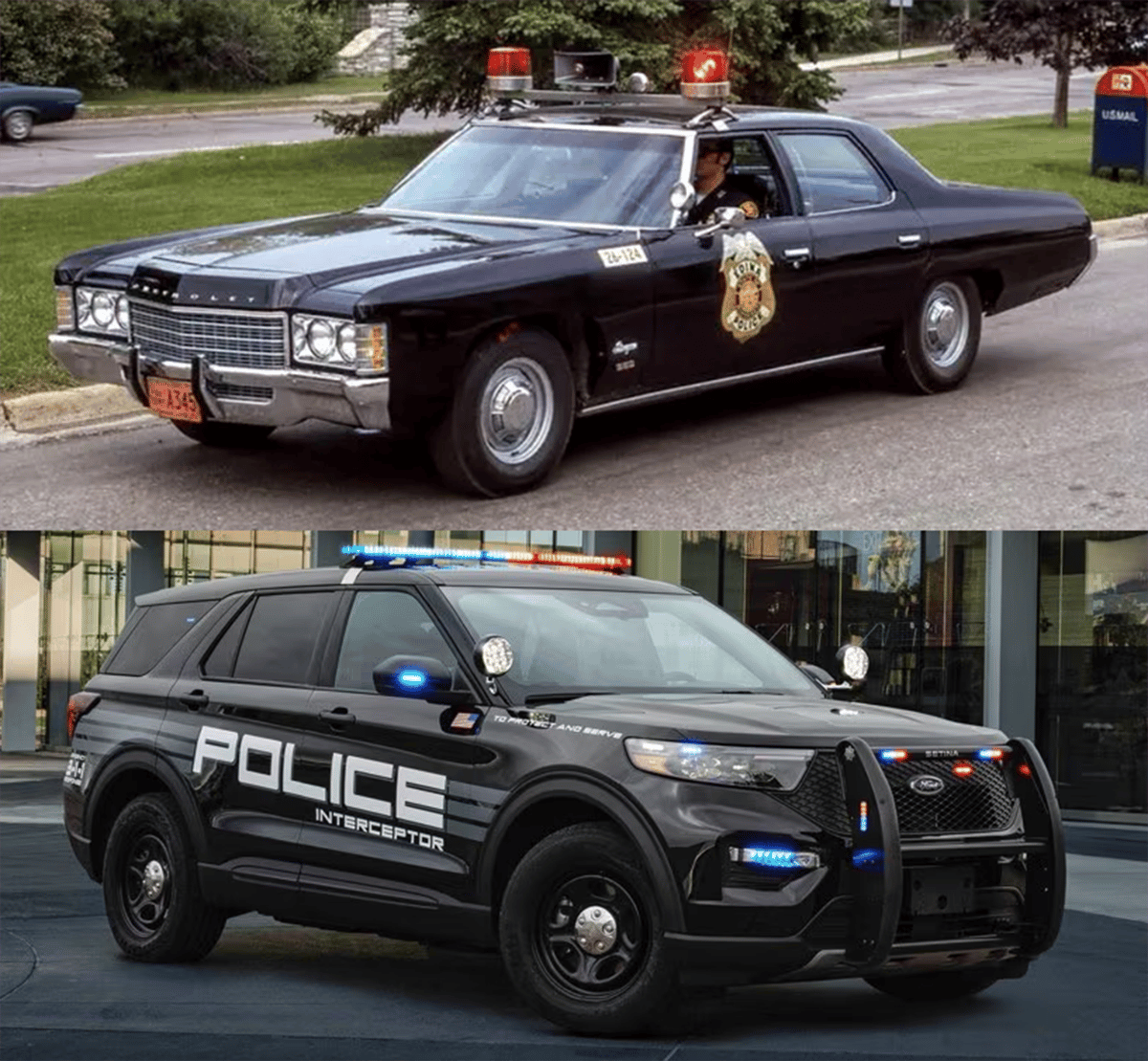
As someone who spent a career in military law enforcement, I’ve always had a fascination with and connection to police vehicles. I began my career in 1978, so I missed the big-block, high-compression era. A rundown of some of the vehicles I drove can be found here and here. But certainly those large big-blocks carry a mystique and aura all of their own, deservedly so or not. So let’s look at a few of the most powerful law enforcement sedans from the Sixties/early Seventies compared to those of today.

First a few caveats;
1) We’ll focus on major production models only – sedans for the Sixties/Seventies and SUVs/pickups today. The Camaros, Mustangs, AMXs and occasional drug kingpin repossessed Lamborghini Gallardo will be saved for another day.
2) You’ll see some info online that claims Chrysler’s 426 Max Wedge engine was available as an option for police vehicles – other more credible sources say that engine was never offered for police duty. Maybe a few were converted after they left the factory. In 1968 the New York State Police requested a Plymouth Fury with a 426 Hemi and Chrysler delivered one as part of a special evaluation program. Other than that, no 426 Hemi’s left the factory in a police-spec vehicle.
3) We’ll use factory-advertised hp figures. No doubt some departments took their Chevys by Smokey Yunick’s garage, their Dodges by Mr. Norm, and their Fords by the good ‘ole boys at Hollman-Moody. Those don’t count.
Let’s get started – a selection of the highest horsepower police vehicles in the Sixties/Seventies.

No. 1: 1966-70 Chevrolet Biscayne and Bel Air with the L72 427 cu. in. engine rated at 425 hp gross.

No. 2: 1962-65 Chevrolet Biscayne/Bel Air with the 409 engine, with both dual and single 4bbl carburetors, with engine ratings ranging from 400, 409, and 425 hp. The dual-quad motor likely didn’t get many orders but it was included in the 1962/63 police catalogue.

No. 3: 1968-70 Oldsmobile Delmont 88 “Apprehender” with a 455 cu. in. V8 (code W33) rated at 390 hp.

No. 4: 1962-65 Dodge/Plymouth “Interceptor” models with the 413 cu. in. RB engine with 380 gross hp.

No. 5: 1967 Pontiac Catalina with the 428 cu. in. HO V8 with an advertised 376 gross hp. Part of the police “Enforcer” models. I didn’t see any Pontiac police units in my section of central Ohio back in the day, so I was surprised to learn the brand had a fairly aggressive police marketing effort.

No. 6: 1966-71 Dodge/Plymouth (Fury/Monaco/Polara) with the 440 cu. in. RB V8 with 350-375 hp (engine code E86). While the models above had higher hp ratings, in testing by the Michigan State Police, a ’69 Polara hit 60 in 6.3 seconds and went through the quarter-mile in 14.4 seconds at 98 mph. Its top speed was a remarkable 147. Within the law enforcement community, with their strong 440’s and torsion bar suspension, these Chryslers are generally considered to be the best “cop cars” of the big-block era.

No. 7 (Tie): 1971 Ford Custom with the 429 Police Interceptor engine (P code) rated at 370 hp.

No. 7 (Tie): 1963 Pontiac Catalina “Super Enforcer” with the tri-carbed 421 cu. in. V8 that put out an advertised 370 gross hp.

No. 8: 1971 Chevy Biscayne/Bel Air with the LS5 454 cu. in. V8 with 365 gross hp.
How about today;

No. 1: RAM 2500 AWD SSV with the 6.4 liter V8 rated at 405 net hp and 429 ft-lbs of torque,

No. 2: Ford F150 “Responder” with the 3.5 Ecoboost V6 with 400 net hp and 500 ft-lbs. During Michigan State Police testing, it was the quickest of the gas models with 0-60 time of 5.68 seconds.

No. 3: Ford Police Interceptor Utility with the 3.0 Ecoboost V6 with 400 hp and 415 ft-lbs.

No. 4: Dodge Durango Pursuit with the 5.7 Hemi V8 with 360 net hp.

No. 5: Chevrolet Tahoe PPV with the 5.3 EcoTech3 V8 with 355 hp. I was surprised to learn GM doesn’t offer the 6.2 V8 as an option, but given its well-publicized issues, that may have been a blessing in disguise.
The Future?

No. 1: Blazer EV PPV with 498 hp and 531 ft-lbs.

No. 2: Mustang Mach E PPV with 480 hp and 600 ft-lbs.
The Michigan State Police tested both a police-spec 2025 Ford Mustang Mach E AWD and the Chevrolet Blazer EV AWD. Both out-accelerated their gas counterparts – the Mach E doing 0-60 in 4.03 seconds and the Blazer in 5.14.
So even with all their nostalgic sentimental appeal, the old bruisers of the big-block era aren’t as quick as today’s smaller, more powerful offerings. As EV technology moves ever-forward, that trend seems likely to continue.
One wonders what a similar comparison in 2045 would look like. Hope I’m around to see.
Thanks to Aaron Severson for a review and suggestions.
Fun Fact: The 1969 Dodge Polara top speed record for four-door sedans of 147 mph stood until 2006 when it was broken by a Dodge Charger Pursuit. You’ll see info online, generally sourced from a GM claim at the time, that its 1994 Caprice 9C1 broke the Polara’s record by a few tenths of a mph. This was based on some testing GM had done at its proving grounds. However, when tested by the Michigan State Police during its annual trials, the 1994 Caprice maxed out at 135 mph. Though it didn’t break the speed record, the Caprice did finish at the top of the ratings.




The photo of your “68-70” Olds Delmont is actually a 1967 with the 425 motor.
Thanks – updated.
I would worry about all the new high performance models due to their complexity and tendency for failure.
Word. The fantasy of buying a fast strippo police car at an auction for dirt cheap evaporate when you are faced with contending with complex and expensive to repair engines that were driven HARD. I’d trust an abused big block Chevy or 440 Dodge to keep going after they were decommissioned back in the day, today’s Ford Eco-boost? Yeah not so much.
You mention central Ohio-i grew up in Worthington. I remember their patrol cars- Novas then the 77 Monaco. They had all the cars painted a silver blue.
On another note, my friend from south Florida was a deputy and always told me his favorite car was the 77 Nova 9c1. He said that car handled so well.
Thanks for this cool article
Chip: I’m not sure about today since I’ve been out of law enforcement for some time. But back when I was a police officer, the 9C1 Nova with the 350 was kind of a legend.
When I first got into police work, we had early 1990’s Ford Taurus’s. There was one “retired” Plymouth Acclaim as well. The Ford’s all had the 3.8 V6 and I’m not sure what the HP was. Then we moved to Chevy Lumina sedans with the 3100 V6 and we liked those a lot more. But the most fun was when we got our first Lumina with the 3800 V6. The county and state were running Crown Vics and the Caprice.
But what I think of most going back well before my time was when my brother (a deputy with the county) had a mid 70’s Dodge Aspen. I have no idea what engine his patrol car had, but he said it was the slowest thing he’s ever driven. There was a 4 lane highway going through the county and one part had about a mile long hill. The grade was steep, but no mountain. Anyhow, one day he decided to see what that Aspen could do. At the bottom of the hill he was going exactly 55 MPH and he put the pedal to the floor. By the time he crested the hill, he said it was going 54 MPH. haha.
The numbers for that ’69 Polara 440 are highly impressive, to say the least. Almost a bit too much so; this must have been an exceptional example, or perhaps one that was very carefully prepped by Chrysler? The acceleration numbers are right there with some of the better/best smaller muscle cars, but it’s the top speed that is really eye popping, given the massive aerodynamic drag of that giant brick.
I agree. The Michigan State Police didn’t start their current formal testing program of all police-spec vehicles until 1975, so Chrysler might have slipped a ringer by them when they were testing single models in 69.
Would also like to see an MPG comparison.
We bought a few ex-police cars for taxi use. First of all, the cops usually ran the bag off the cars, meaning you had to replace the entire front end to pass the safety check. We had two Chevrolet 9C1s, a Ford cop car and two Dodges. For acceleration, the Chevy smoked the other cops cars. The Ford had a better seat, in which you sat high, giving it a better driving position than the Chevy. The Dodge had a super nice interior, decent acceleration but a Queen Mary turning circle.
For a twelve hour shift, the Dodge was the most comfortable, followed closely by the Ford. The Chevrolet cars had terrible seats and an ox-cart ride, but the engine made up for it.
What about the King of the cop cars? Yes, the`74 Dodge Monaco aka the Bluesmobile!
Malaise had set in by then and it was reliving the glory days of that ‘69 Polara!
I remember those CHP Olds Delmonts. There arrival surprised me (as a ten year old) because it seemed to me that most police cars were Dodge or Plymouth, with a smattering of Fords. And I’d never noticed the Delmont name … a full-size Olds should be just an 88 or 98. As for the future, I have seen Tesla police cars on trailers going to Anaheim. A few other cities use Teslas – or at least have tried them. In California, the (V6) Charger has replaced Explorer-style Interceptors in state and local use in many areas, over the last few years. New patrol vehicles I see here are usually either Tahoe or F150.
The CHP, while using Mopar full size police cars between 1966-1975, there was one year when they didn’t. That year was 1970 when they ordered the Mercury Monterey with 428-4V as their car. Few recall and when it comes to a CHP car these are the rarest of the rare now out of 1,820, of the 2,876 built, to the CHP. I personally can’t ever recall seeing one in that time frame and I started driving December 1969. However, I very clearly recall the 1969 Polara.
There was another one year wonder in that stretch, the 1967 Olds Delmont 88. 425 c.i., 370,h.p. No A/C or power steering. Special white steering wheel. Fast, but trouble prone.
I’m very skeptical of the 147 mph claim of the CHP Dodge Polara. The test report from the CHP cited it going 135 mph at the end of two miles and still accelerating. But the power required to get to 147 mph clearly wasn’t there if all it would do is 135 mph at the end of two miles with a 3.23 rear end.
The lights and sirens must have knocked a few miles per hour off the top end speed.