
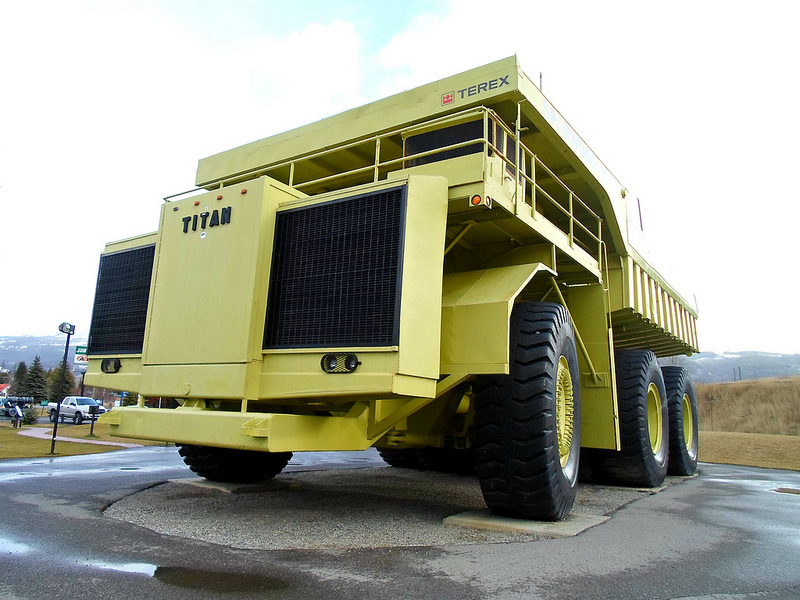
Since we enjoy trucks here at Curbside Classic, I thought I’d bring out the biggest classic of them all: a 1973 Terex Titan 33-19 dump truck that weighs in at a hefty 260 tons when empty. It has since been eclipsed in capacity but in terms of size, it is still the big dog.
The Titan 33-19 was assembled in London, Ontario, Canada by Terex, which was a subsidiary of General Motors at the time. This particular truck was the prototype of a proposed model run. Perhaps the market for these mega dump trucks wasn’t as robust as expected because production never materialized. It did, however, hold the record for largest capacity dump truck from 1973 to 1988.

The specifications of the Titan are truly impressive, but to really understand them better we should perhaps compare with something a bit more familiar. Let’s use the well known and often used automotive benchmark that is the first generation Suzuki Cultus/Suzuki Swift/Chevrolet Sprint/Pontiac Firefly/Geo Metro/etc/etc. The Titan, with a length of 20.09m (65’11”), is equivalent to 5.4 Swifts. The height of 6.88m (22’7″) is almost exactly five Swifts tall. The Titan is a mere 4.8 Swifts wide however. Weight is what really sets the Titan apart from the little Suzuki: the three door hatchback weighs in at 1,650lbs, but the Titan comes in at 520,400lbs (236,053kg). If my math is correct, that is the equivalent of 315 Suzukis. Plus with the Titan’s 700,000lb (317,520kg) payload, one could haul the equivalent of 424 Swifts.

To power this big and heavy beast, a two stroke, turbocharged 169.49L (10,320 cid) V16 diesel engine generating 3300hp @ 900 rpms is fitted. Let’s again compare to our little Suzuki with its 1.0L three cylinder engine. Each Suzuki cylinder has a bore of 73.9mm, compared with 230mm for the Titan. Stroke is 77mm versus 254mm. The Suzuki undoubtedly has the upper hand with fuel consumption as the Titan consumes 265 liters/70 gallons per hour; good thing the fuel tank holds 3232 liters/800 gallons. The car also beats the truck on top speed, as the Titan 33-19 tops out at 30mph or 48km/h. The Titan’s engine (most commonly used in locomotives) is sourced from the GM’s Electro-Motive Division and is used to generate electricity for four 4CM electric motors. The engine puts out enough electricity to power 3200 homes according to the informational plaque.

Interestingly, this big truck has independent front suspension. This rather rebuffs those who like to argue that their three ton truck absolutely needs a solid axle at the front. The brakes are also independent front to rear, likely to help with steering. The Titan rolls on 12′ tall tires.

I actually saw this exact truck in service at a mine near Sparwood, British Columbia during my childhood. We visited the strip coal mine operation where this truck resided and where a fleet of more modest (but still massive) two-axle Euclid dump trucks were in use alongside the Titan.

The Titan started its work life in Eagle Mountain, California at a Kaiser Steel iron mine. By 1978, it was moved by rail to Sparwood, British Columbia to haul coal. It was fully retired in 1991 due to the high cost of maintenance, no doubt because of its one of a kind status. Teck Corporation acquired the Sparwood mine in 1992 and provided the Titan for public display. A restoration (and engine removal) followed in 1993 and it now serves as a tourist attraction for the town of Sparwood, just off Highway 3.

As an extra bonus, this Wabco 3200B Electric Haulpack mining dump truck is a similar but smaller display in Logan Lake, British Columbia. Our old family minivan stands in as a nice size comparison. The specifications are impressive, but overshadowed by the Titan.
Engine : 128.8L (645 cid). 12 cylinders – 2 stroke – 2500 Hp
Height: 6m (19′ 11″)
Width: 7.35m (24′ 1″)
Length: 16.5″ (54′ 3″)
Gross Weight: 383104 kg (844,600 lbs)
Payload: 213188 kg (470,000 lbs)

These monster sized trucks have been eclipsed in carrying capacity, but newer trucks use two axles rather than the three used by our two examples. It is nice that in the face of high scrap prices, both these trucks have been preserved as tourist attractions.
Note: a rerun of an older post.























Incredible! … long live GM EMD (rip!)…speaking as a train buff, they were the best!
Now let’s see the new champions!
That’s really cool. I’m working on a project for Sparwood right now, but sadly I will not get to the site or see this truck.
At first glance I thought it might have been on display in the Fort McMurray area, there is some big equipment there at the side of the road as well.
Thanks for a great presentation. Mankind solves problems sometimes in a big way. I presume that the V-16 Diesel is a Detroit Diesel. It must run quietly (sarcasm). Of course, where these mighty trucks are operated, delicate-eared neighbors should not be a problem. Keep these articles coming!
Not quite. The engines mentioned here are Electro-Motive 645-series. Back in the mid-late 1930s, GM split its 2-cycle diesel ventures into three paths: Electro-Motive focused on locomotives and large stationary applications, Cleveland Diesel (successor to the Winton Engine Co. that GM bought in 1930) focused on marine applications, and Detroit Diesel focused on highway and small stationary applications.
Been around lots of boats over the years and a big fan of Gray Marine then General Motors Diesel then Detroit Diesel, especially pre-Series 60. I can hear a series 53, 71, 92, 149 powered boat or land lubber vehicle miles away. A lovely, unique sound. But, when I learned that EMD locomotive engines were also two stroke, I thought wow they don’t sound anything like their smaller brethren. 🙂
The history of Terex is almost as interesting as the history of the 33-19. It started with GM’s acquisition of the Euclid Road Machinery Co. in 1953, a move that almost from the start was contested on anti-trust grounds. GM wanted Euclid in order to capitalize on Eisenhower’s Highway Act and in addition to use GM’s Detroit Diesel engines. Euclid did very well under GM, but eventually GM was ordered to divest in the late 60’s. This presented a bit of a problem, as under GM Euclid significantly expanded its product offerings to include bulldozers and larger mining trucks. So, GM was allowed to retain all product lines that Euclid had developed under GM ownership, but was forced to sell all product lines that Euclid was manufacturing before the GM acquisition, like scrapers, wheeled tractors, and smaller off-road dump trucks. Euclid was sold to White Motor, and the business that GM retained was named Terex. GM spun Terex off in the early 80’s as that industry went through major consolidation.
A definite local landmark. The scale is something, even if you are used to heavy equipment.
I even wrote a fictional piece on this truck back in the day
Imagine driving this down Main St. !
Even Army tanks would get out of your way!
But would ICE vehicles yield.
What a beast ! .
-Nate