
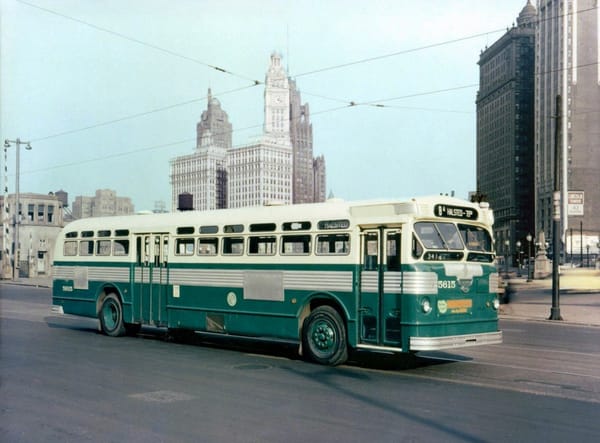
(first posted 1/19/2018) Here’s another bus you would have likely seen or ridden in if you were spending time in any large North American metropolitan area in the decades of the 1950s and ’60s, especially those in the US Midwest. It’s a Flxible Twin Coach FT series urban transit coach.
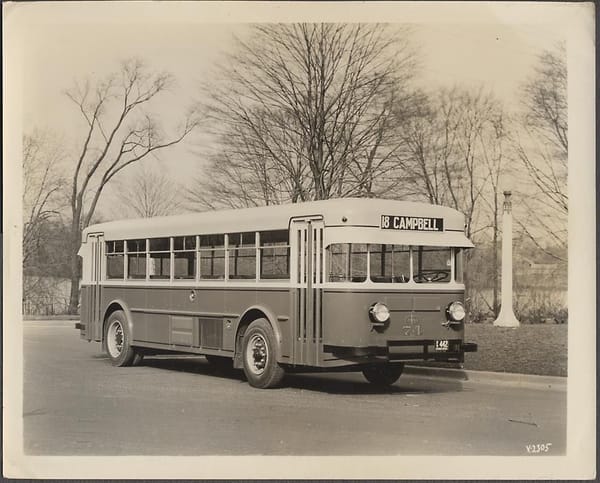
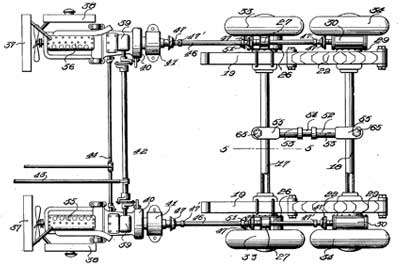
Before there was a “Flxible – Twin Coach” there was a “Fageol – Twin Coach” – a company that manufactured buses, trucks and marine engines – and was founded by the innovative Fageol brothers after they left American Car and Foundry (ACF) in 1927. Why Twin Coach? Because one of the first models they introduced in 1929 was a dual-engined transit bus. It had two Waukesha six cylinder gas engines, one on each side located about mid-way between front and rear. This design offered more power and increased interior space over then current front- or rear-engined models.
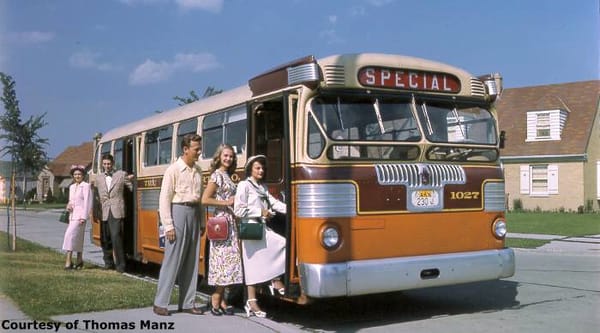
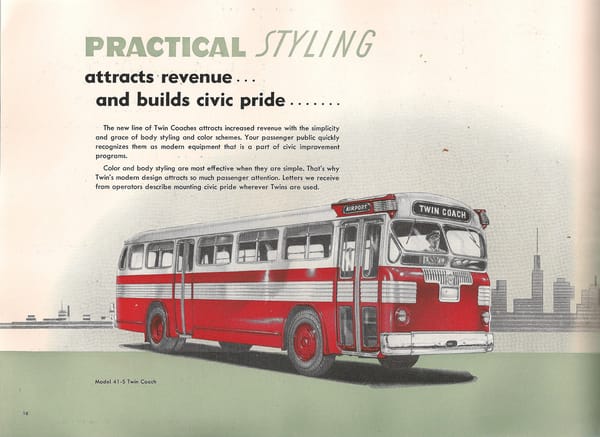
With more powerful and improved engines available post-war, the company introduced a new single-engined design to compete with GM and other urban transit bus manufacturers. It was designated the S-series, and came in sizes seating 34, 38, 41, 44, and 50 passengers. It was 96 in. wide and varied in length from 29 to 38 ft.
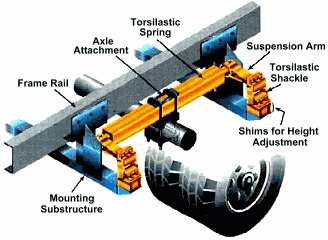
While GM had its innovative airbag suspension and others were still using steel springs, Twin Coach used BF Goodrich’s “Torsilastic” torsion bar setup – later a staple on Eagle coaches and their European predecessors.
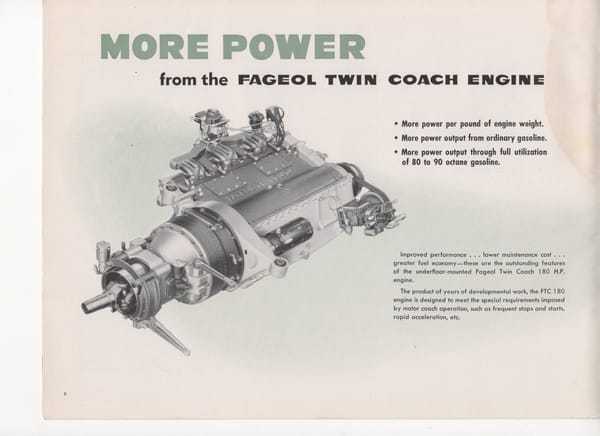
While engines from different manufacturers could be ordered, most came with an in-house gas or propane fueled Fageol FTC, a 404 cubic inch inline OHV six that put out 180 hp and 379 ft lbs of torque (gas version).
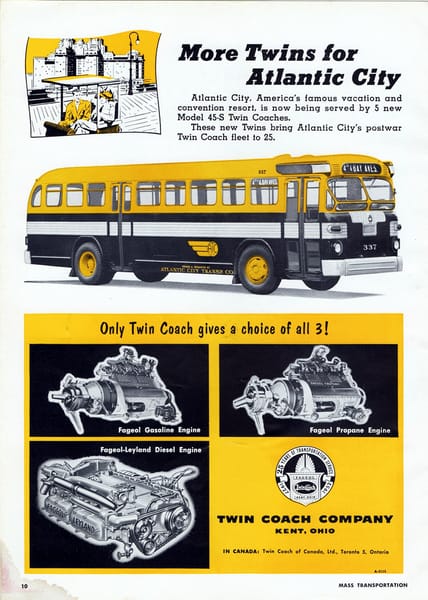
Lacking a diesel engine to compete with GM, Twin Coach partnered with Leyland and produced a version of Leyland’s diesel. Engines were located underfloor amidships and were all longitudinal “laydown” designs.
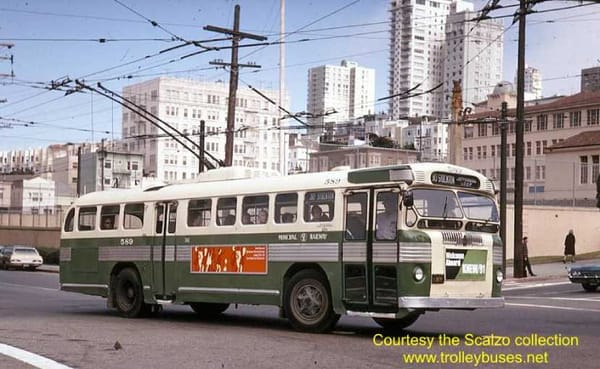
Twin Coach was also a major producer of electric trolley buses.
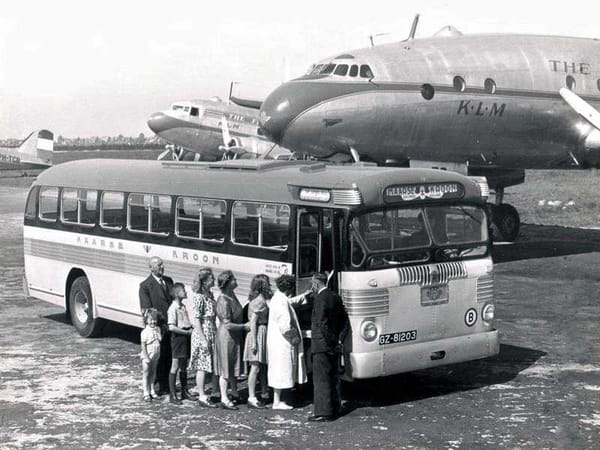
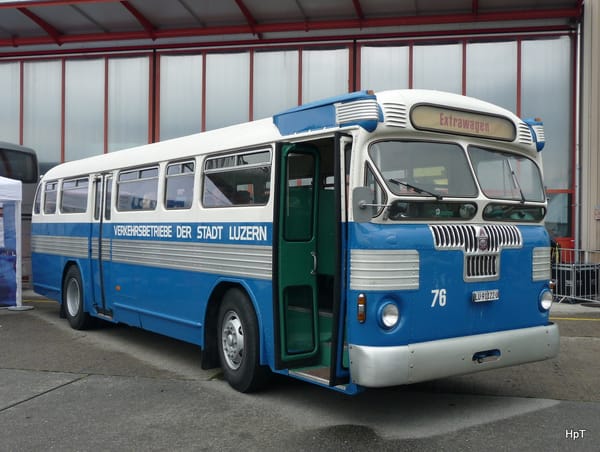
A few also made it to Europe.
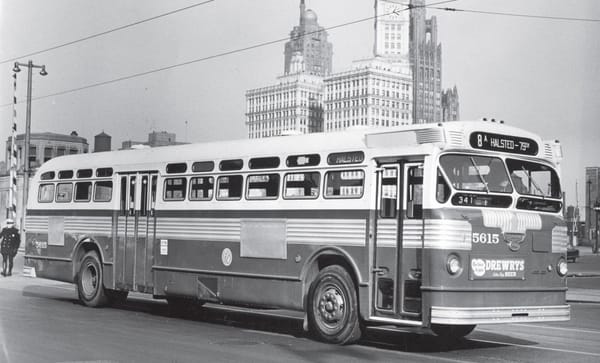
In 1953, Fageol sold the bus portion of the business to Flxible, who at that time did not have a transit model. Flxible kept the design with few modifications, but renamed it the FT series (Flxible Transit). They also kept the protruding six-pane front windshield design, which would become a Flxible transit bus trademark.
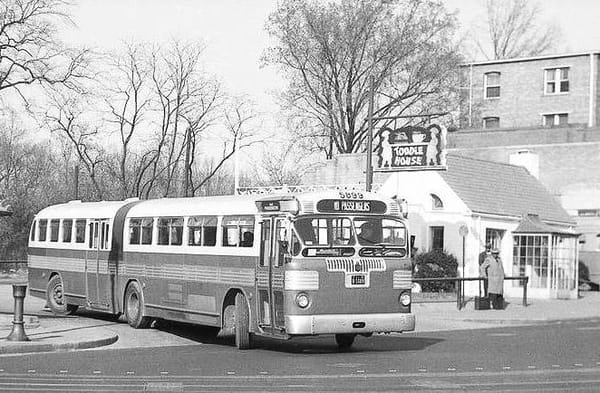
One articulated demonstrator that seated 55 was built, but unfortunately found no buyers – you can see the rear wheel steering in action in the photo above.
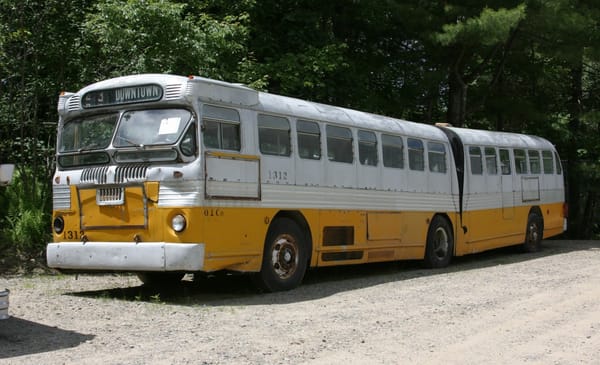
Fortunately it has survived and resides at the Seashore Trolley Museum in Maine, awaiting restoration.
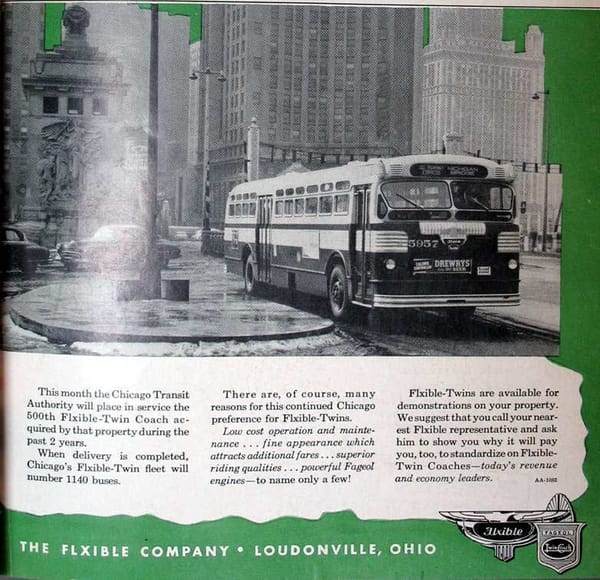
Flxible kept the design in production until 1959, though sales steadily declined throughout the 1950’s. One city that was a loyal Twin Coach customer was Chicago who maintained a large Twin fleet, until finally succumbing to the GM juggernaut. In this photo you can just make out the Flxible logo on the front below the windshield which was placed on top of the Twin Coach badge. This bus is also a 102 inch wide model, introduced in 1952.
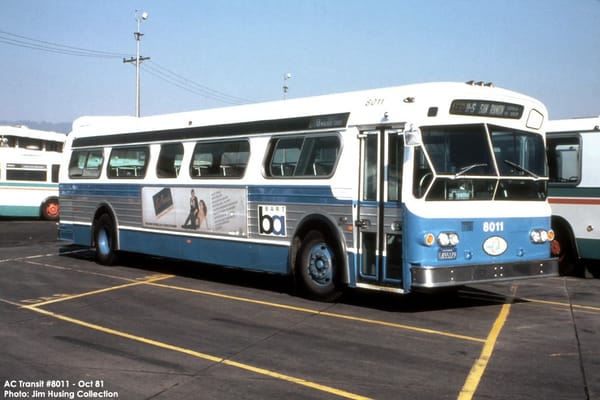
By 1961, Flxible had its “New Look” model ready for the market and the Twin Coach name was laid to rest…
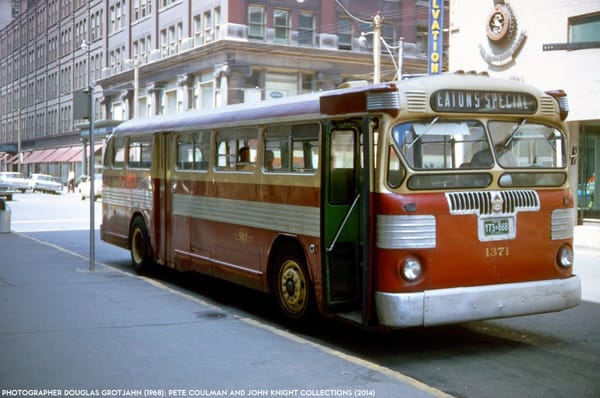
Well built, a few of these Twin Coaches were still in regular service in the mid-’70s.























That last photo – in TTC (Toronto Transit Commission) livery – I don’t ever recall seeing one of these in Toronto. That photo would have been taken downtown somewhere, on its way to Eaton’s department store. Great photo.
The top photo – is that the Wrigley building in the background behind the green bus? Excellent writeup!
The Toronto picture was taken looking west on Albert St. at James St. The Salvation Army building was demolished in 1995 to make way for an expansion of the Eaton Centre. The large building in the background is the Eaton’s Annex, which burned in 1977. Old City Hall is just out of view on the left.
Moparlee,
As far as I can tell this photo was taken on Upper Wacker Drive. You can see the Wrigley and Tribune buildings, and you can see the sign for “Lincoln Tower” which would be slightly up Wacker from the other 2 buildings.
Here’s the best I could get in Google Street View. The Lincoln Tower is to the right- there is a red car parked in front. Obviously it’s got some new neighbors since the top picture was taken.
(I’m also guessing this was a CTA or manufacturer promo picture, because to the best of my knowledge the Halsted bus route did not go downtown- Halsted Street is about a mile west of where this photo was taken.)
For CJC and moparlee, the building behind the Flxible was(is) the Chicago Tribune Tower. The Wrigley Building is out of view to our left(both then and I guess now…it’s been since August, 2015, that I’ve been on that section of Michigan Avenue). Also, while I’m here, most of the postwar Twins, aside from a few exports, and the ETBs, had “torque converters”, presumably a form of automatic transmission…the exports had manual transmissions, complete with stick shifts.
the twin coach fageols ran in toronto till dec 1969
Neat, this is full of good stuff. TTC bus and the KLM Constellation.
How do you pronounce Fageol, is it Fay-ghall or Fah-Gee-All, or ???
Bus guys stay tuned, I’ll need your help later today…
The parent company of Twin Coach, Fageol, also built vans, based on its final bus design. UPS bought some for use as delivery vehicles, used in Manhattan and in Philadelphia…they were used in Philly as late as 1981…I worked for UPS in Philly from October, 1974 to January, 2015. In late April, 1979, I began to load the trucks (called “package cars” in UPS-speak), and, on occasion, I loaded the trip that did the original section of The Gallery shopping mall(now called Philadelphia Fashion District)…it was one of those Faegol vans. The interior of the van had shelves, and a waist-high roller on the right side of the van.
Styling certainly looks to be half a generation ahead of the GM Old Look. That happened again with the Flxible/New Flyer bus in the ’80s.
Forward visibility looks better too, despite it being bisected by a horizontal bar
Another terrific chapter in the Bus Stop Classics.
The clutch and transmission linkages for the two drive trains in the original twin Coach patent drawing look like they would make for easy shifting. 🙂
I can’t help it, but I always have to dig deeper when I see something like that bus with the KLM planes…
Till 1958 Maarse & Kroon, the bus company (defunct since 1973), had 10 gasoline powered Twin Coaches. They were sold to another Dutch company and eventually all of them were dismantled.
But here’s a restored diesel powered Twin Coach, wearing the old Maarse & Kroon color scheme. Imported from Switzerland, many years ago. The former owner was the Verkehrsbetriebe der Stadt Luzern…that’s right, the owner of the blue and white bus in the picture below the image with the Maarse & Kroon bus and the KLM planes…
http://www.sva-museumbussen.nl/1948-twin-coach/
The illustrated San Francisco Muni Fageol Twin Coach electric trolley bus was photographed on North Point Street at Van Ness Avenue. In the background is Galileo High School, where my late father graduated. A proposal was floated to name the football field, which in the photo is between the street and the school building, for Galileo’s most well-known graduate, but it sank when O. J. Simpson began his meteoric descent to infamy.
The Fageols were good riding. The contemporary Marmon-Herringtons and St. Louis Car trolley buses rode roughy, joltingly. The Fageols were soft and quieter…credit their unique suspension?
Muni kept particular types of trolley buses on certain major routes most of the time…the Marmons were on the 41 Union-Howard, probably the City’s longest. 47-Potrero and 14-Mission ran with St. Louis Car. Some of this had to do with assignment of certain classes to particular maintenance bases. The Fageols ran on the 30-Stockton as shown, and the 5-McAllister.
When I lived in San Francisco back starting in the late 60’s all the trolley buses seemed to be really old, and the distinctive Twins were as old or older than any of them. They were clearly smoother riding and felt like they were much less flimsy and weighed more than the others. The heavier weight (?) also smoothed the otherwise abrupt acceleration/slowing of an electric bus. Nice old seats too.
Meanwhile all city buses everywhere in the world, despite being clearly modern low floor designs (the biggest improvement in city buses ever), seem to be harder riding than the GM fishbowl windshield versions of yesteryear or those Twins. I’m sure that bus nerds here know about whether the GMs had air suspension or something and why current buses seem to be worse. It seems to me that a modern suspension system able to adapt to loads would be a big improvement on otherwise modern buses.
Maybe a topic for a CC bus post.
About the San Francisco Faegol Twins (and a lot more on the website)
https://www.streetcar.org/sfmsr-buses/faegol-twin-coach-dual-engine-gasoline-bus/
This posting brings back great memories of my years in Chicago. My office had a great view of The Wrigley Building and one of my clients was located there – it’s beautiful on the inside too! For several years, I would generally ride the bus while my Opel sat rusting away on the street or alley near my apartment. During my time on the job there, I usually got to ride on a GM fishbowl or a Flixible New Look on my way to work and after work I would walk across the Loop and catch the Ravenswood train back home. I always got a seat that way! I’ll never forget the one time the CTA went on strike and I had to take the Chicago and Northwestern. Train was so crowded, the conductor wasn’t able to collect the fares. My boss was really happy I made it to work that day and I had some extra beer money too. Those days, I drank “fire- brewed” Strohs. Can’t find that anymore. I count The Wrigley Building in three of the above photos.
My local bar here in Chicago still carries Strohs. If you ever find yourself back here you can still get one. 🙂
My city has a Twin Coach in their historical fleet. These were popular in Canada.
My Name Is Andrew Tobin And Grew Up In Syracuse New York Riding On The Old Twincoach I Used To Ride Them To And From School, And Was Wondering How I Can Get A Model Of A Twincoach Bus To Add To My Collection Of Old Transit And School Buses , And I Also Would Really Love To Get A Steering Wheel Of A Old Twincoach bus To Add To My Collection Of Bus Steering Wheels My Address Is 11202 North 41st Ave Phoenix Arizona 85929
I remember riding Twin Coaches home from high school the first couple years. Slow but reliable. When it would rain Phoenix Transit would bust out GM Old Looks; our driver told me the Twins tended to short out on wet roads. Thinking about it now, this seems odd seeing that they were common in Chicago and other cities with actual weather.
Thanks Jim for this look back. I’m enjoying your bus series.
When I started work at BC Hydro in Vancouver in 1975 in the Maintenance Dept. they still had about 6 Fageol Twins in rush hour only service. They were a beautiful driving bus, very light steering and a smooth ride. Better than the newer New Look GM’s. Good luck figuring what all the toggle switches on the side dash were for!
I worked on those for CTA yes they had a ton of toggle switches mostly for the interior lights broke down into sections , the new Flxibles had fluorescent lights and only had two sections so two switches , ,
Nice picture of the AC Transit BART express bus-I always thought that was a good way to extend their service out into the country (so to speak,) and make the BART brand even more visible to taxpayers who didn’t live close to the tracks so they could see what they were paying for, too. (Unfortunately, my home county voted no on BART, so we San Joseans had to use a single County Transit line that poked its way along up to Fremont.)
I was wondering about that – the AC Transit is usually in the colors of the buses in the background of that shot – The blue is obviously the BART theme with the AC logo/colors relegated to the front of the bus.
That pic was 1981, so how did that work? Did the BART Express bus end up being a line extension to points north and south or did it go east as well into Contra Costa County? I can’t recall when the various extensions were added on not being in that area until a decade later….
From what I remember, they mostly went into eastern CC County from the Walnut Creek and Concord stations and possibly into the Livermore Valley from the Hayward Station (I think;) the original Richmond-Fremont and Concord lines were able to take care of most of the north-south business.
I never fully appreciated what an industrial powerhouse NE OH was while growing up there. This 1955 story touches on a bit of everything; GM unwilling to sell bus engines to Flxible; US Gov’t taking an interest; Fageol in Kent saying he couldn’t compete in the bus business, etc.
I have never seen these in St. Louis, just lots of old GM buses and Flxible New Look coaches. When those came out, they were really futuristic looking, space age almost!
The Leyland connection is one I was never aware of and explains why they sold in Europe. I have to say that to my eyes they have a European air about them – take away the typical US “bling” and they could be the products of a Dutch or Belgian coach builder.
I assume by “bling” you mean the corrugated trim. This was imitating the stainless-steel streamline style commencing with the Pioneer Zephyr back in the ’30s.
Correct, that’s what I meant. There were some European designs with similar add-ons but those were the exceptions to the norm.
The Twin Coach was used in Edmonton and many were propane powered. If you sat at the back of the bus that was very evident to the nostrils. At least one has been preserved as part of the ETS historical collection.
Seattle had at least two fleets of first generation Twins. 100 Fageol Twins from ‘47-‘48 and 5 Flxible Twins from 1954. I rode the Twins as a boy and later, drove them as an employee. In 1963, Seattle Transit bought 100 “new look” Flxibles. Though only powered by 6 cyl. engines, they were smooth riding and I enjoyed them. Later drove new looks in Los Angeles.
I remember reading somewhere that the FTC 404 engine was a proprietary Fageol design but was manufactured for Twin Coach by Hercules. The FTC was used in all the Chicago Transit Authority propane fueled Twins and as well as a number of Flexible ‘New Looks’. CTA abandoned propane at least in part because they could no longer obtain parts for the FTC engines.
CTA had an interesting coach that was a Twin with a ‘New Look’ nose on it:
https://www.flickr.com/photos/chi-townbuses/36971428734/
CTA purchased 500 51-seat propane Fageol Twins in 1950-51, then 800 50-seat propane Flxible Twins from 1953 to 1958. Then in 1959 they purchased 100 35 ft. 44-seat propane Flxible Twins. But the last one, #8499, was made as a 40 ft. diesel powered demonstrator with the new-look nose. They experimented with various diesel and propane engines, but ultimately ended up with a GM diesel engine. Interestingly, CTA has retained #8499 as a historical bus.
Worked as a Bus Repairman for CTA from 1970/75 , then did 20 more yrs at CTA in the building trades , anyway worked on the Twin Coaches propane powered reliable and had no issues , worked on Flxible New Looks also plus fishbowls and Mack Propane powered CTA had 100 of those , all decent solid busses ,
I worked on 8499 as a Bus Repairman at CTA , in the early 70 s , it had a V6/71 Detroit when it was based out of 77 th st, , as being on the night shift we had to do minor repairs quickly so they would make schedule the next morning whenever one of us saw 8499 on the trouble track we ran from,it , we called it the Frankenbus
The articulated Twin demonstrator you have pictured was converted to a trolleybus in 1948 and was leased to Chicago Transit Authority who later purchased it in 1956. This unit has been preserved at Illinois Railway Museum. The unit you have pictured of the orange and white scheme articulated Twin was one of 20 units that were produced for Omaha, Nebraska, and for quite some time was on display at The National Museum of Transportation near St. Louis before being moved to Seashore Trolley Museum.
Phoenix had a number of the Twins. Some were sold around 1967-68 but the remaining 12 were still in limited service until the tags expired at the end of 1970 and they had found some used GM replacements. I remember them so well to this day and a few are likely sitting derelict out there in the desert waiting to be rescued. Wish I could but I haven’t lived there in years.
Acquired this bus converted to an RV what are the options beyond scrapping?
Depends on how much money you have. It’s a pretty awesome bus. Have you tried selling it, to someone willing to spend the money it would take to resurrect? Try posting it on some old bus forums. Even if you give it to someone willing to resurrect it, that beats scrapping it.
Very good . . Fageol Twin Coach . I own 2 in Rochester , N.Y. – Jerry Fretto
Transit Employee in San Francisco here and a movie buff. SFMTA has a fully restored 1946 model almost ready to roll. Been in restore mode since 2018.
Movie buffs – if you look closely during the chase scene in the movie Bullitt, with Steve McQueen you’ll see a twin roll by on what may be Mission St.
Cheers!
So with the two engines mounted amidships, was there any protrusion in the floor? If not, was the whole floor raised to prevent this? If yes, was there any free space for storage (or anything else) in front of and behind the engines? This bus is reminding me of the Toyota Previa van where the mid-mounted engine seemed to disappear if you were in it, although the previous Toyota vans sold here (Town Ace) had a large doghouse between and behind the front seats housing the engine.
http://www.coachbuilt.com/bui/t/twin_coach/twin_coach.htm
This article has about every photo and engineering drawing of these in existence. Bus floors until recently were really high to clear the rear axle/differential so I guess there was plenty of room inside the wheelbase for a couple leaning over on their sides (like the Previa) straight sixes. It would put the engine noise and vibration in a different location than in most buses.
The “articulated” one with the “steering back wheels” is photographed in “WDC” @ the end of the “Calvert St bridge”.
That “Toddle House” is ((I believe)) “Mama Ayesha’s” now. (on “Calvert)
The buses still stop there.
RE: The European (actually Swiss) Twin Bus: This is the background story: “A shortage of vehicles and a high demand for renewal after 1945 called for additional rolling stock for tram, trolley, and bus operations. The long delivery times of domestic industry forced VBL (city of Lucerne Transport Company) officials to look abroad. In Europe, which had been largely destroyed by the war, this was not possible, so they looked to the American bus industry. The Twin Coach Co. in Kent, Ohio, was able to deliver the desired number of buses within three months, including sea freight. In 1948, five buses arrived in Lucerne (operating numbers 70 to 74), and in 1953, VBL acquired two more Twin Coaches of a slightly smaller design from a private company in Zurich with the operating numbers 75 and 76. Of the latter, bus 76 has been preserved and is still in working order thanks to extensive refurbishment and maintenance. Lucerne is the only city in Switzerland that has used this type of bus in public transport. Technologically, they were a by-product of the aviation industry, which built large numbers of lightweight bodies for air transport when the USA entered the Second World War. One of the few Twin Coach buses still in existence on European soil, our No. 76, can therefore be described as an “airplane cabin on wheels.” Vehicles in this series operated on intercity and city routes for Lucerne’s public transport company until 1974/5.» From a VBL leaflet on the internet, translated using DeepL
Growing up in the 50s in the city of Lucerne, I fondly remember these buses. When I studied economics at the University of Chicago in the early 80s, some very similar buses could still be seen plying the streets of Chicago. I felt immediately at home…
https://duckduckgo.com/?t=ffab&q=you+tube+VBL+twin+coach+bus&atb=v350-1&ia=videos&iax=videos&iai=https%3A%2F%2Fwww.youtube.com%2Fwatch%3Fv%3Dh9yBlWNuv78
I have been interested in buses ever since my dad (may he rest in peace) drove OTR buses for Trailways in the late 1970s through the 1980s, when the National Trailways’ Bus System’s parent company, Trailways, Inc., declared bankruptcy and was acquired by Greyhound. The individual bus companies at the time, all which made up the franchised national system, each retained the Trailways name and currently operate as separate companies. My dad worked for one of those franchises under the Trailways banner: “Denver-Colorado Springs-Pueblo Motorway, Inc.” (DCSP)
DCSP had territory from (north to south) Cheyenne, WY to Santa Fe, NM via I-25 and various State and Federal highways; and (west to east) Grand Junction, CO to Phillipsburg, KS primarily via I-70.
The company’s primary bus at that time was the Silver Eagle, models 05, 07, 09 and 10. There was also an occasional Model 01. The franchise had a contract with Oklahoma Transportation Company to drive its GM double-decker Scenicruiser buses from Oklahoma City to Denver and back, via Lamar and Pueblo, Colorado.There was also a connection with a local bus company in Colorado Springs (Crown Transportation Co.) which ran a twice-daily, round-trip schedule between Colorado Springs and Limon, CO and Oglalla, NE, via US-24 and I-76.
And now a question: Did Flxible ever build school buses? I don’t recall ever seeing any. The only school coaches I remember were those manufactured by Blue Bird and Wayne (and maybe Crown?). The ones I distinctly remember were the flat-nosed, 66-passenger Blue Bird coaches; some had front-engined gasoline power-plants, while others were the Long-Distance, rear-engined diesels.