

(Updated with a not so happy ending, 4/4/2026)
While I always enjoy looking back at some of the classic motor coaches from the Golden Age of bus transportation, its also good to look forward to see where mass transit may be heading. A few months ago we reviewed current and future trends in bus propulsion technology; CNG, Hydrogen, and Battery Electric. We concluded that battery-electric would likely become the dominant player. Here’s an example supporting that view – the Proterra battery-electric urban transit coach.
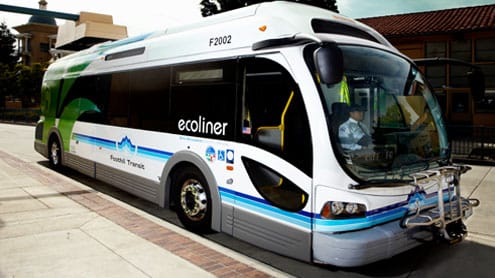
Proterra was launched in 2004 and introduced its first 35 ft battery-electric bus in 2008, the Ecoliner BE35. It’s an innovative design, using carbon fiber and other advanced composite materials for a majority of is structure, resulting in a very light curb weight.
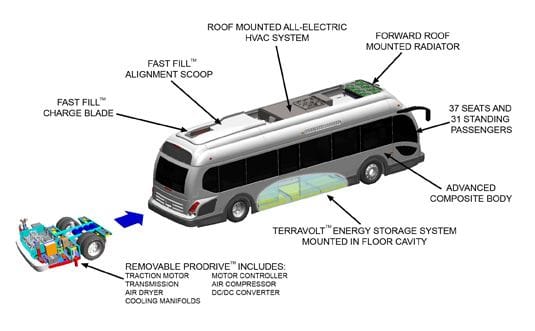
Additionally, like some older bus designs, it has its engine, transmission, and other control functions in one power pack unit that can be easily removed and replaced for service and maintenance.
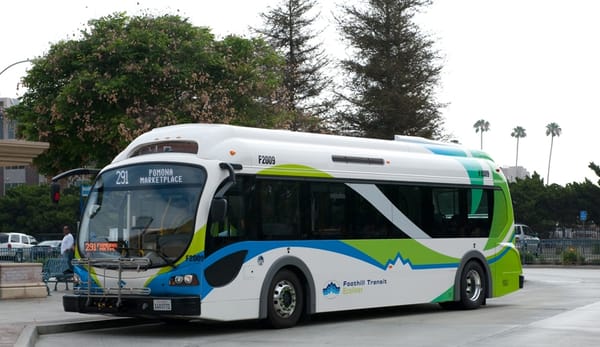
Like every electric vehicle manufacturer from Detroit Electric to Tesla, Proterra had to address the two major hurdles with this type of motive power; battery capacity (as expressed in range) and recharging cycle time. These initial BE35 models have a nominal range of around 146 miles – adequate for shorter lines, but not for a regular urban route which averages around 300 miles in a typical 18 hours of operation. Additionally, recharging requires 3 – 5 hours, which means the bus has to be taken out of service. As a result, initial sales were slow – Foothill Transit of Pomona CA purchased three BE35’s in 2009, ten were sold to five different operators in 2011, nine in 2012, and eleven in 2013.
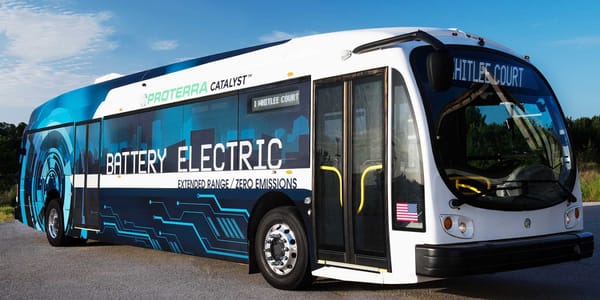
But things brightened considerably beginning in 2014 – the company hired a new CEO, Ryan Popple, who was previously the Chief Financial Officer for Tesla. Additionally, the company’s R&D efforts began paying dividends – a new 40 foot model was introduced named the Catalyst XR. This model has both an extended range, 258 miles, and a new fast-charging system. In turn, total 2015 sales reached sixty-two coaches to 13 different operators.
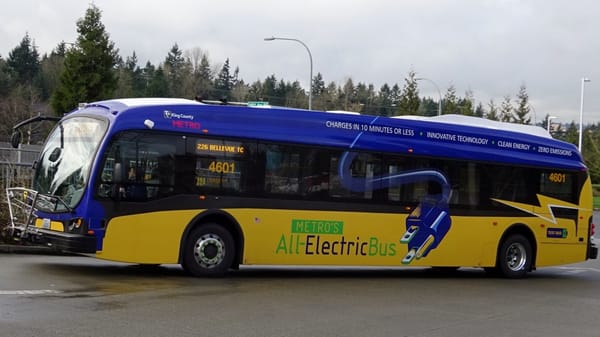
In 2016, an updated Catalyst, the E2, was brought out with the longest range of any battery-electric coach – 358 miles on a typical urban transit route. In addition, a further refined fast charging system permits a 26% recharge in only five minutes and a full charge in less than an hour and a half.
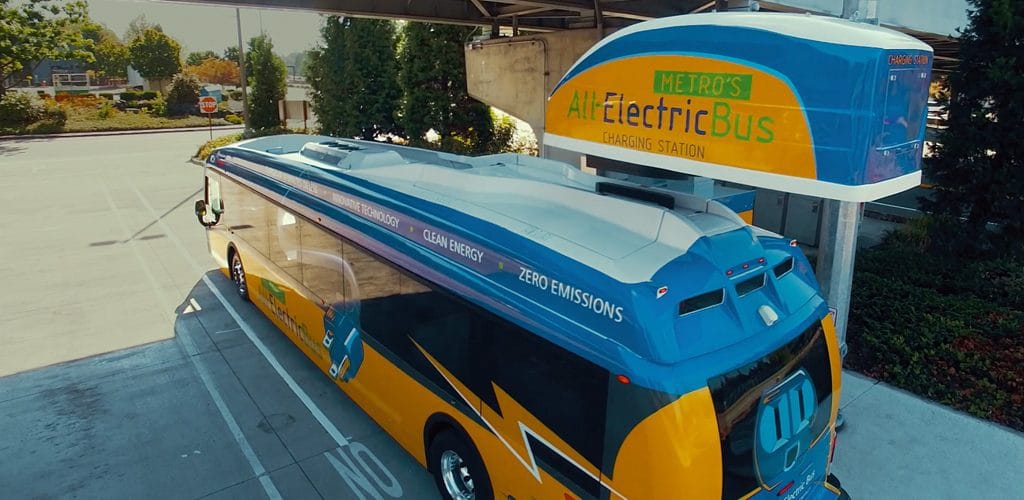
In January of this year the company built its 100th bus, and more importantly has another 200 orders on its books. It forecasts that by 2020 every major urban transportation operator will have a portion of its system operating on battery-electric, with 50% of all new bus sales being electric by 2025. Those figures may seem optimistic, but the numbers are compelling; typical real-world MPG for diesel, CNG and hybrid transit buses are, respectively, 3.8, 3.3, and 4.6. A 2016 study of 12 Proterra buses in use by Foothill Transportation of Pomona over 400K miles showed a power usage rate of 2.15kWh per mile which translates to 17.48 mpg equivalent.
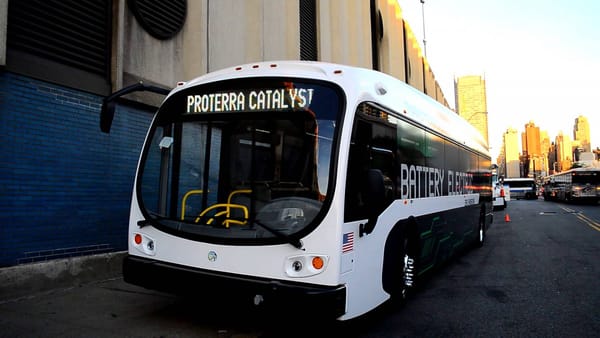
Bus prices are coming down also as the manufacturing process becomes more mature and efficient. Early Proterra models were $1 million each – that price has dropped to $800K. Comparable diesel/CNG/hybrid models start at $300K on the low end, up to around $600K. As we’ve mentioned before, the Federal government provides grants that fund about 80% of the cost of new capital purchases – plus additional federal subsidies are given for zero emission models.
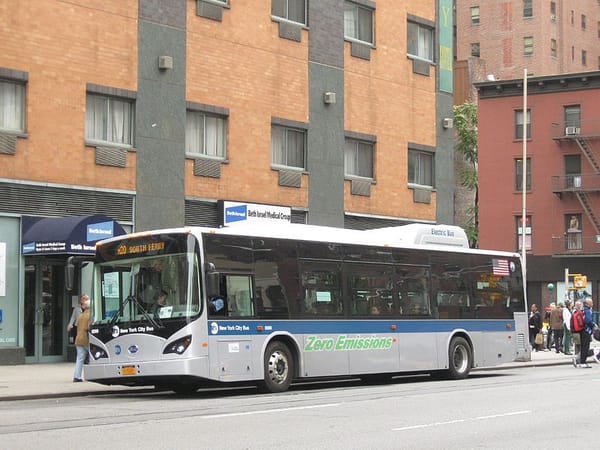
But there are competitors – coach manufacturers in Europe and the US are also pursuing battery-electric models. The Chinese company, BYD, however is on par and in some aspects ahead of everyone else – to date they have built over 4000 battery-electric buses worldwide, and have a new US manufacturing facility in Lancaster CA. They also have a range of sizes that include 35, 40, and a 60 ft articulated version. But while BYD has more models and are less expensive than Proterra’s buses, they lack the range and proprietary fast charging system.
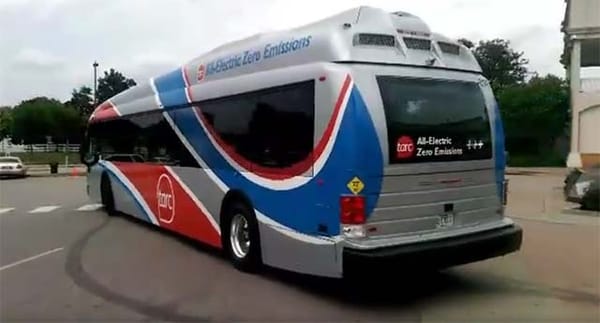
My sense is we’re very likely to be seeing more Proterra buses gliding silently along our streets…
Apr 2026 Postscript: I thought I’d italicize that last statement just to show how wrong I was.
So what happened to Proterra? It went bankrupt.
As mentioned in the original post, the company was doing fairly well – orders were increasing, and the company’s forecasts were that sales would continue to expand. In turn, it took out loans to build a new large battery factory and significantly increase its workforce. Then came COVID – and mass transit ridership and revenue took a big hit. Additionally, the buses proved less reliable than their diesel counterparts, with a higher out-of-service rate. Most orders on the books were cancelled. The stock nosedived and the company didn’t have the capital to operate and pay off its loans, and in Aug 2023 they filed for protection under Chapter 11. In November that same year, its product lines were sold off via a court-appointed auction.
Proterra Powered (Battery Business): Acquired by Volvo Group for $210 million, with the deal finalizing in early 2024.
Proterra Transit (Bus Manufacturing): Sold to Phoenix Motorcars for $10 million in Nov 2023. Phoenix is a manufacturer of small EV trucks and buses using the Ford E-450 chassis. It is now offering Proterra’s previous 35/40 foot bus as the ZX5 – Z for zero emissions, X for extended range, and 5 for 5th generation power module.
Proterra Energy (Charging Infrastructure): Purchased by Cowen Equity.
While Proterra estimated that 50% of new US transit bus purchases would be BEV by 2025, that turned out to be too optimistic. Figures at the end of 2023 (latest data available) show that zero-emission buses (including battery-electric and fuel cell) accounted for approximately 14% of new transit bus deliveries in the US. Figures in Europe and Asia were significantly higher.
Does that mean the transition to BEV buses has stopped? My take is no – only slowed. We’ll continue to see more EV buses on the streets, though not quite as fast as the pre-2020 predictions. A good article on worldwide projected BEV bus growth can be found here.
My guess is Proterra could have made a go of it absent the intervention of COVID. But given how I struck out in 2017, I’m the last guy that should be offering predictions.























CHARGER HEADLIGHTS!
MURANO TAILLIGHTS!
My exact reaction 😀 those stand out like sore thumbs to me. Wait until a few years when they start to fog over and turn yellow like they are on the 06-10 Chargers I regularly see with them, what a lovely dystopian future we’re marching towards.
The future is arriving, and quickly. Both Proterra and BYD continue to rack up sales, including an order from here in the Eugene area. And as a pedestrian and bicyclist, I’m not going to miss the noise and heat coming off the back of a bus, although the new recent diesel-hybrids are quite a bit better already.
I notice the “ZERO EMISSIONS” emblazoned upon one of the demonstrators.
This cannot be true unless the source of the electricity to charge the batteries is also zero-emissions. Hydroelectric, as in San Francisco, which owns its hydroelectric generation faciltiy and distribution, and Vancouver BC, which gets its power from BC Hydro, and whose transit system was once owned by BC Hydro, qualify. Their electric transit is Zero Emissions.
So do solar and wind power but there are currently no all-solar or all-wind electric utility sources; all-solar charging facilities for a captive electric bus fleet is definitely within practicality. Nuclear qualifies, too, as long as its emissions are only water vapor…some nuclear plants use fossil fuel or the pooled electric grid for support facilities to run the reactors.
Any electric power source that includes fossil fuel generation is not Zero Emissions, and that needs to extend to the bus transit systems using that power. Electric intercity, commuter and transit trains in the US East, including Amtrak, also cannot claim Zero Emissions.
San Francisco does proudly, prominently and correctly label its electric trolley bus fleet with “ZERO EMISSIONS VEHICLE.”
“Zero Emission Vehicle” (“ZEV”) is a well-defined legal term used by CARB and other governmental agencies. It clearly (and obviously) refers to the lack of any emissions from the vehicle’s powerplant. It’s been in use for decades now.
Yes, quite obviously, the source of the electricity does create emissions, except to the extent they’re created by renewable sources. At the current average US energy mix, an EV lowers CO emissions (at the source) by 30+%. But of course the whole appeal is that as the energy mix in the US moves towards lower CO output, the balance improves further. So that 30% average improvement alone is substantial, but has the possibility to improve further.
California is making very big improvements in its percentage of renewables in its mix. Just the other day, CA set a record by going for 5 hours with 85% of its state-wide power consumption coming from renewable sources. A 100% period is close at hand.
Note that hydroelectric power may be zero emission but without environmental impact. As matter of fact, those hydroelectric dams in the west have for ever changed the nature of the west. I am not the global warming denial person, but I often doubt the model and calculation of the human green house gas impact. There are just too many political and financial interests on both sides of greenhouse gas debate, which will lead to human in the wrong direction eventually no matter which side is wining. One fact is clear that human progress and high living standards demand more energy
I wonder if anyone ever calculate wether US electric grid and output can accommodate 20% of US vehicles runing on electric power. Fossil fuels have been the main source for industrial and technology revolutions, and will continue to be the human energy source for foreseeable future.
I love it! And I hope that Transcontinental Bus companies (Greyhound and Trailways International) will adopt the Electric bus concepts too. Me, I hope that Intercity Transit (Olympia’s transit system) Will adopt Proterra’s Electric buses to it’s fleet too…
That may take a bit longer yet, until batteries are capable of longer distances (range) and super-fast charging. Probably before too long.
Starting in late 2017 to early 2018, MTA New York City Transit will have a small fleet of five Proterra BE40 Transit Buses which will be its first Proterra product on its future fleet. These might only be leased buses since a demonstrator can only be one or two buses at a time.
Interesting, as always. Recently 43 articulated electric VDL buses went into service in the City of Eindhoven (DAF’s hometown), instantly becoming the European urban region with the highest electric transit bus density.
Tel-Aviv’s Dan co-op uses Chinese Higers which as I understand use ultra capacitor technology – they have low range but charging (which takes place at the respective last stops) takes minutes, not hours.
A clip featuring the bus charging (including at least one CC) plus a ride with Dan’s Route 4. It is obviously very quite and the aircon is being used throughout.
The driver can be heard saying “it’s not a battery, it’s a capacitor” on a number of occasions…
Very interesting design and remarkable technology. I wonder, though, about the durability of the chassis and body given the punishment any bus takes over its lifetime. Some innovative leaps are reliable, some aren’t, so it would be interesting to know how these hold up long-term.
I had the chance to tour the Proterra assembly facility in Greenville, SC a couple years ago. Neat facility, great people and an interesting product.
Jay Leno’s Garage did a YouTube video interview with Proterra. Fascinating stuff with the lightweight composite structure and all, but probably the most interesting bit is that roof mounted blade recharger interface—because if the operator installs the accompanying fast-charge canopy at the transit center or wherever else drivers typically take their smoke/pee break, range essentially becomes unlimited (26% capacity bump per 15 minutes connected), so the bus can run 24-7.
One hitch is that IIRC the batteries are not liquid cooled, which would seem to suggest that frequent fast charging, or deployment in Arizona, would be inadvisable. But it’s possible that I recall that wrong, that it’s not a big deal, or that it will be fixed on the next generation.
The other trouble for Proterra is that making a better bus than everyone else is expensive. Los Angeles put out to bid for electric buses and selected Canadian New Flyer and Chinese BYD electric buses, not the segment’s technology leader right in their back yard. (Officials hastened to add this won’t be the last round of purchases and Proterra could still be selected in a future round. That seems especially likely after some reports of trouble in BYD test fleets: doors that don’t shut, mileage that falls short of estimates, etc.
Our local medium-sized transit company has nine Proterra battery-electric buses and now over 20, of 50 on order, New Flyer hydrogen fuel cell electric buses. This is in a fleet of about 125 buses total. Our school district has some Lion (Canadian, I believe) electric school buses and several electric “short buses” from RIDE, a BYD spinoff. Like BYD (Brighten Your Day), RIDE is an acronym … Real Innovation Delivered with Excellence. As a walker and a cyclist, who has never ridden public transit in 15 years of living here, I appreciate the relative quiet, and cleanliness of these buses.
Minor correction: according to BYD it stands for “Build Your Dreams”, but that’s a “backronym” — the letters were established first, then later they figured out a slogan for that initialism.
The letters BYD derive from the company’s Chinese name Biyadi, which in turn derives from the company’s original name, Yadi Electronics, referring to Yadi Road where they were once based. They later added the Bi to distinguish it from other company names referencing Yadi Road, and to move up in the alphabet for trade show listings.
“Hello, Safelite the windshield on my Proterra needs replacing”
“Okay, let me see what our availability is”
While covid did not help these guys, the ultimate failure was that the product was not fully developed and couldn’t live up to the claims made for it. It was also a very unreliable bus. Numerous lawsuits resulted. Just ask the cities of Edmonton or Philadelphia.
Great idea, but not ready. I hope someone gets it right someday, but I don’t think we are there just yet.
Yes, as mentioned the city of Edmonton, Alberta is involved in legal wrangling as their 60 Proterra electric buses have been on the sidelines for a while.
The story was first covered in 2023; https://globalnews.ca/news/10112257/edmontons-electric-bus-fleet-proterra-issues/
Needless to say, transit officials, Edmonton city counil and citizens not happy. Other makes of electric buses have in this part of Canada have proven to be reliable and capable in most winter driving conditions.
Same here. Ithaca, NY spent around $7 million on 7 buses, twice the cost of a comparable diesel. They had poorer then 30% in-service time for the short year they were operational, and then most of them were permanently sidelined for “cracked frames” and a long list of other problems.
https://www.ithaca.com/news/ithaca/tcat-pulls-all-electric-buses-delays-sustainability-goals/article_4367fe6e-f688-11ee-8e73-0f1455324953.html
I respect the author opinion about this failed EV bus company, however I think he underestimated the technical merit of BYD, stating with BYD has its own battery business and technology, its LFP battery is a safe traction power battery, it has own traction propulsion unlike many other EV bus, as China moves fast forward to EV transition, the fast charging technology is another area it is a leader. There are many more fast charging stations in China than US. However, my prediction is BYD will not be very successful in US, very similar to CRRC operations in Boston Bay Area Transit because it lacks of understanding how businesses operates in US, and current political policies starting with Joe Biden and worsening under Trump, basically fencing off China EV and traction lithium batteries into US. Also, its BYD test bus in NY MTA was not considered successful, MTA has too many demands and regulations it could not follow. Nevertheless, it is still a accomplishment for being the first Chinese vehicle officially operating in New York. I am not sure how its California produced BYD bus behaved in LA Metro J line, two years ago when I used that line, it ran on regular Diesel engine city bus on the LA Freeway.
I sm not sure any one noticed a Wall Street Journal story about a person has a Xiaome SU7 EV running around in NJ, its reporter tested driving that vehicle on the road, she claimed it was the best EV vehicle she had ever driven. If the EV is the next trend, China will be the dominant player. For that reason, in Europe, its auto industry now push its own hybrid to fence out China EV by imposing heavy tariffs.
Politically-correct, Government-subsidized/mandated yet startlingly non-viable junk.
The dinosaurs have been dead for sixty-five million years. It’s about time they contributed to Society.
They very much are and have been “contributing to society”, in the form of CO2 emissions. Some contributions are more welcome than others.
GovDeals has been seeing quite a few of these recently, being sold off by disgruntled operators. The Edmonton and Philadelphia scandals are well-documented. Proterra’s technology was decidedly not mature.
However, I’m still optimistic about BEB’s in general. They’ve come a long way even compared to models from 5 years ago. I’ve heard good things about the Gillig and Nova Bus models. Toronto and Ottawa are currently in the midst of putting Nova and New Flyer electric fleets in service en masse, and a number of other Canadian properties have pending orders. My home transit agency is planning to deploy 120 electric Novas in 2027, and stated that they expect to save $900K per bus on maintenance compared to diesels (and that includes midlife battery replacements! For further reading: https://livewirecalgary.com/2025/11/28/new-electric-buses-save-estimate-900k-lifecycle-costs-memo/). When you see the hellish emissions treatment systems they inflict upon diesel engines these days, it’s not hard to understand the appeal of a simple set of batteries & electric motors.