

Here we have a real survivor: a 1973 Mustang Mach 1 that has belonged to the same owner and parked outside for its entire 52 years. I will tell you his story and the car’s.
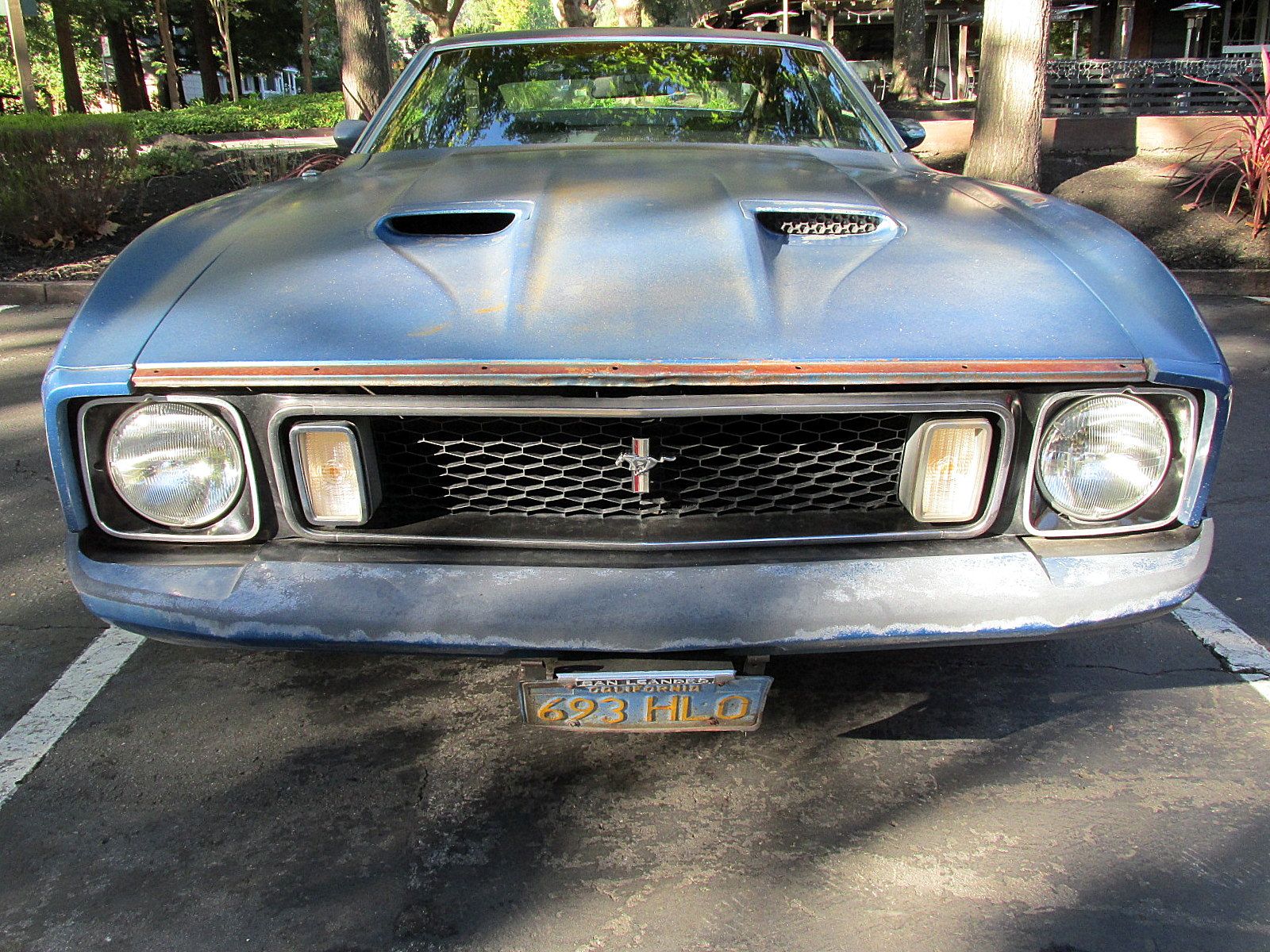
I guess it was about three to four years ago, during Covid, that I saw this car at an informal Cars & Coffee gathering outside Bagel Street Cafe in Danville, a place whose parking lot is visible from my office. From there, I noticed many vintage cars and many newer exotic cars showing up early on Friday mornings, so I stopped in to see. Many of the cars were either well-restored or new, like Corvettes, Porsches, and Ferraris, for example. I walked right past them as farther up I saw this well-worn Mustang, which I made a beeline towards. Pardon the picture quality, as this was at 0900 hours, sun low, and through trees.

The owner is Chris, pictured at the far left in the photo above. He’s owned this car from new, which is a long story.
As Mustang fans know, 1973 was the last year for the original Mustang platform — for 1974, it would be replaced by the Pinto-based Mustang II. Available only as a SportsRoof, the 1973 Mach I was the sportiest Mustang model, although it was mostly an appearance option, with a color-keyed urethane front bumper and moldings, racing mirrors, NASA-style hood scoops, tape stripes, a black rear-panel applique, and a special black honeycomb grille with inset “sportlamps.” It did come with the competition suspension and E70-14 Wide Oval tires, but the standard engine was the 302-2V. Mach 1 production was 35,440 for the year, out of 134,817 Mustangs sold for 1973.

Although the big-block V8s were no longer available in 1972–1973, Chris still wanted the biggest engine available. So, in October 1972, he put in an order for a 1973 Mach 1 with the 351-4V Cobra Jet engine, mated with the four-speed and Hurst shifter. However, a setback occurred when the dealer, Ed Chovanes of San Leandro, didn’t come up with the car and said his order was cancelled.

Chris, not to be deterred, called Ford directly and spoke with someone there. The short of it was that they told him to order any Mustang he wanted, and by March 1973, his Mach I arrived at Elmhurst Ford. Chris paid $3900 for the car.

So, the Mustang showed up, but there was a hand-print in the paint on the C-pillar that required the whole car to be repainted at the dealer. However, as the years have passed, that handprint has come back through and can now be seen. This repaint later became an issue…

See all those little specks in the paint? They have been there, all over the upper surfaces of the car, since 1980. What happened in 1980? Well, has anyone ever heard of the Med Fly?

This is a Med Fly, or better known as the Mediterranean Fruit Fly (Ceratitis capitata). An outbreak occurred in California in 1980, which led to a major agricultural crisis and large-scale eradication efforts. A single fly was found in Northridge and two in San Jose. This led to ground spraying, aerial spraying, quarantine by the CHP, and release of sterile male flies. Citizens were told to strip their fruit trees of all fruit, and you were fined and could even receive jail time for not doing so. Malathion was being sprayed in large regions of California and conducted at night. Naturally, there was an outcry concerning the pesticide being sprayed over towns. Agriculture was for it, while towns were not.
This aerial spraying went on in both North and South. Where I was in Orinda, there was no spraying. However, Chris lived in Castro Valley, and those dots on his car are from droplets of malathion. Of course, people made claims against the state for damages. From what I can learn, very few were ever paid. The state maintained that a warning went out before spraying occurred in your area, so you had ample time to prepare. Chris made a claim, but the state denied it on the basis that the car was a repaint and not the original paint. So, it still wears those spots today 45 years later.

Paint-wise, the next curiosity is the sport mirror. As you can see, the paint is fading, and what is that underneath? The mirror is Medium Green poly. Green doesn’t show up anywhere else on the car, which is either Silver Blue poly (3M) or Medium Blue poly (3K). (Personally, I see both colors here when I look at the paint chips.)

Now, the roof also has a patina that is similar on both sides, right down to bare metal. I’m a little puzzled since the repaint would have been over the existing paint, as it is on my Cougar. That means two layers of the same color, which should be pretty much impossible to rub off. One guess is that the dealer used one medium coat to minimize their cost. However, Chris maintains it was the constant use of a car wash in all the car’s early years.

What other wounds, or signs of older age, do we see? Chris said that the front trim piece got damaged, so it has more of a V in the middle. He also told me how one day he opened the hood and saw one of the fake cowl scoop trim pieces sitting on top of the engine. So, it now has “Single Ram Induction.”

As I said, Chris lived in an apartment in Castro Valley at the time. If any of our readers have ever lived in an apartment complex, you know getting a dent in your car can be quite common in those parking garages. I have a subtle one in my Cougar, and I only lived in an apartment for three months the summer of 1974. Those dents on his door were acquired during that same time.

The above picture shows that the driver’s door was keyed, as was common back then. You can also see the difference between the repaint above the decal and the original color inside the decal. The antenna is also now missing, but I forgot to ask the story on that.

Let’s go to the rear. Since the car has a berm behind it, I couldn’t get to ground level, but you can see that the back end looked to be pretty intact overall.

As we all know, the trunk isn’t very generous in these Mustangs.

Here are some more boo-boos acquired in life. One, a windshield hit by a lug nut…

… second, a crack when Chris hit the driveway curb to his apartment complex. How? Coming home, he saw his son at the side of the street. His son wanted to race his father. In the rush, Chris hit the driveway curb a bit too hard, and “crack!” went the windshield.

You’ve been waiting to see the 351 Cobra Jet engine, and here it is. The M-code 351 in 1971 had a 10.7:1 compression ratio versus the 11.0:1 in 1970. Cylinder heads had a slightly more open chamber than 1970. The one in Chris’s car is the 351-4V Q-code engine. Compression ratio was now around 8.0:1 due to the open heads, which gave superior emission characteristics. You did get a different intake, 4-bolt mains, a high-lift, long-duration camshaft with hydraulic lifters, higher rate valve springs, a 715 CFM Autolite 4300 carburetor, and a dual-point distributor. Power was rated at 266 net hp for the Mustang. This car probably has a 3.25 rear. Apparently, the car could do 0-60 in 6.2 seconds, which isn’t bad at all. There are 136,000 miles on it today.

As you can see, there is no A/C in this car. However, there is a power steering oil cooler in the car, which I found interesting, as I had never seen a Ford with one of those. Meanwhile, spark plug access doesn’t look great, but it can be done.


Apparently there was an issue with leaking brake fluid in the past, so Chris kept brake fluid handy on both sides of the compartment, along with a funnel in the baggy. It has been there for many years now. Note that they reside in that extra space in the front, between the radiator support and the front grille. Why add that empty space? It simply made the Mustang look longer when it really didn’t need to look longer. My ’73 Polara has that same dead space. Designers — go figure.

Here is the Mach 1’s well-worn interior. Mustang fans can run their eyes over this and see what might have gone missing over the car’s 52 years of life.

Here we have what looks like an integrated armrest into the door panel. That certainly makes replacement or restoration much more difficult compared to an earlier generation like my ’68. One can see a green vinyl tape on the armrest.

Looking across the way, we can see the simulated wood is peeling off. Now, why is there any simulated wood in a Mach 1? We can also see a knee brace that Chris uses if he has to kneel on the ground. Chris is 77, so he got this when 25 years old (versus me at 16). So far, all my joints and knees, minus one ACL, are doing fine.

Last, I will throw this picture in for Jeff Sun, who once asked what more we can write about cars. Well, here on the right, by the glovebox, we have something called Echo-mate.

If you were a young driver in the very early 70s, then you know all about 8-track stereos; I had one in my Cougar, under the ignition and over my gas pedal foot. I added speakers both in the kick panel and the parcel shelf. By 1980, I had removed them to go back to the original Ford parts while I still could. Chris already had speakers in each door, so he added this to the car. It’s now an obscure piece of machinery. Technically, the system’s reverb added an extra dimension to the 8-track sound. However, he says the speakers no longer work, which he thinks is a wiring issue.

Chris wrote up a little history on the car that is sometimes out for the public to see. Currently, the car is only driven back and forth to a local market, maybe a few times a week. Chris did say it needs a tune-up, but his hands are affected by arthritis, so it is very hard for him now. I offered my help if he wanted, as I consider myself a decent mechanic.
So, there you have it. The age of the crowd in these gatherings is 90% over 70 years old, with the cars either less than 10 years old or older than 1973, even down to a Model T now and then. Most of the older cars have been modified in one way or the other from their original condition. Needless to say, a walk through the gatherings is a fun way to spend a Friday morning.
Related CC Reading
Curbside Classic: 1973 Mustang – No Apologies Necessary (by Paul N)
Curbside Musings: 1973 Ford Mustang Convertible – At A Canter (by Joseph Dennis)























Chris was certainly determined to have this Mustang as he ordered Oct. 1972 and didn’t get his car until Mar. 1973! Thankfully auto paint has come a long way since the 1960s-70s. My first car was the families 1963 T-Bird, Heritage Burgundy, that I received early 1967. At one time or another, every panel had to be repainted except the hood and roof. Always painted at a Ford dealership and every panel faded differently. No amount of compounding & polishing could ever get the body panels to match. Luckily when I later received my parents 1966 T-Bird it never needed paint touch-up. I loved my T-Birds but every time I took either of them to a Ford dealership to get something done, they would screw up something else. That experience with Ford dealerships in the 1960s is why I never considered another Ford until I bought a newly painted 1966 T-Bird convertible eleven years ago. After my experience with that burgundy T-Bird I have also never bought another dark metallic color car.
The condition of this car hits an unusual spot for an original, one-owner car. Some are much better preserved, and others are of the “I know what I’ve got” category of badly worn out (and rusted). What a great find!
An aunt and uncle bought a new 1978 Cadillac. Aunt Norma found an imperfection in the paint on the deck lid, and insisted that the dealer repaint the panel. Mistake! That paint job was not up to a normal Earl Sheib standard, and looked bad for the next couple of decades that they owned the car. I wonder what this car would look like now if the dealer had not repainted it.
52 years! Amazing. My 1986 Ranger was the same or very similar blue, and paint started peeling on the hood almost immediately. The dealer (Frontier Ford) repainted it under warranty and the color match/blend was perfect and it held up perfectly over the next ten years I owned it. But that was only ten years 😀.
I test drove a new Fiesta in 1978 at Ed Chovanes Ford. The salesman was a stout fellow and stepped out of the car so I could experience the acceleration without his weight. Despite his enthusiasm I ended up buying my Fiesta used elsewhere, but I recall the paint held up fine to the malathion. Or maybe I didn’t notice due to the various rattle-can touchups on dings and scratches from my Showroom Stock outings. But I remember a lot of uproar about paint damage (not to mention general public health concerns) from the spraying. Not to mention checkpoints for fruit inspection leaving the Bay Area.
I love the stories here – makes me think of each little ding and imperfection on my cars, and how I know each one. Also, I’d forgotten all about the Med Flies.
My favorite part here is the Echo-Mate – an obscure product that solves a problem we don’t even think about anymore. It would like having one of those FM Modulator units (that let you connect a phone to your car speakers if your car doesn’t have Bluetooth) in 50 years. Just a great little nugget of random trivia there.
Yup. And while I probably won’t be showing off either of the two of those FM modulator things I have myself in 50 years, I’ll have to make sure that my kid knows where they’re stored so that he can explain what they’re for to any potential grand children.
After reading about the Echo-Mate i had to go looking for mine i had in my 56 Chevy in high school in the late 60’s, I found it don’t know if it still works.
Love it! This is just about the ultimate curbside classic, original, showing all the bumps and bruises of its long life and still being driven. My hat’s off to Chris; may the two of them have many more years of togetherness.
‘Ultimate Curbside Classic’ was my first thought, as well, particularly as a one-owner car where the history of all the imperfections over the many years can be explained.
My ’72 Ranchero, which is gold/green, has faded in the Nevada sun and revealed a drivers side mirror of powder blue underneath. I’m guessing perhaps mismatched mirrors on the production floor was an occasional issue at Ford plants.
What a find, and it’s totally made by being able to talk to the owner and get what is likely most (but probably not all) of the back story. This Mustang gives new meaning to the term “survivor”.
Even the typed up info sheet he has is great. Pulling his wife’s Pinto station wagon with a rope? Excellent.
While I’m sure that working under the hood of that car is made easier by all of the space between the radiator and the grill, and he’s found an inventive use for the two “cubbies” behind the headlights, I’m not sure that carrying multiple containers of brake fluid inspires much confidence.
Finally, the Echo Mate 🙂 A device I’ve never heard of before except for here…but it makes me run and grab a couple of my J.C. Whitney Co. catalogs to see if I can find one in there. No luck, but the catalogs I can lay my hands on quickly are 1979, and that may be a bit too modern for the Echo Mate. From the looks of things, Chris may be on to something with his guess that there’s a “wiring issue”.
Such a blast from the past. I do hope that the owner has a couple of more seasons in him (and his Mustang) to continue attending the Cars & Coffee. There definitely should be more cars like this at those kinds of events.
I couldn’t find anything from J.C. Whitney about the Echo-Mate either, but here’s a Globe Discount City ad (a discount store in the Southwest) promoting the Echo-Mate ($17.77 in 1967 dollars) and a bunch of other goodies:
I was a child when they did the Med Fly spraying in San Jose. I remember thinking it sounded like a war zone at night when the helicopters where flying over our neighborhood. How strong (harmful!) was that pesticide if it damaged automotive paint finishes?
That must have been one huge environmental disaster back then to facilitate the use of large scale spraying like that… you would think they would have learned from all of the spraying done in the late sixties….
When I was a young kid, these trucks would roll through our neighborhood with tanks on the back and spray chemicals high into the air creating a fog that would last for some time after the truck went by. While fun to watch, my parents always told us to get inside when we saw or heard that thing coming.
I would later learn that they were spraying DDT, which is a banned substance (and has been since 1972).
What were they thinking?!?! As the kids say today, albeit sarcastically, “What could POSSIBLY go wrong?” Apparently, a lot.
What a great survivor. These big Mustangs have really grown on me, and with the availability of back up cameras the restricted rear view wouldn’t be a problem. Back when I worked at GMAD Fremont, when the stock of a certain painted part, like that mirror was low, the foreman would send a few out to the paint shop to be painted the appropriate color. Every single car had a specific manifest (build sheet). The builds were scheduled for more than a week in advance, so it was easy to anticipate needs and shortages. Most work stations had a thick stack of manifests for both shifts Manifests were taped all over the outside and interior of the car during assembly.
There is a similar Mustang currently for sale on CL in my area. It has a rebuilt drive train and good interior, but it was improperly repainted, the wrong color, and the paint is now weathered. The seller has been trying to sell it for several years, it goes on and off listing, and the price has dropped a bit. While my favorite Mach Ones are from 1969 and ’70, I had a ’70 coupe and really didn’t like the car that much. The ’71’s were an improvement though a bit bigger. I am getting tempted.
I bought a special order 73 Grande’ (Medium Blue Met) from the second owner in the 1980s. It had the 351Q 4V but he ordered the heavy duty suspension as well as every option except for power windows and tilt wheel.
I hated the duel point dist so I replaced it with a Mallory Uni-lite. Also the intake and Motorcraft 4V got replaced with a nice aluminum Weiand and a Holly spread bore. The spread bore made it much nicer to drive around town and got a bit better mpgs. You sat so low and so far back and with that loooooong hood it felt like driving a torpedo. I still miss that car.
What a great-looking car! The aluminum slot mags that you could get in 1973 look perfect on a Mach 1.
my brother in law has one of these, unfortunately heavy snow brought down the roof of the pole shed.
Surprised this morning to see the story up. So after dropping my son off at school I drove over to where all the cars meet up to show Chris. Unfortunately, it was a cold morning and Chris wasn’t there today. I’ll have to try next weekend.
What a great car and history to go with it. There is something really special about survivor cars like this, with owners that grow old together.
On the Echo Mate, I have a hazy memory that some Chrysler radios had a reverb switch that delayed the signal slightly to the rear speaker, this would have been on AM radios I think.
Another nice survivor .
-Nate
I had a ’73 Mach 1 like that in the late ’80s, same colors even, but I had a 302 and an automatic, it also had the power steering cooler, and other than old ads, it’s the only one I’ve ever seen that had a vinal roof on the front half, it also had a 4.10:1 rear gear in it, I’m sure it was changed long before I got the car for $350, and the 302 had been built into something that was no longer 302 cubic inches, I bought it from an old master mechanic.