

It was November 1994 and I was visiting an old friend in El Salvador, riding by his side as he drove his anything-but-exciting Daewoo Cielo when, entering a roundabout, he started cussing loudly through the window at a bus driver who had almost sideswiped us. Said driver had also apparently hooked up with some ex-girlfriend of his (El Salvador is a small country, what can I say?), so there was a lot of effort placed in the shouting exchange. It all made for a rather frantic scene.
Not stopping to catch a breath (benefits of youth?), on the way out of the roundabout, he immediately started toswear at a white on white 1993 or so Toyota Tercel that appeared ahead of us. The Tercel’s sin? Being new and extravagantly “luxurious” in a city still stuffed with tons of outdated Japanese cars from the 1970s.

Funny, I was living in California at the time, and the idea of a Tercel being “luxurious” would’ve been utterly risible to any of my workmates in the US. Still, tons of Salvadorians shared my friend’s point of view, and within their context, they had a point; the clean looking, very 1990s jellybean Tercels looked like nothing on San Salvador’s roads and were truly an object of envy. Add that there were quite a few of them, all white on white, from a fleet of cars belonging to United Nations personnel in support of the nation’s then-recent peace process, and that they all made for easy spotting; the Tercel’s lines, in white, were readily and notoriously identifiable from any distance. They looked modern, in ways no clattering 1974 Datsun could, and with its jellybean shape, seemed almost otherworldly.

The visit was a three week escape from my work in California, and it was one of many trips I made that freed me from placing any effort into social pretenses. No matter what your preferences and likes are, how cultured, educated, or specialized they can be, travel enough and you’ll come across a place where they’re considered worthless. Was the Tercel conceived from factory as a luxury cruiser for decadent bureaucrats? Certainly not, and I doubt the UN personnel looked at them that way. But for the locals, they bordered on lavish excess.
Similarly, on the opposite extreme, was an S-Class Mercedes desirable in 1990s El Salvador? By all means! The brand had long built a rep in that nation by then. But offer a more cultured rarity, and perceptions will change. A Lambo? Cool! A perfectly preserved 1930s Packard? Geez, who pays that amount of money for an old antiquated car? A Jaguar E-Type? Eeeer… what are those? And, Ok, pretty, but why do they have so many parts that can break down? Give me the keys to a “lavish” Toyota, please!

Regardless of perceptions, the UN Tercels were not used for frivolous, decadent fun, but rather serious, dull work in support of reconstruction efforts after peace was signed in early 1992, a defining event which brought civil war hostilities to an end after twelve years of unrest in El Salvador. An event that I missed by only a few weeks when I visited the nation in December of 1991.

That 1991 trip was an odd and significant one, the first I paid to El Salvador after moving to US territory in late 1987. It was back to see my old high school pals, hang out, catch up, and check out the sights around the capital… as much as that was possible. Tensions in the nation were high as the peace process took place in Mexico (a neutral location) between the military and the leftist guerrilla forces. It wasn’t the first time such negotiations had taken place, and if they broke down, chances were combat would resume, savagely, anywhere, anytime.
Still, be it peace or bullets, life had to go on, and with me being back in the nation, pending personal matters had to be dealt with. First of those, to pick up some paperwork related to my birth in Suchitoto, a town 29 miles away from the metropolitan area that had been a hotbed for military confrontations since the early 1980s. It was to be a two-hour back and forth trip on solitary dirt roads, filled with uncertainty.

Since Dad never drove, bus was our transport of choice (by the way, the type of transport that often got “unintentionally” shot at, when warring forces fought from opposing sides of a road). About thirty minutes into the trip, a little after noon, we entered the solitary dirt road that led to Suchitoto. Not long after, the bus came to a stop near a crossing marked by a large ceiba tree; under its shade, a small contingent of guerrilla members sat on some rocks with machine guns on their laps.
It had finally happened, after years of hearing about and dreading them, I was at close distance to the “child-eating, commie-indoctrinated, sexually-deviant” leftist guerrillas that the government forces had fought with since the late 1970s. The stop was clearly a common occurrence; no one in the bus batted an eye, while the guerrillas remained just as seemingly motionless in their places. Without leaving his seat, the bus driver exchanged a few words with them, after which, one guerrilla with a farmer’s straw hat on, made a languid hand motion signaling we could continue.
By the end of the afternoon, we were back in the city, papers in hand. A few days later, I would fly back to California and a couple of weeks after, news reached me that peace had finally been reached; treaty and all. Life would go back to normal, at last. And that included, for our CC related purposes, car life.

As many of my posts have made clear, El Salvador is 1970s old Japanese car land; the result of a self-imposed five-year embargo during the Civil War that left the local car fleet anchored in the Carter era. A trickle of new models started to show up in the late 1980s when that hurdle was put to an end, but it was the peace process that finally allowed a steady stream of new vehicles, with the UN Tercels being among the most notorious ones from that crop. Unlike the US, little advertising was needed to get them noticed; that’s what “new car starvation” does to you.

Aside from Central America, I doubt anyone anywhere thought of fourth-generation Tercels as “luxurious”, much less as “UN fleet exclusives”. Still, as originally intended, as a set of wheels for a young professional, or a second car for the home, these Tercels more than delivered peace of mind.
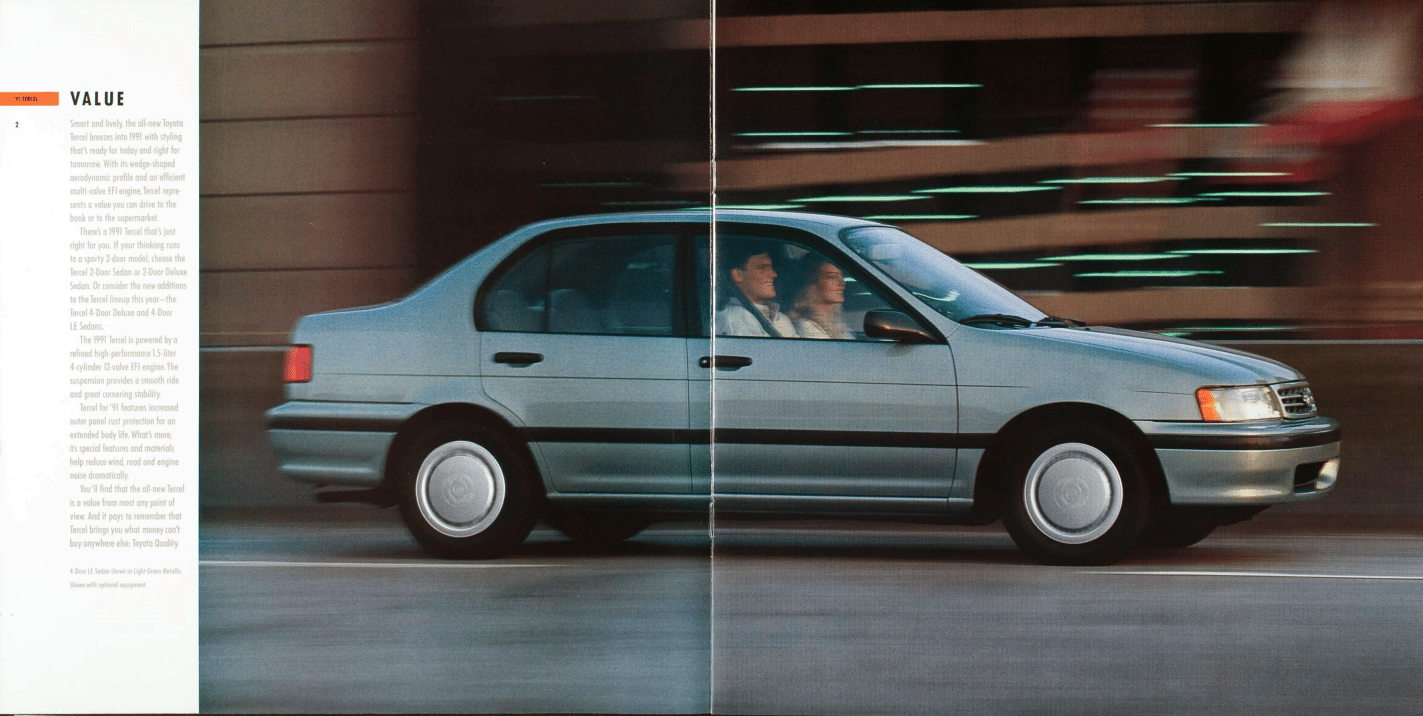
The 1990-1994 models were the fourth-generation of the original FWD Toyota that had debuted in 1978. At the beginning, following a longitudinal FWD format, engines had switched to a transversely mounted position with the 1986 third generation (except on the 4WD wagons that remained around a bit longer). As such, the 1990 models were technically evolutionary around that then-proven concept, so no big news on that front. However, the model was redesigned to be as high quality as the segment allowed, something Toyota was pushing across the board by the late 1980s, and that was felt across their lines. In all, sticking to what had become a Toyota tradition, offering above the segment quality for little money. Concepts that the company pushed on print material.
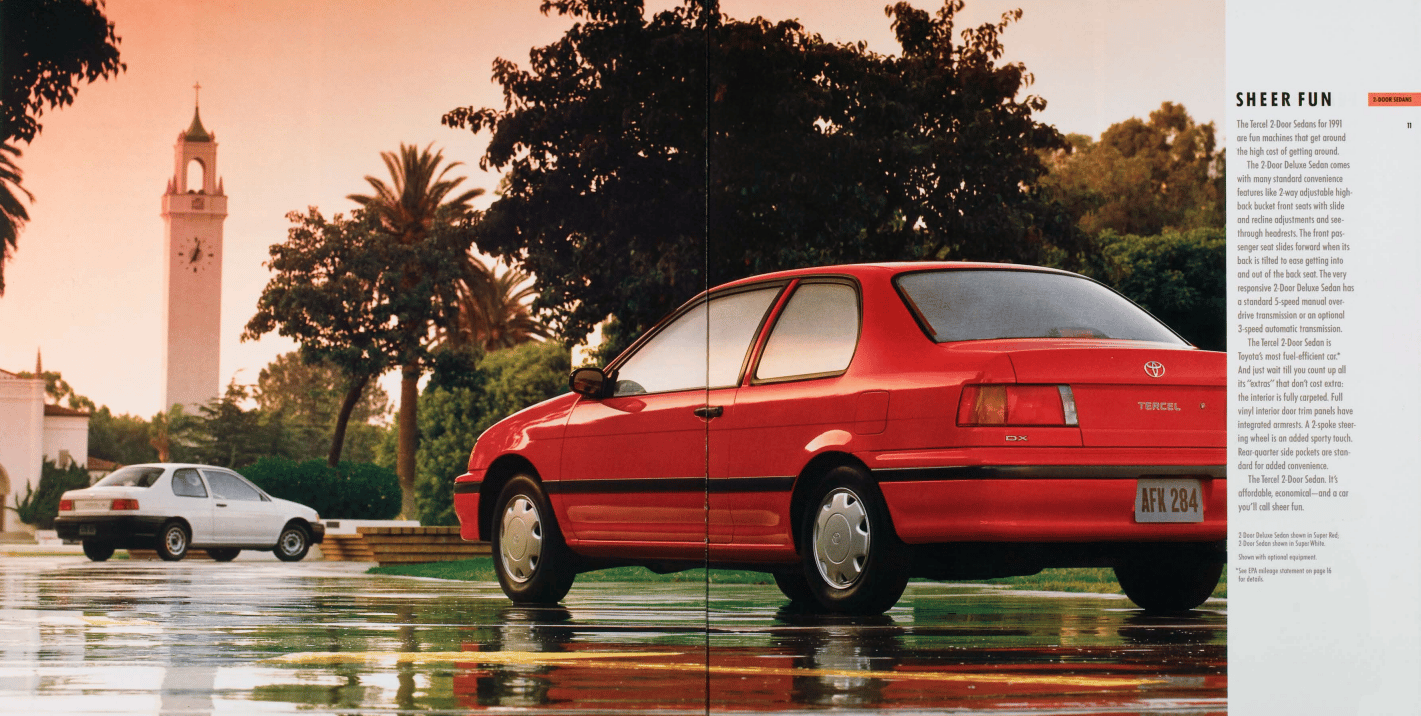
In the designer’s brief, the 1990 Tercel’s styling was conceived to convey a “youthful exterior with an urban flavor”. Something that Civics executed better to my eye, but Tercels were fashionable enough for the times. Indeed, if one squinted hard enough, one could see 1989 Lexus LS’ genes in the Tercel’s flowing lines. Not that anyone would confuse the two, but it follows the known practice of a flagship setting styling themes for most of a company’s lineup.
In the US, the model arrived in 2 and 4 door, all sedans, in the era when the shrunken sedan concept was at a peak of sorts (a neat looking hatchback with distinctive styling remained beyond US borders). Trim lines were limited to DX and LE, with colour-keyed bumpers, full-wheel covers, and foldable rear seats optional on the former and standard on the latter. A mild styling update occurred for 1993-1994, most noticeable of those minor touches being a new grille (to which today’s find belongs). As far as shifting, choices were 4 or 5 manuals, or a 3-speed automatic.

Inside is where most of the renewed Tercel’s accomplishments were felt, and this is from experience. A Tercel of this generation became our family car in Puerto Rico during the nineties; the interior was quieter than any of the other econoboxes I had ever ridden in, plastics were soft and top-notch for the class, and seats were a noticeable improvement over the previous generation’s simpler surfaces. Ergonomics were generally good and unfussy, though the radio was slightly out of the driver’s gaze.
And if you wonder, I spent a little bit of time behind the wheel of our 1993 model (in Medium Red Pearl), but don’t ask me about driving impressions; I remember little, aside from it being easy to use and uncomplicated.

Stateside, these came with a 1.5L SOHC EFI engine offering 82HP at 5200 RPM, which provided decent, sprightly enough performance for the car. Meanwhile, the MacPhersons upfront and twim-beam axles at the rear were tuned to provide above-average handling. In all, the model offered decent performance for the segment, though not class leading in the way a sportier Civic felt at the time. But that was just the way many Toyota owners liked it; Mother would buy a Toyota, use it in the serviceable way she expected, and live in the trouble-free manner the brand had accustomed her to. Our 1993 Tercel shone in those respects for her.
And as some CC commenters had noted, Toyota dealers knew they had a desirable commodity, and the company’s “lowest-priced sedan” advertising tagline was mighty hard to come by in the real world.

I never drove our family’s Tercel after the few short stints I had on the car in the mid 1990s. But the cars are a common occurrence in San Salvador, the city where I currently live, and it’s mighty hard for me not to link them to the many disparate ideas that they bring to my mind: cheap US transport, family car in Puerto Rico, and UN fleet Peace Treaty transport.

About which, I returned to live in El Salvador at the end of 2000, and the old enemies were now part of society. Not long after my arrival, I met Chiyo, a “guerrilla kid” who worked at a local non-profit I became involved with. The “guerrilla kid” term is not gratuitous; at seven years old, he joined the leftist guerrillas fighting in the mountain ranges near the Honduras border, eventually becoming a radio operator, and occasionally being part of the crew involved with “Radio Venceremos”, the guerrillas’ clandestine radio operation.

Chiyo’s involvement with the guerrillas was almost predetermined. In the 1970s, political representation in the nation was limited, with several sectors feeling excluded and ignored. A large movement of rural farmers and city workers became active in demands for a better living, forming unions and nonprofits, with Chiyo’s family joining that rise.
Authorities frowned on those efforts, vehemently and violently. On a protest downtown in the mid 1970s near the El Rosario church, three of Chiyo’s siblings got gunned down by government forces; tensions escalated quickly after that, nationwide, particularly in the countryside. A few months later, Army officers broke into Chiyo’s home, executing his mother and oldest sister. Fearing the end, the remaining family members joined the guerrillas, an idea they had resisted until then.

The remains of Chiyo’s siblings were placed inside the El Rosario church along with other protesters who perished on that occasion. To this day, one can visit the church during mass hours and stand by the somber plaque near the entrance marking their resting place. Somewhat curious that their burial ground is located there, as the church itself is somewhat of an oddity. One of a few brutalist-inspired buildings in San Salvador, built in 1964, and taking over the lot of the previously burned down structure; its design reflects changing attitudes of the Catholic church during the 1960s, with an egalitarian layout that eschews the traditional cross pattern of most Catholic temples. Instead, the interior is basically an open space that makes for a more communal experience, where churchgoers sit close to the temple in as close a congregation as possible.

It didn’t take me long to find lots in common with Chiyo, and we tend to hang out at least once a month or so. Often, to go bowling, of all things (Don’t ask us for any tips, we’re strictly, how shall I say? Self-taught). Today, Chiyo leads a quiet, unassuming life, though if pressed, he’ll share his opinion on current events. His thoughts are those of someone who’s gone through lots, and may not be exactly what some would expect from a former leftist-fighting South American guerrilla. Mainly, his stressing that differences must be settled through ideas, dialogue, and persuasion rather than force.
As for myself, unlike Chiyo, the Civil War’s marks are rather light ones on me, so no need to spill any compassion my way. Overall, they are mostly limited to memories of enduring power outages (some perhaps even perpetrated by Chiyo’s guerrilla cohorts), goods scarcity, and hearing from a distance skirmishes taking place in the city’s outskirts. Needless to say, regardless of those limited marks, my worldview is mostly shaped by those days.

Back to the 1990-1994 Tercel. Regardless of the many locations I relate these cars to, my view of them is mostly California; a competent little vehicle, that delivered on its intentions and its Toyota rep for reliability. I’ll never mistake it for a Lexus, but its higher-than-average quality feel was, let’s say, Lexus-y for the segment.
And I understand that if you’re used to Town Car cruising or Taurus freeway composure, driving these tiny ones could be a distressing thought. But for many, they were easy and peaceful enough proposals to own, and proved to be so under use.
Related CC Reading
CC Capsule: 1991 Toyota Tercel DX – Sub-Corolla Syndrome
Curbside Classic: 1995 Toyota Tercel – Last Of The Mohicans























I like this! My daughter spent a week in Haiti, volunteering, twenty years ago and I treasure the pictures she took. People, world wide, just want to have a normal life.
Rich, you really broaden our horizons with these kind of posts, describing a life most of us just could not imagine. A bit like National Geographic with cars.
We didn’t get the Tercel in Australia – but the idea of a new small Toyota being an object of envy/resentment when new as a sign of the ‘occupying forces/peacekeepers’ is… startling.
Keep up these amazing tales from your past.
Rich: Hope your papers are in order and you do not encounter any of the many predators now stalking people. You are a valuable contributor to this site. Many of us will worry about you.
Thank you Rich. I echo Peter’s point about broadening our horizons. Thank you for reminding me that despite the fact that the world can be a pretty crazy place, and humans can do some really awful things, in the end most of us really just like to be left in peace to go bowling and enjoy dependable, reasonably inexpensive, zippy little cars.
I’ll add that the El Rosario Church is quite something. I’m fascinated by Brutalist architecture (particularly churches), and this seems like a fine example.
Apparently the Pope thought so too. https://www.atlasobscura.com/places/iglesia-el-rosario
Hi Jeff, yes, the El Rosario Church is quite something. Like a lot of modern architecture buildings, the interior is more appealing than the exterior, and the light that enters the interior through colored glass makes for a very nice experience.
Something unintended about the hangar-like exterior is that it was ideal for protests; I’ve seen a few photos from those 1970s days with the church covered in all kinds of handmade protest signs. FWIW, the whole area is now getting a tourist refurbishing, a bit too glossy for my liking, but at least the church is being left alone.
I forgot to mention the El Rosario in my comments. I was momentarily confused when you said that was the church in the outside photo. Hmm… But it is splendid inside! I happen to be a major fan of brutalist architecture, and this one holds a wonderful secret inside.
Fascinating. To us pampered folks it’s hard to imagine a Tercel this way, to most ‘muricans it’d be thought of as a penalty box, but these kinds of well engineered small cars are what Toyota does best, that value proposition is what got them where they are. I like them so much better than the feature over-laden computerized conveyances we’re stuck with these days. Thanks for the very eye-opening perspective of a place few of us know about or understand that you’ve shared with us Rich.
Terrific article on material I never would have known otherwise. I was fascinated by the Tercel angle but the details of El Salvador are fascinating. Also, I’m amazed by the El Rosario church – I didn’t even see a church in your photo at first glance.
And I’ll never look at a white Tercel the same again!
Another good article with many clear thoughts well put .
I some days miss my living in Guatemala, the nxt country North of El Salvador .
I hope things and life go well for you in 2026 .
-Nate
Thanks for sharing this chapter; it’s been a while and I so did love your COAL series for the cultural and political expansion they gave me.
A few months later, Army officers broke into Chiyo’s home, executing his mother and oldest sister. Fearing the end, the remaining family members joined the guerrillas, an idea they had resisted until then.
Wow. Hard to take in. And not hard to see why they joined the guerillas.
I still have a few more such stories; I hope I get around to typing some this year.
Wow, I’d completely forgotten about those Tercels. My Mother in Law had one, no two I think. Seems like an accident in the first prompted the second. What I do remember about them now is the paint never seemed shinny, on any of them not just hers. Always kind of dull. Not like heavy oxidation, but just no real shine. I figured cheap car, cheap paint. Dunno. I think sometimes automakers don’t want the bottom feeders to be too nice or else they will detract from more expensive cars.
Yes, I also remember some like that, and the plain DX model in light green metallic, which is halfway through this post, has that non-shiny finish.
That red “DX”, in the brochure pics, was my new car. Bought it “3/25/91” in “Fairfax, VA”. Became my nephews car in “96ish”.He had it till “2001-2”.
Picture it… December 1991. My parents decide it is time to buy a new car. While our 1977 Dodge Aspen wagon had been the primary family car since new and was already over 200K miles at this point, it had become my dad’s car after he sold is 66 Monaco 500 and my mom took a handme down 1977 Chevette from our aunt when they moved out of California. The Chevette didn’t really last long, it started developing a lot of problems… so a new car with a warranty was coming up.
Being a family with growing teenagers (my brother and I ended up being 6’1″), we went along on the final test drives to ensure that we were able to fit in the back seats. My mom had gone to a few places, and had narrowed it down to a no optioned, 1992 Tercel DX 4-door with a 4-spd manual or a slightly more optioned (it had A/C) base model 1992 Ford Escort with a 5-speed manual.
The Tercel was up first. I thought that car was just awful. The interior was tinny, you could hear every rock on the road. It wallowed, and it was uncomfortable for me to sit in it. Before making the decision we went across town for the Escort. It was a little nicer to be in, but still felt a little tinny and loose. The salesman offered up to drive a leftover 1991 Escort LX 5-door 5-spd manual. This was much nicer than both, and after some wheeling and dealing they were able to leave with the leftover 1991 at the same price that the stripper 92 was at.
That Escort was a great car. Handled well, excellent on gas mileage, and I never felt like I was in a penalty box like that Tercel was. So glad that’s what we ended up with.