

Over the years, I’ve shared my victories and losses in maintaining a fleet of old cars as a (mostly) one-man garage on a middle-class salary. The last 1800S update culminated in a cliffhanger, with disassembled carburetors and a general sense of defeat; but this time, it’s all going to be OK. Sort of.

Even though it probably didn’t need it, I decided to cut my losses with the new aluminum intake manifold and buy a genuine Volvo part from Susquehanna Spares, something I should have done initially because it cost about two-thirds the price of the inferior new one. Also, because I didn’t have to remove material from the original part, I could install the intake sealing “rings,” which don’t really do much if you have an actively sealing intake manifold gasket (but it’s good to know that they’re there).

In the meantime, as I mentioned last time, the carburetor bodies had been sent to an SU specialist for rebushing, and they came back as good as new.
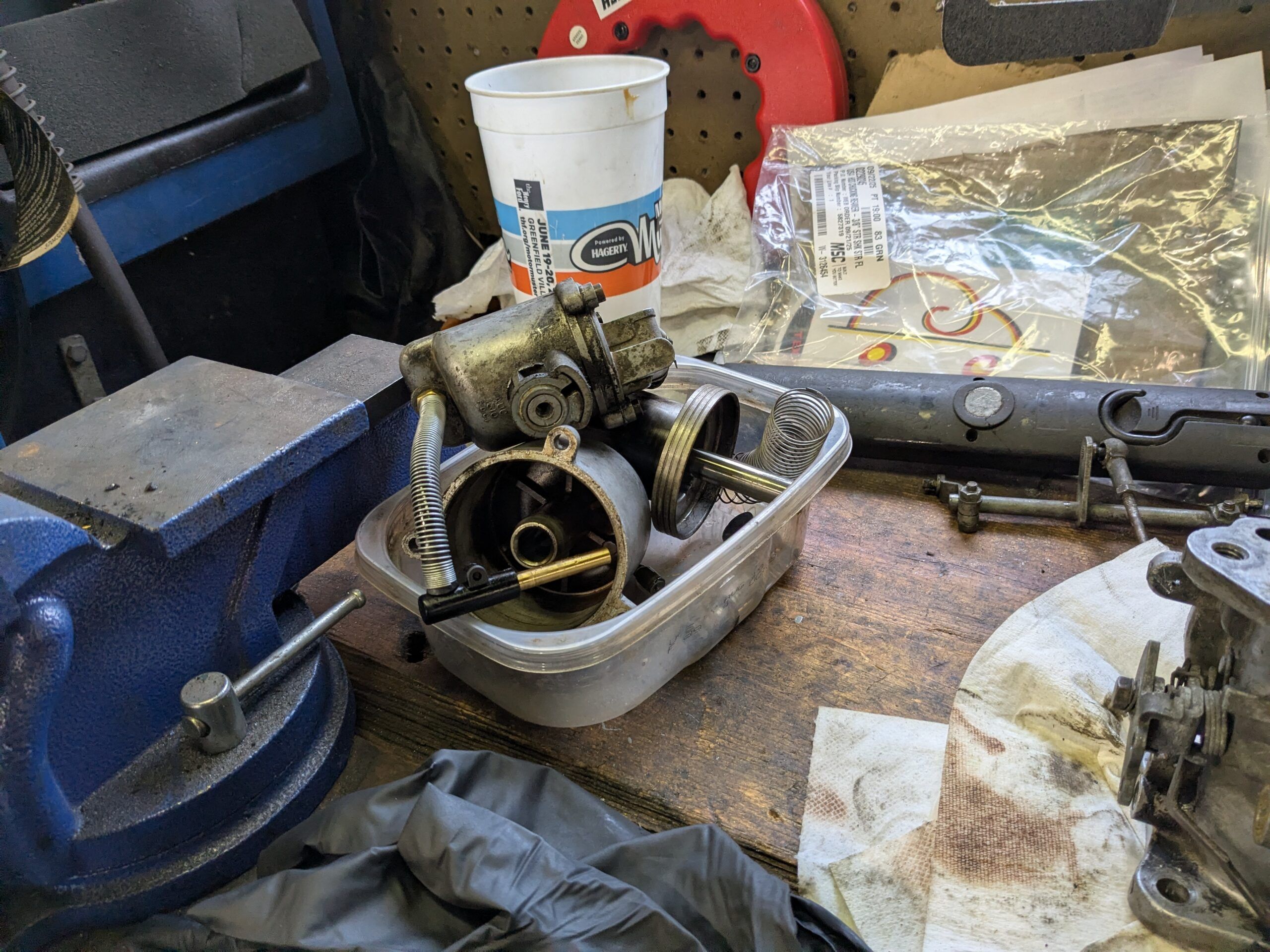
The SU H-series carburetor is really a simple machine, the basic parts (aside from the main body) being shown here, fitting in a small plastic container: the float chamber and attached jet, the vacuum chamber, piston, and spring. The float chambers have to be disassembled to replace the needle and seat, but that’s about it. Something I forgot? To take pictures as I assembled the carburetors.

One thing I didn’t forget this time was to take the exhaust manifold to the machine shop so four mounting flanges could be milled to the thickness of the new/used aluminum intake manifold, so there are no more cheesy washer stacks involved in the assembly of this Volvo. Unfortunately, machine shops are rapidly closing, and those that are still around are busy, so the manifold was out of commission for two weeks. Being that our roads have been consistently salty all winter, that was more a slight inconvenience than anything.

But spring is here and it’s time to drive, and thus, I finally got the engine running again, and it’s running reasonably well. I also replaced the thermostat after the engine overheated and pushed out antifreeze while idling in the garage, and it’s been running at a normal temperature for the 75-odd miles I’ve driven it since I got it going. While it’s clear that I am absolutely not the kind of guy who cares how his engine compartment looks, I will give it a degreasing and power washing at some point this summer. Maybe.
I have to admit to something embarrassing before we set the engine aside for a minute. I just turned 49, and I have always had 20/20 vision. However, for a portion of my manifold “journey,” I couldn’t for the life of me figure out why the engine wouldn’t idle down. It turns out that I was relying on my once-perfect vision to verify that the throttle plates were indeed closed based on when the idle screw lost contact with the throttle lever: That was bad news in a dark garage. After lifting the pistons in the suction chamber high enough for me to see the throttle plates, I saw the error of my ways; the throttle was open farther than it should have been. A quick counter-clockwise turn of the screw put things right. Time to take the concept of reading glasses more seriously.

Next, I had to do something about the exhaust: When I bought the car, I removed the fat, stumpy exhaust tips someone had installed because they were smacking the lower valance panel, which sounded like a hummingbird carrying a bass drum. Without exhaust tips, however, the 1800’s rear panel would be perennially covered in exhaust soot.

Volvo originally used long polished exhaust tips to avoid the soot problem, and while I was able to find a used pair at a very reasonable price, I found that the inlet pipe leading to the rear silencer was rotten.

The silencer itself wasn’t in bad shape, but the inlet pipe had rust welded itself irretrievably into it. I tried air chisels, brute force, heat, taking it to the muffler shop down the street, pleading with it, all to no avail. Shoot.

Like just about everything for this car, a new exhaust system is not inexpensive, probably $800 with shipping. To my occasional detriment, I always start cheap, and in this case, a trip to O’Reilly’s and Auto Zone netted me some 1 3/4″ exhaust pipes, hangers, and clamps, while Summit Racing sent me a glass pack for $32 shipped. While it doesn’t have the cool twin outlets of the original silencer, that is far from the top of my list of concerns right now. I pieced a bunch of stuff together, tack welded it, and then removed it from the car to weld the joints. I didn’t include that picture because I don’t need skilled welders commenting on my “beads,” thank you.

I cut the tailpipe off just inboard of the bumper to resolve the general sootiness.

By the way, the exhaust is not really any louder than it was before. I checked it out before I did any work, because glass packs have a reputation.

This is a little out of order, but I had to deal with the driver’s seat. For those who don’t know, 1800s used Pirelli seat straps as “springs”: They don’t last forever, and I was fundamentally sitting on the floor aside from the cushion itself and a stadium seat I bought to offer a little extra padding.
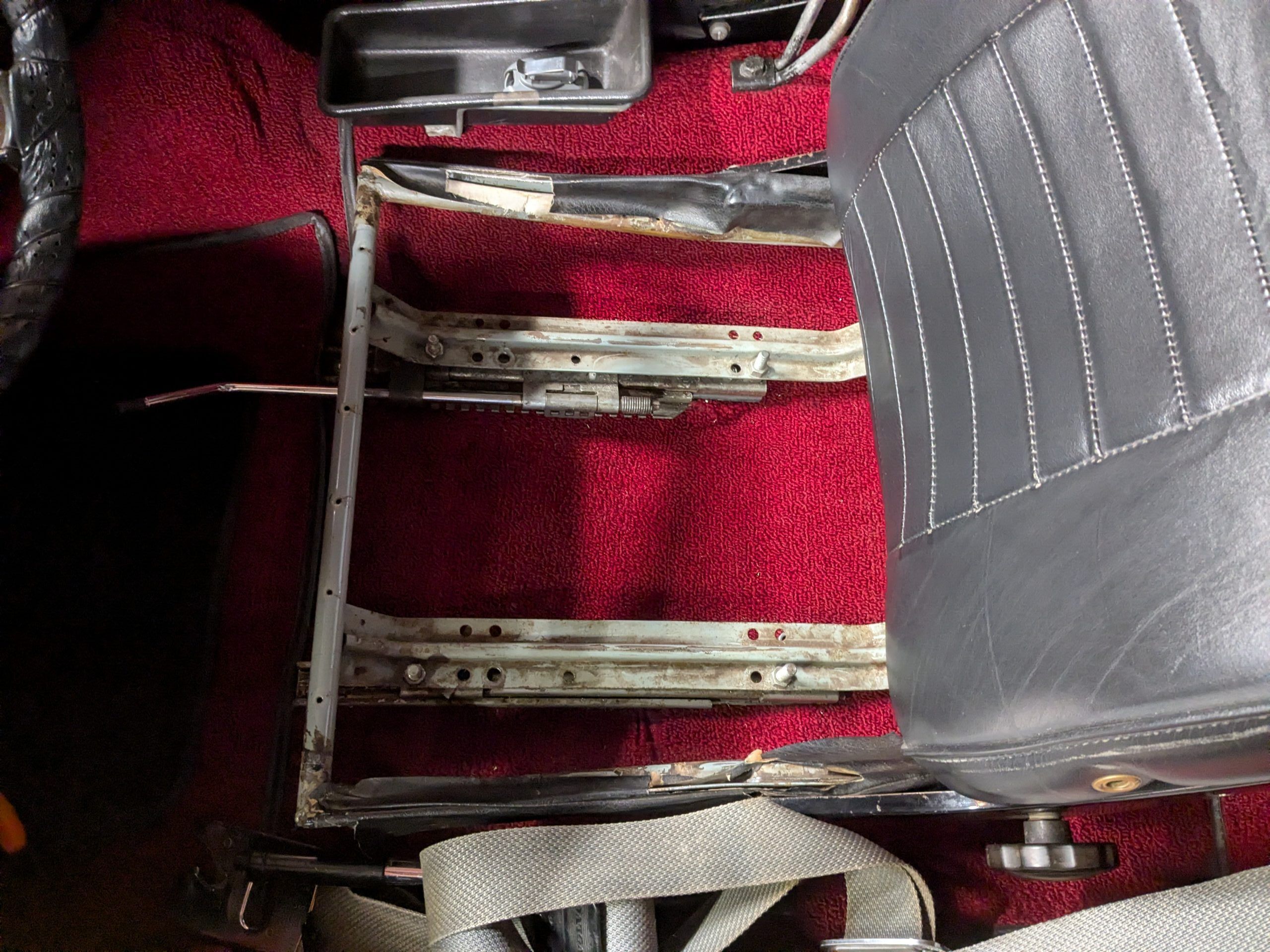
I removed the straps and hooks, and this was all that was left.

Instead of buying new straps, I went to a one-man online shop called SW-EM, where the proprietor sells upgrades he’s designed after owning Volvos for decades. One such upgrade was an ingenious seat spring system that should last a long, long time. It took me about an hour and a half to install, and the second seat will be much quicker because I’ve done it once. The kit requires drilling a few holes in the seat frame, and with a little muscle, it all went together fine. I did tweak a couple of the rear “cables” to tighten them, but I very easily might have gotten one of the drilled holes a bit off, no big deal. It works great. While we’re in here, I’ll also mention that I sent the Smiths speedometer out to West Valley Instrument Specialists in California, as it was in dire need of a rebuild. They did a great job and it’s now one of the steadiest speedometers I’ve ever seen.
This is also a good time to offer a word of thanks to CC’s Evan Reisner, who put me in contact with some Volvo people in case I had questions, which I invariably had, have, and will have. The 1800 is a simple car, but it’s simple in a way that I’m not totally accustomed to yet. I’m learning.

And that leaves us with a running, driving car with plenty of tasks that could be done, and a lot that I may never actually get to. Unfortunately, this particular car could probably use a full restoration; a previous body man used some fiberglass sheeting in commonly rusted areas, and while I’d say it’s a reasonably solid example given how rotten so many of them are, it probably deserves some actual welded-in patch panels. And other things: The engine is more clattery than it ought to be (I’ve spent a lot of time with the valves), the rear axle whines on deceleration, and the electrical system is…Lucas (and is a victim of countless prior mechanics).
I am not, however, a restoration guy. I fix things as they need to be fixed, and I get to the less-important things as I have time to commit to them. If I end up keeping the Volvo (and it would be the first in the fleet to go if need be—by a country mile), that’s the route I’ll certainly take. Nothing on the car is “excellent,” and that’s why I paid half the going rate for a nice driver…and as usual, I’ll save nothing in the long run and will have gained an education. I guess there are worse roads to take.
Related Reading
My 1967 Volvo 1800S: The One Where It’s Still Not Running Right At The End (by me)
Junkyard Sales Lot: 1967 Volvo P1800S – Aaron65, Your (Maybe Running) Parts Car Awaits… (by Jim Klein)























I got the eye thing about the same time. I spent money on an optometrist and nice frame because it seems like a false economy to go cheap when they’re sitting right in everyone’s field of vision. But I’ve also bought the cheap glasses from the 2 dollar shops for non-glamour settings. A pair with the same magnification for facing my computer and another with 3x magnification for attending to detail things such as clearing the minuscule hairs that catch on my turntable’s stylus. Might I suggest these cheap ones for your automotive work.
Sweet ride btw
Thanks, Don. I actually do have a set of cheap readers in the garage for reading carb jets and small drill bits, but the trick is training myself that I need them for other things, too.
If you find yourself squinting to look at something then that’s a pretty good sign. And the difference between magnifications makes a big difference, I ended up getting a simple and “at the mall” optometrist eye checkup to figure out my ideal level for most things (mostly use them for reading an iPad in bed). I still use the phone camera zoom to read an ingredient list on a food item at the store though since I forget to take the readers with me…(or a menu at some restaurants, to the mortification of my kids especially if I turn on the light feature if it’s darkish). Driving at night has become harder too, with the vehicle’s lighting now becoming a much bigger factor being comfortable at certain speeds. And yes it started around or a litle before your current age for me as it apparently does for many.
Congratulations on getting it running! (The junkyard one did end up selling quickly, no doubt either now running around here somewhere or on a container ship being sent back to Europe. Or Tokyo.)
Welcome to one of the first most obvious signs of getting old: loss of close-up vision. It hit me about the same time as you. I’ve been buying little boxes of cheap readers online ever since, and I’ve progressed to 3.0 magnification. And I never go anywhere without them; when I buy pants, I make sure that the pockets are going to accommodate them comfortably.
Stephanie’s strategy is to strategically locate readers in various places as she has so far refused to carry them everywhere. The result is that she ends up borrowing mine fairly frequently. 🙂
And more congratulations on getting it running. I knew you’d get there.
Thanks for reminding me that I need to look for my croakies so I can keep the readers around my neck wherever I am. Aaron you are revealing some important truths about old Volvos. I appreciate learning about some vendors I didn’t know about: SW-EM and West Valley Instrument Specialists. I could use them for my ’66 wagon and spread the word with my Volvo friends. Thank you.
You’re welcome, Alfred. I had good luck with both of those vendors. You may have noticed my dimmish taillights in the opening picture (the engine was running and the car still has a generator). Swedish Embassy (SW-EM) also sells alternator bracket kits quite reasonably, so that might be a future upgrade, too.
Thanks to both of you…it’s been a bit of a confidence-killer getting it here, but it’s also a good reminder to stick to logic and basics. Unfortunately, a car can sometimes play games with you, too, as I’ve found out numerous times.
Regarding readers, I think I’m still just on the edge of needing them. Whenever I put them on, I just can’t wait to take them off, but it might be a matter of getting used to it.
So you are hitting presbyopia. I have been listening to people pretty much tell me the same story for 47 years now and then coming up with a solution for their particular case. Some here, just starting out in reading glasses, are going to find they will one day need distance glasses to pass a DMV test if their state does a vision test.
Speaking of machine shops they are closing. Makes things really hard now. The shop, two miles away, closed down one month ago as the owner got himself into some financial trouble using those quick loans with astronomical interest rates. You can be a great machinist while finances are beyond you and vice versa. Plus his wife passed away at 60 which didn’t help months earlier. He made sure my three engines were done with machining, as others would never get done, and had all out one month before the close date. Parklane 410 goes in next weekend. Now where does the 2.2 in the 91 626 go now?
In December he mentioned to me his vision at near in the shop. Moans and groans so I told him to take a drive down to my office. Comprehensive exam on me. Yep, an unequal distance correction complicating his simple near glasses. Moving around in the shop and viewing different tasks at different distances meant readers would not work. Also on and off, in a shop, is not a good idea. Gave him what I wear which is a near variable focus lens and he is as happy as a clam.
You do house calls, Doc? 🙂
Should have called Irv Gordon for some help. (!!!)
That’s quite a long-distance call.
You will get nothing but admiration of your welding skills from me! That is a skill I have always wanted to learn, but I have never had the right combination of time, money and a project.
On the car, I had faith that you would eventually get it to run right (or close to it), and you did not disappoint!
I have needed glasses for anything farther than about 8 inches from my face for most of my life. These days, trying to find the sweet spot between natural close vision and one of the two lenses in my bifocals is a trial when working on things.
Thanks…I was starting to lose faith in myself for a bit! I still have a couple things I want to do to it this year, such as testing the adjustment of the overdrive solenoid. I just got a Klein multimeter with a 400A clamp for my birthday so I can test the solenoid’s amp draw.
If gas prices stay high, I might be driving it quite a bit…it gets about 27 miles per gallon!
When regularly kept in tune (like every few months 🙂) a twin SU B18 gets surprisingly good gas mileage. But premium, I presume.
Um….actually, I’ve been running midgrade in it. I think the engine has a thicker head gasket than stock based on its compression numbers, and I haven’t heard any pinging (or seen any sign of detonation on the plugs), and I usually have a very good ear for mechanical noises.
Yay! I knew you’d get it straightened out if you kept at it. I feel that one of the great things about these old Volvos is that they tend not to deteriorate once something is fixed and then you just leave it alone. Meaning, that if you keep it dry and inside there’s relatively little that’s going to make it go downhill (aside from rodents…that’s a whole other subject). And you’re right about the gas mileage. That’s indeed reason for exercising it for “the foreseeable future”.
Thanks, Jeff! All the cars stay inside (although we’re not heated storage kinds of people). 🙂
That’s great news, Aaron! And thanks for the shout out; glad to be of help.
Thanks again, Evan…I normally don’t like asking for help, but in times like these it’s very nice to have sets of experienced ears to bounce ideas off of.
Great to see the updates. When I saw one of the cylinder head photos, the cast-in letters KAG caught my eye. Is that perhaps the foundry? I’m pretty sure both my parents’ ‘64 and my ‘65 122S had the same letters. So probably not a date code or pattern identifier if there was more than one casting pattern.
As for the seats, my parents’ car had the older OEM steel springs and the seats held up great for over 20 years, until the 122 was replaced with a 240. Not the case with my 1965 which had the newer, more stylish seats but with the straps and much weaker upholstery stitching and fabric. My car was just ten years old and the seats were in pretty bad shape when I bought it. This may sound sacrilegious but the seats in my 1973 Vega that replaced my 122 were far more comfortable.
Don’t feel bad about the sacrilege; I’m not a big fan of the seats either, or the steering wheel. I think it’s as big as the wheel in my ’53 Buick, but with half the interior space, your legs get a little crowded.
Don’t feel bad about the sacrilege; I’m not a big fan of the seats either, or the steering wheel. I think it’s as big as the wheel in my ’53 Buick, but with half the interior space, your legs get a little crowded.
The seats in my Citroën 2CV use a similar concept but a different design. There is a central panel of canvas that is supported by large elastic bands with hooks that go into holes in the canvas and the tubular seat frame. Over time the bands fatigue and some break. Mine were getting bad enough that I decided to refurbish both front seats. All the parts are readily available and it went surprisingly well. There was one problem that I did not notice until the first time I drove it. With the new elastics I am now sitting an inch or two higher. There is lots of headroom, so that is not a problem, but the windshield is very shallow, so I have problem seeing overhead signs and traffic lights. It is particularly a problem when stopped at a red light. I often have to slouch down or lean over to see it. On the other hand, if I have the roof open, I can just look over the windshield. It encourages me to open the roof.
I have the same issue with my ’53 Buick since I got the seats redone; I have to crane my neck to see stoplights.
Excellent, well done and a good illustration of how to work efficiently to solve problems without creating new ones or overdoing the fixes.
You’re doing better than I am, VW is still buried in the garage. First I need to commission the motorcycles and get the Mustang out of winter storage, then it’s the VWs turn.
There’s always something, huh? I understand. The Dirty Dart’s clutch pedal went “pop,” straight to the floor. I think the pressure plate has gone bad; the fingers aren’t returning to their normal height. Looks like I’ll be tearing out the transmission and putting in a clutch this weekend.
A word about those manifold “sealing Rings” ~ they don’t actually seal, what they do is counteract the manifolds tendency to “crawl” (expand longitudinally) as it heats and cools, this can often cause leaks in intake or exhaust .
It’s why when you torque it to the cylinder head, you begin in the center and work outwards, to properly ‘set’ in in place .
That’s quite a beefy gasket you have there .
Inline 6 and 8 cylinder engines are plagued by this and few bother to re – install the stamped steel rings .
? Did they re bush the throttle plate shafts ? .
Your engine compartment looks pretty clean and dry, I like using commercial degreaser from SAMS Club to keep everything clean and dry, this way I can spot problems before they blindside me and it’s also much easier and more fun whenever I need to go under the hood .
Exhaust soot collecting on the back of any car means it’s either wasted fuel (too rich) or perhaps burning oil, I corrected this on one old truck by going to electronic ignition, not only did the visible exhaust stop, I gained noticeable power, better fuel economy and easier starting cold or hot .
Since you weld I don’t see why you didn’t add some chrome tips to the glass pack you added, I bet it sounds nice now =8-) .
As far as poor beads, if it doesn’t leak and doesn’t crack it’s *perfect* .
I like the upgrade you’ve done to the seat bottom, AutoZone sells a nifty GEL seat pad that will fit in there and make incredible comfort for skinny old bony butts =8-) .
One thing : I always lay some Muslin over the springs or in this case wire supports, it serves to gusset the entire seat’s load making it more comfortable and longer lasting .
I’ve been using West Valley ever since North Hollywood Speedo goosed me a few decades back, le$$ co$tly and good works .
I hope it’s accurate ? .
The car looks great and as long as it drives well it should be worth every penny you put into it .
The lubricants should all be converted to fully synthetic, it’s amazing how long old, tired & noisy engines, trannies and final drives will last with good quality fully synthetic oils .
-Nate
BTW : the time to set the basic throttle plate idle settings is when they’re off and in your hand : you back the idle screws off completely then hold the carby up to a light and sight through it, see if in fact the throttle discs are in fact centered or have unequal light streaming through .
ALWAYS use Blue Loctite on the throttle plate screws ! .
Yep, the throttle shafts were rebushed (and the shafts themselves replaced). The speedometer’s a few miles per hour slow, but not bad. It could come down to tire height, but they’re almost always fast in my experience. The gasket for the intake/exhaust is a Remflex, which is expensive but very good. It’s the only thing that’s effectively sealed my Buick Straight-Eight’s manifolds.