

It was late 1997, and after nearly a year and a half of struggling to make it in Seattle, I was throwing in the towel. The job market was great for young techies, but not for liberal arts grads with no marketable experience. The cost of living exceeded my income, I didn’t quite fit in with my peers, and I was homesick. The only true friend I had made while in Seattle had just returned home to Pennsylvania, coincidentally about 30 minutes from my hometown. The only thing left was to admit defeat and retreat to the safe familiarity of home, where I could lick my wounds and start over (again). I had determined that the Dodge Rampage would not be up to the cross-country slog, so I found a car that also offered a comfortable sense of familiarity: a 1976 Mercury Cougar XR7.
When I set out to find a reliable vehicle to ferry me safely across the country in the depth of winter, a 20-year-old American personal luxury coupe was not my initial target. I had looked at more sensible vehicles and came close to getting a bargain on a 1987 Mercury Sable wagon that just needed a new heater core. As was frequently the case at that time in my life, money was the limiting factor. The seller (understandably) wouldn’t hold the car until I received my paycheck at the end of the week, and it was gone before I got paid. Shortly afterward, a classified ad for another Mercury caught my eye. The advertised mileage was low — as was the asking price — so I made arrangements with the seller to see the car that evening.

As has been told in these pages before, Mercury repurposed and re-platformed the Cougar nameplate in 1974. From its birth in 1967 through 1973, the Cougar shared its unibody shell and base mechanicals with the Mustang, filling a market niche as an upscale, gentleman’s pony car. With the muscle era all but dead, Ford diverged the platform mates to serve two distinctly different places in the market. The Mustang was downsized onto a modified Pinto platform to take on the rising influx of economical, sporty imports that were seizing the youth market. Conversely, the Cougar was moved to the (large) midsize Torino platform, where it would be a posh PLC extension of Mercury’s mainstream Montego line and compete with the likes of the Monte Carlo and Grand Prix.
Mechanically, the bigger Cougar was standard midsize Ford fare. It shared its perimeter frame construction, “road-hugging weight,” and proven powertrains with, by my count, no less than 17 concurrent or subsequent Ford products in coupe, sedan, wagon, and pickup form, together tallying over 5 million units between 1972 and 1979 (as Mr. Shafer documented here). One of those products was the Ford LTD II, which also happened to be my first COAL. First-year 1974 models came standard with Ford’s excellent 351 Cleveland, but the Q-code 351 Cobra Jet could still be ordered, though these were exceptionally rare (about 2,800 produced). In 1975, the 351M replaced the Cleveland, and the Q-code was history. The 351 made all of 154 net hp and 286 lb-ft of torque, delivering a 0-60 acceleration of just under 13 seconds and returning about 12 mpg. The 400 and 460 were optional all three years, each taking an incremental second off the acceleration time, but adding between 300 and 400 lbs to the car’s already prodigious 4168 lb curb weight. The 460 took the output all the way to a very respectable (for 1976) 202hp and 338 lb-ft of torque, reducing elapsed time and fuel mileage to 10.6 and 10.2, respectively.

When I arrived at the seller’s house, I found the Cougar parked along the street with a “For Sale” sign in the window, and I knew instantly that I was going to make this my car. I had always liked this generation of Cougar. The long, low hood and short deck with exaggerated hips gave it a striking silhouette, much like a cat preparing to pounce. The three-piece front end, whose theme carried over from the prior generation Cougar, was handsome and confident, whereas the Montego’s was dull and dorky.
Beyond the basic styling of the car, I was also taken by its color. As I noted in my prior installment, I have an affinity for things that are a bit oddball, and this beast fit that description. Ford called the color 2726 Light Green, and offered it on Cougars from 1975 through 1977. The name does not aptly describe the hue. If you were to take 1 cup of that day-glo ectoplasm slime that the kids love, and mix it with two quarts of eggnog, you would approximate this color. Under certain conditions, the car looked pale yellow, but if it caught the right light the green tones would be enhanced. This was offset by an avocado skin dark green quarter vinyl top (surrounding opera windows with inset chrome cats) and matching vinyl rub strips running the length of the car’s lower flanks.
Peering through the window, I could see that the entire interior – from the vinyl “Twin Comfort Lounge” 50/50 split bench seats to the carpets, headliner, and dash – was enveloped in this same dark green. While this combination may sound repulsive, it was striking on this particular car. That it was all riding on four lovely magnum 500-style steel wheels perfected the look. It was as close as you could get to classic muscle-car styling on a mid-70’s luxobarge and to my eyes, it was stunning. I own the opinion that this was the best-looking car on that platform that is not a 72 Torino SportsRoof.

Walking around the car, I found it to be in near pristine condition. The paint looked thick and shone under the streetlamp, and the vinyl and chrome trim were all in perfect condition. And, being a Washington car, there was not a spec of rust visible in any of the typical areas. It was perfect. Well, at least three quarters of it was. As was stated in the ad, the reason for the low asking price was that the car had recently suffered minor accident damage. The area of the right front fender between the wheel opening and bumper was caved in, and the impact had also shifted the bumper laterally an inch or two and broken a piece out of the headlight trim. No other panels were damaged, so I figured this would be a simple fender replacement.

Sliding into the car for a test drive was an immediate rush of familiarity. The large split bench and dual armrests felt just like my LTD II. The dash layout was identical and, other than the inclusion of a tachometer, all of the gauges and controls were right where I remembered them. The test drive confirmed it was running well, and the owner explained that he was selling it because he had bought it for his son, who shortly thereafter was “screwing around” and had the mishap that resulted in the damaged fender. As punishment for the accident and subsequent insurance hike, he was selling the Cougar and making him share a car with his mom for a while. $750 was exchanged, and I picked up the Cougar the following day.
In those early days of the internet, sourcing a 20-year-old fender meant calling every wrecking yards in the SeaTac metro, but I was fortunate to locate one and my brother helped me swap it out with the damaged unit. I was also able to get a quart of 2726 Light Green, and my brother applied it with a sprayer in his garage. Once it cured and was rubbed out, the match was excellent. The bumper ended up being a bigger challenge. The hit tweaked the bumper mounts and we didn’t have the right equipment to pull them, so we removed the bumper, propped it into position on a couple of jackstands, and my brother welded it directly to the mounts.

Once the repairs were completed, I sold the Rampage to a guy who seemed to collect them and began using the Cougar as my daily driver. While I was hopeful that it would not present any serious issues, I also hoped that if it did, it would do so before I set off to cross the country. My first morning commute was auspicious. As I approached work, it started stumbling, and I noticed smoke coming from the trailing edge of the hood, in front of the windshield. I pulled into the parking lot and shut off the car.
As I raised the massive hood, I found a small fire at the base of the carburetor, its orange flames illuminating the pre-dawn parking lot. Terrified and not knowing what to do, I slammed down the hood, and strolled into work as if my car wasn’t on fire. I had seen enough episodes of “CHiPs” to know what could happen, and I spent the rest of the morning trying to focus on my work while praying that the Mercury would not explode in a spectacular fashion in my employer’s parking lot. By lunchtime, no one had mentioned a burning car, so I figured it was safe to investigate. I was pleased to find the car was not a smoldering cinder, but I was still fearful of what damage may have been done. I clinched my eyelids shut and popped the hood, and as I slowly opened my eyes they revealed no visible signs of damage. I got in and turned the key slowly (while praying that it wouldn’t explode upon ignition), and she fired right up and settled into a smooth idle. It never exhibited the same stumbling, nor did it ever again catch fire.

Crisis averted, I spent the next several weeks getting to know the Cougar. The prior owner had installed an aftermarket stereo and removed it when he put it up for sale, so I filled the hole with a Sony in-dash CD head unit with an oh-so-‘90s removable faceplate. Otherwise, the car was truly in like-new condition. While far from fast, the 351 and C6 auto moved the Mercury effortlessly, much more so than the 302 in my LTD II, and it rode like a big, heavy luxury car should. Yes, this smooth, quiet, comfy beast would certainly be an upgrade over the buzzy little Rampage for my 3,000-mile solo journey.
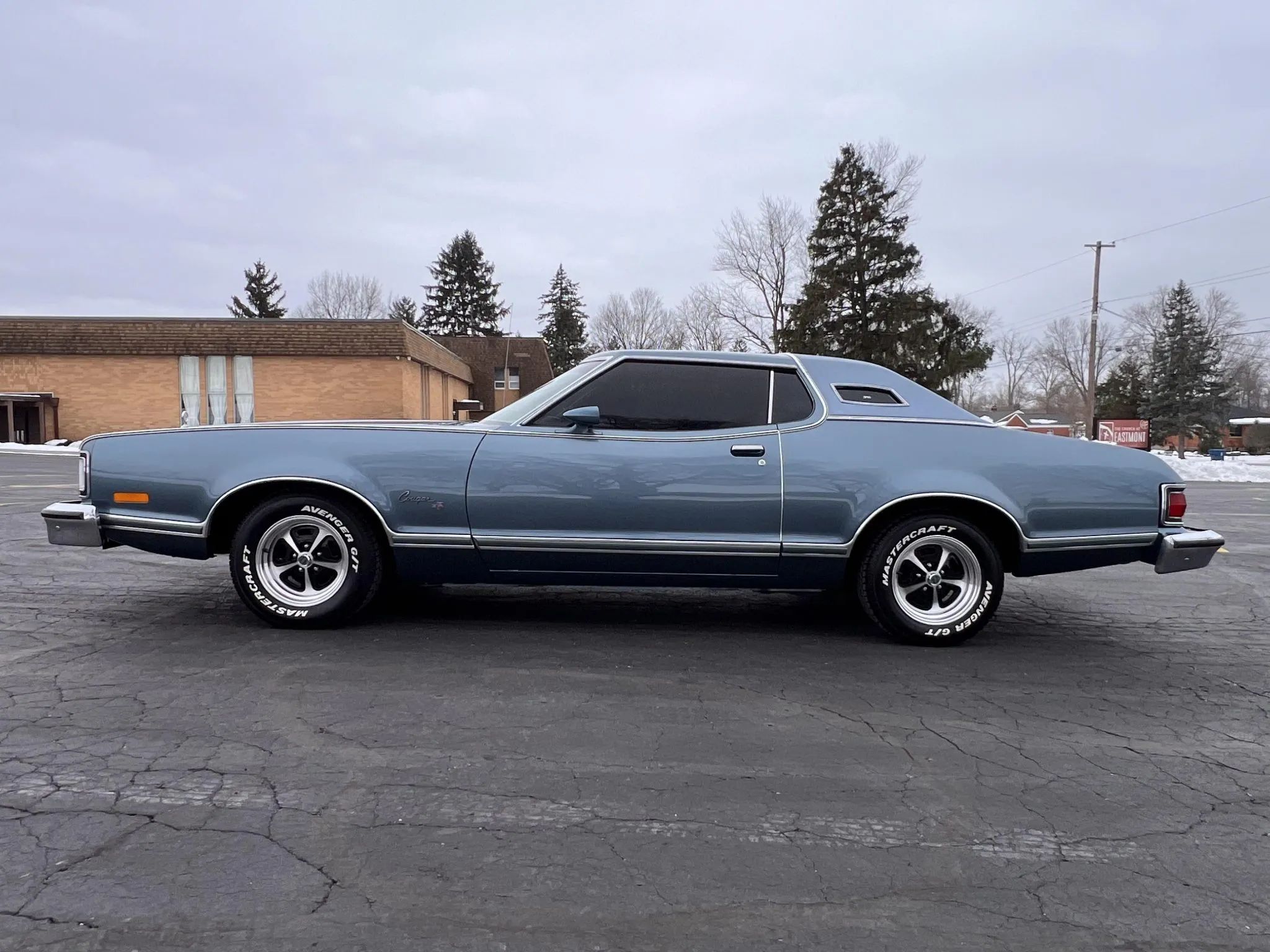
Early on the morning of January 3, 1998, I rolled out of Seattle and pointed the Cougar east. It would not be an uneventful trip.
Related CC Reading
CC Outtake: 1972 Mercury Cougar XR-7 Convertible – Pony Up From That Mustang
Curbside Classic: 1971-1973 Mercury Cougar – Mercury’s Pony Goes Brougham
For further enjoyment, Bud Lindemann provided rather humorous commentary in this comparison of the new 1974 Cougar and Cutlass on Car and Track.























Your description of the car’s color (ectoplasm + eggnog) is excellent.
“It’s like nobody else’s car! Cougar! GRRARRRERRR!!!
At the Sign of the Cat!”
I was in heavy stop and go traffic on my way to work at the mall back in the 80’s. I could smell gas and wondered if it was my car. My car ran ok, so I was not too concerned. Suddenly a 70’s LTD station wagon pulled on to the shoulder of the road, smoke billowing from the unopened hood. I continued past since I did not have a fire extinguisher. As a retired auto mechanic at Sears, we had many Ford’s that came in with gas leaks. It was almost always at the little rubber hose from the fuel line to the fuel filter screwed to the carburetor. If I remember correctly, new fuel filters for these type Fords had a new hose and clips. We always changed these little short hoses, but some did not. These hoses would wear from the heat and crack, causing fuel leaks onto the intake, and sometimes fires.
This comment brought back memories… my grandfather being a long-term Ford guy… when he picked up a triple black LTD Brougham four-door hardtop with a 351 in it he showed me how to swap out that exact factory rubber tube with a better quality replacement with a glass fuel filter… I also remember carrying extra Ford solenoids in glove box after he passed that LTD Brougham to me… for the inevitable 2:00 a.m. in the rain solenoid change out on the highway! My beloved little Scion FRS just ate up a rod bearing, so I’m actually thinking about looking for something from the Brougham Malaise era while I figure out what to do with my little Japanese sports car… years experience with 351s 460s and Cadillac 425s…just need something with a plush leather interior, air conditioning, and preferably Naples yellow or one of the 70s green colors!
This brings up a memory. One day, I was driving along in my 2000 Acura TL. I started smelling gas and looked behind me. The fuel was pouring out of the back of the car.
I decided to drive straight to my preferred shop, which was about 10 km away. I started with a full tank of premium fuel. When I got to the shop, the gauge read one quarter. It had puked 3/4 of a tank on the drive there.
It turned out that it was rodent damage. They had gotten into the evap lines and chewed them up. One was replaced and all seemed well but the next day, there was another leak. Turns out I had to replace all the evap lines, to the tune of $1000. I should have put in an insurance claim, but was too lazy to so so.
Nice Looking Cars shown here. Yikes, the rims on that green one though (and I’m usually ok with a LOT of aftermarket wheels) THOSE are hideous.
I’d take either one of these for the right price.
Like that “blue/gray”, one. Had they started with those crazy “Cougar”, wagons then? Always thought that was some crazy marketing.
Recall seeing a white one a used car lot in the late “80’s”. Seemed to be in good shape. Very clean;don’t remember the year of the car though.
Crossing the country in January is risky business. Been there, done that and looking forward to the next installment.
What if Mercury did a 4-5 inch longer wheelbase on this, then pulled the trunk section out another 2 inches? Modify the roof slightly and you have a semi alternative to Thunderbird/ MarkIV . The name would have to be something other than Cougar of course. The new Park Lane Brougham coupe.
Beautiful car! In my opinion, better than the Mustang.
At the Sign of the Cat.
I never cared for these but am looking at it freshly today and can see its charm. These never got much respect as they aged, but we’re stoutly built cars that made solid daily drivers if you could handle the nautical handling and the gas mileage.
I remember that color well, though not terribly fondly. Ford’s interiors were probably the nicest in the industry at the time.
I was not happy the Cougar had grown in size and purpose in 1974.
At a media event in September, 1973 Ford of Canada had some cars for journalists and selected dealers to try out at an event in downtown Edmonton. The new Mustang was on my radar as I was contemplating what new car I should buy after graduating my post-secondary studies the next year. But it was a very optioned XR7 and I made sure to take it for a drive in addition to the Mustang. Well, it was impressive in many ways and certainly felt more upscale than my father’s 70 Cutlass Supreme. As time passed this generation of Cougar proved popular where I lived sharing the streets with Monte Carlos, Grand Prixs and later Cordobas. And then they disappeared. Nice to see some examples surviving at car shows in 2025.
A 400 would add negligible weight over a 351M since they are the same engine, one having a .5 inch longer stroke.
The 460 would add no more than 250.
A friend in high school (circa 1979-80-81) found a silver over red 1975 Cougar. Being in Fort Myers it was an elderly owned car and was loaded with all the goodies but tilt wheel-something that John who was 6’2” would have liked to have had.
He kept that car in amazing shape, and I don’t recall his ever having issues with it.
He should it when he bought his mom’s 1978 Regal Turbo off the two year lease.
He was saddened when he saw the young man who bought it doing neutral drops and tire burn outs.
Looking forward to traveling with you on the next part!
It’s hard to believe with the passage of nearly 50 years that so many beautiful paint colors were offered!