

After the demise of my 1977 Chevrolet Impala, I needed a new car. I ended up with a four-cylinder 1979 Mercury Zephyr ES with the four-speed stick.

In the winter of 1978-79, after I had wrecked my Impala 2-door sedan, I tried to sell it to the local Chevrolet dealer right around Christmas time. I took it to them one evening, but they said they weren’t buying right now. I was thinking about buying a used Opel wagon to replace it, but the bank manager told me I didn’t need two cars; he actually went out into the parking lot of the bank to verify that I had a Datsun 510 for collateral. Details are hazy as to which year, but I also remember trying to find a VW Rabbit for sale, according to a newspaper ad, which the salesmen claimed to know nothing about. I went to the Cuyahoga Falls VW dealer asking about the “stripper Rabbit,” but the salesman cheerfully told me that “nobody wants those.” (This was also the time that the VW Rabbit was being assembled in Westmoreland, Pennsylvania, and those models were known for being “Americanized” and consequently losing their European distinctiveness.)
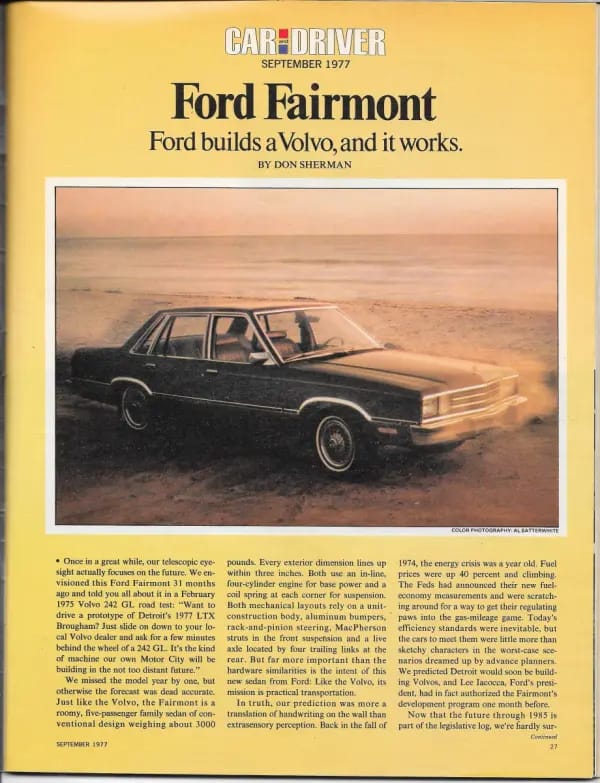
Around the same time, I was very impressed by an article in Car and Driver covering the new Fox platform Fairmont/Zephyr siblings. The pair has been very well-covered at Curbside Classic, and the complete review can be seen HERE.
I decided to buy a 1979 Mercury Zephyr with the ES (European Sport) package. It was white on the outside, black on the inside and had some flair. It was a four-speed, four-cylinder car, had a pseudo-machined plastic insert on the dashboard, and came with blackwall tires. I must have looked around the local dealers and found a model at Halleen in Medina (Meh-Dinah not Me-Deena, is the local pronunciation.)
In European tradition, a zephyr is a light wind or a west wind, named after Zephyrus, the Greek god or personification of the west wind. Zephyr was originally the moniker of a 1930s Lincoln, perhaps Edsel Ford picked this name. And it was a long-time Ford UK model.) Meanwhile, Ford had the Fairmont, which sounds suburban (Fairmont, Glenmont, Oakmont are classic country club names). It was probably meant to pay homage to Fairlane, which was Henry Ford’s Dearborn estate, but Ford decided not to reintroduce that name. At an Akron Ford dealer’s lot, I actually saw a Fairmont/Zephyr — it came out of the Mahwah, New Jersey, assembly plant with Ford nomenclature on one end, and Mercury nomenclature on the other!
This car was the replacement for the Falcon chassis, which had served Ford well from 1959 and continued into the 1970s with the Granada. And you will recall that the Mustang was built upon Falcon underpinnings. And a lot of, if not most, Mustangs were 6-cylinder snazzy-looking cars driven by young professional women (including Mary Richards).

I bought the extended service warranty, as this was the first Ford Motor Company product that I ever bought (although I had been a big fan of the 1966 Ford Galaxie in my youth). I believe I bought the Zephyr because it was new, different, and cheaper to run than the Impala. I was commuting 25 miles each way to work, 250-300 miles a week. Plus, it had a stick shift and it handled better than the Datsun 510, which I still had — the Datsun was not a good snow car.
I was working more normal hours, September 1978-June 1979, hardly any overtime. I had time to ride my bicycle through the roads and trails in the Akron area. The economy in Akron in 1979 was really bad, when some of the last tire plants closed. Not happy working at the company in Parma, I needed another job, which I found in a computer room.
The job kept me busy while figuring out what I really wanted to do with my life. Besides keeping the computer tapes backed up and monitoring the system, I worked in a room full of dot matrix printers, addressing “personalized” letters and was later promoted to the daisy wheel printer room. Didn’t know it then, but it was state of the art for the times — an early permutation of what is now in all of our homes, except the network is worldwide and not just contained in an office environment.

My hazy memory tells me that the Zephyr’s dashboard and the clutch were both replaced under warranty while I owned it. The Internet says that the Zephyr/Fairmont was the first use of MacPherson struts in an American car.
And, as printing and typesetting is in my blood, I got a part time job on the weekends at the local weekly newspaper chain. Then, in the Fall of 1979 the Iran Hostage Crisis started, and gas prices started to rise. Maybe it was time to downsize some more.
Related CC Reading
Curbside Classic: 1978 Ford Fairmont – That Very Rare Honest Car
Curbside Outtake: 1978-1983 Mercury Zephyr – That Very Rare Clean Design
Vintage Review: 1978 Ford Fairmont/Mercury Zephyr – Functional But Flavorless
Vintage Road & Track Review: 1978 Mercury Zephyr-Ford Fairmont – A Boxy New Dawn
Curbside Classic: 1980 Ford Futura – Back To The Futura























Funny you mention that. I know a guy who ordered a ’78 Chevrolet K-20 pickup, and it arrived at the dealer with a GMC tailgate! It does happen.
It’s always great to see Fairmont/Zephyrs here at CC!
I was a big Fairmont fan (at age 14, lol!)
This looks like peak Fairmont/Zephyr: 4-cyl, 4-speed, TWO-door sedan (that outward visibility!), and the ES package. Chances are it had nicer vinyl buckets than our family Fairmont.
Interesting that the author “found” this car. I would have thought it was special-ordered. Did it have power steering and brakes?
In 1979, Ford made the “4-speed” (aka a manual 3-spd plus overdrive) standard on the six cylinder and V8. One could even say the 302-V8 4-speed was a performance sedan, with a quarter mile time under 17 seconds.
Peak would be a wagon with that powertrain and baby-blue interior with plaid cloth seat inserts.
That’s exactly the car my father bought, except of course the stripper trim and not the ES. A very straightforward car that really was the closest thing to a Volvo, with its modest 2.3 L four, 4-speed stick and manual steering. I drove it several times and was impressed that Detroit could finally build a European car that was all-American. Little did I know how the Fox platform would end up under such a vast array of cars in years to come.
Another great period piece which is just so evocative of its time.
I can just imagine how that VW salesman looked and sounded as he told you that “nobody” wants the car that you clearly were there to ask about. Maybe that kind of thing still happens – I wouldn’t know as I’ve pretty much I think sworn off stepping into car showrooms – but it seems so incredibly dated to think about how a customer could be redirected by the salesman telling them that their tastes are out of the mainstream. There would probably be better ways for salesmen to do that kind of thing nowadays.
Ironically, I was told pretty much that in 1984 in a VW dealer, about the car that I ended up buying (a stripper Rabbit diesel). It was parked way in the back of the lot because “nobody wants those”. I loved that car and it was exactly what a broke 23 year old needed.
Finally, I do have to wonder the same thing that TomLU86 asks…which is while that manual transmission was “standard” in the Zephyr, I’m amazed that many actually made it to dealer lots that way.
How did the quality of the Zephyr compare to the Impala? Since the Impala was only a year or two old when wrecked, seems like there would have been decent parts value.
Looking at what I wrote, I’m not sure why wrote demise of the Impala, it was fixed and I traded it in. The Impala was definitely the nicer car, but was bigger, cost more to run and I was laser focused on saving gas money. Back in 1979-80 there were real concerns we were going to run out of oil, or so we were told.
Old salesman story. Nobody wants what the dealer doesn’t have. Everyone is buying what the dealership just happens to have in stock. When people inquire about something a dealer doesn’t have, they often end up hearing a lot of reasons why they don’t want what they want. The culminating question to this pitch? “You wouldn’t want to take a beating at trade-in time would you?”
Interestingly enough, the last Mercury Zephyr I’ve seen was in Ohio, about 5 years ago (picture below).
This seemed like a good choice for the times. I like the VW salesman story – I’ve heard that “nobody wants those” about half the time I’ve ever been at a car dealership. Fortunately, the ability to search dealer inventories online is a boon to those looking for out-of-the-ordinary dealer stock.
1979 would have been a really interesting time to buy a new American car, with choices ranging from obsolete barges like the LTD II or Granada to something like this or maybe the Omni/Horizon.
The Fairmont/Zephyr came across as very European to me, probably moreso than almost any other US car of the time. Yours really nailed that vibe.
Dad worked at Philco Ford and leased a well-optioned Mercury Zephyr station wagon. Equipped with the 302 V8, it moved out very nicely. He liked it well enough that he purchased it at the end of the lease.
The ’78 and ’79 Fairmonts and Zephyrs and the ’79 Mustangs and Capris with the 302 V8 were very decent cars.
I keep thinking about that old Jeff Foxworthy routine that went something like, “If you have a Ford Fairmont, and drive to Walmart and park it, and people come up to you in the parking lot and tell you what a nice car your have, you might be a redneck.”
Sometime in the mid- to late-1990s, I had an idea to buy a base Jeep Wrangler. The one that came with no top, no rear seat, no radio, etc. I made the mistake of going to a suburban Jeep dealer. The salesman told me, “We don’t sell those. Those are for farmers.” Translation: “We don’t make enough money on those to bother selling them.”
As I recall the Zephyr might have had power steering, but I honestly don’t remember. I remember a single mom co-worker asked me about my car and said she liked it but didn’t like the ES trim treatment, I told her that was optional. A lot of these were sold, friends had a Fairmont wagon in Colorado, back in 1993, and I remember flinging it around the mountain roads until the owner’s wife said she was getting car sick in the back seat…
The closes I’ve come to a Fairmont/Zephyr is a ride in the Fox body LTD. It seemed nice enough, and I had spen several years in an old Volvo. That 4 cylinder 4 speed car had a lot of modification potential by the late 80s since Mustang stuff slots right in. As an aside Australian Ford had used the Fairmont name for an upscale Falcon since the 60s, and the other motor vehicle with that name was was the Fairmont Speeder rail car
You might have dodged a bullet with the Rabbit, a friend had an 81? Rabbit C with the Solex carburetor instead of fuel injection, an AM and vinly seats he had foolishly Armoralled. My 78 Scirocco felt like a BMW in comparison.
About stripped Rabbits, I’m not sure about the 1979 model, but in 1975 (first year of the Rabbit in the US), the base $2,999 model had drum brakes all around, bias ply tires, a rear seat that did NOT fold, and no security cover for the cargo area. I gladly paid the extra $330 or for the option package that provided front disk brakes, radial tires, a fold-and-tumble rear seat, and a cargo cover.
I can’t imagine in that inauguaral year that many people actually wanted the base model.
For the 1976 introductory year the Chevette had a stripper model called the Chevette Scooter, with no rear seat. Lee Iacocca, who was a marketing genius for that era, made a big deal of the Pinto having a rear seat and cost $4 less.
The scooter also had NO seat adjustment for the passenger..
Interesting, I wish there was more on how it was to drive .
Ford is perfectly capable of making basic affordable transportation cars and light duty trucks, when they perceive it might make a profit .
I’da thought the 4 banger was too little engine for this but I remember they were very light so mayhap not a bad choice .
-Nate
It was a better handler than the Datsun 510 that I had. The girl friend at the time lived in an area of twisty roads and it was fling able but not a car that accelerated briskly.
One of my brothers bought a 1978 Mercury Zephyr ES 2-door brand new from the L-M dealer in Hermitage, PA. It was his first (and oddly, last) new car. His was very similar to the two-door on the postcard, but it had the steel wheels with the wheel covers and the same chamois paint like the four door one on the postcard.
He was excited to get a four cylinder, four speed car without any options other than the AM-FM radio. His thinking was, if there’s no options on the car, there’s nothing to go wrong. A short while after taking delivery, the car developed a rough idle and cold start stalling. Many visits to the dealer where they could not fix the issue. After the warranty period expired, many local mechanics could not repair the car, either. There were other issues, too, such as the AM-FM radio that would randomly turn itself off, and poor assembly issues, such as persistent squeaks and rattles that could not be remedied. He liked the concept of the car, but not the execution.
The odd thing was, many of our other family members had Fox body cars (I had three!) and never experienced the same level of poor assembly and mechanical malady as that car. When his first child came along, he traded the Zephyr for a 1984 Eagle sedan that he kept 16 years.
I’ve long wanted to drive one of these – ideally a stick-shift four or a V8 auto. They seem like they could have been a decent car. Of course, far too many of them seem to have been started on Friday, finished on Monday. I’m only interested in what a well-sorted one would be like though – see what the best case could be.
Anyway, it’s easy to deride the look, but I imagine (as someone who wasn’t born yet) that the cleaner styling and not-so-park-benchy bumpers was pretty modern to the typical buyer at the time. In the case of the stick-shift four-banger, you could compare it to a basic Volvo in spirit, except it was at least 200lbs short of being truly built to last.
The proponents of the Volvo will tend to suggest that you pay up front and the reliability eventually shifts the cost of ownership in your favor, but I suspect in the really long term it evens out more than you’d think. I don’t doubt the Ford is going to need an engine rebuild much sooner, and probably other work, but the costs of even a relatively minor repair on the Volvo would buy a lot of work on the Ford. Both are capable of lasting a long time with proactive maintenance and barring rust – I think it’s mostly the (typically) nicer appointments and status of the Volvo that has people investing in them long-term.