

Like many of us, my first car was a short-term affair. As I documented in my first COAL, we sold my LTD II at the end of my senior year in high school, in anticipation of needing a more economical and reliable car to hopefully get me through college. My parents had pledged to help me buy my next vehicle, in part because they felt sympathy for being unable to send me to one of the better colleges that I was hoping to attend in the fall. We didn’t have a lot of money to work with, in part because we had refunded the buyer of my LTD II due to its transmission grenading shortly after purchase.
They wisely suggested a nice little hatchback – perhaps an Escort or an older Civic. Sure, either of those would have been practical choices, but I already had eyes for the pretty little thing across the street. A silver 1982 Datsun 280ZX with two seats, T-tops, three pedals, and five forward speeds. She had been quietly rusting waiting in my neighbor’s driveway, rarely driven due to her owner’s infidelity with one of those stately German sedans to which all of the upwardly mobile suburbanites had recently been taking a shine.
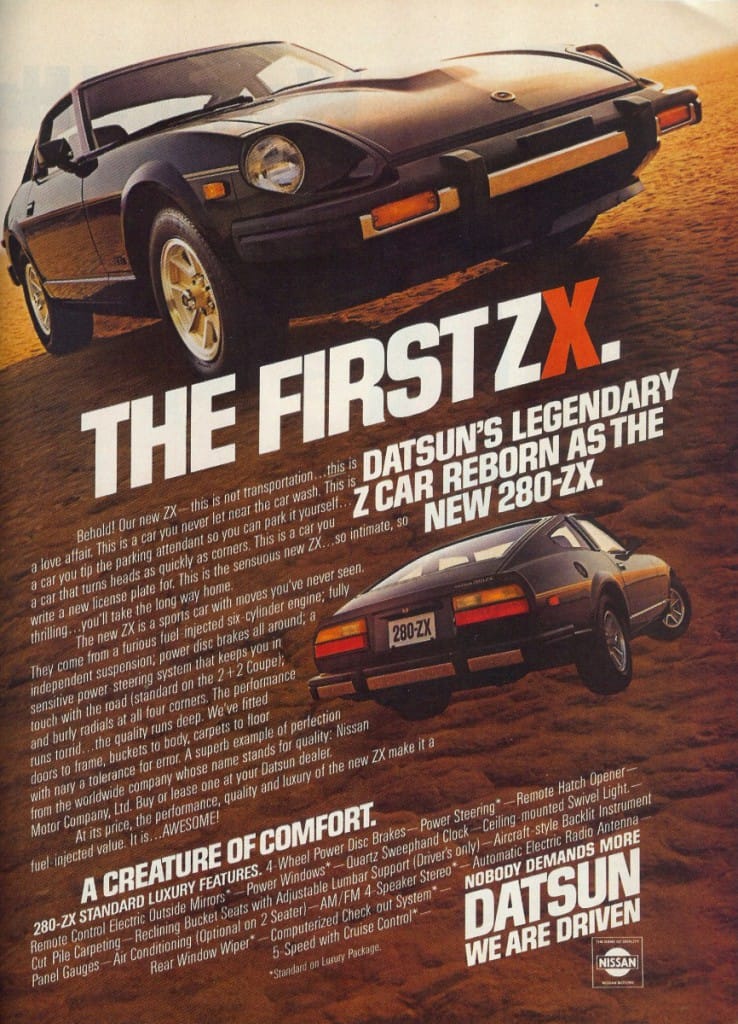
Shortly before leaving for the summer to live and work in the New Jersey shore town of Wildwood with some friends, Dad and I walked over to talk to my neighbor about her Datsun. We were friendly with the owner, as my mom occasionally babysat her son and attended her tea parties. We looked over the car thoroughly, and Dad took us for a spin and deemed it mechanically sound. Note that Dad did all the driving – by this time, I had turned my license over to the Commonwealth due to a non-traffic violation. It wouldn’t have mattered anyway, as I had never before touched a clutch pedal, and a test drive probably wasn’t the time to try.
The only issue with the car was that it had developed a number of rust spots, which was not uncommon among 9-year-old cars in the salt states at that time. Most of the rust appeared to be of the surface variety and appeared in several common spots, including both rockers, the quarter-panel lowers behind the rear wheels, and the seam welds below the outside corners of the taillights. Dad said these could be easily repaired with some good prep work, filler, and paint. The hood was a little more problematic, as there were bubbles and a couple of small holes appearing in both bottom outside corners. This would require fiberglass repair, but no worries, Dad said he could teach me how to address these issues. We discussed a price, and she agreed to hold the car until I returned from the shore and recovered my license.

I spent that summer working at a Pizza Hut in Wildwood during the day, and the nights were about what you’d expect from a bunch of high school grads unsupervised in a beach town with a party reputation. Most of my lucid moments were spent daydreaming about the little silver sports car that would soon be mine and, in my mind at least, would elevate my cool quotient. I told everyone who would listen about the car. I recall discussing cars with the GM at that Pizza Hut. Upon my telling him about the Z, his immediate reply was, “Be careful”. To my puzzled look, he continued, “Take a screwdriver and gently poke around under the floorboards.” Good advice in retrospect. But it was not advice that was heeded at the time, as I was 18, I knew what I wanted and what I wanted to hear, and that was not it.

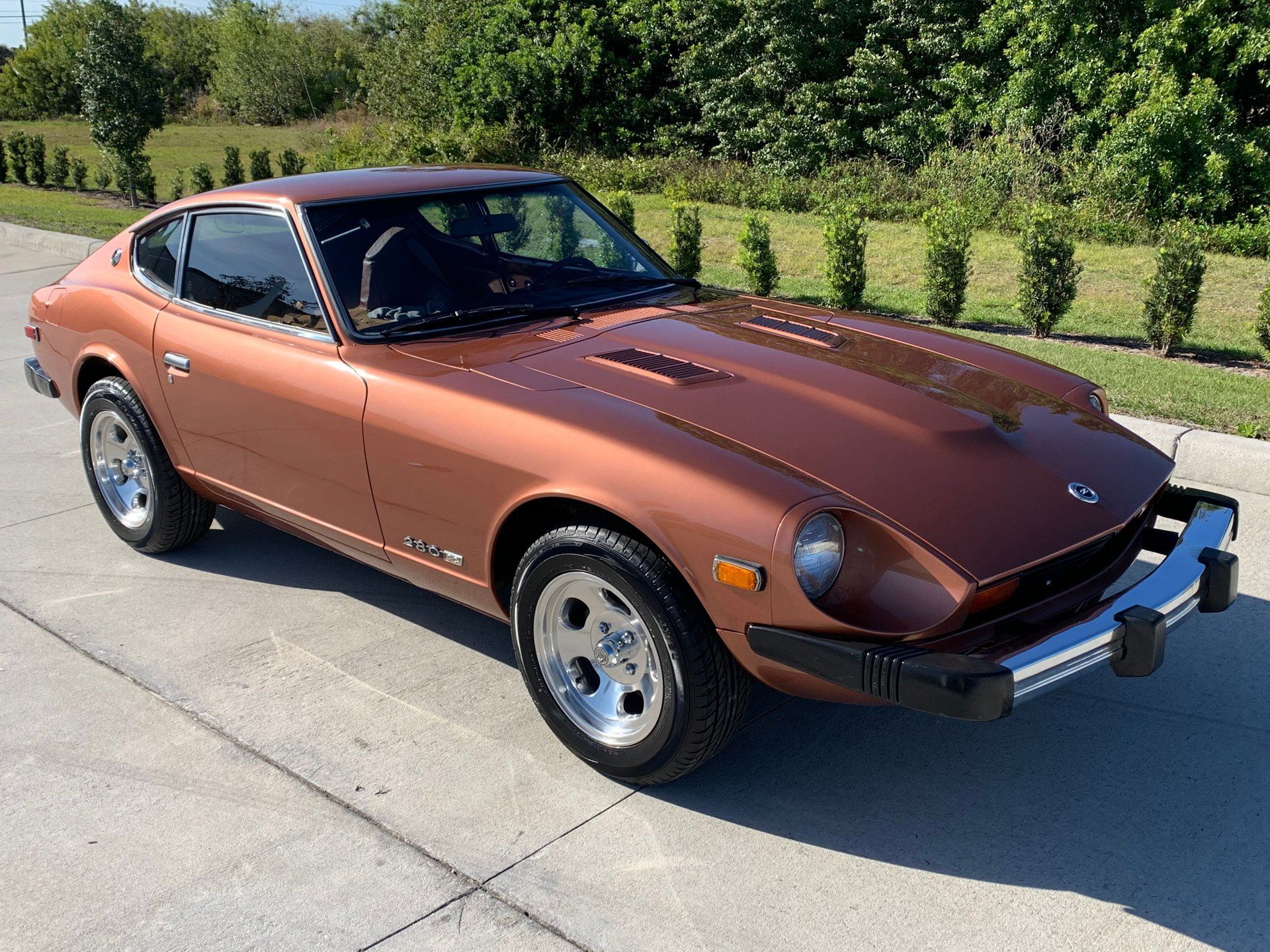
I first fell in love with Z cars when I was about eight years old. We had moved from my birth state of New Jersey all the way west to Marysville, Washington, a small town about an hour north of Seattle. The nice couple next door had a brown 280Z, and their daughter a similarly colored 260Z. I had taken a liking to cars at an early age and could identify vehicles better than most adults. I was already a domestic guy – give me a Mustang or a Firebird, please. Dad usually referred to the imports as “(insert country-of-origin here)-crap”, so I figured they all must be. The Z was the first Japanese import that spoke to me, and for good reason. Those E-type proportions, those distinctive, sugar-scoop headlights, the muscular power bulge in the hood, every line so purposeful. The ZX retained much of the original’s visual character, but on a slightly larger footprint. It was, however, a much softer car, more of a boulevard cruiser than a tight little sports car. But at the time of its production, it seemed more modern and desirable than the (now bona fide classic) earlier models.
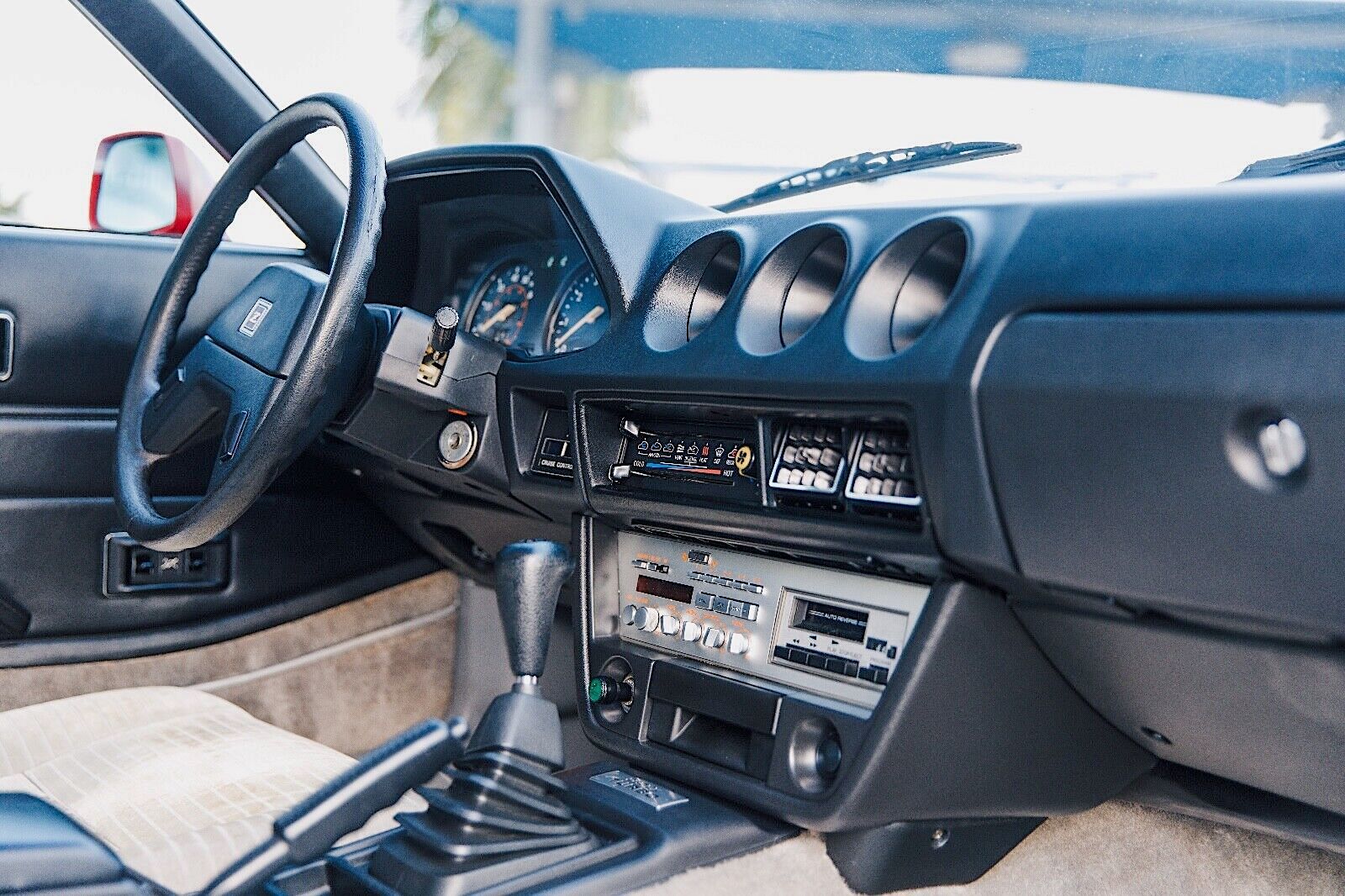
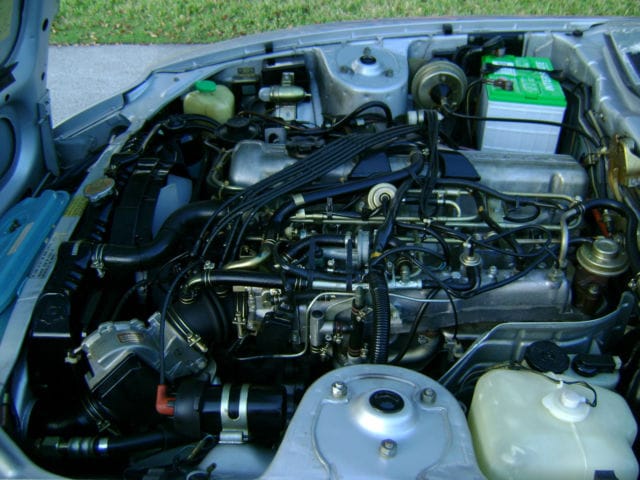
The 1982 models received a successful mid-cycle refresh; the fully-covered bumpers and updated taillights smoothed out some of the fussier details of the earlier models, while the asymmetric NACA-duct of the turbo model had been handed down to the normally-aspirated lesser trims. When I returned home and took delivery of the Z, I took time to soak in every fabulous detail: the exotic forward hinged hood; those faired-in headlights; the brushed aluminum center stack; the ‘talking car’ technology that verbally repeated the idiot lights; the canted secondary gauges; the fire-orange hue of the interior lighting; the high-quality switchgear that emitted a purposeful ‘snick’ and was oh-so-much more precise than the vague items in Dad’s Oldsmobile; and, of course, that 2.8-liter straight six that was as smooth and sonorous as some European offerings. I could not believe that something so beautiful and exciting was mine.
Now if only I could legally drive it.
As I awaited the restoration of my driving privileges, Dad and I got to work on repairing the Z’s aesthetic blemishes. He taught me how to sand the pitted surface rust until nothing was showing but shiny bare steel, and then to gradually feather out wide transitions back to the silver surface coat. Any remaining imperfections were filled with the lightest skim coat of filler, which we’d sand smooth and then gently caress with our fingers so as to detect the slightest of imperfections, which would be spot filled and then sanded with ever-finer paper until they, too, disappeared. The small holes in the hood were reinforced with fiberglass mesh and similarly filled and blended until imperceptible. Primer was then applied, the flat gray revealing any remaining imperfections, which would duly be addressed. He then showed me how to mask the body at a panel gap, trim application, or character line, so that any variation between the factory paint and the repair would be visually minimized. Finally, he demonstrated how to shake and prepare a spray can, and how to fan out the spray until it produced a perfectly uniform application. We managed to find an off-the-shelf color match that was remarkable, considering how challenging metallic silver can be to blend, and the results were fabulous. She looked almost as good as new. For a while.
That summer came to an end, and I was still without a valid license when community college classes commenced. I did have a few friends at the school, and was able to bum rides for a while. Finally, mercifully, an envelope arrived from the Commonwealth of Pennsylvania containing my fully-restored license. The car was fixed, I was legal, and I was now free to roam the Lehigh Valley. One issue did remain, however. I had never driven a manual vehicle on public roads. Dad had taken me to my high school parking lot a few times to teach me the basics, but I had never navigated traffic with three pedals. The first few days were an adventure. There were more than a few times when I was unable to successfully exit an intersection before the light returned to red, and several drivers indicated that I was ‘number one’ in their hearts. Those times I was successful were often embarrassing bucking bronco starts, but I eventually worked out the kinks. By the time fall’s colors lit up the hills around Bethlehem, I was effortlessly speeding around the valley, T-tops always out, music always too loud, soaking in the admiring gazes of lesser cars. The only thing that could disturb my groove was the interruption of the sultry-voiced electronic siren who would speak to me through the dash speakers whenever my fuel level was low.
The honeymoon period was in full swing. Would this love affair last?
Related CC reading:
Curbside Classic: 1983 Datsun 280ZX – The Cutlass Supreme Brougham Z?
CC Capsule: 1983 Datsun Fairlady Z (S130) T-Top – With Aftermarket Staring Wheel!
Curbside Classic: Datsun 280Z – Seduction Of Forms























I always liked the 280 zx’s, even though they took a lot of crap for their boulevard persona. Unlike you, my father would not let us purchase the black 1979 280zx that his friend was selling, even after we looked it over and deemed it a solid car. He also did not let me have the MadMax-ish primered 1971 Mach 1 that a guy was selling a a few blocks away.
He did let me get a 10 yr old 79 Mustang Pace Car that was painted over black. had a few minor dents, and was saddled with the 2.3 Turbo motor/4spd manual. I guess he felt a sports car (albeit underpowered) or a muscle car was too much for my 17 year old sensibilities, and he probably was right. The mustang was just cool enough to keep me satisfied, and slow enough to keep him satisfied.
I think my cousin’s 76-ish 280Z was my first time behind the wheel of a really nice Asian car. Just a short drive around the block wowed me with the steady and plentiful torque and the lovely shifter. I can see how you looked past the car’s faults. Been there.
Great car. I’ve always had a soft spot for these. I’d leave any Porsche behind for one like this.
I’m really enjoying this series for the perspectives and down-the-shore memories. I spent from roughly 9th grade (so…1976?) until about 5 years ago traveling to Sea Isle City multiple times a summer. (When my friend’s Philly-rooted family finally let the house at the shore go…it was torn down and the lot entirely filled with one of those vinyl-sided behemoths within 2 days of closing) And while the activities changed from the time I started going there as a 16 year old (first place I ever drove myself out of town as a newly-minted driver) to when it had become a tradition for me and my own kids to go down every summer…I loved everything about the Shore.
Even Wildwood.
As for the car, well, I was a very young adult when these reached their height of popularity in the mid-80s. They always seemed like a car that probably had good bones, but was unfortunately tarred by becoming a bit too much of a Yuppie symbol. (I still think of the character Michael – Peter Scolari – on the Newhart show who drew constant laughs by nattering away about his “Turbo Z”) It’s a shame sometimes when the culture does things like that.
Peter Scolari, fresh off of his stint opposite Tom Hanks in ‘Bosom Buddies’. I always wondered if he was talking about a 280ZX or the then-new Daytona Turbo Z. I don’t think we ever found out…
Working on a paint and body project myself right now and Brian’s description of bodywork is spot on!
I can’t wait to read the next article .
RUST NEVER SLEEPS .
I grew up in salt country and remember so many fine old cars pre 1959 that had low mileage and never crashed but were rusted out B.E.R. =8-( .
Coming to California in 1969 was a revalation, all these old cars just doing yeoman duty and dirt cheap .
-Nate
Another super-enjoyable entry.
I completely get it about not wanting to hear your Pizza Hut coworker’s advice about poking around the floor boards. At that age (and sometimes even now), we believe what we want to believe, especially when our hearts are set on something.
The Datsun Z / ZX was one foreign car that it always seemed was okay to like even in a diehard GM town like Flint, where I grew up. I have never stopped liking these, and with t-tops, the prospect of owning one might have seemed irresistible, as long as one either a.) didn’t care about it being a two-seater; or b.) didn’t mind the proportions of the 2+2.
I like that you and your dad were able to do the body work on it. I’m cautiously optimistic about reading part 2, which I can guess will have some rust-related heartbreak attached to it if I’m reading context clues correctly.
I ran into the same “ignore the rust” problem with my first car. VW Sciroccos are very rust prone and there was visible rust in the front fenders of the 78 I bought that I thought i could repair, however there was rust in the strut towers. My car was from Connecticut by way of Mamaroneck so it had seen a lot of salt. My subsequent cars were from outside NY so I’ve never dealt with rust again.
As a kid I was fascinated by a neighbor’s bright orange 240z, and my red, white, and blue BRE racing Corgi model of a 240Z. I personally though the 280ZX was a bigger heavier and softer car that the old Z, an impression reinforced by my one experience driving a 280ZX 2+2 where it felt less nimble than our 77 Honda Accord, perhaps because an Accord was 1000lbs lighter