

In the summer of 2000, we decided we needed a minivan, and I was to return to family roots with the purchase with a Chrysler Grand Voyager.
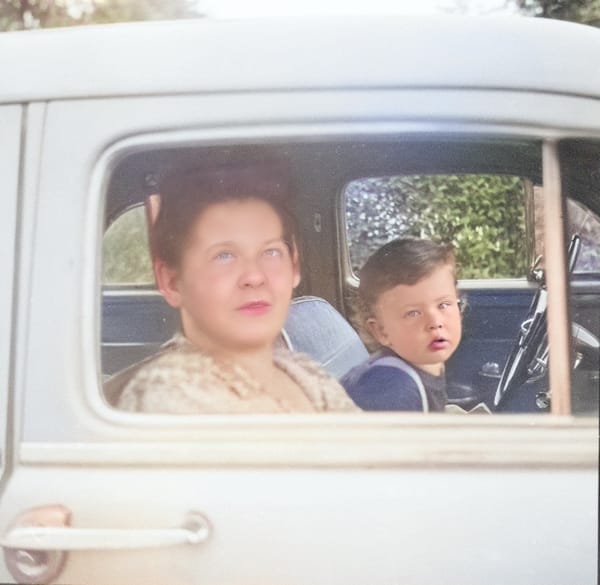
My earliest car-related memories are of being in my dad’s four-door Chrysler sedan; it was a nice car. (Do we really remember these events, or are we remembering them because we have Kodak moments?)
My dad had extremely bad luck with a 1958 Dodge station wagon; it was literally up on blocks in the back yard for two years at an extremely bad time in his work career. That memory kept me from buying a Chrysler product for decades. Fellow workers used to joke, “Don’t buy a Chrysler built on Monday or Friday.”
But Lido Anthony Iacocca and product planner Hal Sperlich had hit on a very profitable market niche with the Chrysler minivan. As others have told, these minivans did a lot of things right, and the later generations built on that success. An earlier COAL post declares the second generation as the best generation of Chrysler minivans.
Then, Chrysler “merged” with Daimler-Benz in 1998. For a while, it was somewhat reassuring to realize that you were buying from the American affiliate of DaimlerChrysler — that logo was a common sight on semitrailers, as Chrysler had a facility in our area. The Cleveland Plain Dealer published an editorial cartoon at the time that was perhaps predictive of the consequent merger issues: It showed a man looking at his early ’60s Dodge Dart, exclaiming, “I’ve always wanted to own a Mercedes!”
Little did I know it wasn’t a “merger of equals.”

Shopping for a minivan, I went to the Toyota dealer to look at the Sienna. The Toyota salesperson dissed Chryslers, telling me about their automatic transmission failures, and in the sales cubicles, little notices said, “The Federal Reserve doesn’t allow us to quote interest rates.” However, the Sienna was expensive, I felt the Ford Windstar and Aerostar were not competitive, and the Mercury Villager/Nissan Quest twins were too small. The Chrysler minivans remained the most attractive proposition.
I really wanted to buy a regular-length Voyager, but when I went to the local family Chrysler-Plymouth (C-P) dealership, I couldn’t get them to give me an exact price. The salesman kept saying, “What payment are you looking for?” Another time, a salesman at that same dealership had told me I had to get credit life insurance with my car loan. They liked to call themselves “the good apples” and always had apples in the showroom. I wasn’t so sure.
There were fewer C-P dealers in the Akron area since I had moved there in 1978. I decided I would not “shop around.” However, in the early days of the Internet, you could check dealer inventories online. On my search, I found both Plymouth and Chrysler models.
I went to the other local C-P dealer (which also had a Ford franchise in a separate showroom), who constantly advertised on the radio with the jingle “We’re closer than you think!” (What does that even mean?) I thought they would be a high-pressure operation. To my surprise, they were one of the only dealerships ever to itemize sale price, trade-in value, etc., without my asking for it. The F&I guy did spend 10 minutes trying to get me to buy a service contract, but I’ve learned in these cases to just say “no.”
Unfortunately, it was now the end of both the model year and production of the second-generation minivan, so they had no short-wheelbase models. So, long-wheelbase Grand Voyager it was, the SE model.

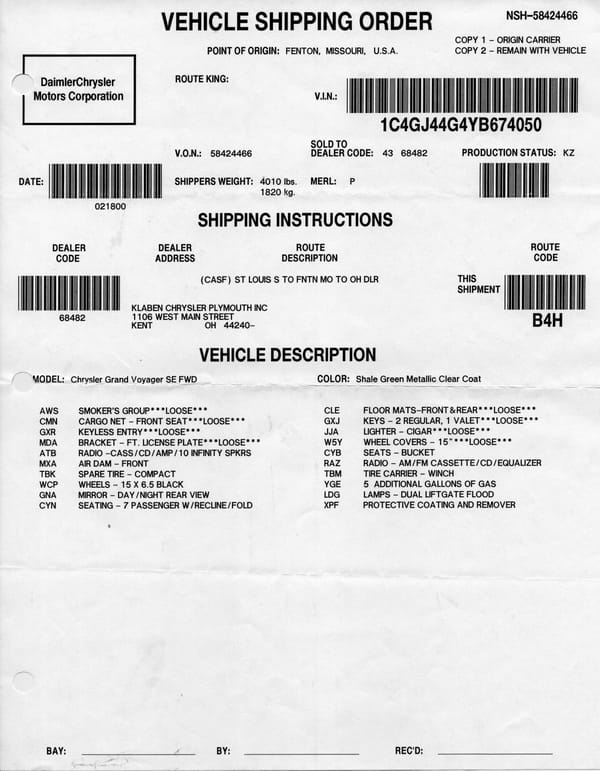
Our Grand Voyager was built in the Fenton, Missouri plant. This sheet was in the glovebox after delivery:
The Grand Voyager SE cost a little more than I really wanted to spend … but I had just had the best years of my business, so I went ahead and signed. How was I to know that before long, 9/11 was going to happen, the Internet would decimate printing companies, all of my customers were going to buy either digital copiers or plate setters, and health insurance rates would put me back on somebody else’s payroll? Not to mention the Great Recession of 2008-2010.
Still, we had a good vehicle for road trips. My friends with large families told me that with the long-wheelbase minivan, I wouldn’t need to take the middle seat out when we went on road trips, but on one trip to Florida, the progeny decided to take that middle seat out anyway. Oh well….
The Grand Voyager had tinted windows all around, and in those pre-rear-view-camera days, it was extremely difficult to back out of blacktop driveways at night. The minivan was great for picking up CRT monitors and television sets, moving stuff, etc. However, my bicycle wouldn’t fit without taking the front wheel off.

In parking lots, you could open up both sliding doors and “play helicopter.”
I dodged the Ultradrive transmission issue by getting the fluid changed every 30,000 miles. There were some minor warranty claims involving weatherstripping, door panels, and one of the motors on the rear vent windows.
At 17,854 miles, the front rotors were “pitted.” Of course, this was not a warranty item. As he pulled a new rotor out from under the counter, the service writer told me, “Be happy you don’t have a Mustang.”
After one of the regular service intervals, as I was driving back to the office from the dealership, other folks on the freeway started giving me distress signals. One of the tires, which the dealer had just rotated, was somehow going flat.
This was a good car to have when our children were teenagers; it consistently got 18 MPG around town at a time when gas prices were manageable, and the service history wasn’t too bad.
| Event | Date | Cost | Mileage |
| Purchase 2000 Chrysler Voyager | 08/28/2000 | $24038.00 | 59 |
| Sales Tax | $1116.08 | ||
| Oil Change/Warranty Work | 11/28/2000 | $10.55 | 3756 |
| Oil Change/Rotate Tires/Warranty Claim | 03/23/2001 | $42.08 | 8819 |
| Oil Change/Warranty Work | 04/24/2001 | $24.12 | 12171 |
| Oil Change/Rotate Tires/Front Rotors “pitted” | 08/15/2001 | $256.21 | 17854 |
| Oil Change | 11/29/2001 | $23.27 | 23444 |
| Oil Change | 03/23/2002 | $44.37 | 28237 |
| Oil Change/Rotate Tires/Warranty Work/Transmission Fluid | 07/25/2002 | $113.53 | 33374 |
| New Tires | 08/21/2002 | $496.77 | 34579 |
| Oil Change/Engine Flush/Air Filter/PCV Valve | 11/19/2002 | $64.44 | 38583 |
| Oil Change | 43851 | ||
| Oil Change | 05/29/2003 | $21.41 | 48897 |
| Oil Change | 07/31/2003 | $49.06 | 53061 |
| Oil Change | 10/26/2003 | $44.79 | 57445 |
| Oil Change/Trans Fluid/Front Brakes/Alignment/Radiator Drain & Flush | 11/26/2003 | $448.29 | 59587 |
| Oil Change/Engine Flush/Air Filter | 03/11/2004 | $70.40 | 64745 |
| Oil Change | 06/25/2004 | $53.33 | 69496 |
| Oil Change/Rear Brakes | 07/29/2004 | $338.22 | 70624 |
| Trade-In | 08/01/2004 | $6500.00 | 73767 |
| April 2005 had 80,020 miles according to CarFax |
But, by 2004, we didn’t need a seven-passenger vehicle anymore; both progeny were going to school/working and had Corollas to drive. The Grand Voyager was approaching the 100,000 mile mark, and I still didn’t trust an American-built car to have longevity. But it was OK — maybe I bought this minivan at “Peak Chrysler.”
Related CC Reading
The 1996-2000 Chrysler “NS” Minivans – The Culmination Of Nineties Chrysler























I don’t know why you think the Grand Voyager is too big. I did quick comparison your vehicle with my current 2015 Honda Odyssey, mine is actually bit bigger. For ten years we own that van, we never feel it too large. We have no problem to use it in New York City even parking. The Honda is actually reasonable to drive. When we were on market for a van, we also looked the Toyota Sienna, but we stayed away because it was a terrible vehicle to drive, it reminded me my 1983 Caprice Sedan. Back then Toyota offered 0%/60 months financing and had all wheel drive options. But we didn’t take the bite, friend of mine has the same vintage Sienna, he complained the under car chassis rust after 6 years. I had stayed away from Chrysler products since I could afford a car. I heard a lot of bad things about Chrysler products.
I have a 2016 Odyssey we got new. I was dead set on the sienna till test driving it and we thought the same thing, this thing drives like a school bus. The Chrysler minivans were not considered because they couldn’t sit 3 across the 2nd row (this was before the pacifica came out). I was worried about the Honda transmission history but it was the 5 speed that was problematic and the 2014+ models came with a new 6 speed. So 10 years later and 110k miles how has mine held up? Well both power sliding doors jammed (broken cable) and needed to have that mechanism fixed. The transmission shudders between 3rd and 4th gear and has now for 40k miles but 30k ATF flushes has kept it from getting worse. Besides that it’s been a great van and I have no regrets.
I had the similar problem but changing fluid and transmission filter solved the problems. The problem start around 70k miles even since we do these two items every 40 k miles
When Honda designed the 99 odyssey they copied all of chryslers features including transmissions that gernade themselves.
We knew about the Honda Odyssey transmission failures, personally I at least know seven such problems on Honda and Acura vehicles. I was told this was designed problem on one gear, there was a Michigan shop offering a beef up gear to resolve the problem. My vehicle is now closed to 150 k miles without failure yet. My mechanic believes changing the transmission oil and filter every 40 k miles will help prolong the life of its transmission.
The price you paid for your 2000 Grand Voyager was close to what I paid for my 2000 Pontiac Montana with similar options. A van which did not last 100,000 miles.
As many know GM Dexcool antifreeze routinely eats head gaskets and I had that repair at around 60,000 miles and at 93,000 the transmission went out. That was more than enough for me. I traded that thing in for a Nissan Xterra.
I dunno…in my commuting days, my informal poll says 80%+/- of road rage incidents were by men (who, I’d guess, imagined themselves as sports car owners) driving mini-vans….
Did not know about the Dex-Cool antifreeze eating head gaskets? My wife’s Dodge Journey calls for that coolant, and maybe that is why her car is running a little rough as of late, at 127,000 miles..
The 3.3/3.8 iron V6 in these vans may have been the stoutest engine Chrysler ever built, even including the slant 6. These things were on the roads for a long, long time. The transmissions failed, but by that time it usually happened past 100k, and rebuilds were relatively cheap. They could nickle and dime you, but they would run a good long time. I loved mine.
Ditto this. Our second ’98 had the 3.3, and it was just starting to smoke a little when the transmission finally stopped transmitting around 278K miles.
https://www.curbsideclassic.com/cars-of-a-lifetime/coal-278727-how-long-will-a-dodge-transmission-last/
I’m with you on the size of minivans. My kingdom for a non-Grand Caravan, or a minivan of about that size.
Your post caused me to go back in the files and review the specifics of my 2001 Chrysler minivan.
I will say that this van got us through most of the worst years of child-rearing, but looking at the full file of receipts, I have to agree with JPC and say that I was pretty much constantly nicked and dimed over one failure or another (the air conditioning compressor was maybe the worst). We also seemed to go through a lot of brake rotors, but I blame myself for that since this was before the time when I did all of that kind of work myself…so $600 for a brake job seems to be routine back then. Unfortunately.
But getting you through the worst years of child-rearing is no small thing. My experience was that back then I’d gladly have taken a snow shovel of cash to throw upon the dealer service department just to make a problem go away and to have the vehicle back in service a.s.a.p….as the alternative would be sheer hell all around. That did lead to some decisions that I’d not make again, now that I’m no longer living in the day to day terror that came from having toddlers in the house.
I call your 2000 DamierChrysler Motors Monroney sticker, and raise you my 2001. 🙂
Every time I see photos of the 96 Chrysler minivans I’m blown away by how much glass they had compared to todays slit window screen mobiles with zero visibility. I wish carmakers would go back to that.
After the flat tire incident I stopped going to the dealer for service — sometimes used a quick oil change place or the Goodyear service center. I should have gone to one mechanic with veteran employees who knew the problem areas of vehicles. This vehicle made it through the early teen years and carried a lot of school kids. And the 3.3 engine never had any issues that left me stranded.
Minor correction here: the 1996-2000 is the THIRD generation; the second-generation vans were from 1991-95. It’s easy to mistake the ’91-’95 as part of the first generation (1984-90), as it still shared some of the chassis & body design (albeit EXTENSIVELY revised) with the original model.
See the Good Apples at Thomas Chrysler Plymouth! Front Street in Cuyahoga Falls. The dealer in Kent you bought your van from outsold them by about 3 to 1.
Thomas Chrysler Plymouth didn’t survive the Great Recession cull of dealers. The lot was overflow for the GMC dealer.