

Last week, I left off standing in a Tesla delivery center, having completed the easiest car purchase of my life. What had started as a carefully planned order for a Radiant Red Chevrolet Bolt EUV Premier had suddenly turned into a Pearl White 2023 Tesla Model 3 Rear-Wheel Drive, thanks to expiring Oregon rebate money, a disappearing supply of Bolts, and a very understanding wife.
So there I was, key cards in hand, sitting in my brand-new Tesla for the first time.
And now I had to figure out how to drive the thing.
Thankfully, the basic controls in the Model 3 were very familiar. The gear selector and turn signal stalk were in the same places as they were in our Mercedes ML350, which made the car feel less intimidating than I expected. That wasn’t a total coincidence. Early Teslas famously borrowed some Mercedes switchgear, and while the Model 3’s interior was radically different from the ML’s in almost every other way, the actual act of putting it in drive and using the turn signals felt completely normal.
That was in stark contrast to my first real exposure to a Tesla, which had happened about six months earlier when my aunt and uncle bought a brand-new 2022 Model S. This was the refreshed version with the yoke steering wheel, no turn signal stalks, and no traditional gear selector. On that car, the turn signals were buttons on the steering wheel, and the gear selector lived on the center screen. I remember sitting in it for about twenty minutes, poking around and trying to build up enough confidence to actually drive the thing.

At some point I remember thinking, “This must be what older people feel like when they use a computer.”
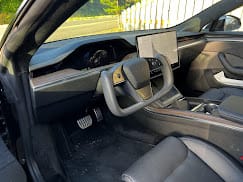
The Model 3, by comparison, felt familiar and simple. Yes, almost everything ran through the touchscreen, but the interface was clean, fast, and intuitive. For my techie brain, learning the menus and settings wasn’t annoying; it was fun. It felt less like figuring out a complicated car and more like setting up a new gadget.

Then I pulled out onto the road and immediately fell in love with the speed.
Even though I had bought the slowest Tesla they made, it was still radically quicker than the somewhat pokey Volt. The Volt was smooth, efficient, and clever, but nobody was ever going to accuse it of being fast. The Model 3 was different. The instant response, the silent acceleration, and the effortless surge of power made it feel like a completely different class of vehicle.
I also used basic Autopilot for the first time, and that was its own revelation. I knew, intellectually, that it could steer, accelerate, and brake within its lane, but experiencing it for the first time was still amazing. It wasn’t full self-driving, and I certainly didn’t treat it that way, but even basic Autopilot made the car feel shockingly advanced.
After years of reading about EVs, driving EVs, leasing EVs, and trying to convince everyone around me that EVs were the future, I was finally driving something that actually felt like the future.
Back at home, Wesley immediately fell in love with the Tesla. He was two years old, which meant that a car with a giant touchscreen, funny sounds, hidden storage compartments, and a glass roof was basically the greatest playground ever invented. He spent a lot of time crawling around inside it, climbing between the seats, opening every compartment he could find, and poking at the touchscreen while I tried to make sure he didn’t accidentally change something important.

As a family vehicle, the Model 3 also turned out to be shockingly practical. On paper, it occupied roughly the same general footprint as the Volt, but the packaging was dramatically better. Since there wasn’t a gasoline engine taking up space under the hood, the frunk provided valuable extra storage for smaller items. More importantly, because the battery was packaged under the floor instead of running through the middle of the cabin like the Volt’s T-shaped pack, the interior felt far more open and usable.
The trunk was in another class entirely. Between the large trunk opening, the deep cargo area, and the underfloor storage, the Model 3 swallowed up anything we needed for normal family trips without complaint. Strollers, diaper bags, groceries, overnight bags, random toddler equipment—it all fit. The Volt had always felt like a clever car working around packaging compromises. The Tesla felt like an EV that had been designed as an EV from the beginning.
Speaking of the Volt, it took a couple of weeks to find the right buyer, but eventually it went to a retiring lawyer in Portland who was absolutely ecstatic to have it. I was happy it was going to someone who understood what made the car special. Even better, I sold it for about $17,000 after buying it three years earlier from CarMax for around $14,500.
That still feels ridiculous to type.
For three years, I had driven a comfortable, reliable, highly efficient plug-in hybrid, put tens of thousands of miles on it, and then sold it for more than I paid. The COVID-era used car market was a strange and wonderful thing if you happened to already own the right car at the right time. In my case, it helped make the entire Tesla deal work.
The other pieces eventually fell into place too. I did receive both the $7,500 federal tax credit and the $7,500 Oregon rebate, just as I had hoped. Of course, “just as I had hoped” does not mean I was completely relaxed while waiting for them. When the final rebate arrived, an enormous sense of relief came over me. The math had worked. The gamble had paid off.
About a month after buying the Tesla, I officially began my new role as Director of Technology for Tillamook School District 9. It was exciting, intimidating, and deeply rewarding. After years of working toward the position, I was finally responsible for the district’s technology department.
I wanted to move things forward, but I also wanted to respect what my predecessor, Chas, had built. He had spent years laying a solid foundation, and my goal wasn’t to tear it apart—it was to build on it.
Around the same time, another important chapter came to an end. After nearly fifteen years, I closed Schild Computer Services. That little side business had helped me pay off debt, buy cars, remodel houses, and build the financial stability that made many of these larger life changes possible. But with a more demanding job and a young family at home, it was finally time to stop juggling three careers. Scaling back to two felt like the right decision.
Then, about four months after buying the Tesla, we had the unexpected opportunity to buy my dream house.
I had known the owners my entire life, and for years I had told Courtney, “If they ever move, I want to buy their house.” It sat on a quiet cul-de-sac in the warmest part of town, with an acre of land, a creek running through the backyard, and all the space we could imagine for raising a family.
Courtney and I have also been intentional about limiting screen time and encouraging our kids to do old-fashioned playtime outside. Thankfully, Wesley already loved being outside, and this house seemed perfect for exploring, riding, digging, splashing, and just being a kid.

We loved our home in Netarts, but the weather was harsher and the yard had become too small. Wesley couldn’t even turn his Power Wheels tractor around without making a three-point turn.
When we learned the owners were moving, we toured the house.
And to the shock of everyone who has read this series, Courtney fell in love with it immediately.
We had an accepted offer before it officially hit the market, and our Netarts house sold in just four days. It still feels miraculous, especially since a brand-new house behind ours sat unsold for six months and ultimately needed a six-figure price reduction.
Somehow, in the span of a few months, I had bought a brand-new Tesla, started my dream job, shut down a business I had run for nearly half my life, and bought the house I had wanted for years.
It was a lot.
The Tesla fit into our lives almost flawlessly. It quickly became our go-to car for nearly everything, and because we owned it outright, I never worried about how many miles we were putting on it. As I write this, it is just over three years old and has a little under 42,000 miles on it, which is a record for me. No car I have owned has ever accumulated miles in our family quite this quickly.
This past year, it also served an important role that I never would have expected.
In September, my dad experienced a terrifying medical emergency while driving his 2015 Ford F-150 on Highway 6. Without warning, while driving along at about 60 MPH in his 2015 Ford F150, he passed out behind the wheel. Thankfully, his wife was in the passenger seat; grabbed the steering wheel, kept the truck on the road, climbed over the center console, and brought it safely to a stop.
Even more frightening, Wesley was in the back seat.
What followed were months of MRIs, CT scans, cardiology appointments, and countless other tests. Although doctors never formally prohibited him from driving, our family did.
Losing that independence was hard for my dad, so we came up with a compromise. By then my Tesla had Full Self-Driving, and I loaned it to him with one rule: if he went anywhere, FSD did the driving. While he had my Tesla, I drove his 2015 Mercedes-Benz C300 4MATIC. It was a fine luxury sedan, but after living with an EV, it felt surprisingly dated.
The arrangement worked remarkably well. My dad still supervised the car at all times, but on local roads and highways, FSD handled much of the driving and gave the entire family far more peace of mind than we otherwise would have had.
It also turned my dad into a Tesla owner. Not long after returning my Model 3, he bought the first brand-new car of his life: a 2026 Model Y.
Eventually, doctors concluded that dehydration had most likely caused the episode, a tremendous relief for all of us. Looking back, though, my Model 3 ended up serving a purpose I never imagined when I ordered it. For a few months, it gave my dad back a measure of independence while helping the rest of us sleep a little easier.
Three years and 42,000 miles later, the Model 3 is still sitting in my driveway. That alone makes it unusual in my automotive history. I have owned a lot of cars, and as this series has probably made painfully clear, I am very good at talking myself into the next thing. But the Tesla has stuck around because it simply works.

It also helps that, unlike every other car I have owned, the Tesla has actually gotten better as it has aged. Through software updates, it has gained features, improved existing ones, and continued to feel fresh in a way no traditional car ever really has for me. For someone who likes both cars and technology, that has gone a long way toward keeping me interested.
It is fast, efficient, practical, cheap to run, and still feels special every time I drive it. It has become one of those rare cars that fits into our life so well that replacing it feels almost impossible to justify.
Of course, no car story in our family stays settled forever.
In October of 2024, our amazing second son, Jonah James, joined our family. The Mercedes ML350 had been exactly what we needed when Wesley was born, but with two kids, two car seats, and an ever-growing pile of kid gear, the lack of a third row started to feel like a real limitation.

So, next time, we outgrow the German tank and move on to something bigger.
Opening photo; The Tesla as it literally sits today with 41,702 miles, outside a home we are staying at in Central Oregon for vacation. It happily transported our family of four and our belongings here with no charging stops.























I want to like the AWD Model Y, primarily for the very forward thinking FSD feature (even at $99/month), but several things continue to keep me away:
– Musk.
– Driving a Giant iPad.
– Lack of Ventilated Seat Availability on the Base Model.
The three things that keep us from buying a Tesla are:
– Musk
– Insurance Cost
– Musk
Your first and third reasons may be valid (I have similar concerns), however the insurance thing really is not. Or you need to shop your whole policy around a bit. Our experience is that it is not more (or at least not significantly more than other comparable in iniitial cost ICE vehicles and we’ve had a Tesla for close to six years now and with two major insurers.
My renewal policies happen to be on my desk as I write this: We have 6 cars with three kids, two of them under 20, one a bit above, all with fairly high limits and full coverage and these four are considered daily drive vehicles, not anything weird. All can drive any of the cars:
2015 Forester, value maybe 10k: $413
2015 Wrangler, value probably 15k: $359
2020 Chevy Bolt, value maybe 15k: $682
2024 Tesla Model Y, value maybe 35-40k (?): $783
Current policies are with State Farm for the last three years, our old insurer was American Family and very similar.
I second a certain reason, although in 2023 things were arguably different than now. I could not consider any EV until we have the infastructure like gas station equivalents of charging stations, but nothing wrong with diversifying energy sources. Glad they’ve worked out for you.
Yes, after we purchased our 2024 things became different to a far greater degree. As a side note, the not at home charging percentage for our Tesla (this and the older one) stands at under 3% of the total and for the Bolt stands at 0 since we got them home. If one doesn’t have accessible electric infrastructure at their home for charging then EVs may not be the current best choice for them. If one regularly or occasionally drives more than a few hundred miles from home and has no access to any other vehicle to do so, then buying any EV besides a Tesla or one that can use the NACS system may be something to be concerned about. If either of those conditions are met for the vast majority of people the “charging infrastructure” obstacle is not a real thing, but yes, change is hard and anything unfamiliar is difficult to overcome initially.
Personally it’s become diifficult for us to consider gasoline vehicles since the city doesn’t allow us to have gasoline refueling infrastructure in our driveway or garage for some reason which limits the convenience and raises the expense by having to seek out third party sources constantly. We (like many of our neighbors) already have a natural gas line that is certainly flammable and can break, why not liquid fuel? We’ve proven we can handle it responsibly at third part outlets without professional help when using it.
What happened to freedom? I weep for the days when the state didn’t control everything. I paid for my land… (/s)
Nice to see a perfect fit for a growing family and a great experience, but I have more basic reasons:
-Plugging and Unplugging for charging outside in the rain or snow. What happens during a multi day storm? Don’t drive?
-Charging it my garage. I know ICE cars can go poof when stored inside, but that’s a lot of electrical potential energy.
-I like to work on and interface with my car independently, not have to ask Big Brother for permission, be monitored while I do so or pay extra for latent capabilities.
–
I think you are simply trolling but okay I’ll bite…
“-Plugging and Unplugging for charging outside in the rain or snow. What happens during a multi day storm? Don’t drive?”
No, use it as you normally would, as does everyone else including everyone in for example Norway where the vast (close to 100%) majority of new cars are now EVs and have been for years and they have far worse weather than we do. One of our cars charges outside exclusively, and nobody in the whole wide world stops using public chargers, virtually all of which are outdoors. It is not like using a battery charger from Sears with two alligator clips when you leave the lights on in your regular car.
“-Charging it my garage. I know ICE cars can go poof when stored inside, but that’s a lot of electrical potential energy.”
While there have been electrical fires associated with electric vehicles in garages, it’s just as likely that the wiring for the charger is at fault in many cases, some people think they know how to do wiring, although any good charger will have a fault interrupter built in, and in any case any installation permit will require a breaker be involved (as it should). Electrical fires can happen in any house, often due to poor or old wiring or anything else . If your garage burns around your old car with a full tank of fuel I wouldn’t want to be near that either. Again, an almost complete nothing-burger, it you coubt me ask your insurer how much they plan to raise your homeowner insurance rates due to charging with a permitted and properly installed charger. In my case there is zero difference, indicating that there is not enough risk to be able to charge me more. If anyone will take (presumably justified) advantage of a reason to raise rates it is an insurer…If the car decides to go poof the insurance company will pay you, and go after the manufacturer if that is where the fault lies, just like they would when a Ford or Hyundai or whatever regular cars have regular issues with spontaneous combustion, even after building them for 100+ years now…
I like working on my own cars as much as the next guy and am as or more capable than the average (but no expert), in regard to our Teslas I rotate the tires, change the cabin air filter, and….well, that’s it, neither has needed or is likely to need anything else while we own them. Bodywork is handled by the bodyshop, and I’m not inclined to change my own windshield when it cracks due to a rock. That is IT as far as maintenance and repair goes. Brakes (haven’t been needed, actually rarely use them due to regenating (free!) energy via the motor when decelerating to zero) and suspension (also good) are exactly like any other car. Oil and most other fluid changes don’t exist, and I’m not concerned with engine air filters, emissions checks, spark plugs, alternators, mufflers, etc simpley because there aren’t any. Who is this mythical big brother you refer to in regard to asking for permission? Is that like BMW where the dealer apparently has to “code” a new 12V battery to their non-EV cars? If the screen breaks (hasn’t happened) it can be unplugged and swapped out like in any other modern car, far simpler than fixing the mechanical odometer that broke on my 1980 Audi, an almost entirely analog car, comparatively. And on and on…
What are “latent capabilities”? Is that like having a passenger side door when you are always the driver and have no family? Or a spare tire when your 4 installed tires are perfectly round and hold air? Perhaps it’s a radio when one prefers to just hum with silence? Is it eight cylinders when other people seem to get where they are going driving a Corolla? Or an engine when things like bicycles exist? Maybe it’s a 2,3, 4, 5, 6, 7, 8, 9, or 10 speed gearbox when a modern EV doesn’t even have one of those things that seems to be the cause of most traditional vehicles being sent to the junkyard?
I have to say, it’s 2026, the internet is at your fingertips. Do a little research. EVs are not new technology although I freely admit they do not fit every use case and it is good to ask questions. I understand CurbsideClassic.com covers many (perhaps too many?) cars from the 1950s and 1960s but even those had individual electrical components to them, the majority of them far less reliable and long-lived than what is produced today.
What a great story. Like Hannibal Smith always said, “I love it when a plan comes together.” 🙂
FSD is incredible. As there are no Tesla dealers in Connecticut except at Mohegan Sun (being a separate nation and all), they have to come up with novel ways of generating sales. We were in the mall a few months ago when we noticed a display of Teslas in the aisle. When I inquired as to why they were there, the representative told me, “We can’t sell you a car, but we are offering test drives to demonstrate Full Self Driving.” I asked how old you had to be, and when he responded 18, I grabbed my son and told him he was taking a test drive. He had no problem with that.
Having experienced Autopilot in a Model 3 rental a few years ago, my expectations weren’t great. However, it blew me away. We took a round with the representative to familiarize us with the technology, then let us out on our own. Out first destination was clogged with mall traffic, so we changed it to a destination in the opposite direct, then watched the Model Y we were in slowly but carefully move over three lanes of heavy stop-and-go traffic, make a U-turn, then take us to our new destination.
Honestly, I wanted to buy the car then and there, but that’s not an option (see my comment above).
I forgot to mention: You can’t buy a Tesla in Connecticut because we need our franchise laws in order to, “protect the consumer from the manufacturer.”
I think you misspelled “Because our politicians are in the pockets of the dealer lobby”. At least you can own one and rest assured that you will be needing to visit the service department virtually never, especially since most of the very few potential reasons can actually be handled by service coming to you.
I can only image how much money changed hands for our representatives to maintain that lame law with that lame excuse. The sad thing is the business revenue the state is missing out on because Teslas are EVERYWHERE in Connecticut.
The absence of mechanical door handles, and interior mechanical door releases, would be the deal breaker for me, although Musk wouldn’t be far behind. There was a horrific crash in Toronto where a Tesla 3 caught on fire and the occupants couldn’t get out and bystanders couldn’t rescue them because the doors wouldn’t open with no battery power.
I don’t believe the current models are different but at least up to 2024 the 3 and Y have easily accessible front door mechanical releases that people new to the car actually instinctively try to use before seeing the marked electric button higher up on the door. The mechanical release is a lift up manual door release paddle right where your hand naturally rests at the front of the door armrest just ahead of the window switches. Try one out and then ask your source about why they didn’t mention that.
.
Windows from the outside break with a tire iron or rock just like any other car’s windows on the non-Cybertruck. I’m guuessing the fire was too hot for anyone to approach the car.
Note i’m not defending the current door handle design in general (which plenty of other cars including non-EVs do to a smiliar degree), just expoundind on facts not included in your original post likely due to non-familiarity with the vehicles).
The attached article claims that the mechanical release in the front is not readily visible and, more moreover, the rear had no release whatsoever up to 2024. I don’t have direct knowledge so can’t comment directly. The article also references an investigation by Bloomberg. Don’t get me wrong, I think EVs are the future and superior in many respects.
https://www.thestar.com/news/gta/trapped-in-a-tesla-why-electronic-doors-are-at-the-centre-of-the-investigation-into-this-deadly-toronto-ev-fire/article_a869d10a-89ef-4276-8744-70c86551cb66.html
The link won’t open for me without paying for a subscription. But thank you for at least including something rather than referencing “many people say…” .
Take a look at the image below from the Model 3 manual. Model Y is the same. We’ve had front seat passengers use it inadvertently to get out more times that you’d imagine. This is for the front doors.
In the rear the release is hidden under the door pocket which nobody would just know. Here is the verbiage from the randomly chosen year 2020 (well before 2024 I’ll note) Model 3 owner’s manual:
1. At the bottom of the rear door pocket, there is a slot in front of the release cover. Slide your finger into the slot and lift to remove the cover.
2. Pull the mechanical release cable forward.
(and there is a clear diagram/picture to provide additional context)
The reason is that the emergency release will override child safety locks, i.e. open them no matter what), something other cars DON’T seem to have, right? BUT you have to know it’s there and be cognizant enough in the event of an accident to figure it out, so yes it’s a problem. Now, HOWEVER in any other car if child safety locks were on in the rear as they would be with little kids what do you or your kids do in ANY other car? Hopefully crawl through to the front assuming the structure isn’t damaged enough, but if that were the case the windows (or glass top) would likely be shattered enough and the doors would likely be deformed enough to not open anyway.
I have to wonder about the objectivity of the reporter when they state (as you say) that prior to 2024 there was no rear release whatsoever. I literally went to google and typed “rear door release 2020 Model 3”, and first an AI answer appeared with what I wrote and the first real link result was the relevant page of the Tesla Owner’s Manual complete with diagram. Try it yourself and see what you get. You (well, I) would expect a reporter to do some basic research before claiming things, then again I suppose this is why I don’t pay for the Toronto Star! 🙂
How “visible” does the front one need to be? That emergency latch is quite similar in position and placement to various other cars that don’t have it painted day-glo orange either. It does not require a particularly large amount of force to use, either.
Yes it would be highly unfortanate to be trapped in a vehicle, especially if there is a fire. Realistically though it occurs every day in every type of vehicle that occupants are trapped with no way to get in or out without a rescuer cutting the car apart, even old cars with purely mechanical door handles inside and out. Bummer they can’t all just be “thrown clear” /s. If it bleeds, it leads, always good for a click on the news though…
Your experiences help explain why Tesla continues to dominate the EV market, with sales up 25% in Q2 and its US market share increasing this year back above 50% despite certain various negative influences. Tesla owners overwhelmingly like the cars and the ecosystem around them, and most are loyal repeat buyers. Sales in Europe are up and have quadrupled in Germany in Q2 2026.
Fascinating obscure tidbit: The Model Y was the best selling automobile in Columbia in the first half of 2026.
In 2021 Rick and I traded our 2017 Mercedes E300 in on a 2021 Model Y. It was our first EV and we LOVED it. The only drawback was for price reasons (it was just under the price limit for Washington State’s EV tax credit). we went with the RWD version. The only drawback was the lack of AWD made it treacherous on rare occasions when Seattle’s streets get snowy or icy. A couple of years later we bought a second AWD Model 3, which became my car. When the warranty expired, and with the Federal EV tax credit going away, we traded that one for a 2025 Model 3, which is my current car. This one came with Full Self Driving, which I’ve grown to love. Once a week I have to drive from my home north of Seattle to downtown. This trip can run anywhere from 20 minutes to 90 minutes, depending on traffic. FSD make the commute MUCH less stressful.
The only negative aspect of this was when a couple of friends refused to ride in the 2025 Model 3 because politics. They were mollified when I put a magnetic rainbow sticker saying “Anti-Elon Tesla Club” on the trunk lid.
It’s good to see these cars are actually nice to have and not hair shirts .
I’ve never test ridden a tesla, might be fun but a hard NO on buying one .
-Nate
I got a Model Y (Juniper) just before the federal tax credit expired last October. We were looking for a vehicle for my wife to replace the 2015 Odyssey. With our past positive experience with 2003 ML350, we looked at the 2026 GLC, test drive indicated it is not same as ML we had, its interior was quite luxurious, the drive was good but the vehicle was not a stable as our old ML, a characteristic my wife likes. Not to mention it is expensive, talking about over $60k out of door. We were back off the Mercedes.
One day in October I suddenly had a urge to look at the Tesla. Before that I was suspicious about the electric vehicle. As an electrical engineer, I know well its virtue and drawbacks. In my opinion, the lithium battery still needs to be further improved. More, in my job battery, AC traction motors and traction inverter are my daily engineering problems. We use a different type of battery (NiCad), traction motors have the premature bearing failure, traction inverters have control boards, capacitors and IGBT issues. My wife suggested we go to test drive at the Tesla Model Y.
I went the dealer alone with my 2004 Matrix and drove the all wheel drive Model Y. What a pleasure experience, as a light foot driver, I was amazed how powerful and smooth the car was, steering and suspension were fine for my driving skills. One more thing was it was very quiet and free of rattling inside and outside. In my opinion, it drove better than our BMW E92 wagon. Ice on the cake was after the test drive, the salesman demonstrated the SFD, and then let me try, it worked very well. I was sold, and put down $500 deposit.
Our car came in mid November after the rebate expired. Since our purchase order was placed before the deadline, so we still got the federal credit, New Jersey also gave out $1000 The total purchase price was around $43k before sales tax and fee. I definitely enjoyed the car, it will be better if the battery has more range. I could only manage under 200 miles in last winter (battery charge from 80% to 30%) before changing. However, we have a new problem, my wife and daughter feel motion sickness while driving the Tesla, they refuse to drive the car. I did a Google search, it appears someone do have such problem. So I end up as the regular driver, we returned the Matrix to our niece and my wife continues driving the van.
In this fall, we will start looking a vehicle for my wife. At this moment, I have an eye on a Toyota Crown Sedan.
That’s pretty good, that indicates the total battery range would be close to upper 300’s miles for you if 80-30 really gets you close to 200 miles, it isn’t really rated to get you more than about 160 for using half the charge if the total range is around 320. We regularly let ours go far below that into the single digit range percentage especially when on a semi-regular semi-local trip where the next charge will be in our own garage and if that’s the case charge it up to at least 85 before setting off, occasionally even to 100…It helps to set it up to automatically precondition itself in the garage while plugged in and heat itself up all with no significant effect on overall range loss over time rather than doing it while in motion, as you may have noticed overall range drops a bit over the first year and then seems to stay leveled off more or less for good. You’ll find over time you spend less time obsessing over it and just drive the thing. Use the navigation on a trip and IT will tell YOU when, where, and for how long to stop/charge to minimize total time stopped as well as pre-condition itself for charging so no time is wasted and updates itself in real time depending on speed/traffic/weather etc including recalculating automatically if you decide to take a different route or stop or not stop as recommended….
My wife liked her 2020 Model Y a lot, enough to insist on another one in 2024 (which she never does, always previously wanted something different the next time), likes that one even better (quieter, handles better, better finishes), and then last week got a new Model 3 as a loaner while the windshield was being replaced on her Y, she said the 3 was even better (another step quieter, quicker and more responsive, and she liked the cooled/ventilated seats a lot.). So it seems like continued and fairly significant improvement is what is happening under the skin and inside even though externally they appear mostly the same over time…
I’ve tried to stay quiet on these comments but the Musk situation is a tough one. I took a paycheck from quite a few years in my career from companies whose CEO’s I didn’t care for, though they paled compared to some of Musk’s behavior. But whether I buy or don’t buy a Tesla really will have zero effect on what he says or does. And if I did buy one, I’d have a damn good car in my garage. I’ve also owned three Fords, including one now, and Henry1 was probably as “bad” as Elon, though I guess that’s ancient history. Then again, my Mom was very uncomfortable riding in our New Beetle. “You know, this is Hitler’s car”.
But I am starting to agree with comments like rudiger’s about the giant iPad. I worked in tech for 30 years and I’m typing this right now on an iPad. But my wife and I recently test drove the Rivian R2. What’s not to like? Brilliant packaging, 600+ horsepower, tasteful design. But switching drivers without having personalized fob settings was a huge pain, navigating through menus to adjust mirrors. Yeah, it will be easy by the 3rd or 4th time, perhaps even easier than 30 years ago when I had to learn to find the button instead of just winding down (yes, with a crank) the window and reaching out to adjust the mirror by hand. Same with changing the ventilation fan speed and a lot of other normal tasks. I can learn. But it’s not really convenient and replacing that screen will be a lot more hassle than a small switch. OTOH Slate seems to be going too far in the other direction, with no adjustable regen or battery pre-conditioning or pet mode, things that enhance the EV experience whether they’re accessed through a touch screen or a physical knob. To be fair, I recently rode in anew fully ICE Subaru (not even hybrid) and it too used the touch screen to adjust the fan speed. And all three of our current cars have touch screens, but for info and ‘tainment only, no regular controls are accessed via touch screen. OK, the old guy rant is over 😀.
Teslas are a common everyday sights in my neck of the woods — Charlottesville, Virginia, home to the University of Virginia. A Wawa convenience store was built less than a mile from our house and it includes 8 Tesla superchargers, which are nearly always in use when we go by.
I considered going EV last year but instead went with my 3rd Toyota hybrid, this one a 2025 Camry XLE. Toyota’s sole EV, the bZ, was widely panned by reviewers, so I stuck with the tried and true.
My older son though has a 2018 Chevy Volt and decided earlier this year to augment it with a new Chevy Equinox EV, which has worked out well for him so far.
Wow! Sounds like life is really going well. We all need some positive vibes these days.
I’ve said before that our current situation doesn’t lend itself to an EV and after your last article, I’ve looked around our city-I’ve seen two Teslas. More in Johnson City and I’m in Columbus Ohio where I’ve seen five in a two mile drive. But I don’t say never. I mean, we are driving a 13 Subaru Outback after reading some articles here!
And Cindy and I may decide to move to flatter ground someday. The other thing is I don’t see any EV charging stations around here. I mentioned my son having a Mach E and he had to drive to Johnson City to charge that car-even the local Ford dealer didn’t offer a charging station.
I guess you could say that, at 63, I’m not close minded.
If someone refuses to ride in a car because of “political” reasons, they are in need of severe mental help. The other truly sick ones are the creeps that vandalized Teslas because of the same reasons. What was hilarious to me was that they were too stupid to know that they were being recorded while they were doing it.
If you want one, buy one, if you dont, then dont.
I agree your point completely. I remember during the height of Musk DOGE craziness, I witnessed a middle age white guy cursing a Tesla S when it waited for a traffic light in Brooklyn Height section of New York. It was the first time for me to realize this country is very divided in politics all because of the orange man, or something or someone more dangerous in US social fabric we have not be recognized yet.
Back to Tesla, it has very little to do with Musk, rather than it is many efforts of Tesla dedicated employees. Musk just happens to be a boss who prefers micromanaging the company, and takes the credits for those working well. My guess he is not too proud of the Cybertruck now.
I beg your pardon.
However, I concur no one should be vandalizing any cars.Two wrongs don’t make a right.
I just bought a new Model 3 standard, my first Tesla was a 2014 Model S, then we got a 2019 Model 3, and the new 3 is so much better in lots of ways, that it feels like another car. FSD is now legal overhere, so hardware 4 was a must have.