

This is an exciting point in the series, at least for me, because we have finally reached the first car in this story that I still own. Every car up to this point has come and gone, each one marking a different season of life. The 2023 Tesla Model 3 is different. It is still sitting in my driveway as I write this, and acquiring it involved one of the strangest, fastest, most nerve-racking car purchases I have ever made.
By the spring of 2023, we had settled comfortably into life as a family of three. Wesley was two years old, full of energy, and keeping us very busy. We were still living in our house in Netarts, and our automotive lineup felt pretty well sorted. Courtney drove the 2015 Mercedes-Benz ML350 as her daily driver and our family vehicle, while I commuted in the 2016 Chevrolet Volt.
The Volt had been exactly what I hoped it would be. It was comfortable, practical, and had been flawlessly reliable. It handled nearly all of my daily driving on electricity while completely eliminating range anxiety, and over the previous three years I had become convinced that plug-in hybrids were a genuinely brilliant idea. Still, there were a couple of things starting to bother me.
The first was the warranty. The Volt was approaching 80,000 miles, which meant the end of the Voltec powertrain warranty was getting closer. While the car had never given me any trouble, I had enough experience owning cars to know that expensive things have a habit of breaking just after warranties expire.
The second issue was space. The second-generation Volt was built on a modified Chevrolet Cruze platform, and its large T-shaped battery consumed a surprising amount of interior room. The rear seat wasn’t especially spacious to begin with, and Wesley’s enormous rear-facing car seat meant the front passenger seat had to be pushed much farther forward than Courtney would have preferred.
There was one other thing. I missed having a pure EV.
The Volt was an outstanding plug-in hybrid, and the gasoline engine was dramatically smoother than the one in my original 2012 Volt. Even so, every time it fired up, I noticed it. After spending years driving electric cars, that little vibration through the steering wheel was enough to remind me that I wasn’t driving a true EV anymore.
Now, to be clear, my soul didn’t actually die every time the engine started.
But it was close.
Fortunately for me, an almost unbelievable opportunity to upgrade to a brand-new EV presented itself at almost the perfect time. Buyers could still take advantage of a $7,500 federal tax credit on qualifying electric vehicles assembled in North America, and Oregon also offered its Charge Ahead rebate, which provided up to another $7,500 for qualifying low- and moderate-income households purchasing a new EV. Since Courtney had resigned from teaching after Wesley was born, our household income had dropped just enough that we qualified. That meant there was potentially $15,000 sitting on the table.
At almost exactly the same time, General Motors dramatically reduced the prices of the Chevrolet Bolt EV and Bolt EUV. Between the incentives and the surprisingly strong value of my Volt—which had actually appreciated since I bought it during the COVID market—I realized I could step into a brand-new Bolt EUV Premier for only about $3,000 or $4,000 out of pocket. That struck me as an absolute no-brainer. Well… after convincing my wife, anyway. Courtney wasn’t immediately sold on the idea of replacing a perfectly good car, but after a few conversations—and probably a spreadsheet or two—we eventually landed on the same page.
There was just one problem: actually finding a Bolt EUV. GM’s price cuts had turned the Bolt into one of the hottest cars on the market almost overnight. Dealers either had empty lots or were demanding thousands of dollars over MSRP. Paying an “adjusted market value” markup for what was supposed to be an affordable EV was completely out of the question, so the search began.
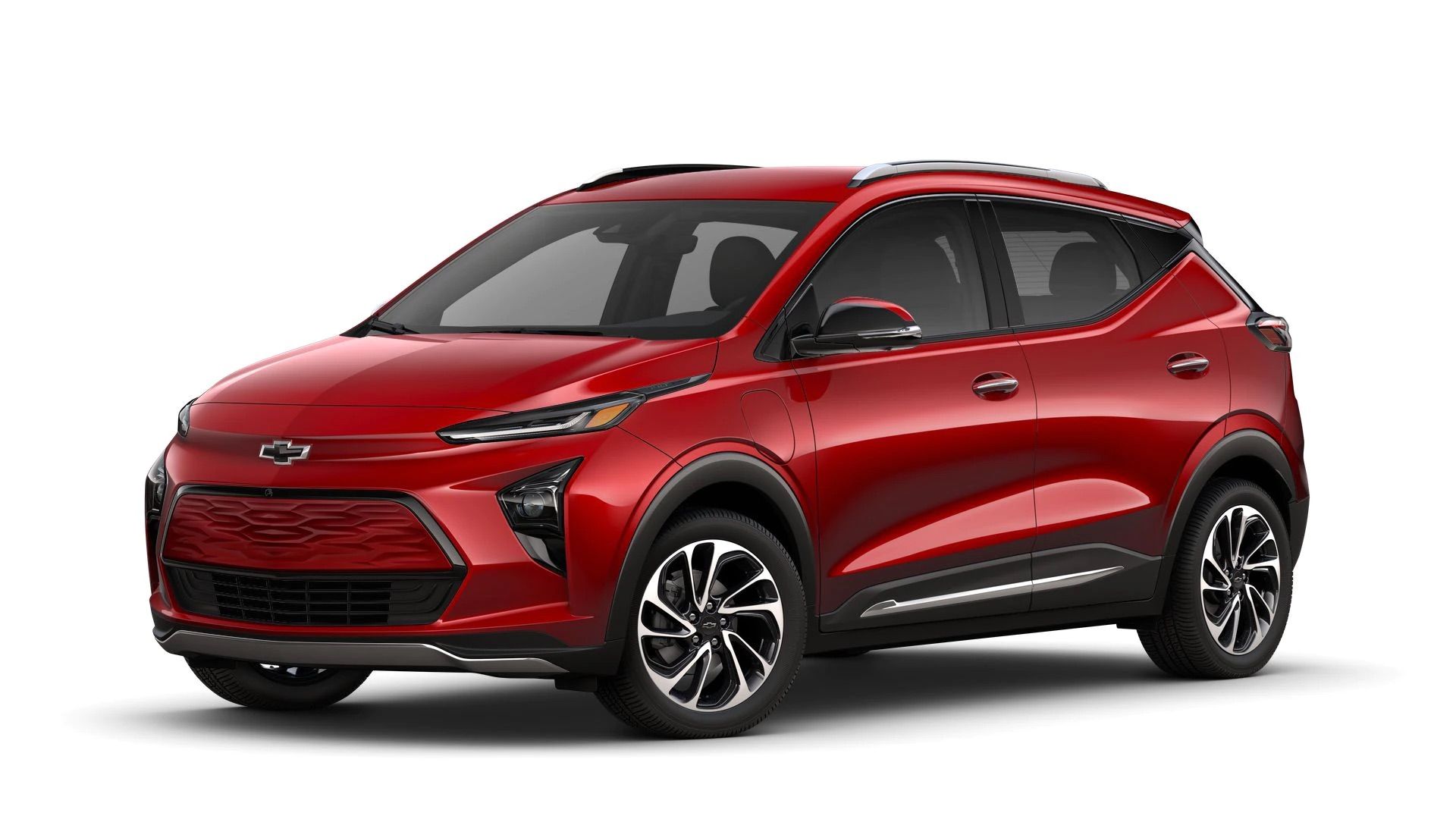
Eventually I found a dealership that restored my faith in humanity: Chevrolet of Bend. They couldn’t sell me a car they didn’t have, but they were willing to take a deposit and place an order as soon as they received an allocation. Their estimate was three to four months, and most importantly, they promised to sell it at MSRP. Done. For the first time in my life, I had the opportunity to order a brand-new car exactly the way I wanted it: a Bolt EUV Premier in Radiant Red Tintcoat with the Sun and Sound Package.
Then the waiting began.
Around this time, I received news that was both exciting and genuinely bittersweet. My boss at the school district, Chas, unexpectedly announced that he would be retiring in a couple of months.
The bittersweet part was easy to understand. I genuinely enjoyed working with Chas. I respected him, and over the years he had become both a mentor and a major influence on my professional life. His departure felt like the end of an era.
The exciting part was that his retirement meant the Director of Technology position at Tillamook School District 9 would finally be opening. It was the job I had been working toward ever since returning to the district in 2014. Suddenly, “someday” had become very real.
I didn’t assume the position would be mine. If anything, wanting it so badly only increased the pressure. I polished my résumé, gathered letters of recommendation, refined my cover letter, and submitted my application. When I landed an interview, I asked my dad to conduct a few practice sessions. After eighteen years as a superintendent, he knew exactly the kinds of questions I was likely to face, and just as importantly, he helped calm my nerves.
The interview went well, and not long afterward I was offered the position. After nearly a decade of working toward that goal, I had finally become the Director of Technology for Tillamook School District 9.
The weekend between my interview and learning whether I had gotten the job, I received some distressing news. The Oregon Charge Ahead program was running out of money for the year because EV sales had exploded, and in order to qualify for the rebate, the vehicle had to be purchased by the end of the month. My carefully ordered Bolt EUV was still months away.
Suddenly, the plan that had seemed so perfect was falling apart. I could either find an in-stock Bolt EUV immediately, lose the Oregon rebate entirely, or pivot to something else. Losing the rebate would change the math dramatically, and the whole reason this idea made sense was that the incentives made it almost absurdly affordable.
So I started searching again, this time with a much shorter deadline. The problem was that every other Bolt shopper in Oregon seemed to be doing the exact same thing. Inventory was nearly nonexistent, and dealers knew exactly what they had, which led to one of the stranger phone calls I have ever made to Courtney.
“I need to buy a Tesla.”
Courtney was understandably surprised and a little miffed by this sudden turn of events. In fairness to her, I had spent weeks explaining why the Bolt EUV was such a smart, practical, financially responsible choice, and now I was calling to say that actually, maybe we should buy a Tesla instead.
This time, though, we had a little more room to talk through it before I pulled the trigger. I explained that while the Model 3 was more expensive than the Bolt EUV, it was also a much more capable EV. It charged dramatically faster, Tesla’s Autopilot system was genuinely impressive, and the Supercharger network was—and really still is—in a class of its own. Most importantly, Tesla actually had cars available to buy immediately, which meant we wouldn’t lose out on $7,500 of essentially free money from the state of Oregon.
Once I ran the numbers, the difference wasn’t as dramatic as it first sounded. Between the federal tax credit, the Oregon rebate, and the projected sale price of my Volt, we could move from a five-year-old car with almost 80,000 miles to a brand-new Tesla for roughly $8,000 out of pocket. That certainly wasn’t nothing, but for a brand-new EV with much faster charging, far better road-trip capability, and access to the best charging network in the country, it was incredibly hard to argue with.
Once I had the go-ahead from Courtney, I proceeded to complete the easiest car purchase of my life.
The entire transaction happened on my phone through the Tesla app. There was no salesperson, no finance office, no waiting around at a dealership while someone disappeared to “talk to the manager.” I opened the app, selected the car, and placed the order.
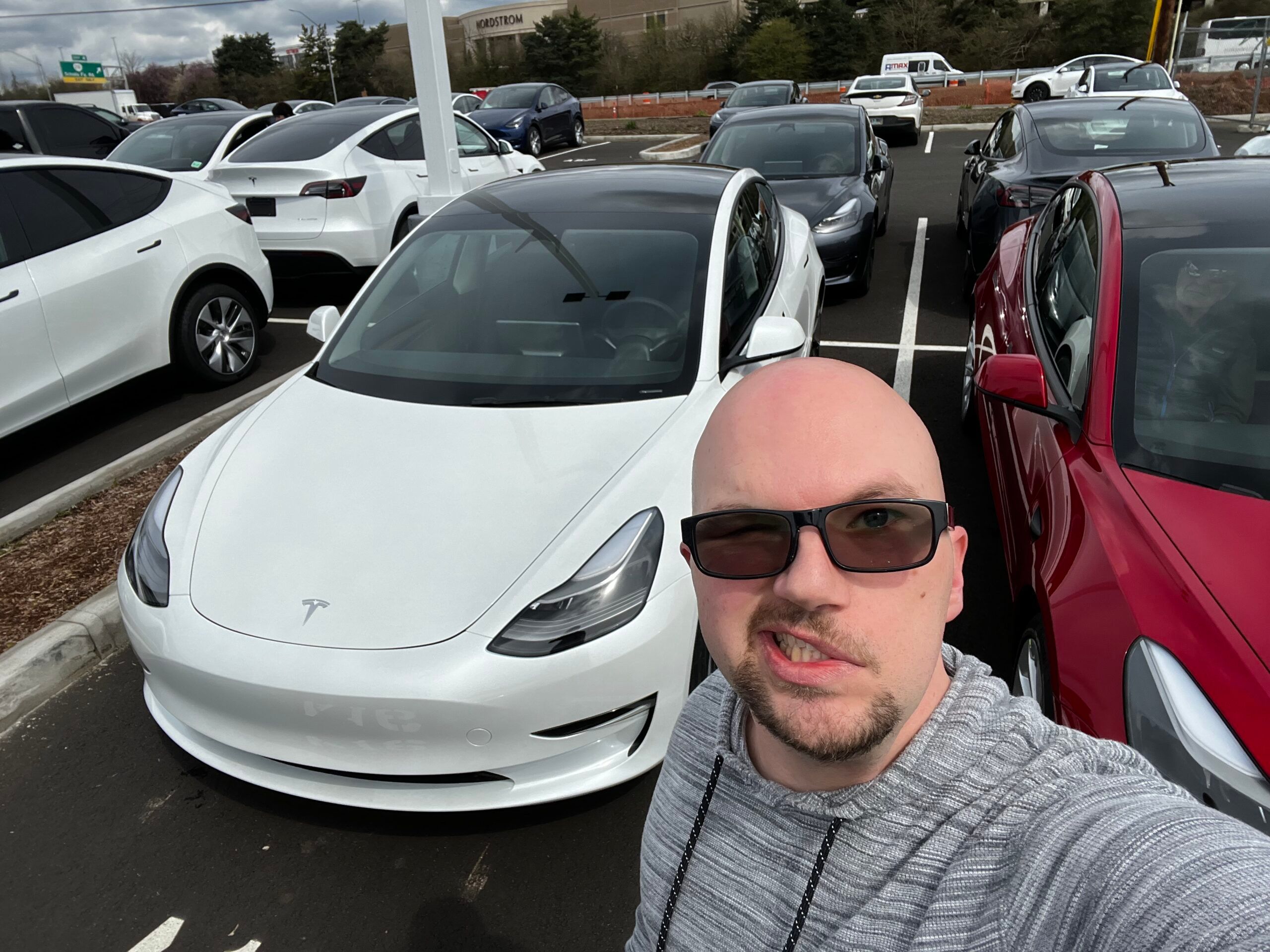
I chose the base 2023 Model 3 Rear-Wheel Drive in the free color, which at the time was Pearl White Multi-Coat. The only option I added was the mobile connector. I really wanted the red paint, but it was a $2,000 option, and after convincing Courtney that we should pivot from an ordered Bolt EUV to a Tesla on short notice, I knew better than to push my luck.
Then came the scary part. I entered our bank account information, and Tesla pulled the money directly from our account. Just like that, our savings account was almost completely drained.
In theory, the math still worked beautifully. The Volt should sell for a good price, the federal tax credit would come later, and the Oregon rebate should eventually replenish a huge portion of what we had just spent. But in that moment, all of those things were still future events. I had to trust that the Volt would sell, the paperwork would go through, and the rebates would actually arrive. Until then, I had just spent a very large amount of money very quickly on a phone.
I scheduled pickup for a couple of days later, which was the soonest appointment they had available. When I arrived, the Tesla app directed me straight to the car so I could inspect it. After that, it sent me inside, where I met with an actual human being for roughly ninety seconds. I signed two pieces of paper, he handed me the key cards, and then he said, “Enjoy your new Tesla, Mr. Schild.”

That was it.
Best. Car buying. Ever.
Next week… actually driving and living with the car!
Related CC reading:
Driving Impressions: Tesla Model 3























I don’t care how fast. Too green and too many, no style. The worst is the hunk of metal Cyber Truck.
That’s the great thing about cars. There are so many to choose from, everyone gets to pick what they want. For me and my family, the Tesla has been a flawless companion, and its operating costs have been next to nothing. That has meant more vacations, more savings, and even an additional car (or two) to get my gas car fix.
Well said 👍.
“too green”… That’s a novel argument. Bring on the dirty drinking water, polluted air, and fire-scorched earth…Nirvana! Jeez.
To Paul: Says the guy who has probably never driven an EV ever?
Not green enough imo, if it were literally painted green – I’m thinking bright but not quite lime green with a matching interior (plaid inserts included on the Plaid model) now we’d be talking!
I genuinely think Tesla missed the mark not doing plaid seat inserts in the plaid. I get being concerned about consumer response to such outrageousness but then soon later the Cybertruck came out??? And didn’t Elon himself buy the Spy Who Loved Me Lotus Esprit submarine with the Plaid interior???? Of all times to reintroduce that pattern into cars there was a perfect time to do it and Tesla whiffed it.
Instead the only identifying feature to a Plaid model is an emblem you can buy in bulk on Amazon for 10s of dollars.
Yes, simply the best car buying experience ever (twice now). It. Could. Not. Be. Easier. Or. More. Transparent. Once you experience it and realize that your own time has value, it becomes even more starkly clear that the “traditional” buying experience is completely designed to take advantage of a buyer and in no way reflects positively on any manufacturer that has to use middlemen to peddle their products.
The best. Also, it sounds like we need an update on your car fleet. I remember you got a model Y years ago, but it sounds like you’ve bought another one since.
I’m definitely not against EV’s like others of my age group seem to be (63). I think there are some real advantages especially, from what I’ve seen, for city use. And our son bought a Mach E that was really eye opening for me.
However (and I cannot state any facts to this) his biggest complaint was that he had to charge it more frequently than he thought necessary, and he blamed it on living in the mountains. He told me that “they use more power climbing up the mountains than he had anticipated.” Our driveway is 19 degrees and over 500’ long.
I am surprised to hear some of my friends down the technology, but I suppose that’s to be expected when new things are brought out. I’ve always tried to keep a more open mind.
And I will say that the people I know with full EV vehicles love them! But they all live in Michigan flatter areas than us!
I’m glad it’s working out-actually sounds like your favorite vehicle so far!
California has the highest and lowest points in the continental US (although you can’t drive anywhere near the highest points, but it’s still easy to drive from below sea level to over 8000’ in a few hours. And Californians buy more EV’s than anyone in the US. My ICE vehicles use more gasoline climbing hills also. That said, I agree that a lot of range estimates are optimistic, but as the saying goes, “your mileage may vary”. That originated with the EPA ratings developed for gasoline cars.
True, but much of it is pretty flat unless you live in the mountains. I had two Nissan Leafs in So Cal. I live in flat land but you can still tell that you use more energy going on the freeway away from the beach and you can regenerate or coast a little more going towards the coast.
They do use more power going uphill, just like a gas vehicle does. But on the downhill you actually gain power back so much of it cancels out. We live in Colorado and rumor has it we have a few sizeable hills in our state. EVs are seen far and wide, summer and winter, it’s a non-issue. It’s not at all uncommon to be in the mountains at a ski area and have less than half a full charge and upon arriving back in the western Denver suburbs find that your battery is full merely from regenerating power coming down I-70. Your driveway is less than a city block long. Going up it will use less than 1% of the range in a Mach-E. Coming back down it to go anywhere will gain you most of that range back.
I don’t know which Mach-E model your son has but the standard Mach-E has about 220 miles or so of range (per the one i reviewed here years ago), although there is an extended range version available. Yeah, the standard range one will require charging more often, just like a car with an eight-gallon gas tank would or a pickup with a 12-gallon tank. Most every Tesla easily has at least 300 miles of “rated” range, if you have a plug near where it’s parked it’s full every morning, plenty for 99% of driving days for 99% of the population.
I’m not sure any the range on his either. He kept it a year and got rid of it, not because he didn’t like it, but two reasons
He was very frustrated with the lack of charging stations here in the Tri cities of NE Tennessee (including the Ford dealers having very slow chargers and only one) and so the second reason was he just couldn’t justify the payment.
Now we owned a C-Max hybrid (not plug in) and it was a simply great car. But it was terrible in snow of any depth. I thought 42mpg in town was great for the time (2016) and it never broke.
Thanks for the info. I never say never. We may find ourselves driving an EV one day.
My company gave me a C-Max in Ice blue Metallic as a change from my usual Prius.
Loved it even in New England winters. So fun to drive. I was sad when I went back to a Prius.
As with your other stories, I can relate a lot. For one, I went EV in 2015 with my cute little blue Chevy Spark EV. Loved it, but after the lease went back to gas. Though I loved going back to gas, but found myself being not happy with them. I then tried an PHEV (2021 Volvo S60 T8) and loved the “concept”. However, my round trip of about 30 miles meant that every day I was burning some (premium) gas. So I ordered a 2023 Chevy Bolt EV (small one) and have never turned back. Which brings me to my second point. I not so fondly recall that time when the Bolt and most EV’s were bringing a premium over MSRP. I didn’t want the EUV, but my sales guy kept trying to talk me into it. I firmly said no. I also wanted the higher trim with leather and Bose, but the prices were too high. My dealer was willing to sell me the car at MSRP, but with the condition that I had to pay $795 for some stupid Lojack thing. I agreed and ordered the car thinking it would take months. Placed the order in late November of 2022 and the car was sitting in my driveway in early January 2023!! How was that possible? Well, it’s because I ordered the EV and not the EUV. According to my sales guy, it was the EUV that was so hot that the orders were back logged.
Maybe if you had gone with the smaller one, you would have gotten it. And the interesting thing? The smaller EV actually has just a hair more “cargo” room over the EUV. That extra length was all placed in the rear seat legroom. No matter, the Tesla Model 3 was one car on my short list and a great car. What kept me from going Tesla? Three things: Musk. Glass roof. And everything in that tablet stuck to the dash.
I think Musk has been at the “Dearborn Independent” phase of billionaire iconoclast decline for a while now and seems to be speedrunning to the “Kleenex box slippers” end stage with his ketamine-up/cannabis-down cycles.
I don’t plan to replace my manual Honda Fit in the near future but if I had to right now I’d be looking for a used small body Bolt.
“Every car up to this point has come and gone”
Well the Tesla is only three years old and it sounds like the Bolt was around five years from what I can gather. I guess come and gone varies from one to another since my two daily drivers are 22 years and 35 years old. They come but are never gone.
I’ve grown comfortable with the thought that my next vehicle will be an EV. I was disappointed when Ford more or less indicated a few weeks ago that there won’t a Gen2 Mach-E; I’m a huge fan of the Ioniq5. I admire the Supercharger network and recognize it as the gold standard, however of the 6 Tesla owners I know, none of them are planning to replace theirs with another Tesla for a myriad of reasons, including NVH, build quality and Musk. I doubt he’ll notice their missing money….
Bought a new Model 3 standard yesterday to replace the 2019 one. Still the best EV’s for the money.
I have a friend with two used Teslas which replaced his Nissan Leaf fleet largely because of charging infrastructure. He likes them enough and has a disclaimer bumper sticker. I’ve always been skeptical of their driver aids and contemptuous of toch screen everything but the Model 3 and Model Y are competent cars as long as you leave FSD turned off. The only Tesla I actively dislike is the Cybertruck which is an unbelievably stupid vehicle.
We currently drive old and cheap cars and thus an EV is unlikely although I would like an electric bicycle
The $$$ numbers wouldn’t pan out for me personally, but they can for others. Right now I wouldn’t buy a Tesla because Musk is such a tool, and IMO outside of the Model S, they’re all ugly. Especially the Cybertruck, only 2 of which have I seen anything in the bed of.
Now, that’s not saying they don’t work for some, just not for me, what I do and where I go. Hybrids really seem like the sweet spot at the moment, kind of the best of both worlds, albeit with some compromises, but not too many.