
Text submitted by Cal Sexsmith.
By the spring of 1960, change was in the air. The family’s well-worn 1952 Buick was beginning to show its age, a second child was on the way, and my parents had just acquired a 99-year lease on a lakefront lot at Christopher Lake, about thirty miles north of Prince Albert, Saskatchewan. Dad intended to build a summer cottage himself, and that meant hauling lumber, tools, and supplies. A station wagon suddenly made much more sense than another sedan.
Dad never bought a car on impulse. Every purchase was preceded by weeks of research, test drives, and comparisons. He considered a used 1957 Pontiac Pathfinder wagon and even looked at a new Frontenac, a uniquely Canadian cousin to the Ford Falcon sold through Mercury dealers for just one model year. In the end, practicality won.
He came home with a light green 1960 Ford Falcon two-door wagon, his first brand-new car.
I can still remember him driving it out of Modern Motors Ford-Monarch in Prince Albert. By modern standards, it was almost comically basic. The padded dashboard was about the only factory option, and the chrome plug where the cigarette lighter should have been reminded everyone that even that was considered an extra-cost luxury. Grandpa later bought Dad an AM radio, though it lacked even the convenience of pushbuttons. Vinyl seats and rubber floor mats meant the interior could practically be hosed clean after a muddy weekend.

That little Falcon immediately went to work.
Weekends often meant loading it to the roof with lumber destined for Christopher Lake. One trip remains especially vivid. Mom, Dad, and I rode squeezed together in the front seat while the rear seat and tailgate were folded flat with the cargo area stuffed with lumber. Perched on top sat Belle, our cocker spaniel, tethered by her leash to a window crank.
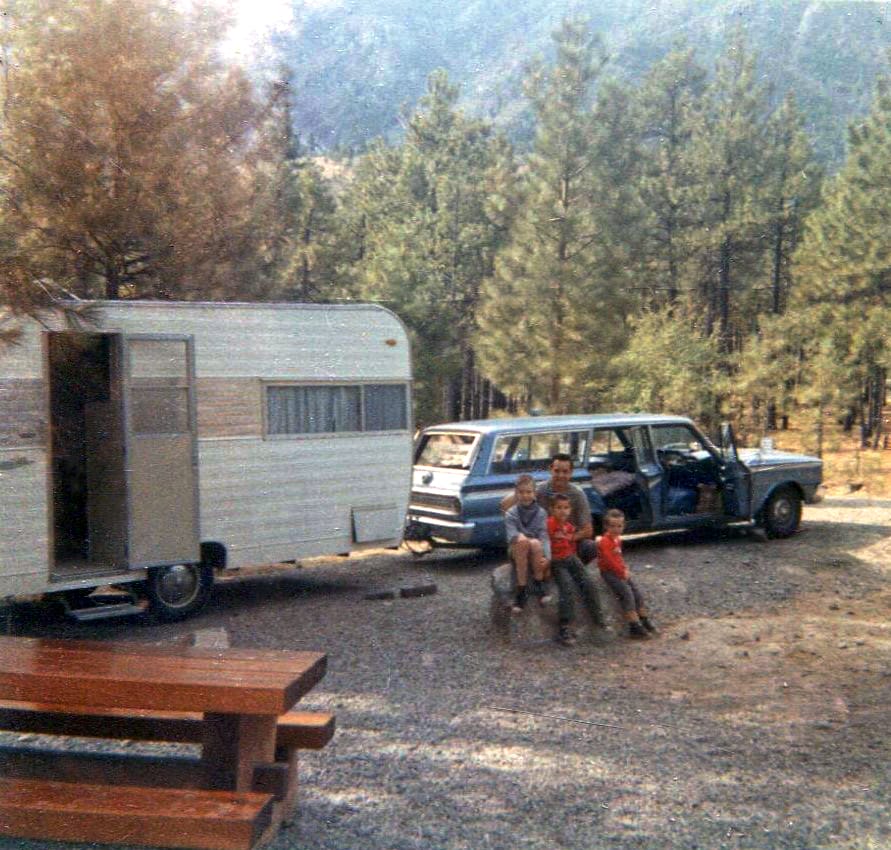
A few years later, Dad added another ingredient to our family’s adventures by buying a Silverliner pop-up tent trailer. It opened up a whole new world of camping trips, though the Falcon wasn’t always thrilled about the assignment.
The trailer’s first outing took us to the grand opening of the Squaw Rapids (now E.B Campbell) hydroelectric station. The summer heat proved too much for the little Ford, which began overheating along the way. We ended up leaving the trailer at a farm near Choiceland while the Falcon struggled home. The farmers had recently lost their house in a fire and were temporarily living in grain bins while rebuilding. When we returned for the trailer, we thanked them with a handful of souvenirs from the hydro project.
Later that same summer we had a camping trip planned to Banff and the Okanagan Valley, and Dad must have been concerned about the Falcon’s ability to tow the trailer because he test drove a black 1961 Ford Galaxie two-door hardtop not long before we left.
Still, we parted on our first truly ambitious family vacation, towing the trailer west through the Rockies to Banff and the Okanagan Valley. We camped at Mara Lake, explored Vernon, and met my mother’s sister Ruth, her husband Ray, and kids at Two Jack Lake in Banff National Park, beginning what would become years of joint camping trips.
The vacation created wonderful memories—but it also finished off the Falcon.
By the time we reached Regina on the return journey, the clutch, transmission, and differential had all suffered badly from towing through the mountains. The Falcon never made it home to Prince Albert. To make matters worse, we have almost no photographs from the trip because one of my younger brothers discovered the rolls of film and proudly wrapped one around his waist, saying “lookey lookey makes a nice belt!” before Mom caught him.
Our return happened to coincide with the annual family reunion on my mother’s side. Dad stayed behind in Regina, supposedly to deal with the broken Falcon, while the rest of us squeezed into my Uncle Ray’s 1956 Chrysler Windsor for the trip to Katepwa Lake.
One of the features of our family reunions was showing off new cars.
Uncle Tommy arrived proudly driving a recently acquired 1960 Buick four door hardtop. Dad wasn’t about to be outdone. When he finally appeared, he wasn’t driving the repaired Falcon.

He had bought a brand-new Ford Fairlane 500 Ranch Wagon. The story, repeated for years afterward, was that buying a new car proved cheaper than repairing the Falcon.
Like the Falcon before it, the Fairlane was strangely equipped; apparently it had been a special order that came in later than promised. It carried the desirable 221 cubic-inch V8 but little else. No automatic transmission. No power steering. No power brakes. No fancy wheel covers. No radio. Dad solved that last omission by hanging a transistor radio from the rearview mirror rather than paying for the factory unit.
Before towing the tent trailer home, he and my uncle fabricated a trailer hitch on the farm, welding it together before installing the wiring and mirrors themselves. In those days, many of the items we take for granted today were optional extras.
Unfortunately, the Fairlane proved to be a lemon, almost as bad as his 1953 Chevrolet.
The first problem was with the rear axle seal on one side, which would fail with oil pouring out of the axle housing into the brake drum, requiring both a new axle seal and brake shoes. After several unsuccessful repairs, a mechanic at the Mercury dealership finally discovered the real culprit: a tiny burr on the axle shaft that kept destroying new seals. A few strokes with a file permanently solved that problem.
The engine was another matter. Water somehow found its way into the oil, ruining hydraulic lifters and rusting the dipstick. A number of fixes were tried but the problem never totally went away.
Despite those frustrations, the Fairlane changed our family’s vacations forever.

While traveling through British Columbia, Dad became fascinated by the travel trailers we encountered. The little Falcon never could have managed one, but the V8-powered Fairlane made it possible. The following spring my parents made a major decision. Rather than continue developing the Christopher Lake cottage, they sold the property and purchased a sixteen-foot Esta Villa (built in Estevan, Saskatchewan) travel trailer.
For several summers that trailer became our second home.
That summer we spent several weeks in the trailer while Dad was fulfilling his obligation as a reserve Army Officer at the Army Cadet Training Camp in Vernon. The following summer we hauled it all the way to Vancouver while he attended the University of British Columbia as the first step toward becoming a high school guidance counsellor.
But as it had happened before, crossing the Rockies twice with a trailer behind it eventually proved too much for the already troublesome Fairlane and was sold to a local plumber who used it as a work vehicle.
So, in the fall of 1965 Dad once again began shopping.

This time the search ended with a 1965 turquoise Plymouth Fury II station wagon equipped with Chrysler’s 318 V8, TorqueFlite automatic transmission, power steering, and an AM radio. It was one of his favorite cars, and in many ways it began a lifelong relationship with Chrysler products. Although he would later own mostly Dodges, there was rarely a time afterward when some Chrysler Corporation product wasn’t sitting in our driveway.
Naturally, getting there required another thorough search.
Dad sampled everything from a Ford Custom 500 to a Meteor Rideau and even a Rambler Ambassador wagon before deciding the Plymouth best suited our needs. He had little interest in General Motors products because he felt their two-speed automatics weren’t well suited for trailer towing.
Unlike the Fairlane, the Plymouth proved mechanically dependable and had only one breakdown when a wheel bearing failed. However, its biggest problems came not from the drivetrain but from bad luck.
Only weeks after purchasing it, a parked 1959 Pontiac rolled out of a driveway and struck the right rear door. The Pontiac’s dramatic tailfins acted almost like a giant can opener, slicing into the side of the Plymouth and jamming the rear door shut. Although repaired, the body was never quite the same. Dust found its way inside on gravel roads, and the chrome on the rear bumper eventually peeled; Dad wire-brushed it and spray painted silver. Perhaps because of the accident’s repainting and possibly partially due to Chrysler’s poor quality control, the paint on the various body panels faded at different rates.
All those flaws never diminished my affection for the car.
The Plymouth provided two memories I’ll never forget.
It was the first car I ever drove.
I was only eleven years old when Dad let me steer along a quiet gravel road near Lily Plain with the entire family aboard (!). Looking back, it seems unbelievable that a child drove a full-size station wagon with all aboard, but those were different times.
The second memory was less joyful.
When I was nine, my brother slammed one of the doors on my right thumb, nearly breaking it. The scar remains today and still serves me tell my right hand from my left hand!

Eventually the faithful Plymouth disappeared from our lives. Years later the car was last seen working as a taxi in La Ronge, northern Saskatchewan—a fitting second career for our family wagon.
By the fall of 1969, however, Dad was once again studying brochures, comparing specifications, and preparing for another exhaustive search for the family’s next car.
That search would become the longest—and perhaps most memorable—of them all.























Very nice stories. My mom never drove and dad always felt he could afford a nice car. The first one i remember (i was born in 63) was his 62 Buick Invicta convertible. Man it was really pretty in a wine red color.
And we all enjoyed that car until it was stolen from our driveway.
I really am looking forward to your next installment and welcome.
Gone are the days when you could tow a trailer with a passenger car, and good luck finding a station wagon. It’s more expensive to commit to a proper tow vehicle. We towed with a 1988 Buick Le Sabre with the 3800 engine and after that with a 6 cylinder GMC Safari Van, both of which eventually had cooling system problems that were not made any better by towing a boat or a trailer behind them. I can understand it when you wrote that some cars just weren’t the same after being overheated. Modern SUVs with tow packages were much better suited to the task. When I was a kid, we towed a 19′ trailer with a V8 Mercury Montego. Dad had an old canvas bag that he’d fill with water and hang over the front grill to cool off the engine the old fashioned way.
It would have been interesting to see how a 60 or 63 Ranch Wagon or Country Sedan with a similar powertrain would have held up compared with either the Falcon or the Fairlane – my bet is that either would have fared better. And I will join your family fan club for those mid 60s Mopar C body cars.
I looked up the towing capacity of the 1960 Falcon Wagon and found there was no towing capacity. It was not unusual for a manufacturer in 1960 to omit such a figure. Still, a stock 1960 Ford Falcon station wagon was not recommended for towing because of its slight construction. In OZ they were called “Foul Cans” because they literally fell apart on their roads.
“The 1960 Falcon used a lightweight, single-unit unibody construction rather than a rigid full frame. Bolting a heavy tow hitch to a thin, unibody metal pan risked tearing or warping the metal. The Engine: The factory 144 cubic-inch inline-six engine produced only @90 horsepower and 138 lb-ft of torque. Pulling heavy loads will dangerously overheat the engine and transmission, and making it up highway hills will be incredibly slow. The Brakes: Classic Falcons came with small, manual drum brakes on all four corners. Stopping a loaded Falcon wagon w/ a trailer in an emergency would likely result in severe brake fade, causing the trailer to push the lightweight wagon out of control.”
Thankfully you all made it and it was only the Falcon that died.
I have a vague memory that the Falcon had a bolt on bumper hitch.
My Dad’s first new car, in Fall 1960, was a 1961 Falcon four door sedan with the Deluxe Trim Package. It had the base engine, three speed manual, and radio delete plate. My first Sears portable transistor radio provided news and music on our 5,090 mile round trip across the US in 1962 to the Seattle World’s Fair. The Falcon was pretty worn by the end of that trip and two years of hard driving. It was burning oil, rusty, and ready for replacement. It’s easy to understand that your family wagon was really taxed by a heavy load and towing a trailer.
It’s amazing how 2-3 years was considered a normal lifespan for a car. We had a Chevy wagon for 8 years and it felt like a lifetime. Now people routinely have cars for 15-20 years and it’s considered normal.
This was my thought too. OP’s Dad bought the 60 Falcon, then a Fairlane & was shopping again by 65. Because they broke down under some modest towing, which should be within the limits for such a vehicle. A decade old car was forever!
Fantastic story! Dads and cars always make for a wonderful combination, and this was no exception. I look forward to your next installment!
Dad sounds just like me – measured, practical and unwilling to end up with the results of a hasty purchase. People often ask me what car they should buy. I answer them, and they NEVER take my advice. They then proceed to whine to me about the issues with the car they did buy.
Nice article. Using a Falcon to tow a trailer over the Rogers Pass must have been quite a trip even then. I’ve probably stayed in that same campsite at Lytton (before the fire) a few times, world class river rafting!
I do like these old family stories, as they reveal more than just about the cars. And the cars reveal more about the owners.
The Fairlane wagon wasn’t really equipped unusually. These really didn’t need power steering or brakes, and lots of buyers still preferred manual transmissions. But the 221 V8 was hardly a powerhouse; it was no more powerful than a typical six of similar displacement.
He definitely got the mission-appropriate car finally.
I too enjoy the stories as much as hearing about the cars .
From the late 1950’s through 1964 or so we camped out of a series of International Harvester Travelalls .
A BIG Cottage tent to hold all six of us brats .
-Nate
Once we got away from motels and started camping, the ’65 Impala wagon served us well with an enclosed roof rack. We also had a giant Sears canvas tent.
Dad loved the desert, and we eventually went off road. First, one Honda CT-70 could be carried by the wagon. Chevy held up surprisingly well to washboard roads, only a broken front sway bar mount. But, it was replaced by a ’69 Dodge A-108 Sportsman and we could carry real 90cc dirt bikes and our gear.
Either V-8 rig would have been fine tow vehicles, but open desert is not a good place for travel trailers. Ask me how I know.
Nice tales. It is always fun to hear about the folk behind their cars.
I was thinking that towing anything at all with a gaspy 144 Falcon was a work of ambition, but then remembered my dad towed a (not huge) trailer full of camping stuff behind a 1.2 litre Kombi van, with eight of us on board. And a pile of stuff on the roofrack. Blimey. Admittedly, not over the Rockies, but most certainly not quickly, screaming in 2nd gear on some long slopes (again, not Canadian-sized slopes, but in days when many roads had far less grading and cuttings, they were fairly stiff).
Like others here, it’s incredible to think of a three year old car as worn out by one or two long and hard drives. Unless you’re a total buffoon in a modern car, and don’t service it or take notice of any warning lights, it would be near-impossible to do that.
This all sounds so so familiar! Dads, moms, cars, trailers, sisters, cousins, camping trips, lots of camping trips, strange and interesting incidents all along the way. A lot of the locations mentioned are very familiar, traveling fro Vancouver BC to visit relatives in Saskatchewan and everything in between. I absolutely love these kind of stories! The 50’s and 60’s were the best! Thanks for the memories!