

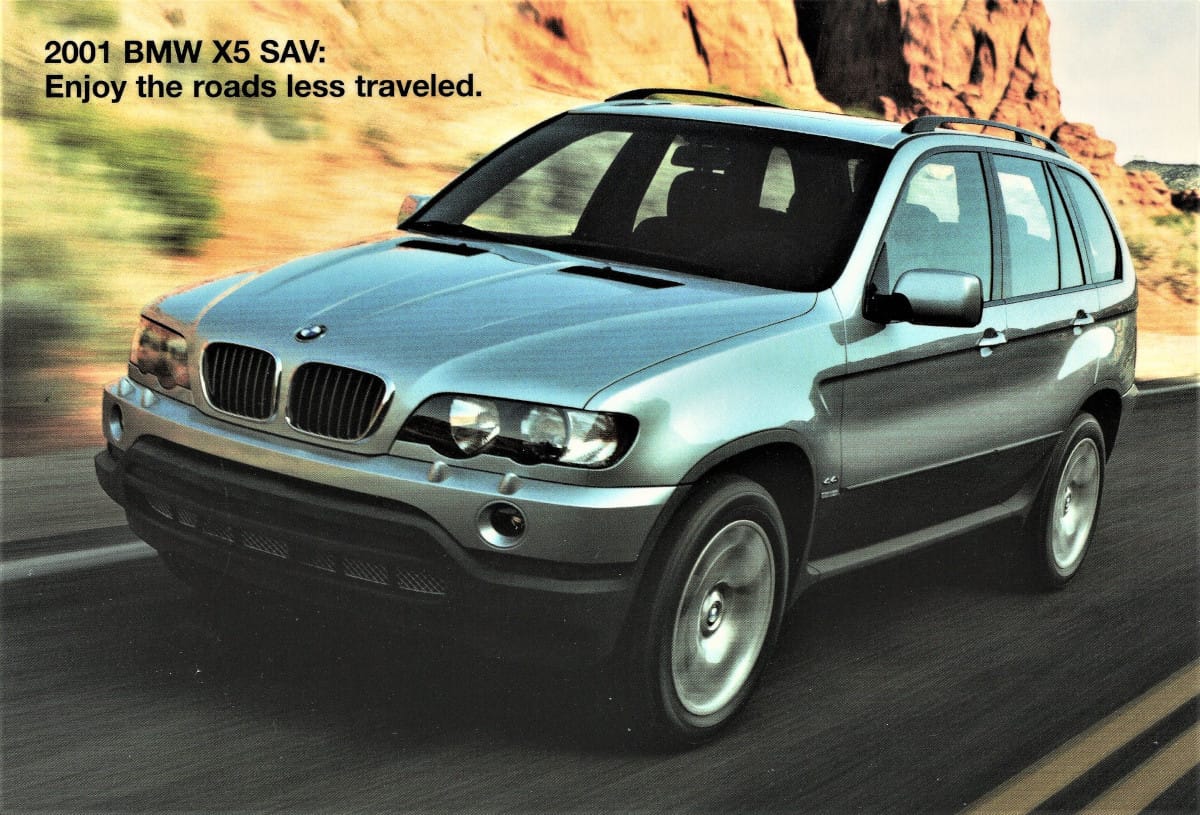
In the summer of 2006, my father went to look at a high-mileage 2002 BMW X5 that seemed like an unlikely candidate for our next family vehicle. At 12 years old, I wasn’t particularly interested—after all, it was just another SUV. But one test drive was enough to change my mind completely and alter the course of my automotive life. What began as a cautious look at a used BMW soon turned into one of the best automotive decisions my family ever made.
While my mother was traveling that summer, my father stumbled across the stick-shift-equipped X5’s listing. It had been routinely serviced and was purported to be in good condition, but mileage was high. My father’s interest was piqued, and so he set up a time to go test drive it and I tagged along to go with him. We met with the seller near a movie theater in Espanola. I recall the seller surprisingly well after 20 years, for the sole reason that he had a mustache and kept calling us “brother,” like a gentler, kinder Hulk Hogan.
Despite the X5 being only four years old at the time, it had covered 117,000 miles. The white paint was in good condition, shone, and the tan leather seats were like-new, with no evidence of any tearing or wear. None of this particularly called to me as a 12 year-old boy. Paint was paint and seats were seats, and the quality of them mattered little if the thing they were attached to was boring, and nothing was more boring to me than a mid-size SUV.
There were, however, a few features that I found quite endearing. First, everything that opened and closed was dampened. Ashtrays, the “oh-shit” handles, and the little cover over the CD player all opened and closed slowly but smoothly. The lights would gradually fade on and off instead of suddenly turning on and off, creating a smooth transition. This was neat, but hardly exciting. Far more exciting was the test drive, which allowed my father and me to see just what the X5 would do.

The E53 X5 could be had with two engine options; a V8 or the base model inline six. If you opted for the inline six, you could opt for a manual transmission, although I doubt many people ever did. The only inline six to be offered in the E53 X5 was the M54B30, a 3.0-liter gem of an engine turning out about 230 horsepower and 220 ft-ibs of torque. On paper, this was nothing to write home about, but in reality, it was more than the sum of its parts. However, due to the dual-variable valve timing and DISA valve, the M54 had excellent low-end torque which peaked out at 3500 RPM, just as the power band came on. The result was that the X5 would jump off the line with ease and sprint to 60 in about 8 seconds, while having near-perfect manners in day-to-day driving.
The chassis was something else, too. It was comfortable but not numb, and it felt so planted and controlled that it seemed like a hurricane would not upset it. Even as a passenger, I could tell it was head-and-shoulders above any car I had ever been in before. Moreover, despite being approximately the same size as our Suzuki XL-7, it became clear that it had plenty of room for five people. I was sold on the car, but my father had not been. He told the seller he would think about it and we went home. The entire drive home was a painful reminder of what we were missing. My father spent most of the ride home repeating reasons not to buy it to me, none of which convinced me.
None of those reasons had quite convinced my father, either, and a few hours after we had gotten home, I found him hunched over the dining room table, researching the X5. His biggest reservation was the high-mileage. In his youth, a car with 117,000 miles on the clock was used up, and certainly was not a viable family car. Twenty years later and with children of my own and a few roadside breakdowns of my own under my belt, I understand his hesitation. However, he could not deny the X5 was in excellent shape and showed little indication of all that wear. He also could not deny that, at the asking price, it was a bargain. After a phone call to my mother, the decision was made; he would buy the X5. It would turn out to be one of the best decisions he had ever made.

The X5 stayed with us for about five years, during which time it served us quite well. My father was infatuated with it, and he spent hours detailing it. He would sit in it just to listen to its wonderful stereo system. Or possibly to avoid us. I never really knew. It replaced the XL-7 for any long-distance travel, as it was more comfortable and more engaging to drive. Besides, we no longer really needed the third-row seating of the XL-7, as I stopped fitting in the back seat at about 11 years old and my sister moved out not long after we got the X5, so it was just my brother and I sharing a very roomy bench seat.
After about a year, my father moved on from the X5 to buy a then-new 2007 BMW 335i. As the XL-7 had been traded in on the 335i, my mother was given the X5. My mother would drive it until her retirement in early 2012, during which time it became the first car I ever got to actually drive. For twenty glorious minutes in an empty parking lot, my mother let 14 year-old me figure out how to drive the X5.

The X5 left our stable toward the end of my senior year in high school. My father, after working for over forty years (starting at the age of 12), had the opportunity to retire, and with the end of parenthood in sight, he chose to retire. My mother retired with him. As a retirement present to her, the X5 was to be replaced with a then-new 2012 E70 X5 50i. Rather than trade the old 2002 X5 in on the 2012 X5, my father listed it for sale on Craigslist, and it sold within about a week. Not long after it left, so did I. Specifically, to New Mexico State University, where my long journey from dumb kid to dumb adult would begin.























Yes, that was quite an upgrade from the XL-7. Maybe the Suzuki was almost as long as the X5, but it was much narrower. These Suzukis were really stretched little 4×4 ‘jeeps”.
These were one of the first significant breakthrough SUVs, and pioneered the genre at BMW. A six with the stick was definitely not a common one in the US.
I was a bit incredulous at the mix of “used BMW” and “best automotive decision” until I got to the part about a six with a stick shift. No personal experience, but I gather it’s mostly the high-output V8s and ultracomplimatic transmissions that wind up too much trouble. You do also have an eventual Pandora’s box thanks to all the plastic components and fasteners (especially if shoddy mechanic work comes into the picture), but most after the 10-year mark.
Ironically, I was in the same boat on SUVs in my early driving years, but now I’ve got a 94 Explorer (4×4, all manual), and a AWD 98 Mountaineer (probably a flip). I was won over by how robust and cheap and easy they are to work on (the really archaic 91-94 in particular). I can’t imagine how dinosaur-like those would be driven back-to-back with an X5, but the requirements of mountain access calls for something truckish. Unfortunately, a lot of recent cars will dead-end once parts supplies (new and used) dry up, but I’d hope at least that this simpler X5 would be one that could make it.