

A 2017 RAV4 LE, first four wheel drive vehicle in our garage
I’ve been known to be impulsive — for good or bad. After a ride in a family member’s Honda SUV, my thought was, “This is pretty nice. Maybe it’s time to sit upright and high again. Let’s look for an SUV.”
I went to my favorite independent used car dealer and sat and drove in several cars; I found the Mazda CX-3claustrophobic, I drove a Subaru that didn’t convince me (great visibility but it made different noises), and finally a 2017 RAV4 LE, which felt right and had a good color. It had the LE trim radio (which wasn’t the best radio we ever had, but it had a CD player), backup camera, lane assist features, and a lot of cargo space. And had been driven just 12,000 miles a year.
I could have shopped around for other RAV4s, but this seemed like a good buy. I was blissfully unaware of options like power lift gates, and a hybrid was available for $$$$ more. A while back, Paul N noted that the 2017 RAV 4 was similar to a 1949 Plymouth Suburban Wagon, and that these current SUVs had similar proportions to those wagons of the past. About which, the first car I really remember is my dad’s 1954 Ford Ranch Wagon.
So I traded in the 2013 Prius C, which had a free and clear title. A significant down payment was made, and we were able to pay off the loan relatively quickly.
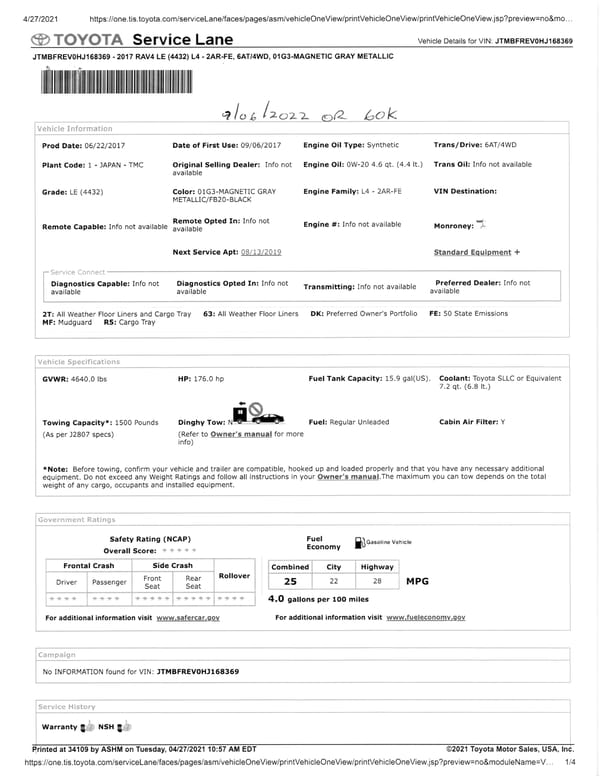
My first visit to the Toyota dealer six months later gave me a complete service history. The RAV4 was a made in Japan model and was a corporate lease car, which had one minor accident reported to Carfax and showed no other red flags. Of all the Toyotas I ever had, I had never seen this type of document before. They gave it to me when I asked how much warranty was left.
My RAV4 was an XA40, fourth generation produced for model years 2013-2018, the first RAV4 generation to remove the spare tire from the exterior and put it inside.
I made two relevant road trips to Atlanta in this vehicle — one for helping my brother move and another to see him get remarried after four years of being a widower. We took one road trip to Vermont in the RAV4, and my wife, I, and Mack the dog saw most of the state, except the Burlington Metro area. Mack did well, but we had to help him into the back seat of the RAV4 as his hind legs were starting to wear out. The new tires were excellent on the twisty two lane roads of Vermont.
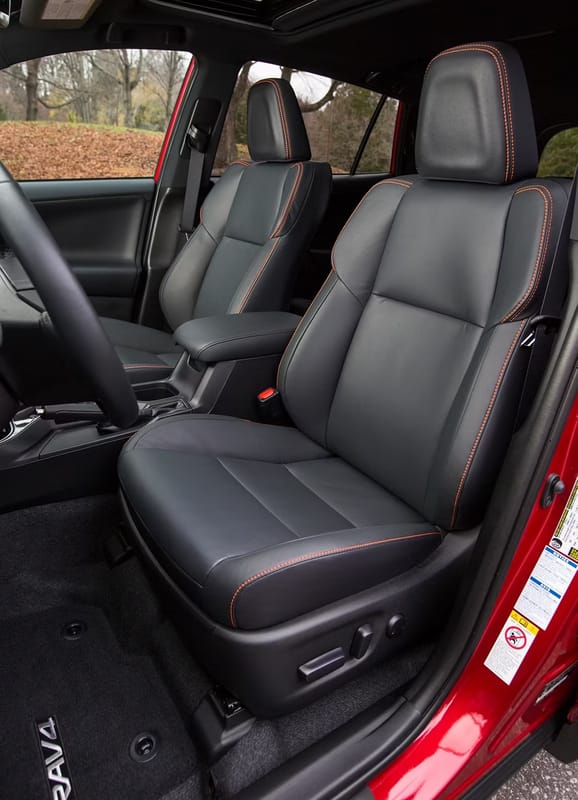
2016 top of the line interior with leather, Toyota of Canada PR photo.

Great car for day trips with buddy Mark

And hopefully this is the last time I will be rear-ended. According to Carfax, this is “minor damage” — $4300 worth.

There were 407,594 2017 RAV4s sold, my daughter called it a “grocery getter” as it is a common sight in suburbia.

The back seat was inviting for Mack the dog, who was the most frequent passenger.

Mack could easily switch windows depending on what he saw and smelled.
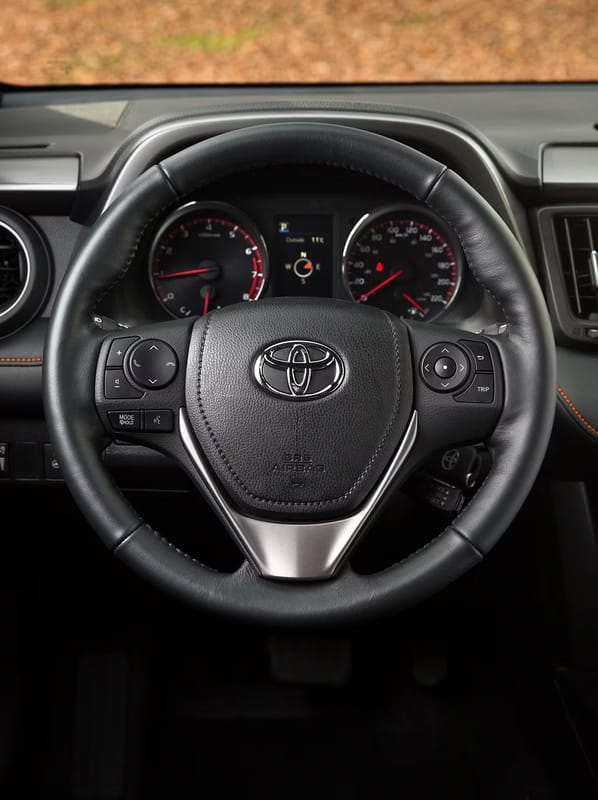
After the Avalons, Camrys, and Prius this was a familiar steering wheel. Toyota of Canada PR photo.
In 2021 I started to ride a bike again, which I bought with my COVID stimulus money — one of the last made in America Cannondales. The RAV4 could fit two adult bicycles in the back with the seat down. I rode on most of the bike trails in Cuyahoga County with serious recreational bikers. One memorable ride was September 22, 2022, which took me along the shores of Lake Erie and I was splashed by the lake for the first time since 1958.
Lots of people have bought RAV4s since its introduction, many close to me. I drove a first generation when looking for a beater for my son, and later drove a third generation that was my son’s car. About which, I told him it was “funner” to drive than my fourth generation one.
Also, my friend Judy had a fifth generation XLE which was quieter and plusher than mine, and she just bought another fifth generation XLE. The RAV4 is one of the most popular new cars sold in the USA in 2026, and “market adjustments” are currently being added to especially popular models like the hybrid.

At the peak of the “supply chain madness,” these Toyota Hybrids were fleet vehicles ready for delivery.
The RAV4 came in LE, XLE, SE, Limited and Platinum trim levels. Glad we had an LE as it didn’t have aluminum wheels that would eventually rust, with oversized, more expensive, not-as-long lasting tires.
As I said earlier, when I bought the RAV4 I got a Carfax report and saw a normal vehicle history; a file I kept in PDF form. After I sold the car in 2024, I checked an updated Carfax report and the only thing critical was the trade-in mileage and the fact that the rear end collision was flagged. Here’s how the two compare:
Highlights of FIRST CARFAX, September 2020
Vehicle History
- The vehicle was manufactured and shipped to Ohio on 07/12/2017.
- It was purchased and titled as a corporate vehicle on 09/06/2017.
- The first owner reported on 10/02/2017, with registration renewed multiple times.
Service Records
- Regular maintenance performed at various dealerships, including oil changes and tire rotations.
Warranty and Recalls
- Original warranty estimated to have 0 months or 16,327 miles remaining.
- No accidents or damage reported to CARFAX.
- No open recalls reported; check with authorized Toyota dealer for updates.
Highlights of SECOND CARFAX, March 2024
Vehicle History
- The vehicle was purchased and title issued on 10/16/2020 with 28,768 miles.
Service Records
- Regular maintenance performed at various dealerships, including oil changes and tire rotations.
- But CARFAX didn’t indicate that a battery had been replaced except by saying the battery system was checked.
- At about 50,000 miles differential had a lubricant change — one of those 4WD maintenance items I had forgotten about.
Accident Reported
- Damage reported 12/28/2021
New Tires
- Four new tires purchased, Yokohama AVID ASCEND LX BW 225/65/R17 — these were great tires.
Recalls
- NHTSA #23V734 Potential Vehicle Fire Related to 12-volt battery
Offered for Sale
- With 63,224 miles 3/1/2024
In reviewing the car’s service history, there is no record of brake part replacement. Is it possible that this car went over 60,000 miles on the original brakes?
In any case, come 2024, it was time to move on and to get another vehicle. What replaced it in our garage?
Related CC reading:
CC Comparison: 1949 Plymouth Suburban Wagon and 2017 Toyota RAV4 – Almost Identical Dimensions























Great photo of Mack the dog! If the dog loves a car, that’s good enough for me. This is of course helped by the fact that dogs tend to love nearly all cars.
It makes sense that the RAV4 is such a popular and successful car. It’s relatively inexpensive, a manageable size, has a solid brand reputation and perhaps most importantly allows the driver to sit up right and have a good view of the road ahead. I think that makes it very appealing to a broad segment of drivers who aren’t looking for more than trouble-free transportation.
As to Carfax, well, I’ve often wondered just what gets reported, to the extent that whenever I read a Carfax report I read it with a large serving of skepticism. It’s not that I think that the company is dishonest, but I also just don’t trust that they’re very thorough in their reporting and it’s easy that as many things could be left out/off as included.
We bought a 2020 Rav4 XLE 2.5L gas version with 8 Spd Aisan-Warner automatic 2 years ago when our daughter decided to sell hers in Denver with only 48k on it. Knowing our move there was upcoming we’ve left it there and put only 2k on it since. But besides the bland and boring dark gray inside and out, the car is rust right for what we need now: boring dependability and durability, good gas mileage, and safe and sound but not sporty or spectacular road manners. My wife likes it and that’s what’s most important, after all.
We’re over the fast or aggressive driving thing so given it’s grocery-getter and visiting family role it’s perfect, and with Toyota’s vaunted reputation, with us being in our mid-late 70s it may well be the last car we’ll ever own as a daily driver.
In 10 years autonomous vehicles may be a practical reality and we won’t even need or want a car at all, if we’re still around. And given their amazing resale value, and perhaps even future desirability as a pretty straightforward non-turbo, non-hybrid, non-electric car, it may well still be worth something to boot! I’d be willing to bet it’s likely we could still have it in 2036, as there’s no way we’d buy a new or even fairly new used car with sales taxes adding $4-6K to the already crazy prices for cars! (Even though I’d love to own the upcoming new xTerra!).
As I age, vehicles of this class have more appeal to me. From pure appearance, I like yours much better than the newest ones.
I’ve owned three Rav4s over the past few years. A 17, a 21 and the current 24 Hybrid. They’ve all been XLE trim and have been rock solid. Yes, they’re appliances but at this stage in life it’s exactly what I need. And given the cost of repairs I’d rather not spend time in the repair shop at all. Regular fluid changes is all they need and they’ll give many thousands of trouble free miles. My latest one is a Japan built model and the only difference I can spot is a bit better fit and finish.
Yokohama AVID ASCEND LX. Yes, excellent tires. I have had them on my 04 Focus for quite sometime.
I find myself eyeing these should we need a new car in the near future. Like you said, a common sight in suburbia, but in some cases, suburbanites are on target. There’s a reason for their popularity.
Regarding brakes, on our 2009 Honda Odyssey, our first set of brakes lasted for 90,000 miles, and our 2018 Kia Sedona is still on its first set of brakes at 110,000 miles – so I wouldn’t doubt that your RAV-4 could make it 60,000 mi., given easy driving and a lot of highway miles.
And like Jeff above, I love the picture of Mack!
The Chevrolet Impala of our time:Best seller, appealing, and great resale value.
“Glad we had an LE as it didn’t have aluminum wheels that would eventually rust,”
Correct me if I wrong, but I wasn’t aware that aluminum could rust, as it is a non ferrous metal??
That’s me getting a C+ on my chemistry test. I call any type of mag wheel aluminum wheels. They are alloy wheels and they are starting to show some surface imperfections.
I get why people love these things. Have had a good bit of seat time and drive time in a 2013 and a 2017, the 2017 is the current gen. Both were very comfortable, great seats, great seating position, back seat in both was comfy and very roomy. Ton of room in the “trunk” Both were reasonably quick, not fast but they never felt underpowered. The 2017 gets 32-34mpg at 80-85mph.
Only real gripe I have with either of them is road noise and tinny radios. And some cheap plastics on the inside, but Ive been kinda jaded about that sort of stuff driving a Lexus. They are affordable and both have been rock solid reliable for their owners, The 2013 had 180k miles and the biggest expense was 1 set of brakes at all 4 corners.
I think when its time to replace my ES350 I will get an SUV. Might not be a rav4, but something where you sit higher. Those rav4s are a lot more comfortable than the sit on the ground sedan, hell of a lot more useful for hauling as well.
This generation of RAV4 is Toyota continuing to produce auto appliance for American car buyers. Its top notch reliability and just hood enough approach made RAV4 top choice for buyers if they could afford to buy. With all those positive points, it had been very little to know to the general public, this generation of Toyota RAV4 has a very poor rating for small overlaps front crash rating. The story I heard was Toyota already finished the RAV4 design and ready for production when IIHS changed the small overlap front test criteria, Toyota had to do catch up to reinforce the driver side to achieve a good rating. Then IIHS also did the same crash test on the front passenger side, this RAV4 did poorly. As far as Toyota let the car into production without any reinforcement on the passenger side throughout this generation of RAV4. I would like to know who in Toyota signed off its production. I thought Toyota is an excellent engineering driven company, or it started loosing its way as it became an American automaker.
One major drawback of this 4th gen Rav4 is its poor design for fuel pump/filter maintenance: there is NO access hatch under the rear seat cushion to reach the fuel pump and its filter, meaning the entire fuel tank must be drop down. I had a 2013 FWD (no need for 6 additional cv joint… even in canada) which I sold after 155,000 km because I had an intermittent starting problem when the engine was very hot in the summer . After several diagnostic errors (crank sensor, cleaning the throttle sensor, fuel pump control module, etc.), no, I wasn’t going to drain the tank for this job without knowing if I’d hit the right spot. Anyway I was tired of being shaken around cause suspension comfort on this generation is awful. But the body design was very pleasing with its sloping hood and isn’t pretentious like the 5th and subsequent generations,that look like an unnecessarily tall Tacoma.
So I replaced it with a smooth design HR-V 2026. It’s night and day in terms of handling and comfort.The footprint is the same, the roof is a little bit lower,but there’s a lot of wasted space under the hood where the 2.0L reliable KO20 (without turbo & D.I. …yes ) seem lost. Probably an advantage when it gonna comes the time to adjust the valves (unbelievable, Honda doesn’t have hydraulic tappets on the K20).
The only remaining question is whether the CVT will hold up. It’s a shame because I considered the 4th gen RAV4 superior in terms of simplicity: a normal 6-speed instead of CVT or 8-speed, 2AR-FE .single-point injection. The 5th and 6th gen models A25A-FKS ”Dynamic Force” have dual injection and more electrically powered engine accessories and of course the 8sp .In short, the 4th gen Rav4 is the simplest… but for me, all of that was ruined by the absence of a fuel-pump simple access hole..