
It’s a matter of record that the 1953/4 Studebaker “Loewy” Coupes were styling highlights of the 1950s, but many feel that the tacked-on trim and sky-high fins that Studebaker used to update their styling as the decade progressed were a backward step. At least as late as 1956, however, buyers could still find a clean-lined coupe in the Studebaker showroom. It was the Power Hawk, and it just happened to be the best bargain of the Hawk lineup.
| Model | Price | Engine | Horsepower |
|---|---|---|---|
| Flight Hawk | $1,982 | 185.6-cubic-inch I-6 | 101 |
| Power Hawk | $2,097 | 259-cubic-inch V-8 | 170 |
| Sky Hawk | $2,473 | 289-cubic-inch V-8 | 210 |
| Golden Hawk | $3,057 | 352-cubic-inch V-8 | 275 |
If you were buying a sporty Hawk in 1956, you had four choices. In my opinion, the Flight Hawk with its flathead six wasn’t worth the savings over the Power Hawk, which came standard with the 259-cubic-inch V8 and cost $115 extra. Some may argue that the Sky Hawk was the sweet spot of the line with its four-barrel 289, but it cost $376 more and had more gingerbread on the body, as we’ll see later. The Golden Hawk was competing with high-end sporty cars and would have arguably attracted a different buyer altogether.

Therefore, the Power Hawk buyer got the clean, relatively unadorned lines that have wowed American car fans for seven decades, and they got a reasonably powerful 259 V8, all for just over two grand. It almost seems like a no-brainer if you were shopping Studebakers in 1956. I found this one parked in front of the Studebaker National Museum in South Bend, Indiana.

The styling was, to some, not without faults. Not everyone warmed to the new-for-1956 nose, which augmented the delicate air inlets with a prominent egg-crate grille that would remain relatively unchanged all the way through 1961. The air scoop was probably a reaction to the 1955 Thunderbird, although its forward placement and small size make it look like an afterthought.

Compared to the clean 1953 Champion Starliner Hardtop seen here, you can see why some prefer the earlier car.

The rear, however, was largely unchanged from those landmark 1953 models, and aside from a redesigned trunk with the model denotation featured in cursive lettering on a ribbed background, the Power Hawk was as clean as ever.

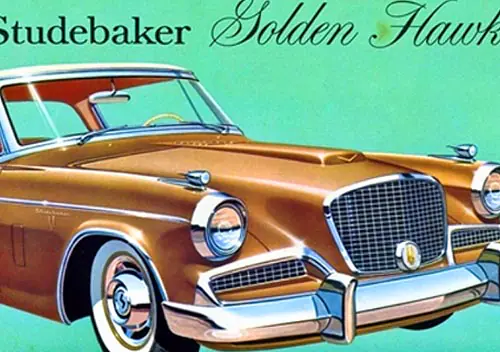
Compare the tail of the Power Hawk to the range-topping Golden Hawk seen above. The Golden Hawk was the first with add-on tailfins, although the 1956 models were the only ones with fins molded from fiberglass (they were stamped in steel afterward).

The two-tone paint makes the Golden Hawk look more dramatic, but the busy “checkmark” polished trim on the sides detracts from the original flowing lines of the Studebaker coupes.

That’s not to say that the Golden Hawk was a bad-looking car, far from it. It’s just that the body that had wowed so many just three years earlier had begun to take on a life of its own to the extent that some may not even recognize the 1953 model underneath.
Despite that, if I had a blank check and were choosing 1956 Studebakers, I’d take this gorgeous red-and-white Golden Hawk with its beefy Packard V8 under the hood. While the Power Hawk certainly looks cleaner, the Golden Hawk looks like a proper dreamboat with its rocker trim and fancy paint.

As I mentioned, there was yet another option, the Sky Hawk, which used rear quarter-panel trim that aped the Golden Hawk’s, but without the auxiliary fins. Plus, it had Studebaker’s most-powerful homebuilt V8, the 210-horsepower 289. It did cost quite a bit more than a Power Hawk, however, and that kept sales down a bit.
| Model | Production |
|---|---|
| Flight Hawk | 4,389 |
| Power Hawk | 7,095 |
| Sky Hawk | 3,610 |
| Golden Hawk | 4,071 |
As you can see, none of the Hawks were huge sellers, but the Power Hawk won the year with its combination of great styling, good performance, and value. Interestingly, the Golden Hawk almost outsold the base Flight Hawk, showing that the basic Hawk platform was extremely versatile; it was both a nice-looking, inexpensive coupe and an exotic range topper with a powerful V8 engine.

But Studebaker buyers had spoken, and the Power Hawk was the sales champion (pun intended). Unfortunately, that didn’t save the Power Hawk, as it turned out to be a one-year model; Studebaker simplified the line in 1957 to include two Hawks, the Silver Hawk (with six and V8) and the Golden Hawk. Those cars all had big tailfins, however, which leaves this 1956 car as possibly the last of the truly clean Hawks until the GT Hawk showed up in 1962. I certainly wouldn’t have complained if it ended up in my driveway in 1956.
Related Reading
Curbside Classic: 1956 Studebaker Golden Hawk–Twilight Pink (by Stephen Pellegrino)
Car Show Classic: 1960 Studebaker Hawk – Rock Bottom? (by JP Cavanaugh)





I’d have to take one of the hadrtop models…that chunky b pillar kills the look for me.
Same, 100%.
How much heavier was the Packard V8? Did it affect the handling?
It was only somewhat heavier (not significantly so), but from my own research it seems that the wider Packard V8 was mounted somewhat further forward in the engine compartment than the Studebaker V8, which made the already unfavorable F/R weight ratio even worse, contributing to serious front-heavy feeling in its handling. This tends to be borne out by contemporary reviews, although the suspension may also have been changed for the ’57 Golden Hawk, which used the supercharged 289 Stude V8.
Even more choices were offered foreign and Canadian buyers.The Flight Hawk was offered in Hardtop form.Also European buyers could opt to delete the fins on later models.
The less gingerbread on the Loewy coupes the better.
I’d be happy to own this lovely Power Hawk but I’d store the hood and wheels, and replace them with the earlier hood and some Halibrand wheels or maybe Torq Thrusts.
Yeah ;
That FUGLY 1/4 window and chunky framed door ruin the otherwise sleek looks, the big dipped “V” on the hard tops screw up the sleek look too .
Maybe cobble one up from parts to have the hard top and the slimmer looking Golden Hawk side trim ? .
I can’t really get past the 1953 styling, they couldn’t hide it and it aged rapidly .
-Nate
Golden Hawk for me, gingerbread and all. Personally I’m not quite as smitten by the original 53 as many here(not to say it isn’t good looking or even timeless), so I don’t really value its purity over subsequent updates any more than I do from say a second gen Firebird, and as far as the the updates went I think 56 with the fiberglass fins was one of the better ones if you accept the car as a period piece, and for me the fins to me are necessary to balance the bulkier nose. The 57 and later fins are way more exaggerated and detract from the core look more than the 56.
The side trim? It’s a mid 50s car! I can think of much more popular cars from the time that did a whole lot worse than a little zigzag! It’s actually kind of clever in a deceptive sort of way that the Sky Hawk sported it to establish the theme going into the Golden Hawk which used it primarily to hide the join line of the fins. I don’t think Studebaker did nearly as well camouflaging that for the 57s
My vote is for the Sky Hawk. The cleaner greenhouse of the hardtop (and the bigger engine) overcome any other sins. Besides, it was 1956 and the little checkmark was a nice idea for the break between colors on the 2 tone design.
I think I may have seen that very Power Hawk on a visit to the museum quite a few years ago. The owner had parked it out front just as it was in your photos.
I’d go for the Golden Hawk with its one-year-only side trim and tail fins, the latter which were still relatively subdued compared to the ’57-61 models, along with a one-year-only engine. This car doesn’t work for me in post-coupe form, only the hardtop. The 1958 four-seat Thunderbird usually gets credit for being the first personal-luxury coupe, the the Golden Hawk had the same basic concept two years earlier. The presence of low-end six-cylinder versions may have prevented the Hawk from having the perceived luxury status of the T-Bird though.
Am I right, the 6-cyiinder engine in the Flight Hawk would have been an L-head? Not something to get the blood running.
That’s correct; the six didn’t get an OHV head until the 1961 model year.
The flight and power hawk. Were basic same car except for drive train. They were built with post. The sky and golden hawk were hardtop. Interior was fancy in the golden and sky hawk. I preferred the golden hawk for 56 the fins were smaller than later ones they extended the body line made car look lower and longer. Personal choice later style two tone is my choice
Power Hawk for me, I don’t mind the pillared look, maybe a more solid feeling car as well, and love the single tone paint and lack of excess trim. Love the idea of a reasonably priced coupe with a V8, sign me up!
In 1956, I would have chosen a Champion, just as tens of thousands more buyer chose the Champion over any Hawk.
I know me, and I know I wouldn’t have had any justification to choose a Hawk over the practicality and cost of a sweet family vehicle like a CHAMPION.
Ooh! A Studebaker Pelham!
I’m a freak for less remembered car names, and especially those for station wagons.
A ’56 Sky Hawk, 3-speed with overdrive, single-tone Redwood, please. The cleanest, most elegant version with the flexibility for fast touring with the overdrive.